
Overcoming Objections to Surcharging: A Merchant’s Guide to $0 Fees in 2026
Published:

What if you could eliminate your credit card processing fees entirely without losing a single customer to a competitor? With average processing fees for e-commerce reaching up to 3.5% in 2026, it’s natural to feel like your hard-earned margins are evaporating. You know you need to offset these costs, yet the fear of negative reviews or a complex legal landscape often stands in the way. It’s a common struggle, especially since a WalletHub survey found that 87% of people feel “nickel-and-dimed” by extra fees. You want to protect your business, but you don’t want to alienate the people who keep it running.
This guide is your roadmap to overcoming objections to surcharging while building even stronger relationships with your clientele. You’ll learn how to confidently implement a surcharge program that maintains total regulatory compliance across every state. We’ll show you how to use a surcharge and dual pricing engine to automate the heavy lifting, ensuring you stay under the 3% Visa cap and respect local laws like California’s SB 478. By the end of this article, you’ll have a clear plan to reach $0 in processing fees while keeping your customer experience at a 5-star level.
Key Takeaways
- Understand the psychology behind merchant hesitation and how to frame surcharging as a transparent checkout practice.
- Compare the psychology of surcharging versus dual pricing to find the model that best preserves your customer loyalty.
- Learn actionable strategies for overcoming objections to surcharging when customers ask about extra fees or competitor pricing.
- Follow a compliant 2026 rollout checklist, from notifying card networks to displaying the correct point-of-sale signage.
- Explore how an automated surcharge and dual pricing engine handles complex tasks like debit card detection and state legality in real time.
Table of Contents
- Why Merchants Hesitate: Understanding the Fear of Surcharge Backlash
- Surcharging vs. Dual Pricing: Choosing the Right Psychology
- Overcoming the Top 3 Customer Objections to Surcharge Fees
- Best Practices for a Seamless Surcharge Rollout in 2026
- Eliminating Friction with Strictly’s Smart Pricing Engine
Why Merchants Hesitate: Understanding the Fear of Surcharge Backlash
Surcharging is a transparent checkout practice where the processing cost is allocated to credit card users rather than being baked into the price of every item. For many business owners, a Surcharge (payment systems) model is the only sustainable way to protect thin margins from rising costs. Yet, a significant fear factor persists. Some industry professionals report that up to 60% of merchants hesitate to implement these programs because they worry about customer sensitivity. They fear a sudden drop in loyalty or a wave of negative reviews that could damage their reputation.
To better understand how to navigate these conversations and the mindset required for successful implementation, watch this helpful video:
Since the digital economy shifted in recent years, consumer acceptance of convenience fees has changed. By 2026, many shoppers have encountered service fees at restaurants, utility companies, and online marketplaces. Overcoming objections to surcharging requires looking past the initial anxiety. While you might worry about backlash, the reality is that businesses are increasingly forced to choose between raising all prices or being transparent about credit costs.
The True Cost of ‘Eating’ Processing Fees
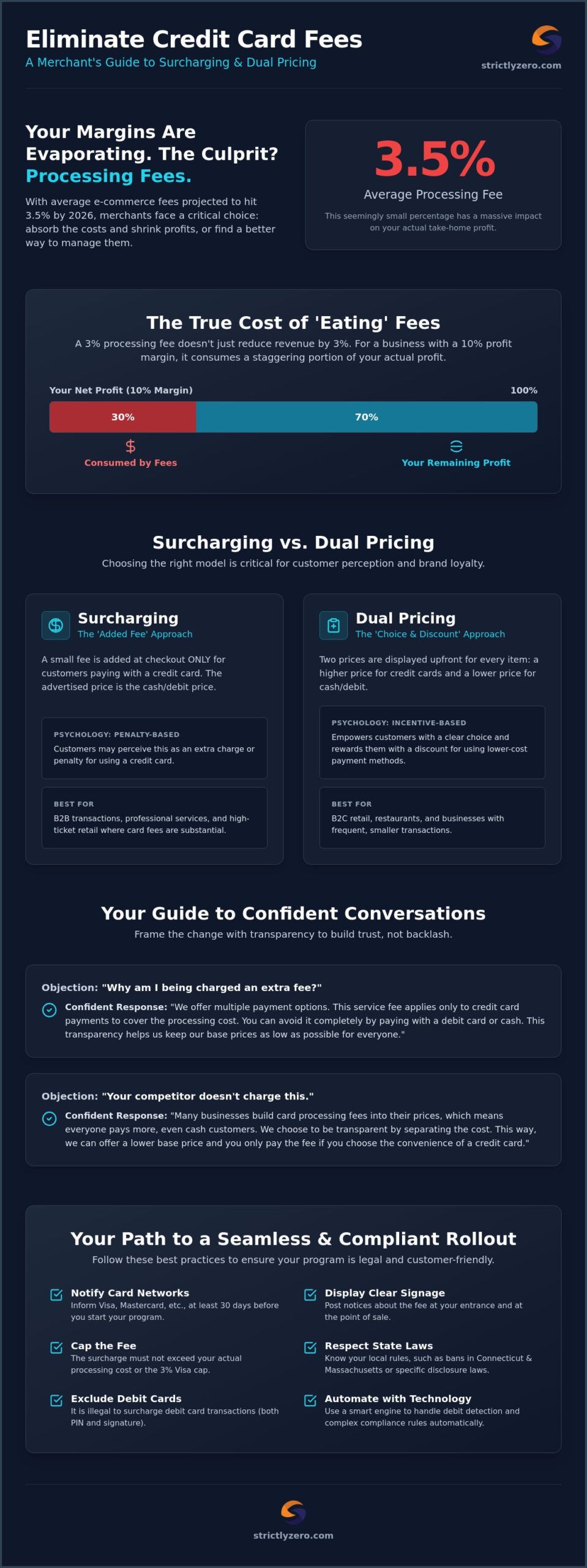
When you decide to absorb a 3% processing fee, you aren’t just losing 3 cents on the dollar. If your net profit margin is 10%, that 3% fee is actually consuming 30% of your take-home profit. This hidden drain stifles business growth, prevents you from hiring new staff, and limits wage increases. Adopting zero fee credit card processing is no longer a luxury. In a high-inflation environment, it’s a necessity for small and medium-sized businesses to maintain their standard of service.
Consumer Psychology: Fee vs. Choice
The “Amazon Effect” has trained customers to value transparency and speed. While a WalletHub survey found that 87% of people feel “nickel-and-dimed” by unexpected fees, the key is disclosure and choice. There’s a massive psychological difference between an unannounced charge and a disclosed option. When you provide a clear alternative, like paying with a debit card or cash to avoid the fee, you empower the buyer. Data from the National Restaurant Association shows that the number of businesses successfully using these models rose to 20% in 2025, proving that customers will stay loyal when they understand the reason for the change. Overcoming objections to surcharging starts with realizing that your customers prefer honesty over hidden price hikes.
Surcharging vs. Dual Pricing: Choosing the Right Psychology
When you look at your end-of-month statement, the math might be simple, but the way you present those numbers to your customers is anything but. Choosing between surcharging vs. dual pricing is the most critical decision for your brand image. It’s the difference between a customer feeling like they’ve been hit with a penalty or feeling like they’ve been given a choice. Overcoming objections to surcharging starts with understanding the “pain of paying” and how different pricing structures can either trigger or soothe that psychological response.
The legal landscape also dictates which path you might take. While many regions have moved toward transparency, you must still navigate state-by-state surcharge laws to ensure your model is compliant. For instance, states like Connecticut and Massachusetts maintain strict bans on surcharging, making a dual pricing or cash discount model the only viable way to reach $0 in fees. If you aren’t sure which path fits your region, reviewing your options with a specialized processor can help clarify the local requirements.
The Surcharge Model (The ‘Added’ Approach)
The surcharge model is often the best fit for professional firms, B2B services, and high-ticket retailers. In this scenario, your sticker price remains the same, and a fee is added as a separate line item only if the client pays with a credit card. This “line-item” transparency is highly effective in business-to-business environments where accounts payable departments expect to see a clear breakdown of costs. The primary challenge is that it can feel like a surprise at the end of the transaction if not disclosed early. To succeed here, you must be upfront about the fee before the customer pulls out their wallet.
The Dual Pricing Model (The ‘Choice’ Approach)
Dual pricing has become the gold standard for restaurants and high-frequency retail shops. Instead of adding a fee at the end, you display two separate prices for every item: a “Card Price” and a “Cash Price.” This model leverages the psychology of choice. When a customer sees that they can save money by using cash or a debit card, the “Card Price” feels like the standard rate rather than a penalty. Many merchants find that dual pricing leads to zero customer complaints because it removes the friction of an added fee. It provides a clear path for the customer to control their own costs, which is a powerful tool when you are focused on overcoming objections to surcharging in a consumer-facing environment.
While the old “Cash Discount” legacy often relied on confusing signage and complicated math, modern dual pricing is clean and automated. It ensures that your business stays profitable while your customers feel respected. Whether you choose the directness of a surcharge or the choice-driven nature of dual pricing, the goal remains the same: protecting your margins without sacrificing the trust you’ve built with your community.
Overcoming the Top 3 Customer Objections to Surcharge Fees
The moment of truth occurs at the point of sale. You’ve set up your signage and updated your software, but now a customer is looking at their receipt and asking questions. Overcoming objections to surcharging isn’t about winning an argument. It’s about education and providing options. When a customer asks, “Why am I being charged extra to use my card?” the answer should be grounded in fairness. You can explain that the fee simply covers the specific cost of the credit transaction, ensuring that those who pay with cash or debit aren’t subsidizing the rewards of credit card users.
If a customer points out that a competitor down the street doesn’t charge a fee, it’s time for the “hidden price” talk. Most businesses simply raise their prices across the board to cover these costs. By using a surcharge, you keep your base prices lower for everyone. For loyal customers who wonder “why now?”, be honest about the economic climate. Tell them that instead of a store-wide price hike, you chose this model to keep their favorite products affordable. To keep everything above board, you can always reference state laws on credit card surcharges to show that this is a regulated, legal practice designed for transparency.
The “Strictly” method focuses on removing the human friction from these interactions. By using a surcharge and dual pricing engine, the technology handles the identification of card types and applies the correct fee automatically. This, combined with clear, compliant signage, means your staff doesn’t have to defend the policy; the system and the signs do the talking for them.
Scripting for Success: The Retail Response
Training your staff is the most vital step in a smooth rollout. Your team should feel comfortable using the “Fairness Script.” This involves explaining that you want to keep costs down for everyone, and surcharging allows you to do that without raising the price of every item on the shelf. If inflation is the primary concern, use the “Inflation Script.” Your staff can say, “We had a choice between raising all our prices or only charging those who use a credit card. We chose the option that gives our customers more control.” This shifts the narrative from a penalty to a choice. Encourage staff to remain calm and point to the compliant signage at the register if a customer becomes frustrated. Overcoming objections to surcharging becomes much easier when your team understands the “why” behind the policy. To help your team master these high-stakes conversations and refine your company’s deal strategy, visit CloseStrong.
The B2B/Professional Services Response
In a B2B environment, the conversation is often more analytical. Reframe the credit card option as a “Convenience Option.” Many clients prefer the float or the points associated with their corporate cards and are happy to pay a small fee for that benefit. However, you should always offer a “Standard” path. By providing an ACH or wire transfer option, you give them a $0 fee route that keeps their costs predictable. A virtual terminal simplifies this process for remote clients by allowing them to choose their preferred payment method through a secure online invoice, ensuring transparency before the transaction is even processed.
Best Practices for a Seamless Surcharge Rollout in 2026
Launching a surcharge program requires more than just a software update; it demands a structured approach to compliance. While your focus might be on overcoming objections to surcharging from a customer service perspective, your legal safety depends on following specific card brand rules. The first step is providing a mandatory 30-day notice to card networks like Visa and Mastercard before you process your first surcharged transaction. As of July 2026, Visa sets a maximum surcharge cap of 3%, while Mastercard allows 4%. Since most merchants accept both, you’ll need to stick to the 3% limit to stay compliant across the board.
Transparency continues at the register and on the paper trail. Your receipts must clearly list the surcharge as a separate line item so the customer knows exactly what they’re paying for. Perhaps the most critical rule is the “No-Debit” mandate. It’s a federal violation to apply a surcharge to debit or prepaid card transactions, even if the customer runs the card as “credit” at the terminal. If you want to ensure your system handles these nuances automatically, you can schedule a demo of a compliant surcharge engine to see how technology prevents these costly errors.
Signage and Disclosure Requirements
To meet credit card processing for small business compliance standards, you must place clear signage at both the point of entry and the point of sale. These signs shouldn’t just be hidden in a corner. They must state that a surcharge is applied to credit card purchases and that the fee does not exceed your cost of acceptance. For e-commerce merchants, this disclosure must appear on the checkout page before the final transaction is submitted. Clear communication here is your best tool for overcoming objections to surcharging before they even reach your staff.
State-by-State Compliance in 2026
The legal landscape for surcharging is a patchwork that changes at state lines. As of July 2026, credit card surcharges remain strictly prohibited in Connecticut, Massachusetts, and Maine. Other states have specific caps; for example, Colorado limits surcharges to 2%, while New York and New Jersey restrict the fee to your actual cost of card acceptance. Attempting to manage these rules manually is a high-risk gamble that can lead to heavy fines or the loss of your processing privileges. A Smart Pricing Engine solves this by automatically detecting the merchant’s location and the customer’s card type, disabling the surcharge in prohibited states or for debit cards in real time. This automation removes the guesswork and ensures your business stays on the right side of the law while you focus on growth.
Eliminating Friction with Strictly’s Smart Pricing Engine
The hardest part of overcoming objections to surcharging is often the manual labor involved in keeping up with shifting regulations. Strictly’s Smart Pricing Engine removes this burden by automating the decision-making process at the point of sale. Instead of a cashier having to inspect every card or check a list of state laws, the engine does it in milliseconds. This technology doesn’t just process payments; it acts as a compliance guardrail that protects your business from accidental violations and customer friction. By handling the technical details, it allows your team to focus on service rather than acting as fee enforcers.
Consider a typical retail merchant who recently moved to this automated model. By implementing the surcharge and dual pricing engine, they saved $2,000 per month in processing fees. Crucially, their sales volume remained steady because the system provided the transparency customers expect in 2026. This success is built into our omni-channel payment processing, which ensures a consistent, compliant experience whether your customers are buying on your website, through a mobile app, or at your physical storefront. When the technology is seamless, the objections tend to disappear.
Automated Compliance: No More Manual Math
Our software identifies a debit card versus a credit card in real-time, ensuring you never accidentally surcharge a debit user. It automatically applies the correct percentage, strictly adhering to the 3% or 4% caps set by card network rules. The Zero Fee model is a tech-driven profit protector that shifts the cost of credit card acceptance away from the merchant’s bottom line through automated compliance software. This removes the risk of human error and ensures that every transaction is processed according to the latest legal standards in the customer’s specific location.
Partnering for Growth: ISOs and Developers
We don’t just support merchants; we empower the partners who serve them. Independent Sales Organizations (ISOs) use ClearSplit™ to manage complex residuals from surcharge programs with total accuracy. This tool simplifies the back-end math, allowing partners to focus on acquisition rather than spreadsheet management. To ensure long-term success, ChurnIQ™ monitors customer sentiment and merchant retention, flagging potential issues before they impact your portfolio. This data-driven approach is essential for overcoming objections to surcharging at scale, providing the insights needed to refine pricing strategies over time. If you are ready to expand your reach and offer a more robust solution, partner with Strictly to scale your payments business today.
Take Control of Your Margins in 2026
Reclaiming your profit margins doesn’t have to come at the expense of your customer relationships. By choosing the right pricing psychology and training your team with honest scripts, you turn a technical change into a conversation about transparency and choice. Success in 2026 relies on moving away from manual guesswork and adopting tools that handle the legal heavy lifting for you. Just as businesses find ways to streamline their overhead, individuals can manage high-interest debt by using Consolidate My Payday Loans to regain financial control. You’ve seen how overcoming objections to surcharging is simple when you lead with fairness and provide fee-free alternatives like cash or debit.
The right technology makes this transition invisible to your daily operations. With automated state-by-state compliance and real-time debit card detection, you can focus on growing your business while the system ensures every transaction follows the rules. Whether you sell online or in person, our omni-channel support keeps your experience consistent across every platform. It’s time to stop letting processing fees dictate your success. Eliminate your processing fees today with Strictly’s Smart Surcharge Program. You’ve built a great business; now it’s time to keep more of what you earn.
Frequently Asked Questions
Is it legal to surcharge credit card customers in 2026?
Yes, credit card surcharging is legal in 47 states as of July 2026. The practice is strictly prohibited in Connecticut, Massachusetts, and Maine, along with the territory of Puerto Rico. In all other states, merchants can legally pass on the cost of credit card acceptance as long as they follow specific card network rules and state-level disclosure requirements.
What is the difference between a surcharge and a convenience fee?
A surcharge is a fee added specifically for the use of a credit card, while a convenience fee is charged for using a non-standard payment channel. For example, a theater might charge a convenience fee for online ticket purchases that are typically made at a box office. Surcharges only apply to credit cards, but convenience fees can apply to any payment method used in that specific channel.
Can I surcharge debit card transactions?
No, it is illegal to apply a surcharge to any debit or prepaid card transaction nationwide. This federal prohibition remains in place even if a customer chooses to run their debit card as “credit” at the terminal. Attempting to surcharge a debit card can result in significant fines from card networks and may lead to the loss of your merchant processing privileges.
How much can I legally charge as a surcharge fee?
You can legally charge a maximum of 3% for credit card transactions. While Mastercard allows for a 4% cap, Visa’s 3% limit, which went into effect on April 15, 2023, serves as the practical ceiling for most businesses. Some states have even stricter limits, like Colorado, where the surcharge is capped at 2% regardless of the card brand used.
What happens if a customer complains about the surcharge to their bank?
If a customer disputes a surcharge, the bank will verify if you followed all mandatory disclosure and notification rules. As long as you provided the required 30-day notice to card brands and displayed compliant signage at the point of entry and the register, the fee is legally defensible. Overcoming objections to surcharging through clear, upfront communication is the best way to prevent these disputes from starting.
Do I need to notify my customers before I start surcharging?
Yes, you are required to provide clear disclosure at the point of entry and the point of sale. This includes physical signs in retail locations or digital notifications on e-commerce checkout pages. Furthermore, the surcharge must be listed as a separate line item on the final receipt so the customer sees exactly what they were charged for the transaction.
How does the Strictly Smart Pricing Engine handle different state laws?
The engine uses real-time geolocation data to automatically adjust your pricing based on your business location and the customer’s card type. It identifies if you are operating in a prohibited state like Connecticut and disables the surcharge feature immediately. This automation is vital for overcoming objections to surcharging because it ensures your business never accidentally applies an illegal or non-compliant fee.
Will surcharging affect my PCI compliance status?
Surcharging does not change your PCI compliance level, but it does require that your payment software is certified to handle the extra line item securely. Using a dedicated surcharge and dual pricing engine ensures that your transaction data remains protected according to PCI DSS standards. You must still follow all standard security protocols to ensure that customer card information is handled safely during every transaction.