
Payment Analytics for Merchants: Turning Transaction Data into Profit in 2026
Published:

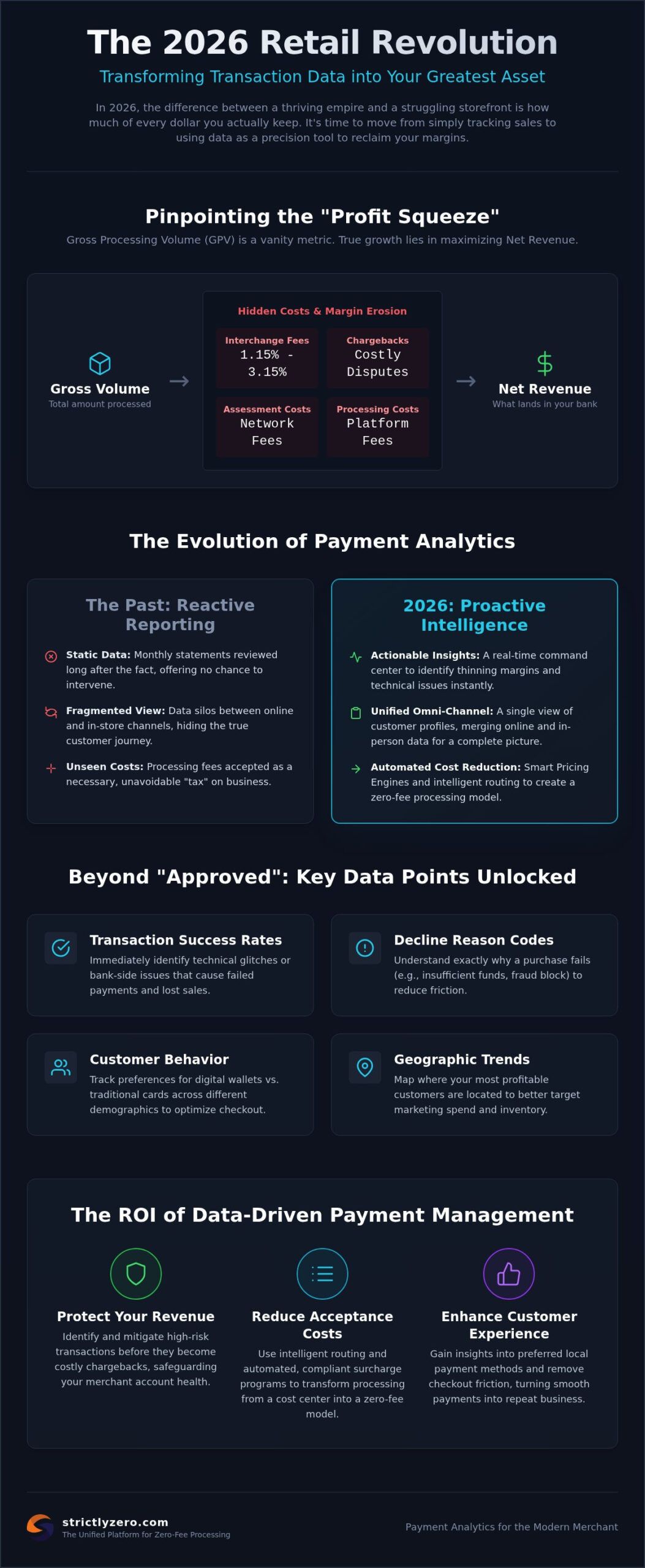
In 2026, the difference between a thriving retail empire and a struggling storefront isn’t just what you sell; it’s how much of every dollar you actually keep. While interchange fees can still climb as high as 3.15%, most businesses treat these costs as an unavoidable tax on growth. But what if your transaction data held the secret to erasing those fees entirely? By leveraging advanced payment analytics for merchants, savvy operators are no longer just tracking sales. They’re using data as a precision tool to reclaim their margins and fuel expansion.
You’ve likely felt the sting of fragmented data between your online store and your physical storefront, or watched helplessly as hidden processing costs eat into your profits. It’s frustrating to feel like you’re losing money to a system you don’t fully see. We’ll show you exactly how to gain clear visibility into every dollar processed and use predictive insights to stop customer churn before it starts. You’ll discover how to implement automated cost reduction via surcharge programs and optimize your omni-channel strategy to ensure you never leave money on the table again.
Key Takeaways
- Learn how to shift from static reporting to actionable insights that drive immediate profit in the 2026 landscape.
- Understand the “squeeze” between gross volume and net revenue by leveraging advanced payment analytics for merchants to pinpoint hidden costs.
- Discover how a Smart Pricing Engine automates state-by-state compliance to support a zero-fee processing model.
- Identify the dangers of data silos and learn to unify online and in-store customer profiles for a true omni-channel view.
- Transition from basic data collection to predictive intelligence that helps prevent churn and scales your business.
Table of Contents
- The Evolution of Payment Analytics for Merchants in 2026
- Core Metrics: Transforming Transaction Data into Growth
- The Strictly Difference: Analytics in a Zero-Fee Environment
- Omni-Channel Insights: Unifying Online and In-Person Data
- Scaling Your Business with Strictly’s Unified Platform
The Evolution of Payment Analytics for Merchants in 2026
Payment analytics is the systematic computational analysis of transaction data to uncover patterns and optimize revenue. While merchants once viewed monthly processing statements as a chore to be filed away, 2026 has marked a definitive shift toward actionable data. We’ve moved beyond static reporting where you simply see what happened in the past. Now, payment analytics for merchants acts as a real-time command center for your entire operation.
This evolution transforms payment processing from a passive utility into a strategic financial ecosystem. With credit card interchange fees in the U.S. ranging between 1.15% and 3.15% in 2026, businesses can’t afford to be reactive. Real-time data allows you to identify exactly where your margins are thinning. It’s the difference between blindly paying fees and using intelligence to eliminate them. For example, a Smart Pricing Engine can use this data to ensure state-by-state compliance for surcharge programs, effectively turning your processing cost into a zero-fee model.
Beyond the Transaction: What Data is Being Collected?
Modern analytics engines look far deeper than a simple “approved” or “declined” message. By leveraging the rich transaction data generated during each swipe or click, you can unlock a narrative about your business health. Key data points include:
- Transaction success rates: Identifying technical glitches or bank-side issues immediately.
- Decline reason codes: Understanding exactly why a customer couldn’t complete a purchase to reduce friction.
- Customer behavior: Tracking preferences for digital wallets versus traditional plastic across different demographics.
- Geographic trends: Mapping out where your most profitable customers are located to better target marketing spend.
This level of detail helps you spot temporal spending trends, allowing you to staff up or stock inventory based on when your customers actually spend. You aren’t just seeing a sale; you’re seeing the lifeblood of your business in motion.
The ROI of Data-Driven Payment Management
The return on investment for sophisticated payment management is immediate and measurable. By using payment analytics for merchants, you can reduce the cost of acceptance through intelligent routing and automated surcharge programs. It’s about more than just saving money, though. It’s about protection. You can identify and mitigate high-risk transactions before they ever become costly chargebacks, protecting your merchant account health.
Additionally, providing a better customer experience becomes easier when you know exactly which local payment methods your buyers prefer. When you optimize the payment layer, you aren’t just processing money; you’re actively growing your bottom line through smarter, data-backed decisions. This proactive approach ensures that every transaction is an opportunity for growth rather than a drain on your resources.
Core Metrics: Transforming Transaction Data into Growth
Most business owners focus on Gross Processing Volume (GPV) as their primary success metric. While a high GPV looks impressive on a dashboard, it often masks the “squeeze” where processing fees, assessment costs, and chargebacks erode your actual earnings. True payment analytics for merchants prioritize Net Revenue. By analyzing the gap between what you process and what actually lands in your bank account, you can identify which sales channels or card types are dragging down your margins.
Average Transaction Value (ATV) also provides critical insights when viewed by channel. You might find that your mobile app users have a higher ATV than in-store shoppers, but perhaps they also suffer from lower authorization rates. While a 99% authorization rate sounds like a gold standard, it isn’t always the ideal goal. An exceptionally high rate can sometimes indicate that your fraud prevention settings are too loose, potentially inviting high-risk transactions that spike your chargeback-to-transaction ratio. Healthy account management requires finding the balance where you capture every legitimate dollar without exposing yourself to unnecessary risk.
ChurnIQ™: Predicting and Preventing Merchant Attrition
One of the most overlooked benefits of transaction data is its ability to predict when a customer is about to leave. While traditional reporting tells you a customer is gone only after they stop spending, modern intelligence is proactive. ChurnIQ™ acts as a predictive tool for long-term stability by analyzing historical patterns to identify “at-risk” segments before they drop off. By monitoring recurring billing analytics and spotting shifts in frequency or payment failures, you can intervene before the customer officially cancels. This turns your payment stack into a powerful retention engine that stabilizes monthly cash flow.
Interchange and Assessment Fee Transparency
Traditional processing statements are often designed to be confusing, burying costs in layers of jargon. Sophisticated analytics peel back these layers to reveal the true cost of different card types. In 2026, credit card interchange fees generally range from 1.15% to 3.15%. Seeing exactly how these fees apply to your specific volume is the first step toward reclaiming your profit. This transparency allows you to identify surchargeable volume and prepare for zero fee credit card processing. When you understand the data, you can stop guessing and start implementing strategies that eliminate overhead. If you want to see how these insights can transform your margins, you can explore our unified platform for a clearer view of your financial data.
The Strictly Difference: Analytics in a Zero-Fee Environment
Most payment processors treat interchange fees as an immutable law of nature. They provide reports that simply categorize how much money you lost to Visa or Mastercard. We take a different approach by positioning payment analytics for merchants as the engine behind a zero-fee model. Instead of just documenting your overhead, our platform uses transaction data to actively eliminate it. This shift requires a sophisticated understanding of the “Smart Pricing” landscape where data determines the cost of every swipe in real time.
Our Smart Pricing Engine is the brain of this operation. It doesn’t just apply a flat fee; it analyzes the card type and geographic location to ensure state-by-state compliance with surcharging regulations. In 2026, these regulations are more nuanced than ever. By using real-time debit card detection, the system ensures you never accidentally surcharge a debit transaction, which is a major compliance risk. This precision minimizes customer friction at the point of sale. When the system identifies a credit card, it applies the appropriate fee; when it sees a debit card, it processes the transaction normally, keeping you fully compliant without manual intervention.
Dual Pricing Analytics: Comparing Cash vs. Card Performance
Understanding the psychology of the checkout is vital for any merchant moving toward a zero-fee environment. Many worry that passing on credit card fees will drive customers away, but the data often tells a different story. By visualizing the savings generated through dual pricing, you can see the direct impact on your bottom line. Analytics allow you to track customer preference shifts and see how many buyers opt for the “cash price” versus the convenience of credit. You can even optimize your pricing thresholds based on transaction size, ensuring that your most frequent small-ticket sales remain frictionless while larger transactions carry their own weight.
ClearSplit™: Transparency for Partners and ISOs
For those managing complex business structures or partner networks, data accuracy is the only way to maintain trust. ClearSplit™ automates partner compensation by using data-driven accuracy to handle even the most intricate residual splits. This creates a “single source of truth” where everyone involved can see exactly how funds are distributed without the need for manual spreadsheets or messy reconciliations. If you’re looking to expand your reach, exploring a payment processing platform for ISOs provides the deeper insights needed to scale a partner program in 2026. This level of transparency ensures that as your business grows, your reporting remains as clear and actionable as it was on day one.
Omni-Channel Insights: Unifying Online and In-Person Data
Data silos are the silent killers of modern merchant efficiency. If your in-store POS doesn’t communicate with your online storefront, you’re missing half the story. Comprehensive payment analytics for merchants solve this by creating a unified view of every customer interaction. You can finally recognize the buyer who browses on their mobile device but chooses to complete the purchase in your physical boutique. This level of insight isn’t just about tracking sales; it’s about understanding the customer journey to drive repeat business and long-term loyalty.
The API-First Approach to Data Integration
Demand open APIs for your payment stack. An API-first platform lets you pipe transaction data directly into your CRM or ERP systems, creating a seamless flow of information. This integration provides a 360-degree view of your business, allowing you to see which marketing campaigns drove the most profitable sales. To build a truly resilient strategy, you should explore ecommerce payment processing guides that focus on bridging the digital and physical divide. When your systems talk to each other, you spend less time on manual entry and more time on high-level strategy.
Mobile and Payment Link Performance
Mobile wallet adoption continues to dominate; research from 2025 indicated that 96.5% of merchants have already adopted contactless options. Tracking how your specific demographic uses Apple Pay or Google Pay helps you optimize your checkout for speed and convenience. Payment links offer similar advantages for service-based businesses or B2B operations. Payment links provide granular data on invoice fulfillment by showing exactly when a customer views and pays an outstanding balance. This visibility allows you to manage your cash flow with surgical precision. If you want to unify your sales data and eliminate fragmentation, connect with our omni-channel specialists to see the platform in action.
Scaling Your Business with Strictly’s Unified Platform
Security is a fundamental part of scaling. As your volume grows, so does your profile as a target for bad actors. Our AI-driven fraud prevention uses your historical transaction data to build a defensive perimeter, identifying suspicious patterns before they impact your bottom line. This proactive approach lowers your risk profile and protects your merchant account health. To make the transition seamless, we recommend a 30-day plan: start by auditing your current processing data for hidden fees, map out your existing data silos, and then deploy the Smart Pricing Engine to begin offsetting those costs immediately.
Custom Reporting for Enterprise and Developers
For larger organizations and developers, a one-size-fits-all dashboard is rarely enough. Our API-first architecture allows you to build bespoke analytics modules that fit perfectly into your existing workflow. You can integrate POS lending data directly into your overall financial health reports, giving you a clear view of how consumer financing impacts your average transaction value. This flexibility extends to our partners as well. ISOs can take advantage of white-label opportunities to provide these high-level analytics to their own merchants, creating a “single source of truth” across their entire portfolio. This ensures that every stakeholder has access to the same high-quality, data-driven insights.
Ready to Eliminate Processing Fees?
The true power of payment analytics for merchants lies in its ability to prove the value of a zero-fee model. When you can see exactly how much of your margin is being consumed by traditional interchange and assessment fees, the path forward becomes clear. Our platform doesn’t just show you the problem; it provides the tools to solve it. By using data to drive your surcharge and dual pricing strategies, you can reclaim thousands of dollars in annual overhead. If you’re ready to stop guessing and start growing, it’s time to see how our unified platform can transform your financial operations. Get started with Strictly’s zero-fee processing and advanced analytics today.
Take Command of Your Financial Future
The landscape of 2026 demands more than just accepting payments; it requires a strategic mastery of your transaction flow. By implementing robust payment analytics for merchants, you move from simply managing overhead to actively generating profit. You’ve seen how a unified omni-channel view and predictive tools like ChurnIQ™ can transform fragmented data into a clear roadmap for growth. Transitioning to a zero-fee model isn’t just about cutting costs; it’s about gaining the financial clarity needed to scale with confidence.
Our platform is built for this modern era, offering an API-first architecture that integrates seamlessly into your existing systems. With ClearSplit™ for partner transparency and a Smart Pricing Engine that remains compliant in all 50 states, you have the tools to protect your margins while improving the customer experience. Don’t let hidden fees or data silos hold your business back any longer. It’s time to put your transaction data to work.
Eliminate your processing fees and unlock deep insights with Strictly today. We’re ready to help you turn every swipe into a strategic advantage for your business.
Frequently Asked Questions
What are the most important payment metrics for small businesses to track?
Small businesses should focus on Net Revenue, chargeback-to-transaction ratios, and Average Transaction Value (ATV). While Gross Processing Volume looks good on paper, Net Revenue tells you what you actually keep after fees. Tracking your chargeback ratio is also vital for maintaining your merchant account health. By monitoring ATV across different channels, you can identify which platforms drive the most profitable sales for your specific industry.
How can payment analytics help me reduce my processing fees?
Payment analytics for merchants identify the specific card types and transaction methods that carry the highest costs. Once you see the interchange and assessment fees, you can implement a surcharge or dual pricing program to offset those expenses. Data allows you to pinpoint exactly which transactions are eligible for these programs. This moves your business toward a zero-fee model by passing the cost of credit convenience to the consumer.
Is it possible to see online and in-store sales in one dashboard?
Yes, our omni-channel platform unifies your digital and physical storefronts into a single source of truth. You don’t have to jump between different software to see how your web store compares to your brick-and-mortar location. This unified view helps you recognize the same customer across multiple touchpoints. It also ensures your inventory and financial reports stay perfectly synced regardless of where the sale happens or how the customer pays.
What is ChurnIQ™ and how does it help my business?
ChurnIQ™ is a proprietary intelligence tool designed to predict and prevent customer attrition before it happens. It analyzes historical transaction patterns to identify segments that are at-risk of leaving. By spotting these trends early, you can intervene with targeted retention strategies. This proactive approach stabilizes your cash flow and helps you maintain a loyal customer base without waiting for a cancellation notice to act. It turns your payment data into a retention engine.
Can I integrate my payment data with my existing accounting software?
Integration is seamless thanks to our API-first architecture. You can connect your transaction data directly to CRM and ERP systems or popular accounting software. This automation eliminates the need for manual data entry and reduces the risk of human error. Having your data flow directly into your financial books gives you a real-time 360-degree view of your business health without any extra administrative work or messy spreadsheets.
How does the Smart Pricing Engine ensure my surcharges are compliant?
The Smart Pricing Engine uses real-time data to detect card types and apply state-by-state compliance rules automatically. It distinguishes between credit and debit cards instantly, ensuring you never accidentally surcharge a debit transaction. Since regulations vary across the country, the engine stays updated with the latest legal requirements. This technology removes the guesswork and risk from your zero-fee strategy, keeping your business fully protected while you recover your processing costs.
Will using a surcharge program affect my customer retention data?
Most merchants find that offering a dual pricing option actually maintains or improves customer satisfaction. When you use payment analytics for merchants to track behavior, you’ll see that many customers appreciate the choice of a lower cash price. The data often shows that the convenience of credit remains the priority for most buyers. By monitoring your retention metrics, you can fine-tune your messaging to ensure the transition feels transparent and fair.
How do I get started with Strictly’s payment analytics platform?
Getting started begins with a comprehensive audit of your current processing data to identify potential savings. You can then schedule a platform demo to see our unified dashboard and Smart Pricing Engine in action. We’ll help you map out your data silos and create a 30-day transition plan to move toward a zero-fee model. It’s a straightforward process designed to get your intelligence tools running with minimal disruption to your daily operations.