
Payment Gateway API: The Developer’s Guide to Zero-Fee Integration in 2026
Published:

What if the code you write today could completely eliminate your company’s transaction costs by tomorrow? Most developers view a payment gateway API as a necessary expense, a technical bridge that inevitably carries a heavy toll on every transaction. It’s frustrating to build elegant systems only to watch high fees and complex PCI DSS 4.0.1 requirements erode the bottom line. You’re likely looking for an integration that is flexible, secure, and doesn’t force you to choose between a smooth user experience and the company’s profitability.
You’re about to learn how to integrate a payment gateway API that doesn’t just process payments; it automates a zero-fee processing model through compliant surcharging and dual pricing. This guide shows you how to build a RESTful integration using a Smart Pricing Engine that handles state-by-state legal updates automatically, including the latest 2026 regulations like the Illinois Interchange Fee Prohibition Act. We’ll walk through implementing AI-driven fraud prevention and supporting seamless omni-channel payments, giving you the technical roadmap to turn your payment infrastructure into a strategic profit center.
Key Takeaways
- Master the technical flow of a modern payment gateway API to handle secure tokenization and real-time transaction metadata effectively.
- Implement a Smart Pricing Engine that automatically manages state-by-state surcharge compliance to achieve a zero-fee processing model.
- Minimize PCI DSS 4.0.1 scope with hosted fields and protect your platform using advanced AI-driven fraud prevention.
- Use automated partner management tools like ClearSplit™ to scale your ecosystem and streamline residual compensation via API.
Table of Contents
- What is a Payment Gateway API and Why Does It Matter?
- How a Payment Gateway API Works: The 2026 Technical Flow
- Beyond Integration: The Surcharge & Dual Pricing Advantage
- Security, PCI Compliance, and AI Fraud Prevention
- Building with Strictly: The API-First Platform for Partners
What is a Payment Gateway API and Why Does It Matter?
A payment gateway API acts as the digital handshake between your software and the complex financial networks that move money. Unlike a simple checkout button, it’s a programmatic layer designed to authorize, capture, and manage every transaction your business processes. To understand the foundational technology, it’s helpful to look at What is a Payment Gateway in a broader context. Essentially, the API serves as a “contract.” It defines the exact data formats, such as JSON, and the interaction protocols your application must follow to communicate with the processor safely and efficiently.
Modern businesses are moving away from rigid, third-party hosted pages in favor of direct API integrations. The primary driver is control. With an API, you own the user experience from start to finish. You don’t have to redirect customers to an external site that looks nothing like your brand. This level of customization reduces checkout friction and keeps your conversion rates high. Today’s developers also prioritize omni-channel payment processing. This approach allows you to manage web sales, mobile app transactions, and even in-person payments through a single, unified endpoint, creating a consistent data stream across all sales channels.
To better understand how this technology bridges the gap between your store and the bank, watch this helpful video:
The Core Functions of a Modern Payment API
Developers need more than just a “pay” button. A robust API provides granular control through authorization and capture. Authorization verifies that funds are available, while capture actually moves the money. This two-step process is vital for shipping physical goods or providing services where the final amount might change. Beyond that, the API handles refunds and voids programmatically. You can build logic to automate these tasks without manual intervention from your finance team. Security is handled via tokenization. This process replaces sensitive card data with a non-sensitive identifier, or “token,” before it ever touches your server. It’s a key requirement for maintaining security and reducing technical debt.
The Business Impact of API Integration
How a Payment Gateway API Works: The 2026 Technical Flow
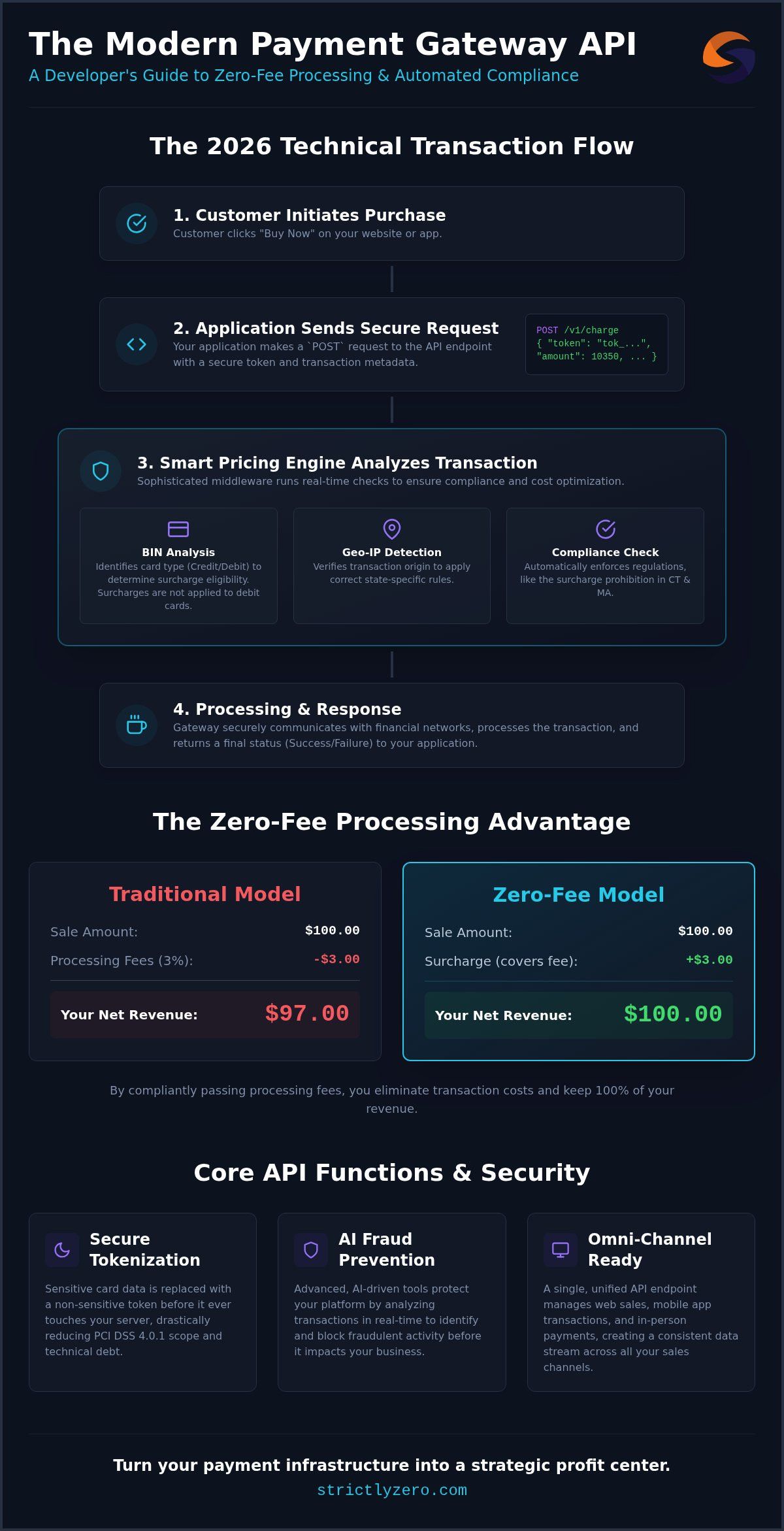
When a customer clicks the purchase button, your application initiates a POST request to the payment gateway API endpoint. This request carries a JSON payload containing transaction metadata and secure tokens generated on the client side. Successful payment gateway API integration relies on this structured exchange to ensure data integrity and security. Once the gateway receives the request, it doesn’t just pass the data to the bank. Instead, it triggers a series of real-time logic checks designed to optimize the transaction for both cost and compliance.
The Smart Pricing Engine acts as a sophisticated middleware during this flow. It analyzes the card’s Bank Identification Number (BIN) to distinguish between debit and credit cards in milliseconds. This distinction is critical because surcharges cannot be applied to debit cards under current regulations. The engine also performs Geo-IP detection to confirm the transaction’s origin. This ensures the system remains compliant with specific state laws, such as the total prohibition of surcharging in Connecticut and Massachusetts as of 2026. If you’re looking to simplify this technical journey, you can explore how to build a compliant zero-fee platform that handles these complexities for you.
The response from the API provides the final status of the transaction. It handles success, failure, or a prompt for 3D Secure authentication programmatically. For developers, managing these responses effectively means building a resilient user experience that can recover from network timeouts or authentication hurdles. Webhooks serve as the nervous system of modern payment architecture, pushing real-time status updates to your backend services so your order management system stays in sync without constant polling.
The Anatomy of a Secure Request
Security in 2026 starts with robust authentication headers and secret keys. JSON remains the industry standard for payloads because it’s lightweight and easily parsed by modern tech stacks. One of the most important elements you’ll include is the idempotency key. This unique identifier prevents duplicate charges if a network timeout occurs during the request. It ensures that even if you send the same request twice, the gateway only processes the transaction once, protecting your customers and reducing manual refund work.
Real-Time Processing Logic
The API makes intelligent decisions based on the data it receives. It checks the card type to apply the correct surcharge cap, which Visa currently limits to 3% while Mastercard allows up to 4%. It also accounts for recent regulatory shifts like the Illinois Interchange Fee Prohibition Act (IFPA). Effective July 1, 2026, this law prohibits interchange fees on the tax and gratuity portions of electronic payments in Illinois. A modern API handles these calculations in the background, ensuring your business stays compliant while maximizing net profit on every sale.
Beyond Integration: The Surcharge & Dual Pricing Advantage
Traditional APIs are often treated as mere technical utilities. They facilitate the movement of data, but they also facilitate the steady erosion of merchant margins through “invisible” transaction fees. Most developers focus on the technical handshake, yet the real competitive edge in 2026 lies in using a payment gateway API as a strategic profit center. By shifting from a standard processing model to a zero fee credit card processing strategy, businesses can reclaim the 2.9% or more that typically vanishes during every checkout.
This shift is made possible by a Smart Pricing Engine that lives within the API layer. Instead of a flat transaction fee, the system applies compliant surcharging or dual pricing logic in real time. Dual pricing offers the ultimate transparency by displaying two distinct totals to the customer: a standard price for card payments and a discounted price for cash-equivalent transactions. This dynamic display happens within your existing checkout flow, ensuring the user experience remains smooth while the business protects its net profit. To ensure you are building on a secure foundation, it’s vital to work with partners listed in the Visa Global Registry of Service Providers, confirming they meet rigorous industry standards.
Automating State-by-State Compliance
Managing surcharge rules manually is a significant legal risk for developers. Laws are not static. For instance, as of 2026, surcharging remains prohibited in Connecticut and Massachusetts, while other states require specific, clear disclosures at the point of sale. Strictly’s API removes this burden by automatically updating its logic as state laws change. This means your code doesn’t need a constant overhaul every time a legislature meets. The API also handles the backend heavy lifting of maintaining transparency by auto-generating compliant receipts that clearly break down any applied fees, keeping the merchant safe from regulatory scrutiny.
The ROI of Fee-Free Processing
When you compare the long-term costs of ecommerce payment processing, the difference between a standard model and a zero-fee model is staggering. For a business doing millions in annual volume, those small percentages translate into six or seven figures of reclaimed revenue. Pitching this to a CFO or business owner becomes simple when you frame the API as a tool for margin protection. The Smart Pricing Engine instantly identifies debit cards through BIN lookups to ensure no illegal surcharges are applied to non-credit transactions. This precision allows the business to eliminate processing costs on credit transactions while remaining fully compliant with card brand rules and federal law.
Security, PCI Compliance, and AI Fraud Prevention
Security isn’t just a technical requirement. It’s the core of building trust with every customer who enters their card details. In 2026, a payment gateway API must do more than just encrypt data. It needs to comply with PCI DSS 4.0.1, which mandates continuous monitoring and robust authentication for all payment-related endpoints. By implementing hosted fields, you keep raw card data off your servers entirely. This approach replaces sensitive information with secure tokens, ensuring that even if your system is compromised, there’s no usable financial data for attackers to steal.
High security shouldn’t mean high friction. 3D Secure 2.0 allows you to verify identities in the background, only challenging the user when a transaction looks suspicious. This balance is critical for maintaining high conversion rates while preventing unauthorized use. When combined with end-to-end encryption across your omni-channel endpoints, you create a fortress that protects both your business and your customers. This level of protection is a standard part of maintaining trust as a payment processor.
Understanding PCI DSS SAQ Levels
For developers, SAQ A is the “Holy Grail” of compliance. It represents the lowest possible level of PCI burden because the merchant never handles, transmits, or stores card data. The architecture of your payment gateway API determines this level. If you’re researching credit card processing services, look for providers that use iframe-based or hosted field integrations. This setup can significantly reduce the 15% to 20% of the integration budget typically dedicated to security and compliance, allowing you to focus on building features rather than managing complex security audits.
AI-Driven Fraud Intelligence
Fraudsters are now using generative AI to create sophisticated phishing and synthetic identities, leading to a 71% increase in AI-powered fraud attempts in 2026. To counter this, your API must leverage behavioral fraud detection. Instead of relying on static rules, AI-driven intelligence analyzes real-time risk scores for every transaction. This technology is incredibly efficient; 80% of financial institutions now report that AI has effectively eliminated the need for manual fraud reviews. By integrating these tools, you can also automate dispute management, using the API to programmatically submit evidence and fight chargebacks. To secure your revenue and streamline your operations, explore our AI-enhanced payment platform today.
Building with Strictly: The API-First Platform for Partners
Scaling a payments business requires more than a standard connection to the financial rails. For ISOs and developers, the right payment gateway API serves as a comprehensive infrastructure for growth. Strictly’s partner ecosystem is built to support high-volume portfolios by providing the tools needed to manage, track, and optimize every transaction. This isn’t just about moving data; it’s about providing a foundation where partners can build their own unique value propositions on top of a reliable, high-performance engine.
Automation is at the heart of the platform. ClearSplit™ eliminates the manual burden of calculating residuals by automating partner compensation directly through the API. This ensures that every stakeholder is paid accurately and on time without the need for complex spreadsheets or back-office intervention. To help partners maintain their merchant base, ChurnIQ™ provides predictive data intelligence. By analyzing transaction patterns, it identifies merchants at risk of attrition, allowing you to intervene proactively and keep your portfolio healthy.
Flexibility is another core pillar of the Strictly experience. The same payment gateway API that powers your web checkout also handles virtual terminals and mobile integrations. This omni-channel approach ensures that your merchants can accept payments wherever their customers are, all while maintaining a single, unified data stream for reporting and reconciliation. It’s a streamlined way to offer a sophisticated payment experience without the technical debt of managing multiple disparate systems.
Tools for ISOs and MSPs
Managing a diverse portfolio of merchants is simplified through a single, intuitive partner dashboard. You can oversee multiple accounts, track performance metrics, and manage risk from one central location. For those looking to maintain a consistent brand identity, the API is fully white-labelable. This allows you to offer a high-end payment experience under your own brand name, backed by Strictly’s robust technology. If you’re ready to take your business to the next level, you can explore the ultimate payment processing platform for ISOs to see how we help you scale in 2026.
Getting Started with the Strictly API
Developers can hit the ground running with comprehensive documentation and dedicated sandbox environments. We support the modern languages your team already uses, including Node.js, Python, Ruby, and PHP. Our goal is to make the integration process as smooth as possible, providing the code samples and support you need to go live quickly. Whether you’re building a custom SaaS platform or a large-scale ISO operation, the tools are ready for you. Partner with Strictly to scale your payments business today and start building the future of zero-fee processing.
Future-Proof Your Payment Infrastructure Today
Integrating a payment gateway API in 2026 is about more than just technical connectivity; it’s about strategic margin protection. By leveraging automated surcharging and real-time compliance logic, you can turn a standard technical requirement into a powerful engine for profitability. We’ve covered how to significantly reduce your PCI compliance workload while implementing advanced AI-driven fraud intelligence to protect every transaction from sophisticated modern threats. These tools ensure your platform remains secure without sacrificing the smooth checkout experience your customers expect.
The transition to a zero-fee model doesn’t have to be complex. With the right infrastructure, you can manage state-by-state legal shifts and partner compensation without manual oversight. Our platform provides everything you need to scale, featuring a Smart Pricing Engine for 100% compliant surcharging and automated partner residuals through ClearSplit™. You also get built-in AI-Driven Fraud Prevention to stay ahead of evolving risks in a rapidly changing digital landscape.
Ready to reclaim your revenue and streamline your operations? Eliminate your processing fees with Strictly’s API-first platform. Building a secure, fee-free payment ecosystem hasn’t ever been this accessible. It’s time to stop paying for the privilege of getting paid and start scaling your business with confidence.
Frequently Asked Questions
What is a payment gateway API?
A payment gateway API is the programmatic interface that allows your software to communicate directly with a payment processor to authorize, capture, and manage transactions. It acts as a digital contract, defining the structured data formats like JSON that your application must use to send transaction metadata and receive real-time responses from the financial network.
How much does it cost to integrate a payment gateway API?
Industry data for 2026 shows that custom web API development typically ranges from $10,000 to $30,000, while mobile app integrations can cost between $15,000 and $50,000. These figures generally include the 15% to 20% of the budget required for PCI compliance and security auditing. Costs can exceed $100,000 for businesses building entirely custom, proprietary gateways from scratch.
Is surcharging legal when using a payment API?
Surcharging is legal at the federal level in the United States, but it’s prohibited in Connecticut and Massachusetts as of 2026. Using a payment gateway API with a Smart Pricing Engine ensures compliance by automatically identifying the card type and transaction location. This technology prevents illegal surcharges on debit cards and respects the 3% cap set by major card brands like Visa.
How does an API reduce PCI compliance scope?
An API reduces your compliance burden by using hosted fields and tokenization to keep sensitive cardholder data off your servers. Because the raw data is sent directly to the processor, your system never handles “clear text” card numbers. This architecture allows most merchants to qualify for SAQ A, which is the simplest level of annual PCI DSS 4.0.1 verification.
Can I use one API for both online and in-person payments?
Yes, an omni-channel API allows you to manage web, mobile app, and virtual terminal transactions through a single unified endpoint. This centralized approach streamlines your backend operations and ensures that transaction data from every sales channel is synced in real time. It eliminates the need to maintain separate codebases for different payment environments.
What is the difference between a payment gateway and a payment API?
The payment gateway is the overall infrastructure that routes transaction data between the merchant and the bank. The API is the specific set of tools and protocols that developers use to programmatically interact with that infrastructure. You can think of the gateway as the engine and the API as the dashboard that lets you control the engine’s functions.
How does the Smart Pricing Engine work with my API?
The Smart Pricing Engine acts as an intelligent middleware layer that analyzes every transaction request in milliseconds. It uses BIN lookups to distinguish between debit and credit cards while checking Geo-IP data for state-level compliance. The engine then calculates the correct surcharge or dual pricing amount before the transaction is finalized, ensuring the merchant’s margins stay protected.
Does the Strictly API support recurring billing?
Yes, the platform includes robust support for automated recurring billing and subscription management. You can programmatically create customer profiles, store secure tokens, and set up flexible billing schedules for various service models. This allows you to automate your revenue collection and manage invoicing without needing to manually trigger each individual transaction.