
Payment Gateway Integration for Developers: A Comprehensive Guide
Published:
What if the payment gateway integration you’ve been dreading could actually eliminate your processing fees entirely? That’s not a hypothetical – it’s a real outcome developers are achieving by pairing smart integration strategies with compliant surcharge technology.
If you’ve spent any time wrestling with payment gateway integration for developers, you already know the frustration. The documentation is dense, the security requirements feel like a moving target, and just when you think you’ve got it figured out, transaction fees start quietly eroding your margins. You’re not imagining it – this is one of the most common pain points in modern application development.
The good news is that it doesn’t have to work that way. In this guide, you’ll learn how to simplify the integration process, stay compliant with evolving surcharge regulations, and build a payment flow that works for your application without the usual cost overhead. We’ll walk through the core concepts, the technical foundations, and the pricing strategies that can shift processing costs away from your bottom line entirely.
Key Takeaways
- Payment gateway integration for developers doesn’t have to be complex – with an API-first approach, you can connect your application to a payment processor and automate transactions with far less friction than traditional methods.
- Processing fees aren’t inevitable: compliant surcharging and dual pricing models can shift transaction costs away from your bottom line entirely, without violating card network rules.
- Choosing the right gateway partner matters as much as the integration itself – API capabilities, compliance support, and state-by-state surcharge handling should all factor into your decision.
- A step-by-step integration process – starting with a clear assessment of your payment needs – helps you avoid costly rework and keeps your build on track from day one.
- Smart pricing technology can automate regulatory compliance across different states, removing one of the biggest hidden risks in surcharge-based payment models.
Table of Contents
- What is Payment Gateway Integration?
- Benefits of Payment Gateway Integration
- Eliminating Processing Fees with Smart Technology
- How to Set Up Payment Gateway Integration: A Step-by-Step Guide
- Choosing the Right Payment Gateway Partner
What is Payment Gateway Integration?
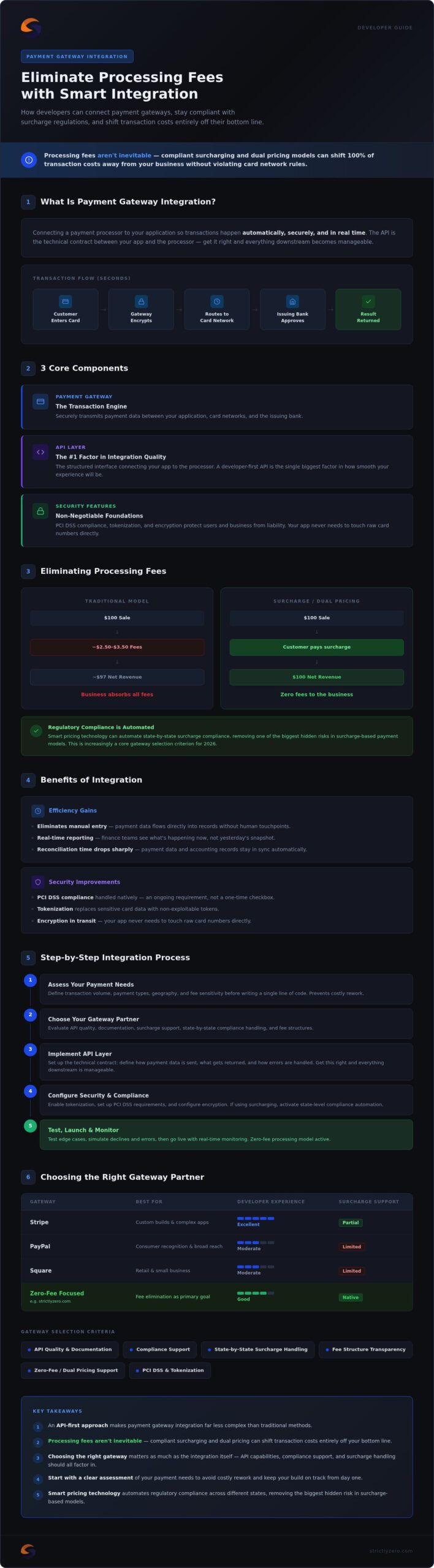
At its core, payment gateway integration is the process of connecting a payment processor to your application so that transactions can happen automatically, securely, and in real time. When a customer enters their card details, the gateway encrypts that data, routes it to the relevant card network and issuing bank, receives an approval or decline, and returns the result to your application – all within a few seconds. You’re not just adding a checkout button; you’re building a live communication channel between your software and the global payments infrastructure.
That distinction matters more than it sounds. Simplistic definitions, like “connecting your POS to accounting software,” miss the underlying mechanism entirely. The API is what makes the whole thing work. It’s the technical contract between your application and the processor, defining exactly how payment data gets sent, what gets returned, and how errors are handled. Get the API layer right, and everything downstream becomes manageable. Get it wrong, and you’re debugging transaction failures under pressure.
Key Components of Payment Gateway Integration
Understanding what you’re actually building with helps you make better decisions before you write a single line of code. Three components sit at the center of every integration:
- Payment Gateway: The service that facilitates transaction processing by securely transmitting payment data between your application, the card networks, and the issuing bank.
- API (Application Programming Interface): The structured interface that connects your application to the payment processor. A well-documented, developer-first API is the single biggest factor in how smooth your integration experience will be.
- Security Features: PCI DSS compliance, tokenization, and encryption aren’t optional extras. They’re foundational requirements that protect both your users and your business from liability.
Common Payment Gateways
The market offers several established options, each with a different focus. Stripe is widely regarded as the most developer-friendly, with clean documentation and flexible APIs suited to custom builds. PayPal brings broad consumer recognition and extensive integration options, though its fee structure can be less predictable. Square targets retail and small business environments with tightly bundled solutions.
For 2026, the conversation around payment gateway integration for developers is shifting. Zero-fee processing models, powered by compliant surcharging and dual pricing engines, are moving from niche strategy to mainstream expectation. Choosing a gateway that supports these models natively, with built-in state-by-state compliance handling, is no longer a nice-to-have. It’s becoming a core selection criterion.
Benefits of Payment Gateway Integration
Getting the integration right isn’t just a technical milestone. It’s a business decision with measurable downstream effects on your operations, your cash flow, and your exposure to fraud. For developers building payment flows into their applications, the benefits extend well beyond “transactions now work.”
Efficiency Gains
Manual payment entry is a liability. Every time a human touches transaction data, there’s an opportunity for error, and those errors compound during reconciliation. A properly integrated gateway eliminates that touchpoint entirely. Payment data flows directly from the transaction into your records, automatically and in real time, without anyone retyping a card number or cross-referencing a spreadsheet.
The reporting impact is just as significant. Real-time transaction data means your finance team isn’t waiting until end-of-day to understand what’s happened. Decisions about inventory, staffing, or cash deployment can be made on current information rather than yesterday’s snapshot. For applications handling high transaction volumes, this shift from batch reporting to live visibility changes how the whole business operates.
Reconciliation time drops sharply when your payment data and accounting records stay in sync automatically. That’s time your team gets back, and operational overhead that simply disappears from the budget.
Security Improvements
PCI DSS compliance isn’t optional, and it’s not a one-time checkbox. It’s an ongoing requirement that governs how cardholder data is stored, transmitted, and processed. Integrated systems handle much of this burden natively, using tokenization to replace sensitive card data with non-exploitable tokens and encryption to protect data in transit. Your application never needs to touch raw card numbers directly, which dramatically reduces your compliance scope.
Fraud prevention is where integration quality becomes especially visible. An AI-driven fraud prevention layer, built into the payment flow rather than bolted on afterward, can flag suspicious patterns before a transaction completes rather than after the damage is done. That’s a meaningful difference in exposure.
Taken together, these security layers do something manual or loosely integrated systems can’t: they make your application a harder target while simultaneously reducing the internal workload of staying compliant.
Cost savings round out the picture. Payment gateway integration for developers working with a compliant surcharge and dual pricing engine, like the one built into Strictly’s platform, can shift processing costs to the point of transaction rather than absorbing them as a business expense. That’s not a workaround; it’s a structured, regulation-aware pricing model. If reducing your processing overhead is a priority, exploring zero-fee processing options is a practical next step worth taking early in your integration planning.
Eliminating Processing Fees with Smart Technology
Processing fees are one of those costs that feel small until you actually calculate them at scale. A 2.9% fee on every transaction doesn’t sound like much until you’re running hundreds of thousands of dollars in monthly volume. At that point, you’re not paying a fee; you’re paying a significant operational expense that compounds month after month without delivering any additional value to your application or your users.
The traditional model assumes those fees are just the cost of doing business. They don’t have to be. Two compliant pricing structures, surcharging and dual pricing, give developers a legitimate path to shifting that cost away from the business entirely.
Surcharging vs. Dual Pricing Models
Surcharging adds a fee to credit card transactions to recover processing costs, applied transparently at checkout. Dual pricing presents two distinct prices: one for card payments, one for cash or ACH. Both models are legal in most U.S. states when implemented correctly, but the implementation details matter significantly.
Getting surcharging right inside your application means more than just adding a line item to the checkout total. You need to:
- Display the surcharge clearly before the customer confirms payment, not after
- Ensure the surcharge amount doesn’t exceed the actual cost of processing
- Apply the fee only to credit card transactions, not debit
- Register with card networks before activating surcharging, as Visa and Mastercard both require advance notice
Strictly’s Surcharge and Dual Pricing Engine handles the calculation and display logic automatically, which removes one of the most error-prone parts of the implementation. Rather than building and maintaining that logic yourself, the engine applies the correct fee structure based on the card type detected at the point of transaction.
Compliance and Regulatory Considerations
Surcharge compliance isn’t a single national standard. It varies by state, and that’s where most developers run into problems. Some states prohibit credit card surcharging entirely; others permit it with specific disclosure requirements. Building a static surcharge model into your application without accounting for these differences creates real legal exposure.
This is where Strictly’s Smart Pricing Engine addresses a gap that most payment gateway integration for developers guides don’t even acknowledge. The engine handles state-by-state compliance automatically, adjusting the pricing model based on where the transaction originates. Your application doesn’t need to maintain a separate compliance ruleset or manually track regulatory changes across jurisdictions.
For ongoing regulatory updates, the Consumer Financial Protection Bureau and individual state attorney general offices publish guidance on surcharge rules. Card network operating regulations, available directly from Visa and Mastercard, are the authoritative source for network-level requirements. Checking these periodically, or working with a processor that monitors them on your behalf, keeps your payment gateway integration for developers compliant as rules evolve.
The ROI case is straightforward: every dollar in processing fees you eliminate through compliant surcharging is a dollar that stays in the business. At meaningful transaction volumes, that’s not a marginal improvement. It’s a structural change to your cost model.
How to Set Up Payment Gateway Integration: A Step-by-Step Guide
Most integration failures aren’t caused by bad code. They’re caused by decisions made too early, before the developer fully understood what the payment flow actually needed to do. A structured approach prevents that. Here’s how to move from concept to live integration without the rework.
Step 1: Assess your existing payment processing needs. Before you touch an API, map your transaction types. Are you processing one-time purchases, subscriptions, invoices, or some combination? Do you need to support ACH alongside card payments? Which states will your customers transact from? That last question matters more than most developers expect, particularly if you’re planning to implement surcharging. State-by-state rules vary, and your architecture needs to account for that from the start, not as an afterthought.
Step 2: Choose the right payment gateway for your business. API quality, compliance support, and pricing model flexibility are the three criteria that actually separate good gateway choices from frustrating ones. A gateway that doesn’t natively support compliant surcharging forces you to build and maintain that logic yourself, which is a significant ongoing burden. Strictly’s API-first architecture is designed specifically for developers who need that compliance layer built in rather than bolted on.
Step 3: Implement the API and configure settings. Start with sandbox credentials and work through authentication, error handling, and webhook configuration before you process a single live transaction. Configure your surcharge and dual pricing settings early, since these affect how the checkout flow is presented to customers and need to be accurate before testing begins.
Step 4: Test the integration thoroughly before going live. Test every edge case: declined cards, network timeouts, partial refunds, and surcharge calculations across different card types. Don’t skip debit card scenarios. Surcharges apply to credit cards, not debit, and your integration needs to detect and handle that distinction correctly every time.
Step 5: Monitor and optimize post-launch. Transaction monitoring isn’t a set-and-forget task. Watch your decline rates, reconciliation accuracy, and any state-level compliance flags that surface in reporting.
Data Mapping and Configuration
Mapping transaction data to your ledger correctly from day one prevents reconciliation headaches later. Each transaction record should carry enough metadata, card type, surcharge amount, originating state, and transaction ID, to make your reporting self-explanatory without manual cross-referencing. When configuring surcharge compliance settings, Strictly’s Smart Pricing Engine handles the state-by-state logic automatically, so your configuration work focuses on connecting the engine to your checkout flow rather than building jurisdiction rules from scratch.
Developer Tips for Smooth Integration
Read the error documentation as carefully as the happy-path documentation. Most integration delays come from unexpected error states that weren’t anticipated during build. Common pitfalls include hardcoding surcharge percentages instead of pulling them dynamically, skipping webhook signature verification, and failing to register with card networks before activating surcharging. Visa and Mastercard both require advance registration; this isn’t optional and can’t be handled retroactively.
For payment gateway integration for developers who want to reduce back-and-forth during build, Strictly’s API-first design keeps the documentation aligned with actual behavior, which cuts the gap between what the docs say and what the API does. Connect with Strictly to start your integration and access the tools built specifically for developers who need compliance handled at the infrastructure level, not the application level.
Choosing the Right Payment Gateway Partner
The gateway you choose shapes everything downstream: your development timeline, your compliance exposure, and your long-term cost structure. Most comparisons focus on feature checklists, but the real differentiator is how well a provider’s architecture aligns with what your application actually needs to do. For payment gateway integration for developers, that means evaluating API quality, built-in compliance handling, and whether the provider’s pricing model works with your business rather than against it.
Start with the API itself. Clean, consistent documentation that matches actual API behavior cuts integration time significantly. Look for sandbox environments that mirror production accurately, versioned endpoints that don’t break without notice, and webhook support with proper signature verification. A provider that treats developers as the primary user, not an afterthought, will show it in how the documentation is structured and how edge cases are handled.
Beyond the API, evaluate whether compliance support is built into the platform or something you’d need to manage separately. State-by-state surcharge rules, card network registration requirements, and disclosure obligations aren’t static. A gateway that handles these at the infrastructure level removes a meaningful ongoing burden from your team.
Security and Compliance Checkpoints
Before committing to any provider, work through these verification points:
- End-to-end encryption: Confirm that cardholder data is encrypted in transit and that your application never handles raw card numbers directly. Tokenization should be a standard feature, not an add-on.
- PCI DSS compliance status: Ask for the provider’s current Report on Compliance or Self-Assessment Questionnaire results. A compliant provider will share this without hesitation.
- Fraud prevention tooling: Strictly’s AI-driven fraud prevention operates within the transaction flow, flagging suspicious patterns before authorization rather than after. That’s a structural advantage over solutions that layer fraud detection on top of an existing integration as a separate service.
- Surcharge compliance automation: If you’re implementing a zero-fee model, verify that the provider handles state-by-state rule differences automatically. Building and maintaining that logic yourself is a significant ongoing risk.
Next Steps for Your Business
The financial case for a zero-fee model is worth calculating before you finalize your gateway selection. Map your expected monthly transaction volume against your current or projected processing rate, then model what eliminating that cost entirely would mean over a twelve-month period. For businesses processing meaningful volume, the difference is structural, not marginal.
Strictly’s Surcharge and Dual Pricing Engine, combined with its API-first omni-channel processing platform, is built for exactly this use case: developers who need compliance handled at the infrastructure level and a pricing model that doesn’t quietly erode margins over time. Scheduling a consultation with a payment expert is a practical way to pressure-test your integration plan before you build.
For a broader foundation on how processing services fit into your overall payment strategy, read our guide on credit card processing services for more insights on structuring a cost-efficient, compliant payment operation from the ground up.
Build Smarter, Process Cheaper, Scale with Confidence
Payment gateway integration for developers doesn’t have to mean months of frustrating documentation dives, compliance guesswork, or processing fees quietly eating into your margins. The path forward is clearer than most developers realize.
Three things matter most. First, your API foundation determines everything downstream, so choose a gateway built with developers as the primary user. Second, compliant surcharging and dual pricing are legitimate, regulation-aware tools that can fundamentally change your cost structure. Third, state-by-state compliance isn’t something you want to manage manually; it belongs at the infrastructure level, not in your application code.
Strictly brings all three together. Its API-first architecture keeps integration straightforward, the Compliant Surcharge and Dual Pricing Engine handles fee recovery automatically, and omni-channel support means your payment flow works consistently across every channel your customers use.
You’ve done the hard work of understanding the landscape. Now it’s time to build something that actually works for your business. Eliminate your processing fees and sync your accounting today with Strictly and start processing smarter from day one.
Frequently Asked Questions
What are the benefits of integrating a payment gateway?
Integrating a payment gateway automates transaction processing, eliminates manual data entry errors, and gives your finance team real-time visibility into cash flow. Beyond operational efficiency, a well-built integration reduces your PCI DSS compliance scope through tokenization and encryption, since your application never handles raw card numbers directly.
For developers building with cost efficiency in mind, the right gateway integration also opens the door to compliant surcharging and dual pricing models, which can shift processing costs away from the business entirely rather than absorbing them as a fixed overhead expense.
How long does it take to complete a payment gateway integration?
Timeline varies significantly based on your application’s complexity, the quality of the gateway’s API documentation, and how much custom logic you need to build. A straightforward integration using a well-documented API can be completed in a few days to a couple of weeks. Integrations requiring custom surcharge logic, multi-currency support, or complex webhook handling typically take longer.
Choosing an API-first gateway with documentation that accurately reflects actual API behavior cuts integration time considerably. Mismatches between docs and real API responses are one of the most common sources of unexpected delays.
Are there additional fees associated with payment gateway integration?
Most gateways charge some combination of setup fees, monthly platform fees, and per-transaction processing fees. The per-transaction cost is usually where the real expense accumulates at scale. It’s worth reading the full fee schedule before committing, since some providers bundle features that others charge for separately.
That said, processing fees aren’t necessarily a permanent cost. Payment gateway integration for developers using a compliant surcharge or dual pricing model can recover those fees at the point of transaction, passing the cost to cardholders transparently and legally, rather than absorbing it as a business expense.
What security measures should I consider during integration?
Three layers of security are non-negotiable: encryption for data in transit, tokenization to replace raw card numbers with non-exploitable tokens, and PCI DSS compliance across your entire payment flow. Your application should never store or directly handle cardholder data; the gateway should handle that entirely.
Beyond the basics, verify that your gateway includes fraud prevention tooling that operates within the transaction flow rather than as a separate service. Catching suspicious patterns before authorization completes is meaningfully different from detecting fraud after a transaction has already processed.
Can I integrate multiple payment gateways into one application?
Yes, and there are legitimate reasons to do it: geographic coverage, redundancy if one gateway goes down, or supporting different payment methods that a single provider doesn’t cover. The tradeoff is added complexity in your codebase, since each gateway has its own API structure, error handling patterns, and webhook format.
If your primary reason for considering multiple gateways is cost, it’s worth evaluating whether a single provider with a strong surcharge and dual pricing engine would achieve the same outcome with less architectural overhead. Simplicity in your payment stack usually pays dividends during debugging and reconciliation.
How do I troubleshoot integration issues?
Start with the error response itself. Most gateways return structured error codes that point directly to the problem, whether it’s an authentication failure, an invalid card type, or a misconfigured webhook. Reading the error documentation as carefully as the happy-path documentation during your build prevents most of these surprises from appearing post-launch.
For surcharge-specific issues, the most common culprits are applying the surcharge to debit transactions instead of credit-only, hardcoding a surcharge percentage instead of pulling it dynamically, and skipping card network registration before activating surcharging. Each of these has a specific fix, and catching them in sandbox testing is far less costly than discovering them in production.
What is the difference between surcharging and dual pricing?
Surcharging adds a fee to credit card transactions at checkout to recover processing costs. The base price stays the same, and the surcharge appears as a separate line item that the customer sees before confirming payment. Dual pricing takes a different approach: it displays two distinct prices upfront, one for card payments and one for cash or ACH, giving customers a clear choice rather than a fee applied at the end.
Both models are legal in most U.S. states when implemented correctly, but they suit different business contexts. Surcharging works well when you want a single listed price with transparent fee disclosure. Dual pricing is often more intuitive for customers because the choice is framed around price rather than a surcharge. Strictly’s Surcharge and Dual Pricing Engine supports both models and handles state-by-state compliance automatically.
Do I need technical expertise to set up a payment gateway?
Some level of technical knowledge is genuinely required. At minimum, you need to understand API authentication, how to handle HTTP requests and responses, and how webhooks work. Developers comfortable with REST APIs will find the core integration manageable; the complexity usually comes from edge cases like error handling, surcharge logic, and compliance configuration rather than the basic connection itself.
That said, payment gateway integration for developers is considerably more approachable when the gateway is built with developers as the primary user. Clean, accurate documentation and sandbox environments that mirror production behavior reduce the learning curve substantially, letting you focus on your application logic rather than decoding inconsistent API behavior.