
Payment Processor Holding Funds? A 2026 Guide to Cash Flow Stability
Published:

Last Monday, an e-commerce owner named Marcus discovered an email about his payment processor holding funds for a standard review just as he was preparing to restock inventory. Instead of seeing a healthy deposit from a record-breaking sales weekend, his revenue was locked in a digital vault with no clear release date. It’s a gut-wrenching experience that leaves many business owners feeling like they’ve lost control over their own success while scrambling to meet payroll or supplier costs.
We understand that unpredictable cash flow isn’t just a nuisance; it’s a threat to your operations. This guide explains why these holds occur, especially with the 2026 Nacha rule changes and Visa’s stricter 1.5% VAMP threshold. You’ll discover how to transition from reactive delays to a reliable system using AI-driven fraud prevention. We’ll show you how to choose a partner that prioritizes transparency so you can maintain predictable, daily access to your hard-earned revenue.
Key Takeaways
- Understand the critical difference between transaction-specific holds and rolling reserves to better manage your business’s liquid capital.
- Identify the specific risk triggers that result in a payment processor holding funds and learn how proactive documentation can prevent freezes.
- Discover how AI-driven fraud prevention uses real-time data to distinguish between high-volume sales spikes and actual fraudulent activity.
- Learn how to stabilize your bottom line by switching to compliant surcharge and dual pricing models that eliminate unexpected “junk fees.”
- Explore how API-first architecture and automated residual tools provide the technical and financial reliability needed for long-term growth.
Table of Contents
- Why Is Your Payment Processor Holding Funds?
- Technical vs. Financial Reliability in Payment Processing
- How AI-Driven Fraud Prevention Reduces Unnecessary Holds
- Financial Reliability: Eliminating Fee Volatility
- Partner Reliability: Tools for ISOs and Developers
Why Is Your Payment Processor Holding Funds?
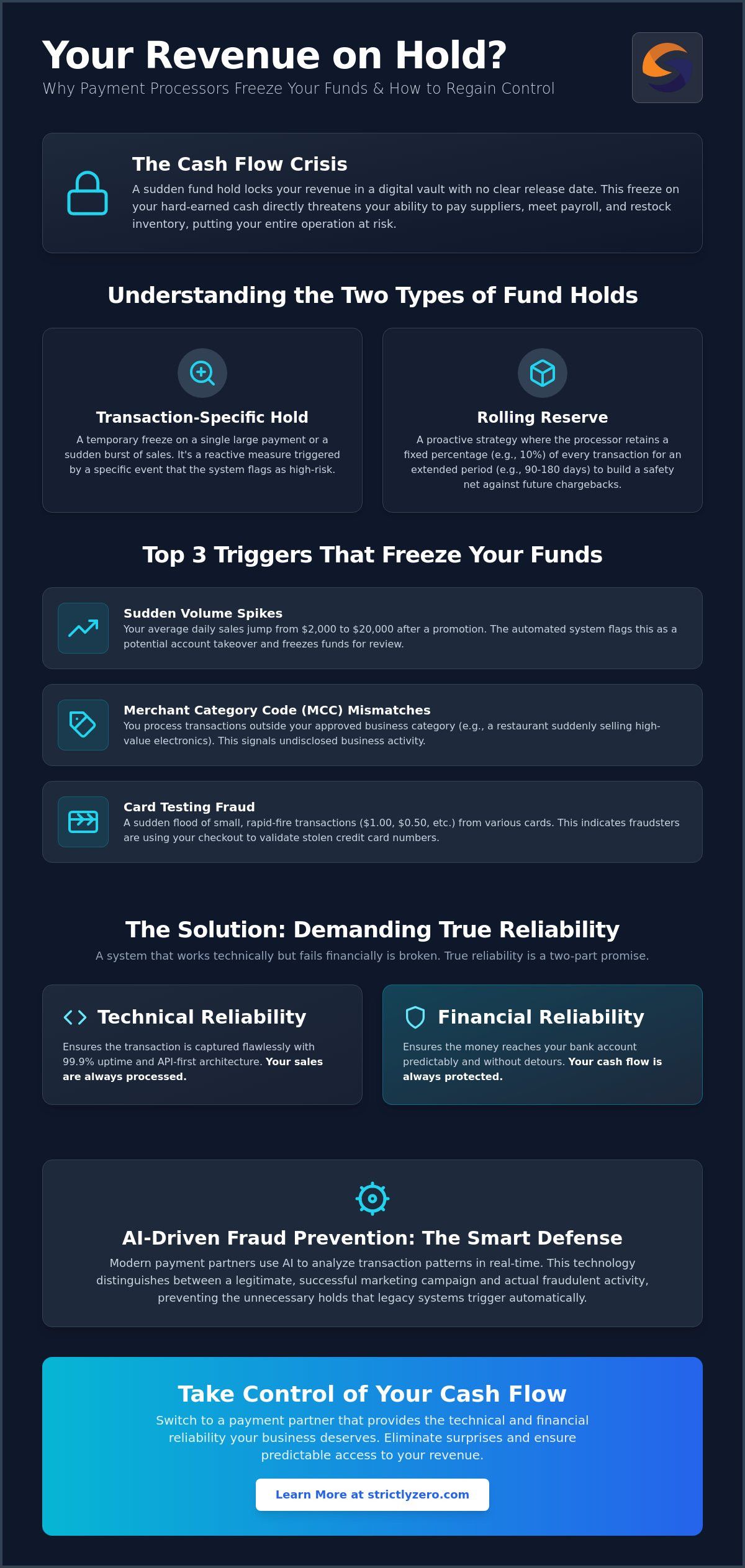
A fund hold is a precautionary freeze on merchant revenue to ensure capital is available for potential consumer disputes. It’s a primary tool used by your payment processor to mitigate the financial risk of chargebacks or fraud before funds are permanently cleared. While it feels like a personal attack on your business, it’s technically a strategic pause designed to protect the financial ecosystem from sudden losses.
In 2026, these risk models have become significantly more aggressive. With the Visa Acquirer Monitoring Program (VAMP) tightening its excessive threshold to 1.5% as of April 1, 2026, processors are under immense pressure to prevent violations. This means your revenue might be flagged for patterns that were ignored just a year ago. Global cybersecurity threats and new Nacha account verification rules have forced many institutions to adopt a “freeze first, ask later” mentality.
To better understand why these freezes happen and how to resolve them, watch this helpful video:
It’s vital to distinguish between a standard hold and a reserve. A fund hold is usually transaction-specific; it occurs when a single large payment or a sudden burst of sales triggers a red flag. In contrast, a rolling reserve is a percentage-based strategy where the processor keeps a fixed portion of every sale, often for 90 days to 12 months, to build a safety net against future liabilities.
Common Triggers for Fund Reviews
- Volume Spikes: If your average daily volume is $2,000 and you suddenly process $20,000 in one afternoon, the system assumes your account has been compromised.
- MCC Mismatches: Processing transactions that fall outside of your established Merchant Category Code (MCC) signals that you’re selling products or services you didn’t disclose during onboarding.
- Card Testing: A sudden wave of small, rapid transactions can indicate “card testing” bots are using your checkout to verify stolen data.
The Impact on Merchant Cash Flow
When you’re facing a payment processor holding funds, the impact is immediate and physical. Frozen revenue disrupts your inventory cycles and makes it nearly impossible to meet payroll obligations on time. The psychological toll is often worse because these “black box” risk decisions usually happen without human support or clear release dates. Choosing reliable credit card processing for small business requires a partner with transparent hold policies and real-time communication tools that prevent these surprises.
Technical vs. Financial Reliability in Payment Processing
Reliability in the payments world isn’t just about 99.9% uptime; it’s about the liquidity that keeps your business alive. A system that processes a transaction perfectly but leaves the revenue in limbo is technically functional but financially broken. True reliability requires a dual-pronged approach where a high-performance, omni-channel gateway is backed by a stable merchant account. You need a system that ensures the sale is captured and a partner that ensures the money reaches your bank account without detours.
Technical reliability starts with API-first architecture. This ensures that your checkout, virtual terminal, and backend accounting software communicate without dropping data packets. By utilizing redundant gateway infrastructure, the system can reroute transactions instantly if a specific network node experiences a delay. This prevents the technical mismatches that often result in a payment processor holding funds for manual verification. When your data stream is unified across all sales channels, your business profile remains consistent and less likely to trigger the automated risk flags that cause unnecessary freezes.
Financial reliability, however, is where many providers fail. When a processor relies on hidden “junk fees” or faces regulatory heat, their risk appetite often shrinks overnight. For example, a recent FTC action against a payment processor demonstrates how legal pressure over poor fraud monitoring can lead to sweeping account freezes. You need a partner that maintains a stable capital base and offers clear, predictable pricing models. If you’re tired of guessing what your next merchant statement will look like, you can explore our transparent pricing engine.
Uptime and Redundancy in 2026
In 2026, simple server redundancy isn’t enough to guarantee stability. Your virtual terminal must sync in real-time with your physical POS systems to create a single source of truth for your business operations. This level of ecommerce payment processing stability protects your brand reputation. Customers expect a seamless experience, and any technical friction can lead to abandoned carts or, worse, a flagged transaction that puts your daily revenue at risk.
Pricing Transparency as a Stability Metric
Hidden fees are more than just an expense; they act as a “silent hold” on your growth. These costs eat into your margins without warning, making it impossible to forecast your monthly cash flow with any accuracy. Transitioning to a zero fee credit card processing model provides the margin protection you need for long-term planning. Look for red flags like “non-qualified” surcharges or vague administrative dues in your statements. These often indicate a processor is struggling with its own overhead, which could eventually lead to them holding your funds to mitigate their own financial instability.
How AI-Driven Fraud Prevention Reduces Unnecessary Holds
Legacy risk models are blunt instruments. They see a sudden spike in sales and immediately trigger a payment processor holding funds alert, treating your best sales day like a security breach. AI-driven fraud prevention changes this by learning your business’s specific pulse. Machine learning models analyze thousands of data points per second to validate high-value transactions without human intervention, checking variables like IP geolocation, device fingerprints, and historical buying patterns in real-time.
This intelligence is vital as federal regulators increase their gaze on the industry. The recent CFPB oversight of digital payment apps emphasizes the need for robust fraud reduction to prevent “debanking” or sudden account closures that hurt honest merchants. By using proactive fraud scoring, you can protect legitimate revenue and stop “card testing” bots before they ever reach your checkout. This precision reduces false declines, ensuring that your customers have a smooth experience while your cash flow remains uninterrupted.
Even if a processor requires a rolling reserve due to your industry’s risk profile, partnering with a specialist like PlatinumEdge Technologies can provide the specialized high-risk payment solutions needed to stay stable while you offset that financial pressure. Implementing a compliant surcharge model ensures you aren’t paying out-of-pocket for processing fees. This effectively keeps more cash in your operational budget, helping you bridge the gap while your reserve funds mature. It’s a strategic way to maintain liquidity even when the system demands a temporary safety net.
The Role of Tokenization and Encryption
Security isn’t just about stopping thieves; it’s about reducing your overall liability. Tokenization replaces sensitive card data with a unique identifier, meaning the actual card numbers never touch your environment. This significantly lowers your risk profile and simplifies the headache of PCI DSS compliance. The best credit card processing for small business must integrate end-to-end encryption to ensure that every transaction is shielded from the point of swipe to final settlement. When your data is secure, processors have fewer reasons to flag your account for manual reviews.
Proactive Security vs. Reactive Holds
Most legacy processors wait for a problem to happen before they act. They authorize a transaction and then freeze the funds 24 hours later once a “suspicious” pattern is detected. This reactive approach is what leads to the dreaded payment processor holding funds email during your peak season. Strictly takes a different path by identifying risk before the transaction is even authorized. By scoring risk in real-time, we reduce the “surface area” for technical and financial errors, ensuring that approved sales stay approved.
Financial Reliability: Eliminating Fee Volatility
Fee volatility is often the silent partner of cash flow instability. While much of the frustration in this industry centers on a payment processor holding funds, the unpredictable erosion of your margins through hidden fees can be just as damaging. The “Zero Fee” revolution has shifted the power back to the merchant. By moving from complex Interchange Plus models to a compliant surcharge or dual pricing structure, you can stabilize your overhead and protect your bottom line from the fluctuating costs of card network rates.
A sophisticated Smart Pricing Engine is the backbone of this financial reliability. It ensures that your credit card processing services remain fully compliant with the 2026 regulatory environment, which varies significantly from state to state. If you’re already dealing with a payment processor holding funds, the added stress of fee volatility can be the breaking point for your business. Implementing a system that legally passes processing costs to customers ensures that your revenue remains yours to keep.
One of the biggest risks in surcharging is the accidental application of fees to debit cards, which can lead to heavy fines or account termination. Automated debit card detection solves this by identifying the card type in milliseconds. The system ensures you only apply surcharges to credit transactions, maintaining your merchant account’s health and keeping you on the right side of card brand rules. If you’re ready to eliminate these financial surprises, you can switch to our compliant dual pricing engine.
Compliant Surcharge and Dual Pricing
The 2026 landscape requires a clear distinction between surcharging and dual pricing. Surcharging adds a fee at the point of sale for credit users, while dual pricing presents two distinct prices: one for cash and one for card. Automation handles this complexity for you, adjusting for varying state laws in real-time. This level of transparency is the ultimate form of merchant trust. It shows your customers exactly what they’re paying for while ensuring your business doesn’t absorb the rising cost of rewards cards.
Predictable Cash Flow Models
Predictability is the foundation of growth. By removing “statement shock” caused by hidden batch fees, annual dues, or mid-month adjustments, you can forecast your cash flow with total accuracy. Unified billing simplifies accounting for multi-location businesses, bringing all your processing data into a single, transparent report. This clarity allows you to spot trends early and maintain a stable relationship with your processor, reducing the likelihood of the sudden reviews that lead to held funds.
Partner Reliability: Tools for ISOs and Developers
Independent Sales Organizations (ISOs) face a unique challenge in the 2026 market. Your reputation is tied directly to the uptime and stability of the platform you represent. When a sub-merchant encounters a payment processor holding funds, they don’t call the bank; they call you. To protect your portfolio and your brand, you need a reliable infrastructure that prioritizes transparency and automated risk management over reactive freezes.
Scaling a payments business requires more than just sales grit. You need a robust payment processing platform for ISOs that offers deep visibility into merchant activity. Tools like ClearSplit™ take the manual labor out of the equation by automating residuals, ensuring you and your partners are paid accurately and on time. Meanwhile, ChurnIQ™ provides proactive intelligence to identify merchants at risk of leaving. This allows you to intervene before a minor technical hiccup turns into a lost account.
A reliable partner doesn’t just process transactions; they provide the tools to manage them at scale. By using AI-driven insights to monitor sub-merchant health, ISOs can spot potential risk triggers before they lead to a payment processor holding funds. This proactive approach reduces merchant churn and builds a foundation of trust that is essential for long-term growth in a competitive industry.
Scaling with a Unified API
A unified, API-first architecture is the only way to manage thousands of sub-merchants efficiently. It allows for automated onboarding, which significantly reduces the risk of those frustrating initial account holds caused by manual data entry errors. For developers and Managed Service Providers (MSPs), white-label reliability is paramount. You need a system that feels like your own while leveraging the heavy-duty security of a global processor. This ensures that your software remains the star of the show while we handle the complex compliance and risk overhead in the background.
Conclusion: Trusting the Strictly Advantage
Reliability isn’t a single feature; it’s the intersection of technical, financial, and operational excellence. Throughout this guide, we’ve explored how AI fraud prevention stops the “freeze first” mentality that often results in a payment processor holding funds. We’ve also looked at how a Smart Pricing Engine eliminates the fee volatility that erodes your margins. Strictly combines these elements to create a fortress for your cash flow. If you’re ready to move beyond the uncertainty of legacy processing, the path is clear. Partner with Strictly to scale your payments business today and give your merchants the stability they deserve.
Take Control of Your Revenue Today
Managing a business is difficult enough without the constant threat of a payment processor holding funds during your busiest hours. By moving toward a system that prioritizes proactive AI-Driven Fraud Prevention, you can significantly reduce false flags and manual reviews. Integrating a Smart Pricing Engine ensures 50-state surcharge compliance while providing the financial stability necessary to weather shifting regulations like the 2026 Nacha and Visa updates.
Reliability isn’t just about uptime; it’s about knowing your revenue is accessible when you need it most. Whether you’re a merchant looking for predictability or a partner using ClearSplit™ for automated residuals, the right infrastructure makes all the difference. Don’t let legacy risk models dictate your growth. Switch to a reliable, zero-fee processing partner today and build a foundation of trust that supports your success. You deserve a partner that works as hard as you do to keep your cash flow moving.
Frequently Asked Questions
Why is my payment processor holding my funds for 24-48 hours?
Processors hold funds for 24 to 48 hours primarily to verify the legitimacy of transactions and ensure your account hasn’t been compromised. This short window allows the system to check for suspicious patterns or “card testing” before the money is permanently cleared to your bank. It’s a standard security protocol used by almost every major institution to minimize the risk of immediate chargebacks or fraudulent activity.
Is it legal for a payment processor to hold funds without notice?
Yes, it is legal for a processor to hold funds without prior notice if they suspect risk or potential fraud. Most merchant agreements include clauses that grant the acquirer the right to withhold funds to cover liabilities like chargebacks. Legal frameworks like UCC Article 4 also support a bank’s right to protect itself from financial loss while processing payments on your behalf.
How can I prevent my payment processor from putting my account under review?
You can prevent reviews by maintaining consistent processing volumes and ensuring your transactions match your Merchant Category Code (MCC). Sudden spikes in ticket size or volume are the most common triggers for a payment processor holding funds. Using a partner with proactive AI fraud detection helps because the system learns your business patterns, reducing the likelihood of a false flag during your peak sales seasons.
What is a “rolling reserve” and how long does it last?
A rolling reserve is a risk management strategy where the processor holds a fixed percentage of every transaction for a set period, typically between 90 days and 12 months. This creates a financial buffer to cover potential chargebacks or refunds. Unlike a standard hold, a rolling reserve is an ongoing agreement that eventually releases the oldest funds back to you as new ones are collected.
Does AI-driven fraud prevention actually reduce fund holds?
AI-driven fraud prevention significantly reduces fund holds by validating transactions in real-time rather than relying on reactive reviews. By analyzing thousands of data points like device fingerprints and IP locations, machine learning models can distinguish a legitimate holiday sales spike from fraudulent bot activity. This proactive approach ensures your sales are authorized and cleared without the need for manual intervention or “black box” freezes.
Can I switch payment processors if my funds are currently being held?
You can switch processors at any time, but the original provider will continue to hold any existing funds until their review or reserve period expires. Switching to a more reliable partner can prevent future issues, but it won’t force an immediate release of money currently locked in a “termination hold.” It’s best to establish a new account and transition your volume while working to resolve the existing review.
What are the red flags of an unreliable payment processor?
Red flags of an unreliable partner include “junk fees” hidden in statements, a lack of clear communication during reviews, and legacy risk models that freeze accounts without warning. If a processor can’t explain their hold policies or doesn’t offer tools like real-time fraud scoring, they’re likely a liability. Reliable partners prioritize transparency and offer compliant surcharge engines to help you maintain predictable cash flow.
How does a surcharge program affect my fund availability?
A surcharge program doesn’t negatively impact fund availability, but it does help you maintain liquidity if you’re facing a payment processor holding funds in a reserve. By passing processing costs to customers, you keep a larger portion of each sale in your pocket. This extra margin acts as a financial cushion, helping you meet payroll and inventory obligations even if a portion of your revenue is temporarily withheld.