
Payment Processor Partner Compensation: The 2026 Residuals Guide
Published:

In a market where premium, low-attrition portfolios are trading for up to 30x monthly residuals, you can’t afford to leave your earnings to guesswork. Yet, many agents still struggle with opaque reporting and manual calculations that quietly eat away at their bottom line. Understanding the nuances of payment processor partner compensation is no longer just about negotiating a high split percentage. It’s about ensuring every basis point is accounted for through modern automation and total transparency.
It’s frustrating to watch merchant churn or “residual leak” erode the portfolio you worked so hard to build. We know how difficult it is to verify earnings when your processor provides confusing data or requires manual intervention for every sub-agent split. This guide will show you how to master the mechanics of residual splits, buy rates, and automated compensation so you can scale your payments business with confidence. We’ll explore how tools like ClearSplit™ for automated funding and ChurnIQ™ for retention intelligence provide the transparency you need. You’ll also learn how to leverage $0 fee surcharge models to grow your portfolio quickly while protecting your long-term wealth in 2026.
Key Takeaways
- Learn how to navigate the 2026 ecosystem of ISOs and software partners to secure stable, long-term payment processor partner compensation through lifetime residual models.
- Master the math of buy rates and interchange-plus pricing to ensure your wholesale costs are optimized for maximum transparency and profit.
- Discover how automated tools like ClearSplit™ eliminate “residual leak” and manual spreadsheet errors that often cost partners thousands in unaccounted revenue.
- Understand the direct link between merchant retention and your portfolio’s valuation, using intelligence tools like ChurnIQ™ to protect your long-term assets.
- Scale your business by shifting the focus from simple commission percentages to a robust tech stack featuring compliant surcharge and dual pricing engines.
Table of Contents
- Understanding the Payment Processor Partner Ecosystem
- The Math of Residuals: Buy Rates vs. Revenue Share
- Eliminating Residual Leak with Automated Compensation
- Maximizing Lifetime Value: Retention and Churn Intelligence
- Scaling Your Business with the Right Partner Program
Understanding the Payment Processor Partner Ecosystem
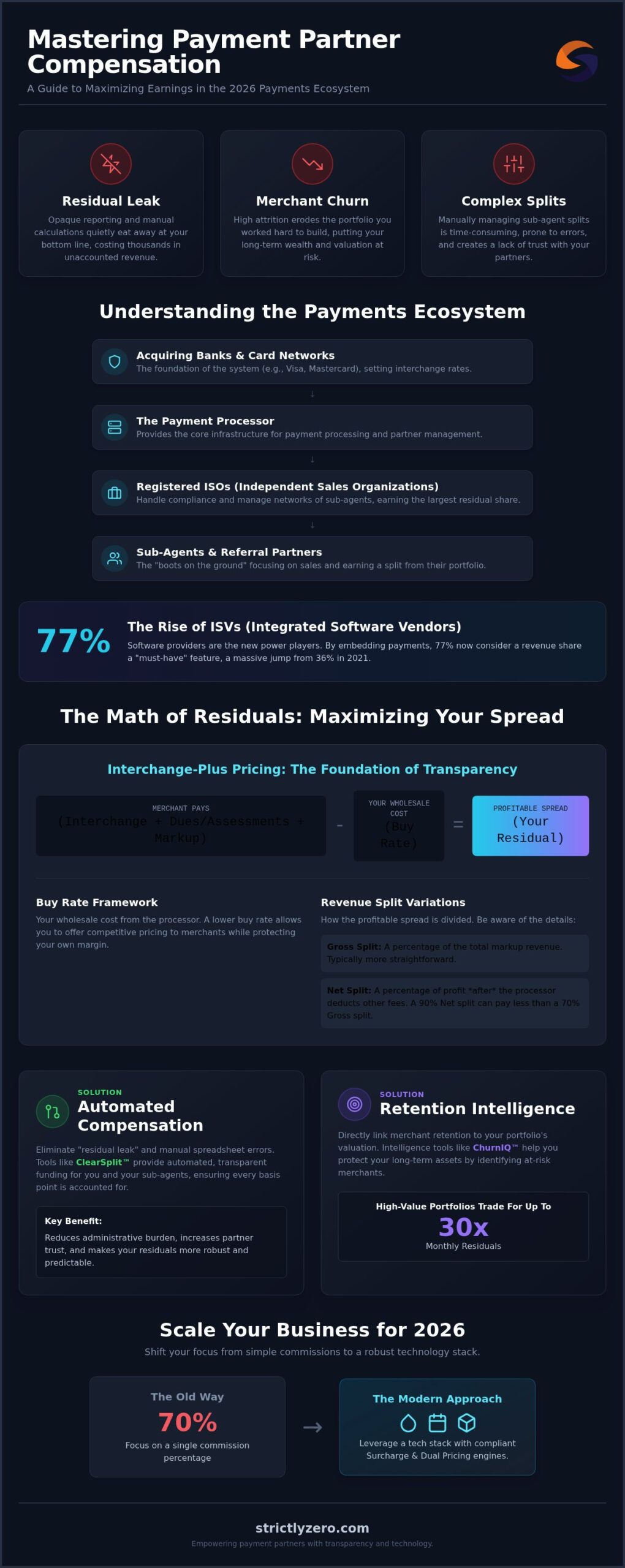
The payments world is no longer a simple transaction between a merchant and a bank. It’s a complex web of intermediaries where your position determines your profit. At the center of it all is “Trust as a Payment Processor.” This isn’t just a marketing slogan; it’s the foundation of a partner’s ability to sell. If a merchant doesn’t trust the security or the reporting, the partner’s residuals are at risk. In 2026, the most lucrative payment processor partner compensation models prioritize long-term stability over short-term gains. We’ve seen a massive shift from one-time referral bonuses to lifetime residuals. This change means partners aren’t just salespeople; they’re portfolio owners.
ISOs vs. Agents: Who Earns What?
Registered Independent Sales Organizations (ISOs) act as the primary bridge between acquiring banks and the Payment Processor infrastructure. They manage the heavy lifting of compliance and often oversee a network of sub-agents. These sub-agents are the boots on the ground, working directly with local businesses to implement omni-channel payment processing. The compensation hierarchy usually reflects the level of risk and overhead:
- Registered ISOs: They earn the largest share of the residual split because they handle the most significant operational and compliance burdens.
- Sub-Agents: These partners focus on sales and relationship management, earning a split of the monthly residuals from their specific merchant portfolio.
- Referral Partners: These entities pass leads to a processor and often receive smaller, fixed payments or short-term bonuses.
To maximize payment processor partner compensation, agents now look for processors offering advanced partner management tools. These tools allow for transparent reporting and automated split-funding for sub-agents through systems like ClearSplit™, which reduces the administrative burden on the ISO. These tools make the sale easier and the residuals more robust.
The Rise of Integrated Software Vendors (ISVs)
Developers and software companies have become the new power players. By embedding payment processing into their specialized platforms, they provide a seamless experience for the merchant while creating a new revenue stream. They’ve moved from being simple integrators to acting as “payment facilitator lite” entities. This allows them to capture a larger share of the margin without the full overhead of a traditional PayFac. According to a 2024 Wind River Payments survey, 77% of software providers now view a revenue share as a “must-have” feature. This is a massive jump from 36% in 2021. For these partners, success depends on leveraging high-retention tools like ChurnIQ™ to protect their portfolio valuation.
The Math of Residuals: Buy Rates vs. Revenue Share
Understanding payment processor partner compensation requires a deep dive into the “spread,” which is the difference between what the merchant pays and the wholesale cost of the transaction. Most transparent models rely on interchange-plus pricing. This ensures that when the Federal Reserve Payment Systems or card networks adjust underlying rates, the partner and the merchant see those changes clearly. For instance, the 2026 Visa and Mastercard settlement reduced the average effective credit interchange rate by 10 basis points. In a transparent revenue share model, that reduction directly benefits the merchant’s bottom line or increases the available margin for the partner, rather than being swallowed by the processor.
The Buy Rate Framework
Negotiating your wholesale costs is the first step toward a profitable portfolio. High-volume partners often secure lower buy rates because they provide economies of scale to the processor. A buy rate is the base cost provided by the processor before partner markup. If your buy rate is set too high, you’ll find it impossible to offer competitive pricing to larger merchants without sacrificing your own margins. Success in 2026 depends on finding a balance where your wholesale costs allow you to remain aggressive in the market while still capturing a meaningful share of the revenue.
Revenue Split Variations
Once the buy rate is established, the remaining profit is divided between the processor and the partner. Common splits like 70/30 or 80/20 sound straightforward, but the devil is in the details of “Gross” versus “Net” residuals. A 90% split on a “Net” basis might actually pay less than a 70% “Gross” split if the processor pads the net calculation with hidden administrative fees or inflated network costs. This is often called the “hidden fee trap.”
To avoid these pitfalls, modern partners use automated tools like ClearSplit™ to verify that every cent is accounted for in real-time. Additionally, the rise of surcharge and dual pricing programs has fundamentally changed the math. These programs allow merchants to offset processing costs entirely, creating a $0 fee model that is incredibly easy to sell. Partners looking for full transparency often choose to explore compliant surcharge models to maximize their margins while providing massive value to their clients. By using a smart pricing engine, you can ensure state-by-state compliance is handled automatically, protecting your portfolio from regulatory risks while you scale.
Eliminating Residual Leak with Automated Compensation
Manual spreadsheets are a relic of a slower era. They introduce human error, cause payout delays, and ultimately damage the relationship between agents and processors. This friction often results in “residual leak,” a phenomenon where unverified calculations and missed transaction data cost partners thousands of dollars every year. In a high-stakes environment, real-time reporting is the only way to maintain the “Trust as a Payment Processor” standard that modern agents demand. Accurate payment processor partner compensation depends on a system that tracks every cent from the moment a card is swiped to the moment the residual hits your bank account.
ClearSplit™: The Future of Partner Payouts
Managing complex hierarchies is one of the biggest headaches for growing ISOs. When you have multiple sub-agents, referral partners, and software integrators all tied to the same merchant, manual split-funding becomes impossible to manage at scale. This is where Automated Residuals: How ClearSplit™ Works for ISOs becomes a game changer. By automating the distribution of residuals to every stakeholder, agency leads can eliminate hours of administrative overhead. This ensures that every sub-agent is paid accurately and on time, which is essential for maintaining a loyal sales force.
Transparency Through Partner Portals
A modern partner dashboard must do more than just show a total balance. In 2026, essential features include real-time volume tracking, payout history, and proactive churn alerts. Providing sub-agents with their own dedicated view of earnings is critical for morale. It removes the “black box” feeling that often plagues traditional ISO models. When your team can see their daily performance and projected residuals, they stay motivated to close more deals. API-first platforms allow partners to pull data into their own CRMs. This level of integration ensures that your internal sales tools are always synced with the processor’s actual merchant activity, providing a single source of truth for your entire business.
Beyond simple tracking, these portals should integrate with tools like ChurnIQ™ to provide intelligence on merchant behavior. By identifying accounts at risk of leaving before they actually cancel, partners can protect their payment processor partner compensation and maintain the long-term value of their portfolio. Transparency isn’t just about showing the numbers; it’s about giving you the tools to act on them.
Maximizing Lifetime Value: Retention and Churn Intelligence
The first 90 days of a merchant’s lifecycle determine the long-term health of your portfolio. In 2026, general retail ISO portfolios face annual attrition rates between 8% and 15%. This churn is the single biggest threat to your payment processor partner compensation. When a merchant leaves, you don’t just lose their monthly volume; you lose the 20x to 30x valuation multiple that low-attrition portfolios command in the current market. Protecting your earnings requires moving beyond simple sales tactics and embracing churn intelligence as a core business strategy.
ChurnIQ™: Protecting Your Portfolio
Proactive retention is more effective than reactive saves. ChurnIQ™ acts as an early warning system by identifying merchants at risk of leaving before they ever pick up the phone to cancel. It monitors specific data points, such as sudden drops in processing volume or a decrease in the variety of card types accepted, which often signal that a merchant is “shopping” for a new processor. Data shows a strong correlation between omni-channel usage and higher merchant stickiness. Merchants who rely on a single POS terminal are far more likely to switch for a lower rate than those who are deeply integrated into a processor’s ecosystem.
The Value of Omni-Channel Solutions
Merchants who utilize virtual terminals, invoicing, and payment links are significantly harder to displace. These tools weave the payment process into the merchant’s daily operations, making the cost of switching much higher than a simple hardware swap. To understand how to position these services, see our Ecommerce Payment Processing: The Ultimate Omni-Channel Guide. By cross-selling POS lending and AI-driven fraud prevention, you deepen the relationship and provide value that goes far beyond a simple transaction rate. This strategy turns you into a business partner rather than just a vendor.
In high-competition markets, the $0 fee surcharge model is your strongest retention tool. It allows you to offer merchants a way to eliminate their processing costs entirely, which is a powerful incentive to stay. When combined with automated compliance for state-by-state regulations, this model provides a “set it and forget it” benefit for the merchant. By reducing their overhead, you secure your payment processor partner compensation for years to come. If you’re ready to build a high-retention portfolio, partner with a processor that prioritizes your long-term growth.
Scaling Your Business with the Right Partner Program
Choosing a partner program based solely on the highest commission percentage is a common mistake for new agents. A 90% split of a shrinking portfolio is far less valuable than a 70% split of a rapidly growing, high-retention merchant base. To scale effectively in 2026, you need a technology stack that handles the heavy lifting of compliance and reporting. Your payment processor partner compensation should be viewed as a strategic business investment rather than just a monthly paycheck. Scaling from a solo agent to a full-scale ISO requires shifting your focus toward building a team. This transition is only possible when you have automated tools like ClearSplit™ to manage sub-agent payouts without the manual labor that leads to errors.
Smart Surcharge compliance is no longer optional. With the 2026 Visa and Mastercard settlement allowing merchants expanded options to surcharge, you have a unique consulting angle. You aren’t just selling processing; you’re selling a way for businesses to reclaim their margins. Additionally, the reintroduction of the Credit Card Competition Act in early 2026 has introduced more routing choices for merchants. Being able to explain these regulatory shifts makes you a trusted advisor. This expertise is the key to moving up the ISO hierarchy and securing larger, more stable accounts that would otherwise be out of reach.
The Sales Advantage of Zero-Fee Processing
Traditional processing models are often a hard sell in saturated markets where every merchant is tired of being pitched. However, Zero Fee Credit Card Processing: The 2026 Merchant Guide to $0 Fees provides a blueprint for opening doors that were previously closed. By leveraging state-by-state surcharge rules, you can show merchants exactly how to legally pass on costs. This “Zero Fee” model acts as a powerful acquisition tool, allowing you to build a massive portfolio in a fraction of the time it takes with standard pricing. It also provides a built-in defense against competitors who only offer traditional interchange-plus models, as the cost savings are impossible for most merchants to ignore.
Support and Training for Partner Success
Scaling requires more than just a good product; it requires sales enablement. Access to white-label marketing materials and dedicated partner support allows you to resolve merchant issues quickly, keeping your retention rates high. As you grow, you’ll need a processor that acts as a partner, not just a vendor. Accessing the ClearSplit™ dashboard gives you the real-time data needed to manage your agency’s growth and payout your sub-agents with total transparency. If you’re ready to move beyond the limitations of legacy ISO models, Partner with Strictly to scale your payments business today.
Build a High-Valuation Payments Business
The landscape of 2026 demands more than just a high commission split. To truly scale, you must eliminate “residual leak” and protect your portfolio from the high attrition rates seen in commodity retail sectors. By leveraging advanced tools like ClearSplit™ for automated residuals and ChurnIQ™ for retention intelligence, you can build a business based on transparency rather than guesswork. Mastering the math of buy rates and utilizing a compliant surcharge engine allows you to offer merchants a $0 fee model that is both easy to sell and incredibly hard for competitors to displace.
Your payment processor partner compensation should be a source of long-term wealth, not a monthly administrative headache. If you’re tired of opaque reporting and manual spreadsheets, it’s time to switch to a platform built for modern ISOs and agents. Join the Strictly Partner Program and start earning automated residuals today. You have the sales expertise; we have the technology to help you protect and grow every basis point. Let’s build something that lasts.
Frequently Asked Questions
How are payment processing residuals calculated?
Residuals are calculated by subtracting the buy rate and any network fees from the total processing revenue generated by a merchant. The remaining spread is then divided according to your specific revenue share agreement. For example, if a merchant is priced at 2.90% and your buy rate is 2.40%, the 0.50% spread is what you split with your processing partner. Using automated reporting ensures these calculations remain accurate every month.
What is a typical revenue split for a payment processing partner?
Revenue splits usually range from 50/50 to 90/10, depending on the volume of your portfolio and the level of risk you manage. While higher percentages look attractive, it’s vital to check if the split is based on gross or net revenue. A 70% gross split often pays more than a 90% net split if the processor includes hidden administrative fees in their net calculation. Always prioritize transparency over the headline percentage.
What is the difference between a buy rate and a residual split?
The buy rate is the wholesale price the processor charges you for every transaction, while the residual split is the percentage of the remaining profit you keep. Think of the buy rate as your cost of goods sold. Your payment processor partner compensation grows when you maintain a wide gap between the merchant’s price and your buy rate. You then keep a high percentage of that profit as your monthly residual.
How often are payment processor partner commissions paid?
Most partners receive their residual commissions once per month, typically between the 10th and 20th day following the month the transactions occurred. While some modern platforms allow for more frequent reporting, the actual payout cycle usually remains monthly to account for chargebacks and adjustments. Having a transparent dashboard allows you to track these accruals in real-time before the payment hits your bank account.
Can I lose my residuals if a merchant cancels their account?
Residuals are lifetime only for as long as the merchant remains active and processing. If a merchant cancels, that specific stream of income stops immediately. This is why using retention tools like ChurnIQ™ is so important. By identifying merchants who might be shopping for a new provider, you can step in and save the account. This protects the long-term valuation of your entire portfolio and your monthly income.
Is it possible to automate residual payments to my sub-agents?
Automation is the standard for modern ISOs who want to scale without hiring a massive accounting team. You can use specialized tools to set specific split rules for every sub-agent or referral partner in your hierarchy. Once the processor calculates the total residual, the system automatically routes the correct portion to each stakeholder. This eliminates the manual spreadsheet errors and delays that often lead to disputes or costly residual leak.
What is ClearSplit™ and how does it help ISOs?
ClearSplit™ is a specialized partner management tool designed to automate the distribution of residuals across complex hierarchies. It removes the administrative burden of calculating sub-agent splits by handling the funding automatically. For ISOs, this means total transparency and faster payouts for their teams. It ensures every partner sees exactly how their payment processor partner compensation is calculated. This builds long-term trust and reduces the time spent on manual accounting tasks.
How does a surcharge program affect my partner compensation?
A surcharge program significantly boosts your compensation by allowing you to offer merchants a $0 processing fee model. Because the merchant isn’t paying the fees, you can often maintain a healthier margin on the transaction without the merchant feeling price gouged. Our Smart Pricing Engine ensures these programs stay compliant with state-by-state rules and debit card restrictions. This makes it an easy-to-sell, high-margin product for your growing portfolio.