
Payment Processor Partner Program: The 2026 Guide to Scaling Your Business
Published:

What if your payment partnership felt less like a manual accounting headache and more like a high-growth engine? For many ISOs and developers, the reality of managing a payment processor partner program involves wrestling with error-prone spreadsheets and losing sleep over rising merchant churn. You already know that manual residual calculations are too slow for a scaling business. It’s exhausting to watch your hard-earned merchants walk away just because processing fees continue to climb and your current tools can’t help you pivot fast enough.
It’s time to stop settling for legacy systems that delay your product launches with difficult API integrations. This guide will show you how to leverage a modern partnership to maximize your residuals and offer competitive zero-fee solutions that merchants actually want. We’ll explore how automated split tools like ClearSplit and retention intelligence like ChurnIQ can stabilize your portfolio. By the end of this article, you’ll have a clear roadmap to scaling your business using advanced analytics and compliant dual-pricing engines to stay ahead of the competition through 2026.
Key Takeaways
- Learn how to differentiate between referral and ISO models to find the most profitable structure for your specific business goals.
- Discover how to leverage surcharge and dual-pricing engines to offer merchants a zero-fee solution that drives high conversion rates.
- Identify the critical technical requirements for a modern payment processor partner program, including API-first architecture and omni-channel support.
- See how automated residual management tools like ClearSplit eliminate manual accounting errors and speed up your compensation cycles.
- Understand how to use data-driven intelligence like ChurnIQ to identify at-risk merchants and proactively protect your portfolio revenue.
Table of Contents
- What Is a Payment Processor Partner Program?
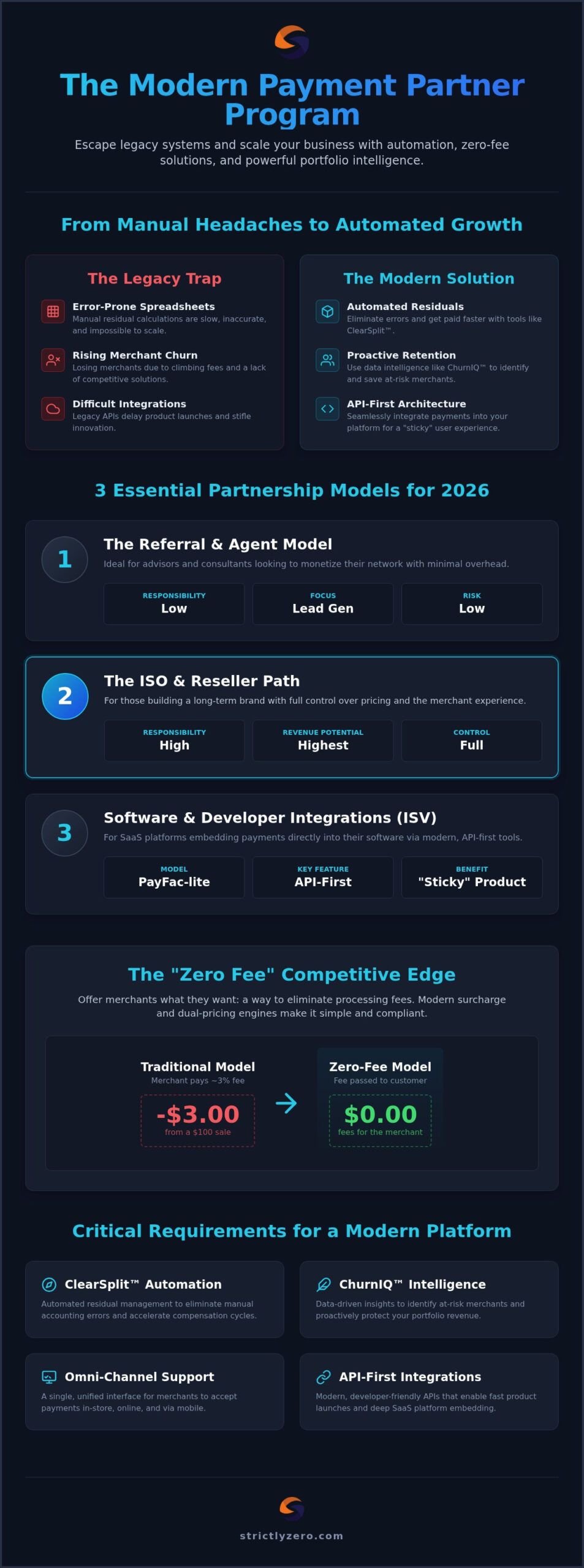
- 3 Essential Partnership Models for 2026
- The Competitive Edge: Surcharge and Dual Pricing for Partners
- How to Evaluate Your Next Payment Partner Program
- Scaling with Strictly: ClearSplit™ and ChurnIQ™
What Is a Payment Processor Partner Program?
A payment processor partner program is a strategic B2B relationship where a business aligns with a merchant services provider to offer payment solutions to its own client base. It’s no longer just a simple referral agreement where you pass a lead and collect a one-time check. In 2026, these programs have evolved into complex, integrated SaaS ecosystems. They provide the technical and financial infrastructure that allows ISOs, software developers, and consultants to act as a bridge between merchants and the global banking networks.
The evolution of these partnerships has moved away from basic processing toward comprehensive business management. Modern partners don’t just facilitate transactions; they provide a tech-forward platform that supports omni-channel capabilities. This means giving merchants the power to accept payments in-store, online, and via mobile through a single, unified interface. The processor takes on the burden of maintaining security standards and PCI DSS compliance, shielding the partner and the merchant from the heavy lifting of data protection and regulatory updates.
Success in 2026 requires a specific focus on “Zero Fee” models. These programs, which include surcharge and dual pricing engines, have become the primary tool for winning over merchants who are tired of losing their margins to processing costs. A high-quality payment processor partner program provides the automation needed to keep these programs compliant across different state jurisdictions, turning a complex legal requirement into a push-button sales advantage.
The Role of an ISO vs. an Agent
An Independent Sales Organization (ISO) is a registered entity that maintains a direct relationship with card brands and processors. ISOs often take on a higher level of responsibility, including parts of the underwriting process and risk management. Because they shoulder more liability, they typically command higher residual splits and have more control over their branding. Agents, on the other hand, usually operate under an ISO’s umbrella. They have a lower barrier to entry and less financial risk, making the agent model ideal for those who want to focus strictly on sales without the overhead of managing a full corporate structure.
Why Businesses Seek Payment Partnerships
The primary driver for seeking a partnership is the ability to monetize existing customer relationships. Instead of letting payment revenue flow to a third party, businesses can capture a percentage of every transaction through recurring residuals. For software providers, embedding these services creates a “sticky” product that is hard for merchants to leave. It transforms a simple tool into a one-stop-shop for merchant services. If you are searching for the ultimate payment processing platform for ISOs, the goal is to find a partner that offers the tools to automate this growth while protecting your portfolio from churn.
3 Essential Partnership Models for 2026
Choosing a payment processor partner program isn’t a one-size-fits-all decision. Your choice depends on how much control you want over the merchant experience and how much technical heavy lifting you can handle. In 2026, three primary models dominate the industry, each offering a different balance of revenue potential and operational responsibility.
The Referral and Agent Model
This model is perfect for business advisors and consultants who want to monetize their network without becoming a full-time payment expert. You focus on lead generation; the processor handles the rest. Residuals are often structured as a percentage of the margin or a flat fee per referral. Success here depends entirely on your partner’s close rate. If the processor’s sales team can’t convert your leads, your efforts go to waste. It’s a low-risk way to add a revenue stream without worrying about underwriting or technical support.
The ISO and Reseller Path
For those looking to build a long-term brand, the registered ISO model offers the highest residual potential. You get full brand ownership and can often white-label the technology; for example, Gemba provides the infrastructure for non-banks to launch their own branded financial services. This path requires more effort, as you’ll need to manage a sales team and navigate the registration process with card brands. However, the payoff is significant. You control the pricing strategy, allowing you to deploy a surcharge and dual pricing engine to win over cost-conscious merchants. Managing this level of complexity is much easier when you use a tech-forward payment processor partner program designed for scale.
Software and Developer Integrations
Integrated Software Vendors (ISVs) are shifting toward PayFac-lite models. This allows you to embed payments directly into your SaaS platform using API-first tools. By leveraging ecommerce payment processing for omni-channel SaaS, you create a seamless user experience where merchants never have to leave your app to manage their money. This model creates the highest stickiness for your software while providing a steady stream of passive income. If you’re ready to automate your portfolio management, you can explore the partner management tools at Strictly to see how they fit your software’s needs.
The Competitive Edge: Surcharge and Dual Pricing for Partners
In 2026, the most effective way to close a deal isn’t by shaving off a few basis points. It’s by eliminating the merchant’s processing bill entirely. A modern payment processor partner program should provide you with a robust surcharge and dual pricing engine. This technology allows you to offer “Zero Fee” processing, which has become the ultimate competitive advantage for ISOs. When merchants can pass the cost of acceptance to the consumer, they see an immediate boost to their bottom line, which makes your value proposition undeniable.
Selling the Zero-Fee Revolution
Pitching zero fee credit card processing requires a shift in the conversation. Skeptical merchants often worry about customer pushback or losing sales. However, data shows that consumers are increasingly accustomed to service fees in various industries. You can help merchants understand that they aren’t charging extra so much as they are offering a discount for cash payments. The math is simple: a merchant doing $100,000 a month in credit card sales could save roughly $3,000 every single month. That is $36,000 a year back into their business, which is a far more powerful message than a minor rate reduction.
Compliance as a Service
The biggest hurdle for ISOs in the past was the legal minefield of surcharging. By 2026, regulations have become even more localized, with different rules applying at the state level. You need a payment processor partner program that includes a smart pricing engine to handle this automatically. This technology detects whether a customer is using a debit or credit card in real-time. Since surcharging debit cards is a violation of federal law, the system must be smart enough to disable the surcharge for those transactions instantly.
Automating this compliance reduces the risk of heavy fines for your merchants and protects your reputation as a partner. When the platform handles the signage requirements and receipt disclosures, you spend less time acting as a legal consultant and more time scaling your portfolio. This level of automation directly impacts merchant retention. Merchants who see their processing costs vanish are far less likely to switch providers, ensuring your residuals remain stable for years to come.
How to Evaluate Your Next Payment Partner Program
Selecting a payment processor partner program isn’t a decision to take lightly. You’re choosing the infrastructure your business will rely on for years. To avoid the trap of generic promises, you need an objective evaluation framework for any payment processor partner program you consider. Start by analyzing the technology stack. Is it truly API-first? An omni-channel platform allows your merchants to sync sales across web, mobile, and physical locations. If the tech is fragmented, your support tickets will skyrocket and your merchants will look for simpler alternatives.
Residual Transparency and Payouts
Many partners discover too late that their “high” splits are eroded by hidden fees buried in the buy-rates. You should demand a clear breakdown of every cost associated with the account before signing. Real-time reporting is non-negotiable for growing ISOs; you shouldn’t have to wait until the end of the month to see how your portfolio is performing. Residual income in the context of credit card processing for small business is the recurring share of transaction fees earned by the partner for the lifetime of the merchant’s account. If the reporting is opaque, your revenue is at risk.
The Merchant Onboarding Experience
Nothing kills sales momentum faster than a slow underwriting process. In 2026, your merchants expect a digital application process that provides instant or near-instant approval. If your partner requires faxed documents or takes three days to review a file, you’ll lose deals to faster competitors. Frictionless onboarding isn’t just about the initial sign-up; it’s about the first 90 days. Ensure the processor provides tools to help merchants get their first transaction processed without a hitch.
Beyond the tech and the money, look at the support structure. Churn is the silent killer of residual portfolios. You need a partner that provides advanced analytics to predict when a merchant is about to leave. A dedicated partner manager who understands your specific niche can be the difference between a stagnant portfolio and a scaling empire. If you want to see what a modern management interface looks like, check out the partner management tools available today.
Scaling with Strictly: ClearSplit™ and ChurnIQ™
Scaling a portfolio in 2026 requires more than just a list of merchants. It requires a tech stack that works for you every hour of the day. Strictly has built a payment processor partner program that prioritizes the automation of back-office tasks, allowing you to focus on high-level strategy. By integrating specialized tools directly into the partner experience, we’ve eliminated the friction that usually slows down high-growth ISOs and software developers. It’s widely considered the ultimate payment processing platform for ISOs because it addresses the specific operational pains of the industry.
Automating Residuals with ClearSplit™
Managing complex payout structures shouldn’t involve endless spreadsheets or manual data entry. ClearSplit™ automates the entire compensation cycle, ensuring every residual split for partners and sales reps is calculated with precision. You can provide your sub-agents with their own transparent dashboards, giving them real-time visibility into their earnings. This transparency builds trust and keeps your sales team focused on closing new deals rather than auditing their last paycheck. Automated accuracy means you spend less time fixing errors and more time expanding your reach.
Predictive Retention with ChurnIQ™
Protecting your revenue is just as important as growing it. ChurnIQ™ uses AI-driven intelligence to analyze processing patterns across your entire portfolio. It identifies subtle shifts in merchant behavior, such as a sudden drop in transaction volume or a change in processing frequency, that might indicate they’re looking for a new provider. Instead of reacting to a cancellation notice after the fact, you can take proactive steps to save the account before the merchant leaves. This predictive approach is essential for maintaining a stable, low-churn portfolio in a competitive market where every merchant counts toward your valuation.
Join the Strictly Partner Ecosystem
Getting started is simple with our developer-friendly, API-first platform. Whether you’re an ISV looking for seamless integration or a registered ISO building a white-label brand, our ecosystem provides the support you need. You’ll gain access to professional marketing materials, sales support, and a dedicated partner manager to help you navigate the 2026 landscape. An omni-channel approach ensures your merchants can accept payments anywhere, which increases their longevity and your residual potential. Become a Strictly Partner and scale your payments business today to experience a payment processor partner program designed for the next generation of merchant services.
Future-Proof Your Portfolio for 2026
The payments landscape is shifting rapidly. To stay competitive, you can’t rely on legacy systems and manual processes that eat away at your margins. We’ve explored how transitioning to a modern payment processor partner program allows you to leverage automated tools like ClearSplit to handle complex residual splits without the spreadsheet headaches. By offering compliant zero-fee surcharge programs, you’re not just selling a service; you’re giving merchants their profit back. This creates a level of stickiness that traditional models simply can’t match. Additionally, many forward-thinking leaders find that exploring the future through literature, such as the sci-fi recommendations at Books of Brilliance, helps them stay ahead of the curve in their own industries.
Success in this industry comes down to the intelligence behind your data. Using tools like ChurnIQ to predict merchant behavior ensures you protect your hard-earned revenue before it walks out the door. It’s time to stop managing your business through rearview mirrors and start using a platform built for growth. Join the Strictly Partner Program and start scaling with ClearSplit™ and ChurnIQ™ today. You have the roadmap to scale; now it’s time to take the lead in the merchant services market.
Frequently Asked Questions
How much can I earn through a payment processor partner program?
Earnings depend on your processing volume and the specific residual split you negotiate. Most partners earn a percentage of the transaction margin for the life of each account. High-volume ISOs generate substantial recurring revenue by layering surcharge programs that protect their margins from rising interchange costs. Your total income grows as you add more merchants and increase your portfolio’s total processing volume.
What is the difference between a referral partner and an ISO?
A referral partner focuses on lead generation and typically has lower risk and lower payout potential. An Independent Sales Organization (ISO) is a registered entity that manages its own branding and sales team. ISOs take on more operational responsibility but command higher residual splits within a payment processor partner program. Choosing the right model depends on your technical resources and growth goals.
How does a surcharge program benefit me as a partner?
Surcharge programs allow you to offer merchants a “zero fee” solution, which is the most effective sales tool for 2026. By eliminating the merchant’s processing costs, you increase your close rates and improve long-term retention. These programs often result in higher residuals for you because the margin isn’t being squeezed by interchange fees or complex rate negotiations.
What tools do I need to manage my merchant portfolio in 2026?
You need an omni-channel dashboard that provides real-time transaction data and automated residual reporting. Modern partners also require predictive analytics to identify at-risk merchants and compliant pricing engines that handle state-specific regulations automatically. Fragmentation is the enemy of scale; you need a unified platform that manages everything from onboarding to payouts in one place.
Can I integrate my own software with a payment processor partner program?
Yes, you can use API-first platforms to embed payment processing directly into your SaaS or mobile app. This allows your users to process transactions without ever leaving your ecosystem. It creates a seamless user experience and turns your software into a high-margin revenue generator. Integrating payments through a professional payment processor partner program is the fastest way to monetize your existing user base.
How do I handle state-by-state compliance for my merchants?
You should choose a partner that offers a smart pricing engine to manage compliance automatically. These systems detect card types and location data in real-time to ensure surcharging only happens where and how it’s legal. This removes the legal liability from your shoulders and protects your merchants from costly regulatory fines. Automation is the only way to stay compliant across multiple jurisdictions.
What is ClearSplit™ and how does it help with residuals?
ClearSplit™ is an automated tool that manages complex residual splits between partners and their sales representatives. It eliminates the need for manual spreadsheets by calculating every payout instantly and accurately. This ensures that every sub-agent gets paid on time and has full transparency into their earnings. By removing manual data entry, you reduce errors and build a more loyal sales force.
How does ChurnIQ™ help reduce merchant churn?
ChurnIQ™ uses AI-driven intelligence to monitor processing patterns and flag merchants who show signs of leaving. It identifies volume drops or processing inactivity before a cancellation request actually occurs. This gives you the opportunity to reach out proactively with a retention offer. Preserving your existing residual income is much more cost-effective than constantly hunting for new accounts to replace lost revenue.