
Payment Processor Reliability and Uptime: Why 99.9% Isn’t Enough in 2026
Published:

If your payment processor boasts 99.9% uptime, they’re essentially telling you they’re comfortable with your business being dark for nearly nine hours every year. In 2026, those nine hours don’t usually happen on a quiet Tuesday at 3 AM. They hit during your highest-volume sales peaks, leading to abandoned carts and massive revenue leaks. For modern merchants, payment processor reliability and uptime isn’t just about a green status light on a dashboard. It’s about the surgical precision of your transaction logic. When your system lags, your automated surcharge and dual pricing engines can fail, leaving you with unexpected fees and compliance risks under mandatory PCI DSS v4.0.1 standards.
You’ve likely felt the sting of a system glitch right when a customer was ready to pay. It’s frustrating to watch hard-earned traffic disappear because of infrastructure you don’t control. This article provides a technical framework for vetting processors to ensure you achieve near-zero downtime even as you scale. You’ll learn how to protect your revenue, maintain strict compliance, and ensure your surcharge logic executes flawlessly every single time.
Key Takeaways
- Learn why the “Five Nines” (99.999%) standard is the new benchmark for modern commerce to prevent hours of annual revenue loss.
- Understand how to audit payment processor reliability and uptime by demanding 24 months of historical data rather than just current snapshots.
- Discover how high-availability architecture prevents compliance errors by ensuring surcharge engines identify card types with total accuracy.
- Explore the role of multi-region cloud hosting and API-first platforms in maintaining stable, omni-channel payment processing during traffic spikes.
- Gain a practical framework for vetting automated failover processes to protect your business from the logic failures that cause merchant fee leaks.
Table of Contents
- Understanding Payment Processor Reliability: Beyond the "Up or Down" Binary
- The Architecture of High Availability: How Modern Gateways Prevent Failures
- Reliability in Zero-Fee Models: When Surcharge Logic Cannot Fail
- How to Evaluate a Processor’s Reliability Before You Sign
- Why Strictly is the Most Reliable Foundation for Your Business
Understanding Payment Processor Reliability: Beyond the “Up or Down” Binary
Most business owners view uptime as a binary state: it’s either green or red. If the website loads, they assume payments are working. However, true payment processor reliability and uptime is far more complex than a simple server ping. A payment processor acts as the critical bridge between the merchant’s gateway, the processing network, and the acquiring bank. This chain requires every participant to be perfectly synchronized. If the gateway is active but the processor’s connection to the acquiring bank is sluggish, your customers will see a spinning wheel instead of a confirmation page. Reliability is the measure of how consistently these parties communicate under heavy transaction loads.
To better understand how these systems interact and why reliability varies, watch this helpful breakdown:
The Difference Between Infrastructure and Transaction Success
Your infrastructure might be “up,” but if the API response time exceeds three seconds, your checkout is effectively down. High latency is a silent killer of conversion rates. Customers in 2026 expect instant gratification; they’re used to systems like SEPA Instant Payments that settle within seconds. When reading a status page, you should look for “Transaction Success Rate” instead of “System Availability.” A system that’s technically online but rejecting 5% of valid cards due to lag is a system that’s failing your business. You need to know that every part of the chain is functioning at peak performance, even during high-traffic surges.
Measuring the True Cost of 0.1% Downtime
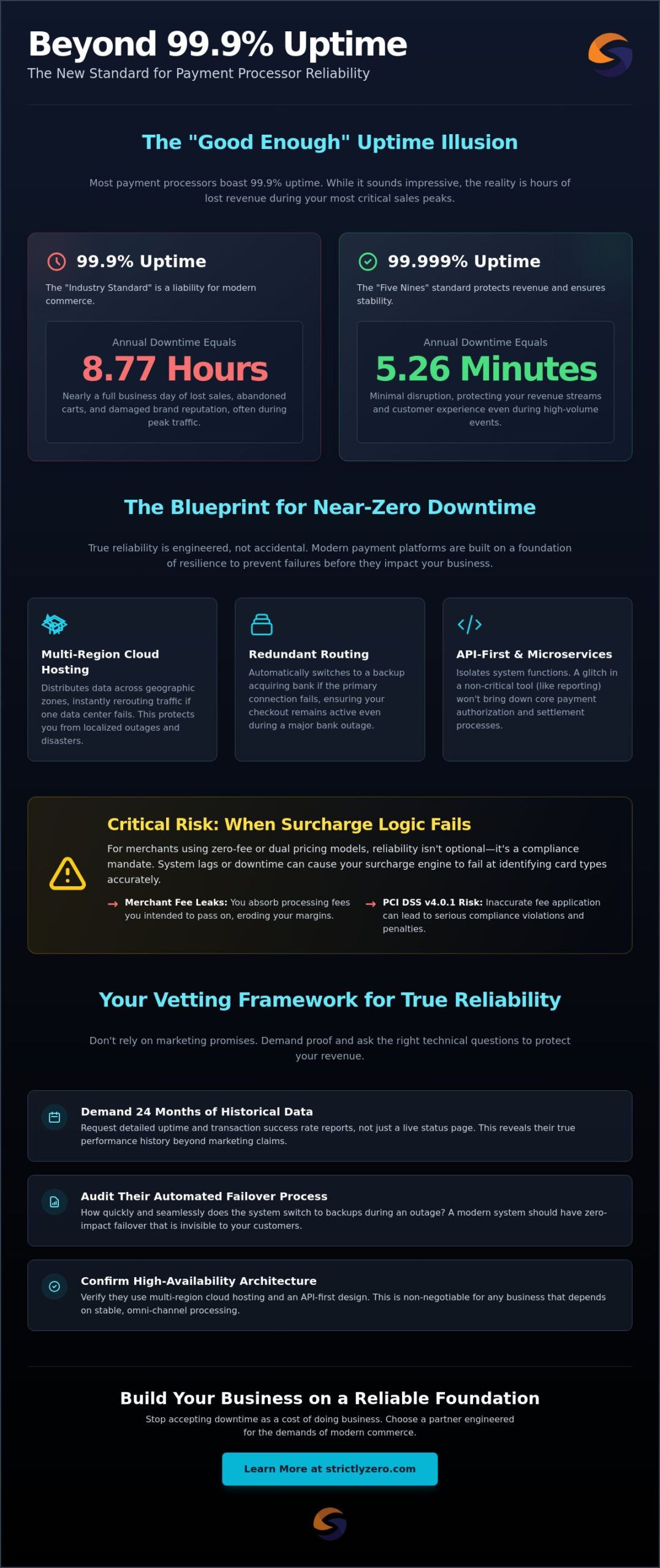
Uptime is the ability to process, authorize, and settle payments without interruption. While 99.9% sounds impressive, it allows for nearly nine hours of lost sales every year. If those hours happen during a holiday rush or a major promotion, the cost isn’t just the immediate transaction. It’s the permanent damage to your brand reputation and the loss of customer lifetime value. In contrast, the “Five Nines” standard (99.999%) limits downtime to just over five minutes per year. It’s also vital to distinguish between scheduled maintenance and unplanned outages. Reliable partners perform updates during low-traffic windows and provide transparent, real-time communication. Relying on a processor that treats 99.9% as “good enough” means you’re accepting a significant risk to your annual revenue.
The Architecture of High Availability: How Modern Gateways Prevent Failures
Achieving elite levels of payment processor reliability and uptime isn’t an accident of luck; it’s a result of intentional engineering. Legacy payment systems often rely on monolithic architectures where a single bug in one department can bring down the entire transaction flow. Modern providers have moved toward microservices and API-first designs that isolate specific functions. This structural shift ensures that if a non-critical service, like a reporting tool, experiences a glitch, the core ability to authorize and settle payments remains untouched. This level of Operational Resilience in Digital Payments is what separates a standard vendor from a true enterprise partner.
High availability also depends on multi-region cloud hosting. By distributing data across multiple geographic zones, processors protect your business from localized infrastructure failures or natural disasters. If one data center goes dark, traffic is instantly rerouted to another. This is paired with redundant routing, where the system can automatically switch to a backup acquiring bank if the primary connection fails. For merchants, this means your checkout stays active even when a major financial institution faces an outage. If you want to build your business on a stable, modern framework, choosing an omni-channel payment processing partner is the first step toward eliminating these technical bottlenecks.
API-First Design and Reducing Technical Debt
An API-first platform allows for cleaner integrations and less technical debt over time. When a processor uses a modern API, your developers don’t have to build complex workarounds for outdated protocols. These robust APIs often include built-in fail-safes, such as automatic retries for timed-out requests. By isolating different parts of the payment process into microservices, the system prevents cascading failures. It’s the difference between a house of cards and a modular building; taking out one piece doesn’t collapse the entire structure.
Real-Time Fraud Prevention and System Performance
Reliability also involves the speed of security checks. AI-driven fraud prevention must analyze hundreds of data points in milliseconds. If these filters are slow, they become a bottleneck that mimics a system outage for the customer. High-performance gateways ensure that security scrutiny doesn’t sacrifice transaction speed. In 2026, your fraud engine should be invisible to the user, providing total protection without adding enough latency to trigger a cart abandonment. Reliability means the system is fast enough to keep the line moving while keeping the bad actors out.
Reliability in Zero-Fee Models: When Surcharge Logic Cannot Fail
For most businesses, a brief lapse in connectivity is a nuisance. For merchants using a zero-fee model, a millisecond of lag in transaction logic is a financial and legal liability. When we discuss payment processor reliability and uptime in 2026, we aren’t just talking about whether the gateway is reachable. We’re talking about the surgical execution of surcharge and dual pricing rules. If your processor stays online but fails to correctly identify a card type due to system stress, you face “slippage.” This happens when a credit card is processed without the fee being passed on, forcing the merchant to eat the cost. Even worse, misidentifying a debit card as a credit card and applying a surcharge can lead to immediate compliance violations and heavy fines.
The technical demands of modern resiliency are evolving. As the Federal Reserve highlights in their research on Offline Payments: Implications for Reliability and Resiliency, the ability to maintain logic integrity during network instability is critical. A truly reliable zero fee credit card processing platform doesn’t just stay “up.” It ensures that its automated compliance engine is functioning at 100% capacity regardless of traffic volume. This protects your margins by ensuring you never pay a fee you’ve planned to offset.
The Smart Pricing Engine: Reliability Meets Compliance
Strictly’s Smart Pricing Engine is designed to handle automated debit detection with zero latency. In a high-uptime environment, the system must check the Bank Identification Number (BIN) of every card in real-time. If this logic is “mostly reliable” rather than perfectly reliable, you’re rolling the dice on your state-by-state compliance. Different states have varying laws regarding surcharging, and your processor’s logic must adapt instantly to the customer’s location. A laggy system might default to a generic setting, leaving you exposed to legal risks. True reliability means your surcharge logic is as robust as your server hardware.
Dual Pricing Stability for Omni-Channel Merchants
Maintaining consistency across different sales channels is a major technical hurdle. Your ecommerce payment processing must stay perfectly synced with your physical terminals to ensure a unified customer experience. If your online store shows a dual-pricing discount that your in-person POS fails to recognize due to a sync error, you’ll face customer frustration and cart abandonment. Strictly ensures your pricing data remains stable across our unified platform. This level of synchronization prevents the “logic drift” that often plagues less sophisticated processors during peak scaling hours.
How to Evaluate a Processor’s Reliability Before You Sign
Selecting a partner based on a marketing brochure is a common mistake that leads to expensive outages. When you’re vetting a provider, you need to look past the “99.9%” claim and demand hard data. In 2026, a truly robust partner should provide historical payment processor reliability and uptime logs for at least the last 24 months. This window is critical because it shows how the system handled major industry shifts, such as the ISO 20022 migration and the full implementation of PCI DSS v4.0.1. If a processor is hesitant to share these logs, it’s a red flag that their infrastructure might not be as resilient as they claim.
You also need to understand the specifics of their failover process. If a primary server goes down, does the system switch to a backup automatically, or does it require manual intervention? Manual failover is a recipe for extended downtime. Additionally, verify their certifications. A reliable processor must maintain PCI DSS Level 1 and SOC 2 Type II status. These aren’t just badges; they’re proof that the company undergoes rigorous, third-party audits of their security and operational stability. If you want to avoid the pitfalls of legacy systems, you should partner with a processor that values transparency and technical excellence.
Monitoring Tools and Transparency
Partner-Specific Reliability: ISOs and MSPs
For ISOs and MSPs, reliability isn’t just about a single merchant; it’s about protecting an entire portfolio. You need a dedicated payment processing platform for ISOs that ensures your agents and merchants stay online during high-volume events. Reliability also extends to your back-office tools. Even during technical shifts, automated residual reporting via ClearSplit™ must remain accurate and punctual. If merchants are leaving your portfolio, ChurnIQ™ can help you determine if those departures are linked to payment processor reliability and uptime issues, allowing you to address the root cause before it spreads.
Why Strictly is the Most Reliable Foundation for Your Business
Choosing a partner for your financial infrastructure isn’t just about finding a vendor; it’s about building a foundation that won’t crack under pressure. Strictly delivers payment processor reliability and uptime by offering a truly unified, omni-channel platform. Many competitors rely on a patchwork of third-party integrations that create “integration friction” and multiple points of failure. By consolidating your processing into a single, cohesive system, we eliminate the technical gaps that lead to transaction timeouts and lost revenue. Our API-first architecture means your developers can build with total confidence, knowing the underlying logic is stable and responsive.
The core of our reliability is the Smart Pricing Engine. This system provides 100% compliant, reliable surcharging by executing complex card-detection logic in real-time. We don’t just stay online; we ensure every transaction is handled with the precision required to protect your margins. This technical excellence is backed by the human element. Our expert support team understands the nuances of your business and is available 24/7 to ensure your operations never miss a beat. We believe that trust is earned through performance, not just promises.
Trust as a Core Offering
Strictly treats reliability as a product feature, not just a technical requirement. By operating a unified system, we significantly reduce the number of “middlemen” involved in your transaction flow. This streamlined approach minimizes the chance of a third-party outage affecting your ability to accept payments. Additionally, our AI-driven fraud prevention works in perfect sync with the processing engine. Instead of acting as a bottleneck, our security layers are optimized for speed, ensuring that high-scrutiny checks don’t compromise your overall system uptime.
Scaling with Certainty
Whether you’re an individual merchant or a large ISO managing a diverse portfolio, our infrastructure is built to grow alongside you. You don’t have to worry about outgrowing your processor or dealing with the “logic drift” that occurs when scaling legacy systems. Having a single partner for your virtual terminal, invoicing, and POS lending simplifies your back-office and strengthens your operational resilience. You can focus on expansion while we handle the technical heavy lifting. Partner with Strictly to build a payments business on a foundation of absolute reliability.
Secure Your Revenue with a Future-Proof Payment Strategy
In 2026, the cost of a single hour of downtime is too high for any growing business to ignore. You’ve seen that true payment processor reliability and uptime goes beyond a simple status page; it requires a sophisticated architecture that protects your surcharge logic and ensures every transaction completes with surgical precision. By demanding historical transparency and automated failover processes, you take control of your financial future and eliminate the “slippage” that drains your margins.
Strictly provides the infrastructure you need to scale without fear. Our API-first omni-channel platform, powered by the Smart Pricing Engine for automated compliance and ClearSplit™ for reliable partner residuals, is built for the demands of modern commerce. Don’t let legacy limitations hold your revenue hostage. Switch to a more reliable payment processor today and build your brand on a foundation that never blinks. Your customers, and your bottom line, will thank you for the consistency.
Frequently Asked Questions
What is a good uptime percentage for a payment processor?
A good uptime percentage is 99.999%, commonly known as “Five Nines.” While 99.9% sounds acceptable, it can result in nearly nine hours of lost sales every year. In contrast, the Five Nines standard limits annual downtime to roughly five minutes. This level of performance is critical for merchants who can’t afford to go dark during high-stakes holiday peaks or major product launches.
How does payment processor downtime affect my PCI compliance?
Downtime doesn’t instantly revoke your certification, but it can compromise the continuous security monitoring required by PCI DSS v4.0.1. If your system is offline, it might miss critical logging events or fail to transmit security evidence to your compliance dashboard. Maintaining high payment processor reliability and uptime ensures your security protocols remain active 24/7, keeping your merchant account in good standing without manual intervention.
Can a payment processor handle sudden spikes in holiday traffic?
Yes, a modern processor handles traffic spikes by using auto-scaling cloud architecture and sophisticated load balancing. These systems detect a surge in transaction requests and immediately deploy extra server capacity to maintain speed. Without these tools, your system might experience “logic lag,” where the gateway is online but too slow to complete authorizations. This leads to customer frustration and high cart abandonment rates during your busiest hours.
What happens to my customer data if the payment gateway goes down?
Customer data remains secure during an outage because modern systems use tokenization to replace sensitive card numbers with encrypted identifiers. If the gateway fails, the transaction simply won’t authorize, but the data isn’t left vulnerable to theft. The primary risk isn’t a data breach; it’s the immediate loss of the sale. You’ll need to wait for the system to recover before you can successfully capture and settle the customer’s payment.
Is there a difference between gateway uptime and processor uptime?
There’s a significant difference between the gateway that captures data and the processor that moves the money. The gateway is the entry point, while the processor is the engine connecting to the banking networks. A gateway might be online and accepting data, but if the back-end processor is down, no money actually changes hands. Achieving true payment processor reliability and uptime requires both systems to be perfectly synchronized without any latency.
How does Strictly ensure my surcharge fees are always calculated correctly?
Strictly uses a proprietary Smart Pricing Engine that performs real-time Bank Identification Number (BIN) lookups for every transaction. This engine identifies if a card is debit or credit in milliseconds, applying the correct surcharge or dual pricing logic automatically. By building this logic into our high-availability infrastructure, we ensure your business stays compliant with state laws even when your transaction volume scales rapidly during peak sales hours.
What should I do if my current payment processor is frequently offline?
You should start by documenting every instance of downtime and requesting a 24-month historical uptime report from your provider. If they can’t offer an automated failover process or explain why their infrastructure is failing, it’s time to migrate to a more resilient partner. Frequent outages often indicate that a processor is running on legacy code that isn’t equipped to handle the demands of modern, omni-channel commerce.
How do I check the real-time status of my payment processing platform?
You can check the real-time status of your platform by visiting the processor’s public status page, which should list API and gateway performance. For a more proactive approach, your developers can use webhooks to receive instant alerts if latency increases or a service goes offline. This transparency allows you to stay informed and pivot your operations before an outage impacts your customers or your total daily revenue.