
Payment Processor Security Standards: The 2026 Merchant Compliance Guide
Published:

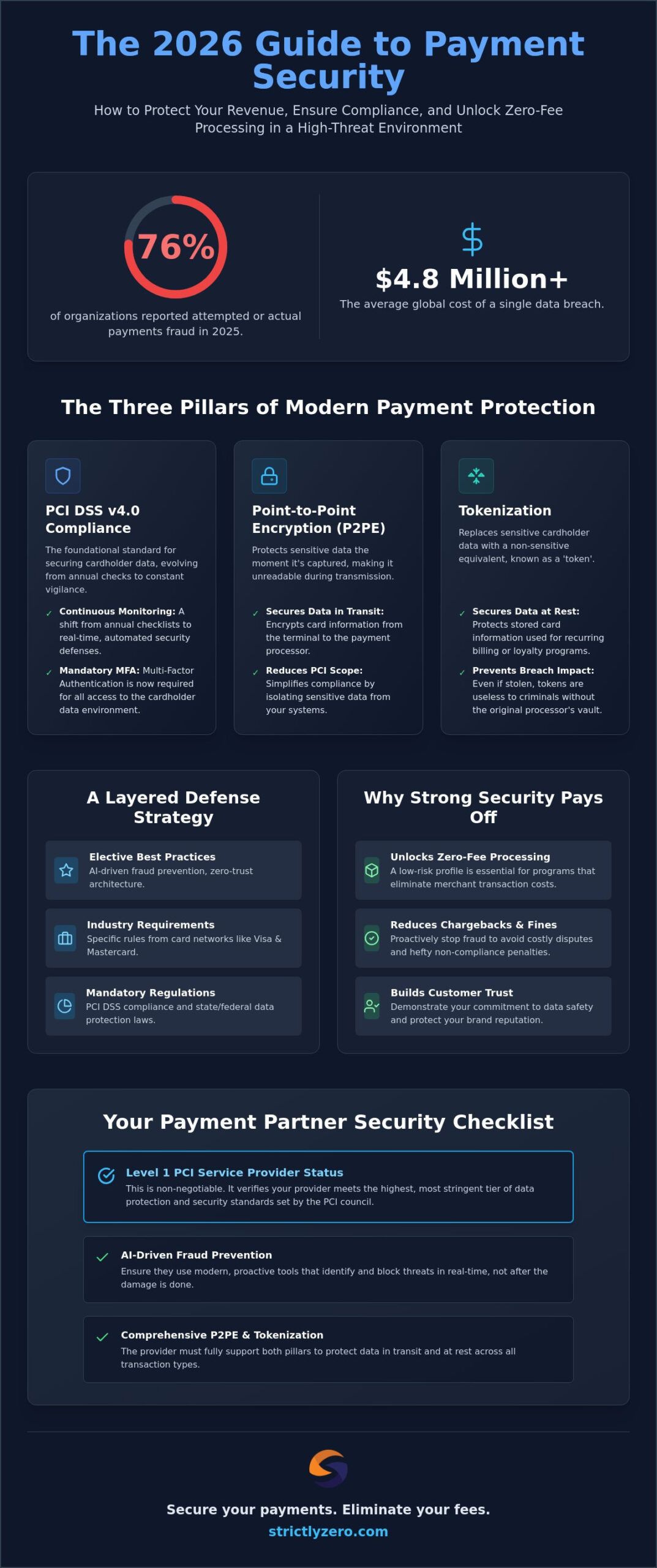
76% of organizations reported experiencing attempted or actual payments fraud in 2025, a sobering reminder that yesterday’s defenses aren’t enough for today’s sophisticated threats. As you look toward your 2026 goals, staying ahead of the latest payment processor security standards is no longer just a checkbox for your IT team; it’s a fundamental requirement for business survival. Between the mandatory shift to PCI DSS v4.0 and the rising costs of chargebacks, it’s easy to feel overwhelmed by the technical complexity of modern compliance.
You shouldn’t have to spend your nights worrying about heavy fines or shifting regulations. This guide will help you master the essential security technologies that protect your revenue and unlock the door to cost-saving models like zero-fee processing. We’ll explore the mandatory standards for 2026 and show you how AI-driven fraud prevention can simplify your compliance journey while lowering your risk profile. By the end of this guide, you’ll know exactly how to choose a partner that handles the heavy lifting so you can focus on growing your business.
Key Takeaways
- Understand the shift from annual checklists to continuous monitoring and mandatory multi-factor authentication under the latest PCI DSS v4.0 requirements.
- Learn how modern payment processor security standards like point-to-point encryption and tokenization work together to keep sensitive cardholder data unreadable.
- Discover the direct link between robust security protocols and the viability of zero-fee processing programs that help eliminate merchant transaction costs.
- Explore how AI-driven fraud prevention proactively identifies threats in real-time, reducing the risk of chargebacks and protecting your revenue.
- Identify the critical criteria for evaluating your provider, including verifying Level 1 PCI Service Provider status to ensure the highest tier of data protection.
Table of Contents
- What Are Payment Processor Security Standards?
- The Big Three: PCI DSS, Encryption, and Tokenization
- Why High Security Standards are Essential for Zero-Fee Processing
- Evaluating Your Provider: A Security Standards Checklist
- Strictly: Secure, Omni-Channel, and Fee-Free
What Are Payment Processor Security Standards?
Payment processor security standards are the technical and operational protocols designed to protect sensitive cardholder data as it moves through the payment ecosystem. In 2026, these standards have evolved from simple firewall checklists into complex, integrated systems that secure data during both transmission and storage. Central to this framework is the Payment Card Industry Data Security Standard (PCI DSS), which provides the baseline requirements for any merchant accepting credit cards.
The PCI Security Standards Council (PCI SSC) remains the primary governing body responsible for these rules. Since the full compliance deadline for PCI DSS v4.0 passed on March 31, 2025, the council has shifted its focus toward continuous security. This means your business is now expected to maintain real-time monitoring and automated defenses rather than just passing a single annual audit. It’s a proactive approach that treats security as a living part of your business operations.
To better understand how these security layers interact with your payment flow, watch this helpful video:
Adhering to these rules isn’t just about avoiding a slap on the wrist. Industry reports suggest the average cost of a data breach has climbed past $4.8 million globally. For small and mid-sized merchants, a single event can be terminal. Beyond the immediate cash drain, these standards act as the foundation of customer trust. If a shopper feels their data is at risk, they’ll abandon their cart and never return. Security follows a clear hierarchy:
- Mandatory Regulations: PCI DSS compliance and state-level data protection laws.
- Industry Requirements: Specific card network rules from Visa and Mastercard.
- Elective Best Practices: Advanced AI-driven fraud prevention and zero-trust architecture.
The Consequences of Ignoring Security Standards
Ignoring these protocols triggers a cascade of financial pain. Card brands impose monthly non-compliance fines that can reach five or six figures depending on your transaction volume. Perhaps more damaging is the hidden cost of high chargeback ratios. If your processor flags you as a high-risk merchant due to poor security, you’ll face higher processing fees and potential account termination. This makes cost-saving models like zero-fee processing nearly impossible to maintain, as those programs rely on a low-risk profile.
Regulatory vs. Industry Standards
Understanding how payment processor security standards intersect with legal frameworks is essential for any modern business. While PCI DSS is a private industry mandate, government regulations like GDPR and various state-level privacy laws introduce legal obligations for data handling. In 2026, the trend has moved toward proactive security. Instead of reacting to a breach after it happens, modern standards require merchants to use tools that identify vulnerabilities before they’re exploited. This shift protects your bottom line and ensures you remain compliant across both industry and legal jurisdictions.
The Big Three: PCI DSS, Encryption, and Tokenization
The core of modern payment processor security standards rests on a powerful triad: PCI DSS v4.x, Point-to-Point Encryption (P2PE), and tokenization. In 2026, these aren’t just technical suggestions; they’re the pillars that keep your business from becoming a fraud statistic. While version 4.0 was once the “new” thing, we’ve now entered an era where the PCI Security Standards Council demands much more than an annual check-in. The focus has shifted toward verified, real-time protection.
Multi-factor authentication (MFA) is now mandatory for anyone accessing the cardholder data environment. This isn’t just for your IT staff; it’s for every user who touches the system. Automated monitoring has also become standard, replacing manual logs with systems that flag suspicious activity the moment it happens. This shift toward “always-on” security is what separates secure processors from those lagging behind. Adding 3D Secure (3DS) 2.0 into the mix provides frictionless customer authentication, using data-rich exchanges to verify identities without slowing down the checkout process.
P2PE ensures that sensitive data is unreadable from the exact moment a customer swipes or taps their card until it reaches the secure authorization server. This prevents “man-in-the-middle” attacks where hackers try to intercept data as it travels across networks. Tokenization takes this a step further by replacing actual card numbers with unique digital identifiers. Since these tokens have no value to thieves, you eliminate the risk of storing “data at rest” on your servers. Experts project that tokenization will handle over 1 trillion transactions by the end of 2026, highlighting its role as a global safety standard.
PCI DSS v4.x Compliance for Small Businesses
Compliance doesn’t have to be a full-time job. For most small businesses, the Self-Assessment Questionnaire (SAQ) is the primary tool used to report your security status to the card brands. While this used to be a point-in-time assessment, the latest standards require continuous security practices. Modern processors now use hosted payment pages and advanced integrations that can reduce your compliance burden by up to 90%. By keeping sensitive data off your local network, you significantly shrink your “PCI scope.”
Encryption vs. Tokenization: Which Protects You Better?
It isn’t a matter of choosing one over the other; you need both. Encryption is your primary defense for data in transit across ecommerce payment processing channels. It creates a secure tunnel for the data to travel. Tokenization, however, is the champion for data at rest. It’s especially vital for recurring billing and “one-click” checkouts where you need to recognize a returning customer without actually storing their credit card number. A multi-layered approach is non-negotiable in 2026 to stay ahead of AI-driven fraud. If you want to simplify this process, you can partner with an omni-channel processor that integrates these technologies natively.
Why High Security Standards are Essential for Zero-Fee Processing
Many business owners view security as a defensive cost, but in 2026, it’s the engine that powers your most aggressive cost-saving strategies. The success of a zero fee credit card processing program depends entirely on your merchant risk profile. If your fraud rates are high, processors will either charge higher markups or require massive cash reserves. High payment processor security standards act as a filter, ensuring only legitimate transactions enter your system and keeping your risk profile low enough to sustain a fee-free model.
AI-driven fraud prevention is the secret weapon for merchants using surcharge models. These systems analyze thousands of data points in milliseconds to spot suspicious patterns before the transaction is even authorized. This proactive approach is vital for “Smart Pricing” tools. These tools must instantly and securely distinguish between debit and credit cards, as surcharging debit cards is prohibited. Without robust security protocols to handle BIN-level data safely, your surcharge engine could inadvertently trigger compliance violations or slow down your checkout line.
Reducing Chargebacks to Protect Your Margins
Secure processors can offer more favorable surcharge programs because they’ve mastered risk mitigation. When you use tokenization, you’re not just protecting data; you’re preventing “friendly fraud” in subscription and recurring billing models. By using secure authentication, you provide a clear digital trail that makes it much harder for customers to claim a transaction was unauthorized. This stability protects your merchant account from being flagged, ensuring your zero-fee program remains active and profitable over the long term.
Automated Compliance in Surcharge Programs
Strictly’s platform is designed to handle the logistical nightmare of state-by-state surcharge rules through secure automation. These laws vary significantly and change often. A secure Surcharge & Dual Pricing Engine ensures that your business automatically applies the correct fee based on the customer’s location and card type. This doesn’t just keep you compliant with payment processor security standards; it also ensures your dual pricing display meets strict transparency requirements. By merging payment security with consumer protection automation, you protect your brand from both hackers and regulatory scrutiny.
Evaluating Your Provider: A Security Standards Checklist
Choosing a partner to handle your transactions is the most critical security decision you’ll make. It isn’t enough for a provider to claim they’re secure; you need to verify their adherence to the highest payment processor security standards. Start by confirming they hold Level 1 PCI Service Provider status. This is the most rigorous tier of certification, requiring annual third-party audits and sophisticated network scans. If a provider can’t produce this documentation, they shouldn’t be handling your customers’ sensitive data.
Beyond basic certification, look for the depth of their AI-driven fraud prevention. In 2026, simple rule-based systems that block transactions based on zip codes are no longer effective. You need a processor that uses machine learning to analyze behavioral patterns in real-time. This includes checking for data residency compliance to ensure your business follows local privacy regulations, especially if you operate across state lines or international borders. Your developer API should also be “security-first,” featuring robust documentation, webhook signing, and scoped access keys to prevent unauthorized data exposure.
The Omni-Channel Security Audit
Security gaps often appear when businesses use different systems for different sales channels. Your credit card processing for small business POS should share the same encryption and tokenization standards as your mobile app and virtual terminal. Unified reporting is essential here. If you can’t see fraud patterns across all channels in a single dashboard, you’ll likely miss emerging threats. When you’re searching for the best credit card processing for small business, prioritize solutions that offer a single, secure token for a customer regardless of where they shop.
Partner and ISO Security Considerations
If you’re an enterprise or an ISO, the security of your partner management tools is just as vital as the payment gateway itself. Tools like ClearSplit™ must be vetted for how they handle sensitive partner data and commission structures. High-level security also means following strict KYC (Know Your Customer) and AML (Anti-Money Laundering) protocols during sub-merchant onboarding. Advanced risk tools like ChurnIQ™ play a defensive role by identifying high-risk merchant behavior early, allowing you to intervene before a security lapse becomes a financial disaster. To see how these layers work together in a single ecosystem, evaluate your security needs with Strictly and discover the power of integrated protection.
Strictly: Secure, Omni-Channel, and Fee-Free
Strictly doesn’t just meet the industry’s baseline; we set a new benchmark for how payment processor security standards should protect a modern business. As a Level 1 PCI Service Provider, we maintain the highest tier of certification available. This means our systems undergo rigorous, ongoing audits to ensure every byte of cardholder data is shielded by the most advanced protocols. We believe that security shouldn’t be a barrier to growth, which is why we’ve integrated these protections directly into our core infrastructure.
Our AI-driven fraud prevention acts as a proactive guardian for your revenue. Instead of simply reacting to chargebacks after they happen, our system analyzes behavioral patterns in real-time to stop suspicious transactions at the gate. This level of protection follows your business across every channel. Whether you’re processing a sale through our Virtual Terminal & Invoicing or managing a complex retail environment with our Omni-Channel Payment Processing, you get a unified security experience. You won’t have to worry about the security gaps that often plague merchants who piece together different systems from multiple providers.
A Security-First Approach to Zero-Fee Processing
The biggest challenge for merchants in 2026 is balancing the need for cost reduction with the necessity of data integrity. We’ve solved this through our Surcharge & Dual Pricing Engine. This system is powered by our Smart Pricing Engine, which instantly identifies card types and applies the correct pricing model while keeping all sensitive data encrypted and tokenized. This technology allows us to eliminate your processing fees entirely without compromising the safety of your customers’ information. It’s this commitment to secure, compliant automation that makes Strictly the trusted choice for ISOs and high-growth merchants who need a partner that can scale alongside them.
Ready to Secure Your Revenue?
Transitioning to a more secure and cost-effective payment model is simpler than you might think. Our team handles the heavy lifting of integration, ensuring that your switch to our platform is seamless and your compliance is handled from day one. You can finally stop choosing between high fees and high security. Elite security meets $0 processing fees. Get started with Strictly today and experience a platform where your bottom line is as protected as your data.
Future-Proof Your Revenue with Elite Payment Security
The 2026 landscape demands more than just basic compliance; it requires a proactive stance where security and profitability work in tandem. By mastering the latest payment processor security standards, you’ve taken the first step toward shielding your business from the rising tide of fraud. You now understand that technologies like tokenization and real-time AI monitoring aren’t just technical hurdles. They’re the essential tools that allow you to eliminate processing costs while maintaining total data integrity.
Don’t let the complexity of shifting regulations slow your growth. You deserve a partner that handles the technical heavy lifting so you can focus on your customers. With a Level 1 PCI DSS Certified infrastructure and AI-Driven Fraud Prevention built-in, Strictly provides the peace of mind you need to scale. Our compliant state-by-state surcharge engine ensures you stay on the right side of the law while keeping your margins high.
It’s time to stop paying for security and start letting your security pay for itself. Eliminate Your Processing Fees with the Industry’s Most Secure Platform and join the revolution of zero-fee processing today. Your business is ready for the future. We’re here to help you secure it.
Frequently Asked Questions
Is PCI compliance mandatory for every business?
Yes, PCI compliance is mandatory for every business that processes, stores, or transmits cardholder data, regardless of your annual transaction volume. If you accept major credit cards like Visa or Mastercard, you must adhere to the current PCI DSS v4.0 standards. Failing to comply can lead to significant monthly fines from card networks and the potential loss of your ability to process payments entirely, which can be devastating for any small business.
How does tokenization differ from encryption in 2026?
Encryption and tokenization are complementary technologies that serve different roles in your security stack. Encryption uses a mathematical algorithm to scramble data while it’s in transit across networks, making it unreadable without a key. Tokenization, however, replaces sensitive data with a non-sensitive digital identifier called a token. Since tokens have no value to hackers if stolen, they’re the preferred method for securing data at rest in 2026, especially for recurring billing.
Can a secure payment processor really eliminate my transaction fees?
Yes, a processor can eliminate your transaction fees by using a secure surcharge or dual pricing engine. These platforms automatically identify eligible credit card transactions and pass the processing cost to the consumer at the point of sale. To do this safely, your provider must maintain high payment processor security standards to ensure the surcharge is calculated accurately and the card data remains protected throughout the entire transaction lifecycle.
What is the most common cause of payment security breaches?
Compromised credentials and human error remain the leading causes of security breaches in the payment industry. This is exactly why the latest PCI DSS v4.0 requirements now mandate multi-factor authentication for all personnel accessing the cardholder data environment. Without robust access controls, even the strongest encryption can’t protect your business if an attacker gains entry through a phished password or an unsecured employee account on your local network.
How often do I need to renew my PCI DSS certification?
You must validate your PCI DSS compliance at least once every 12 months, though the shift toward version 4.0 has turned this into a continuous security process. Depending on your merchant level, you’ll either complete a Self-Assessment Questionnaire or undergo an on-site audit by a Qualified Security Assessor. Many modern processors now offer tools that monitor your environment daily to ensure you don’t fall out of compliance between your annual reports.
What should I do if I suspect a data breach?
If you suspect a breach, your first step is to isolate compromised systems to prevent further data loss without deleting any forensic evidence. You’re legally required to notify your payment processor and local authorities immediately according to your state’s data breach notification laws. Following your written incident response plan is critical to limit your liability and begin the recovery process while maintaining your payment processor security standards during the investigation.
Does using a virtual terminal require different security standards?
The core security standards remain the same, but the way you implement them changes when using a virtual terminal. Because you’re entering card data manually into a web browser, you must ensure the computer you’re using is secured and that the terminal itself is hosted by a Level 1 PCI-certified provider. This setup helps keep your local network out of scope for many of the most complex and expensive PCI requirements.
Are surcharge programs legal and secure in all 50 states?
Surcharge programs are legal in the vast majority of states, though specific regulations vary in places like Connecticut and Massachusetts. To stay secure and compliant, you must use an automated engine that detects the card type and customer’s location in real-time. This ensures you only surcharge credit cards, as surcharging debit cards is prohibited nationwide. A secure platform handles these complex rules automatically to protect you from legal risks and consumer complaints.