
PCI DSS News Today: 2026 Compliance Updates and Security Trends for Merchants
Published:

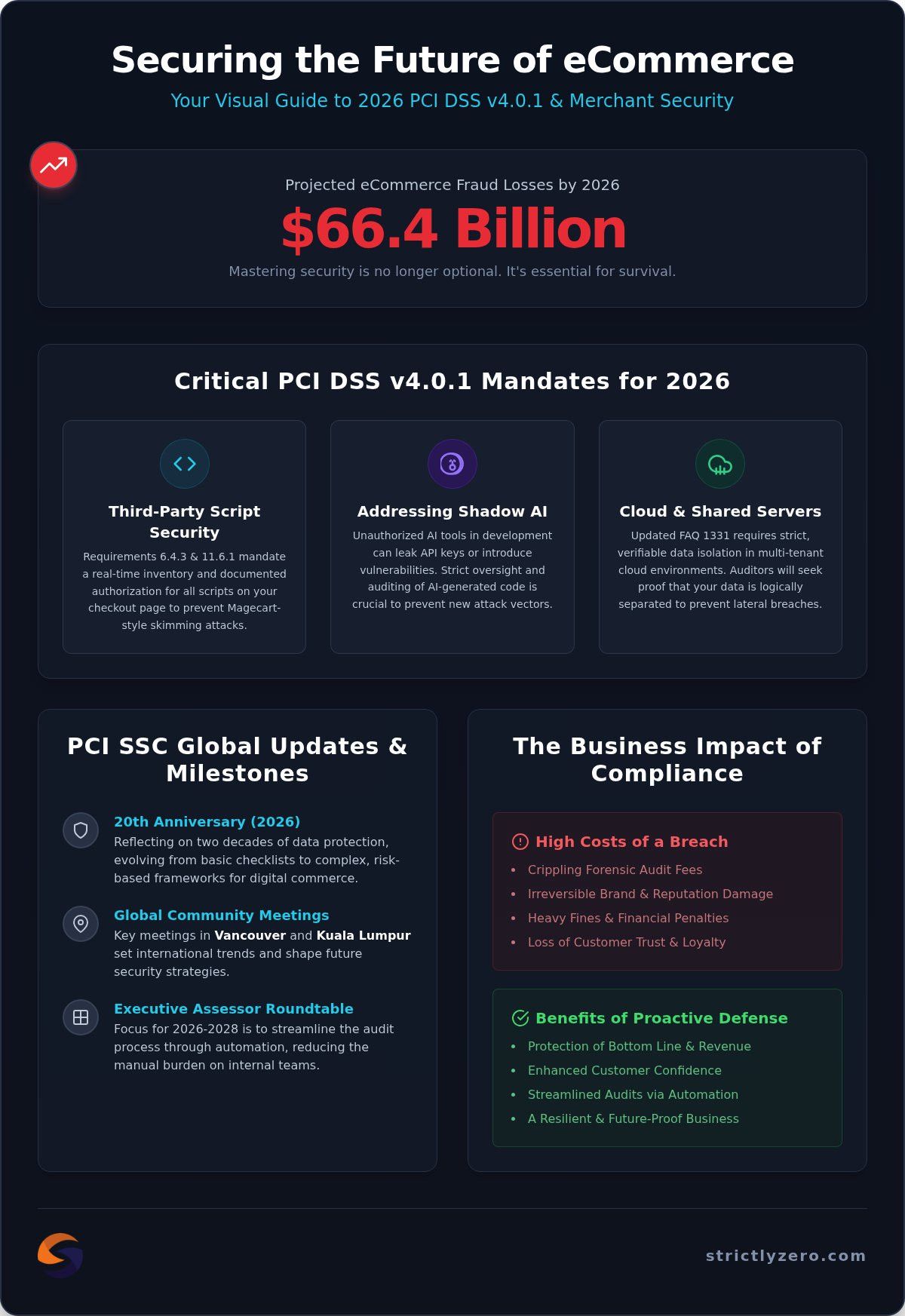
With eCommerce fraud projected to drain $66.4 billion from merchants in 2026, mastering merchant account security best practices is no longer optional. You’re likely feeling the pressure of PCI DSS v4.0.1 requirements, especially as the threat of checkout page skimmers and AI-driven identity theft grows more sophisticated. It’s exhausting to keep up with manual audits while trying to protect your bottom line from these rising risks.
We understand that compliance often feels like a moving target that demands too much time and money. This guide simplifies the latest 2026 PCI DSS announcements and provides actionable steps to keep your data safe and your costs low. We’ll explore the key takeaways from the 2026 Global Community Meetings in Vancouver and Kuala Lumpur, specific methods to secure your checkout scripts against modern attacks, and how to build a compliance strategy that supports a high-efficiency, zero-fee processing model.
Key Takeaways
- Discover why PCI DSS v4.0.1 places a critical focus on managing third-party scripts to stop checkout page skimmers before they strike.
- Identify the key 2026 Global Community Meeting locations and themes to keep your security strategy current with international trends.
- Learn how to integrate merchant account security best practices that address the rise of Shadow AI and unauthorized codebase access.
- Review the ROI of compliance by weighing the high costs of forensic audits and brand damage against the benefits of a proactive defense.
- Find out how automated systems can manage state-by-state surcharge compliance so you don’t have to worry about the technical scope of annual audits.
Table of Contents
- The 2026 PCI DSS Newsroom: Top Announcements and Council Milestones
- Emerging Threats: Checkout Scripts and the 'Shadow AI' Problem
- 2026 Global Community Meetings: Vancouver to Kuala Lumpur
- The Business Impact: Why Compliance News Matters for Your ROI
- How Strictly Simplifies 2026 PCI Compliance for Zero-Fee Merchants
The 2026 PCI DSS Newsroom: Top Announcements and Council Milestones
The PCI Security Standards Council (PCI SSC) marks its 20th anniversary in 2026. This milestone is more than a celebration; it’s a reflection on how two decades of rigorous data protection have built the foundation for current merchant account security best practices. Since its inception, the council has transitioned from basic firewall checklists to complex, risk-based frameworks. These frameworks now account for the massive shift toward digital commerce. Understanding these updates helps you stay ahead of auditors and attackers alike.
Steering these changes is the 2026 to 2028 Global Executive Assessor Roundtable. This group of senior leaders from major audit firms ensures the Payment Card Industry Data Security Standard (PCI DSS) remains practical for the real world. Their focus for the next two years involves streamlining the audit process through automation. This shift aims to reduce the manual burden on your internal teams while maintaining a high security bar.
Highlights from the First-Ever PCI SSC Annual Report
In late 2025, the Council released its inaugural Annual Report, offering a rare look into its strategic trajectory. A major takeaway is the expansion of the global participation program. In 2026, the Council aims to lower the barrier for small merchants. They’re providing more tailored resources to help you meet v4.0.1 requirements without drowning in technical jargon. The report also solidifies cloud-native payment security as the baseline. It outlines a clear roadmap for emerging technologies, specifically biometric checkout systems and IoT payments. This ensures that as your business adopts new ways to pay, the security protocols are already in place.
Revised FAQ 1331 and Its Impact on Your Audit
Clarity is often the biggest hurdle in compliance. The Council recently updated FAQ 1331 to address the complexities of multi-tenant environments and shared servers. This is a game-changer for businesses using shared hosting for their e-commerce checkouts. The revised FAQ 1331 ensures that cloud-based payment environments maintain strict isolation between merchant data sets. For you, this means your auditor will look for specific evidence that your data is logically separated from other tenants on the same infrastructure. It’s a vital step in preventing lateral movement during a breach. Implementing these merchant account security best practices protects your customers and minimizes the scope of your annual review.
Emerging Threats: Checkout Scripts and the ‘Shadow AI’ Problem
Criminals have shifted their focus from your back-end database to the customer’s browser. Modern Magecart attacks no longer rely solely on server breaches. Instead, they compromise the third-party scripts you already trust, such as analytics tools or chat widgets. This evolution makes merchant account security best practices a moving target. PCI DSS v4.0.1 introduces rigorous standards for script integrity to combat this. You’re also now required to implement DMARC to secure the communication layer, preventing attackers from using spoofed emails to intercept payment data or credentials.
Small businesses are often the primary targets for these client-side attacks because their security resources are spread thin. Following CISA’s Cyber Guidance for Small Businesses can provide a foundational layer of protection against these sophisticated threats. Protecting your checkout page requires more than a simple firewall; it demands a proactive approach to every piece of code that touches your payment environment.
Requirement 6.4.3 and 11.6.1: The Script Security Mandate
By 2026, you must have a documented authorization for every script running on your checkout page. This isn’t a one-time check. You need a real-time inventory that tracks what each script is doing and where it’s sending data. Automated monitoring is essential here. It detects behavior changes instantly, such as a script suddenly trying to send data to an unknown external domain. If you can’t see what your scripts are doing, you can’t stop a skimmer from harvesting card details in real time.
Addressing Shadow AI in Payment Environments
Shadow AI refers to the unauthorized use of AI tools within your organization. This often happens in development environments where engineers use AI agents to write or debug code. If these agents aren’t properly audited, they can accidentally leak sensitive API keys or introduce vulnerabilities into your payment codebase. Gartner predicts that 70% of security operations centers (SOCs) will pilot AI agents by the end of 2026. While AI offers efficiency, it also creates new risks that require strict oversight. Auditing AI-generated code for compliance standards is now a mandatory part of a modern security strategy. To stay ahead of these risks, consider using AI-driven fraud prevention tools that are built specifically for secure payment environments.
2026 Global Community Meetings: Vancouver to Kuala Lumpur
Staying informed on global standards is a core component of merchant account security best practices. The 2026 PCI SSC Global Community Meetings serve as the primary stage for these updates, bringing together auditors, developers, and retailers. These events aren’t just for policy wonks; they’re where the practical applications of v4.0.1 are refined. For deeper technical guidance, the PCI Council Merchant Resources hub provides a wealth of documentation to help you prepare for the shifts discussed at these summits.
Beyond the formal sessions, the “Coffee with the Council” podcast has been teasing major themes for the year. Keynote speakers like CJ Meadows and Ken Hughes are expected to bridge the gap between high-level innovation and consumer trust. While Meadows focuses on how AI reshapes payment infrastructure, Hughes brings a vital perspective on how security measures impact the actual customer experience at the checkout.
Vancouver 2026: The Future of North American Payments
Scheduled for September 15 to 17, 2026, the Vancouver meeting centers on the rapidly evolving North American retail landscape. A major focus this year is Contactless Payments on COTS (CPoC). This technology allows merchants to accept payments on commercial off-the-shelf mobile devices without additional hardware. The Vancouver meeting highlights the shift toward mobile-first payment security for small to mid-sized retailers. For ISOs and partners, these sessions provide a roadmap for building secure portfolios in an era where mobile flexibility is a requirement, not a luxury. You’ll learn how to validate these mobile environments while maintaining strict compliance.
Edinburgh and the European Regulatory Landscape
The European meeting in Edinburgh, taking place October 20 to 22, 2026, tackles the intersection of PCI standards and regional law. A primary topic is the alignment between PCI DSS and the EU Cyber Resilience Act (CRA). This regulation introduces new reporting requirements for any software with “digital elements,” including payment applications. Global firms must also navigate how to align their merchant account security best practices with the NIST Cybersecurity Framework (CSF). For merchants operating in European markets, the takeaway is clear: security documentation must now satisfy both payment-specific auditors and broader government cybersecurity regulators. This dual-layer compliance is becoming the new global standard for data protection.
The 2026 circuit concludes in Kuala Lumpur on November 11 and 12. This meeting addresses the unique payment challenges in the Asia-Pacific region, where digital wallet adoption is outpacing traditional card use. Understanding these regional nuances helps global merchants maintain a consistent security posture across every border they cross.
The Business Impact: Why Compliance News Matters for Your ROI
Compliance isn’t just a cost center; it’s a powerful tool for protecting your profit margins. When you implement merchant account security best practices, you aren’t just checking a box for an auditor. You’re building a moat around your revenue. In 2026, the financial gap between secure and insecure platforms is wider than ever. A single breach can trigger a chain reaction of expenses that far outweigh the cost of proactive defense. Beyond the immediate financial hits, failing to keep up with PCI DSS v4.0.1 news can lead to a total loss of trust from your customers and partners alike.
Smart merchants use these security standards as a broader framework for general business data privacy. By aligning your internal data handling with PCI requirements, you naturally comply with many aspects of global privacy laws. This unified approach reduces the administrative burden of managing multiple security protocols separately. It transforms security from a technical hurdle into a core business asset that supports long term growth.
Beyond the Fine: The Hidden Costs of a Breach
The headline-grabbing fines are often just the tip of the iceberg. Industry data indicates that forensic investigations alone can exceed $50,000 for small businesses. This figure doesn’t even include legal fees or the mandatory credit monitoring services you may have to provide for affected customers. Perhaps most damaging is the potential loss of your status as a trusted merchant. If a processor identifies your business as high risk due to poor security, your transaction fees will skyrocket. Modern tokenization standards in 2026 are designed to prevent this by ensuring recurring billing data never sits on your servers in a readable format, significantly lowering your risk profile.
Compliance as a Growth Lever for Partners
For ISOs and MSP partners, security updates are a major competitive advantage. You can use these 2026 council milestones to show merchants why legacy systems are a liability. Offering a unified platform that reduces audit scope automatically is a massive selling point. Tools like ChurnIQ™ play a vital role here by identifying merchants who are at risk of leaving due to security concerns or high processing friction. Reducing friction while Finding the Cheapest Credit Card Processing Option is possible when security is baked into the platform architecture. To maintain this balance without the manual burden, you can secure your merchant account with a unified system that handles these complexities for you.
How Strictly Simplifies 2026 PCI Compliance for Zero-Fee Merchants
Strictly simplifies the complex world of PCI DSS v4.0.1 by providing a unified platform. Instead of managing disparate systems, merchants get a single environment that reduces the scope of their audits automatically. This is essential for merchant account security best practices because it eliminates the human error variable in data handling. With AI-driven fraud prevention built directly into the transaction flow, you meet the latest requirements for proactive threat detection without needing a dedicated security team. It’s about moving from reactive fixes to a system that’s secure by design.
ClearSplit and automated residuals further enhance this ecosystem. They provide a secure, compliant way to handle partner compensation without manual spreadsheets or insecure data exports. This level of automation is why ISOs and MSPs choose us to future-proof their portfolios. It ensures every stakeholder in the payment chain is protected by the same high standards. When security is baked into the foundation, compliance becomes a byproduct of your daily operations rather than a seasonal hurdle.
Automated Surcharge Compliance in a Volatile Regulatory Market
Surcharge laws are constantly shifting at the state level. Strictly’s Smart Pricing Engine manages this volatility by ensuring automated state-by-state compliance. It’s a sophisticated tool that removes the guesswork from your daily operations. The engine automatically detects debit cards to prevent non-compliant surcharges. This keeps you within both PCI rules and state legal boundaries without requiring manual updates to your checkout logic.
This technology allows you to maintain a Zero Fee Credit Card Processing model without compromising on security. Many merchants fear that “zero-fee” means cutting corners on safety. With Strictly, the opposite is true. We use the efficiency of our automated systems to reinvest in even stronger AI-driven fraud prevention. It’s a win for your bottom line and your customers’ peace of mind.
Omni-Channel Security for In-Person and Online Sales
Modern merchants don’t just sell in one place. Whether you’re using a virtual terminal, mobile processing, or a web store, security must be standardized. Our Ecommerce Payment Processing Guide explains how to integrate the latest 2026 news into your digital storefront. Standardizing security across e-commerce and mobile channels is one of the most effective merchant account security best practices you can adopt today.
By using an omni-channel system, you ensure that data protection is applied consistently across all touchpoints. This unified approach doesn’t just protect data; it builds the trust necessary to scale your brand globally. Security becomes a seamless part of the customer journey rather than a point of friction. If you’re ready to simplify your compliance and focus on growth, Partner with Strictly to scale your compliant payments business today.
Future-Proof Your Payments with Automated Compliance
The transition to PCI DSS v4.0.1 and the emergence of Shadow AI threats highlight a clear reality. Your security strategy must be as dynamic as the risks you face. Moving beyond a “checkbox” mentality allows you to implement merchant account security best practices that shield your brand and your bottom line. By focusing on script integrity and real-time fraud detection, you ensure that your checkout remains a safe space for every customer transaction.
Staying ahead of these trends shouldn’t drain your resources or your time. You don’t have to manage these updates alone when you have a partner that automates the heavy lifting. Scale your business with a secure, zero-fee payment platform that features AI-Driven Fraud Prevention and automated state-by-state surcharge compliance. With ClearSplit™ streamlining your partner residuals, you gain a unified system built for trust and efficiency. Take the next step toward a more secure and profitable future today.
Frequently Asked Questions
What is the most important PCI DSS news for small businesses in 2026?
The transition to PCI DSS v4.0.1 is the most significant news for small businesses this year. Since v4.0 was retired on December 31, 2024, v4.0.1 is now the only active standard. It requires stricter authentication and more frequent risk assessments. Small organizations should focus on these updates to maintain merchant account security best practices and avoid non-compliance penalties that can range from $10 to $100 per month.
How do the new script security requirements (6.4.3) affect my website?
Requirement 6.4.3 mandates that you authorize every script running on your checkout page. You must maintain a real-time inventory to ensure no unauthorized code is harvesting customer data. This prevents Magecart-style attacks where approved scripts are compromised to steal card details. Implementing automated monitoring is the best way to satisfy this requirement. It allows you to detect behavior changes in third-party scripts before they can cause a data breach.
Can I still use a surcharge program and remain PCI compliant?
Yes, you can use a surcharge program while remaining fully PCI compliant if you use a system with automated safeguards. Compliance depends on following state laws and card brand rules, such as avoiding surcharges on debit cards. Strictly manages this through a Smart Pricing Engine that handles state-by-state compliance automatically. This ensures your zero-fee model doesn’t increase your audit scope or create technical vulnerabilities in your payment environment.
What happened at the 2026 PCI SSC Community Meeting in Vancouver?
The 2026 North America Community Meeting in Vancouver focused on the impact of AI on cybersecurity and the future of payment security. Key sessions explored contactless payments on commercial off-the-shelf (COTS) devices and how mobile merchants can secure these environments. The event also celebrated the Council’s 20th anniversary. It provided a roadmap for how emerging technologies like biometric checkouts will be integrated into future versions of the standard.
How does PCI DSS v4.0.1 differ from the original v4.0?
PCI DSS v4.0.1 is a limited revision of the original v4.0 standard. It provides necessary clarifications and corrections but doesn’t introduce entirely new requirements. The primary goal of this update is to resolve ambiguities found during the early adoption phase of v4.0. For merchants, this means the core security controls remain the same. However, the documentation and validation processes are now more precise to ensure consistent application across the industry.
What is Shadow AI and why is it a threat to payment data?
Shadow AI refers to the unauthorized use of AI agents or tools within your development or business environments. It’s a threat because these tools can accidentally leak sensitive API keys or introduce insecure code into your payment systems. If your team uses AI to write checkout scripts without proper auditing, you risk creating vulnerabilities that attackers can exploit. Monitoring for these unauthorized tools is now a critical part of merchant account security best practices.
Does Strictly automate PCI compliance for its merchants?
Strictly reduces the manual burden of compliance by providing a unified, omni-channel platform that limits the scope of your PCI audits. While no processor can claim to make a merchant compliant automatically, our system handles the most technical requirements. This includes AI-driven fraud prevention and automated surcharge compliance. By using our secure infrastructure, you minimize the amount of sensitive data you handle, which simplifies your annual self-assessment process significantly.
How often should I check for PCI DSS news updates?
You should review PCI DSS news at least quarterly to stay ahead of emerging threats and council announcements. The shift to v4.0.1 emphasizes a proactive, risk-based approach rather than a once-a-year audit mentality. Attending annual community meetings or following the Council’s official blog helps you anticipate changes before they become mandatory. Continuous monitoring of your own security controls is also required to ensure your defenses remain effective against evolving fraud tactics.