
POS Financing for Merchants: 2026 Strategy Guide
Published:

Businesses that offer point of sale financing for merchants see their average order value jump by as much as 30%. It’s a staggering figure, yet many brands still hesitate because they fear complex technical integrations or high fees that eat into their hard-earned margins. You’ve likely felt the frustration of watching a customer abandon a high-ticket cart simply because they didn’t have a flexible way to pay. It’s a common hurdle, but in 2026, it is one you can overcome without sacrificing your bottom line.
We know the choice between various BNPL providers and installment loans feels overwhelming. This guide is designed to clear that confusion and show you exactly how to implement a financing strategy that drives higher conversion rates and provides instant funding. You’ll discover how to pair these lending options with zero-fee processing to maximize your 2026 profit margins. We will walk through the latest PCI DSS 4.0 compliance requirements and show you how to create a seamless omni-channel experience that keeps your customers coming back for more.
Key Takeaways
- Learn how to boost your average order value by up to 30% by making big-ticket items more accessible to your customer base.
- Understand the core differences between BNPL and installment loans to select the right point of sale financing for merchants based on your specific margin goals.
- Discover how to integrate lending options into an omni-channel payment stack to create a seamless checkout experience across every sales channel.
- Find out how a compliant surcharge engine can offset the merchant fees associated with financing to protect your 2026 profit margins.
- Explore the benefits of a unified platform that manages payments, AI-driven fraud prevention, and lending through a single API-first architecture.
Table of Contents
- What is Point of Sale Financing for Merchants?
- The Strategic Benefits: Why Offer Financing in 2026?
- POS Financing Models: BNPL vs. Installment Loans
- Implementation Guide: Integrating Financing into Your Stack
- Maximizing Margins: The Strictly Zero-Fee Advantage
What is Point of Sale Financing for Merchants?
At its core, point of sale financing for merchants is a credit solution offered directly at the time of purchase. It turns a large, intimidating price tag into a manageable series of payments, helping businesses close sales that might otherwise stall. While many people associate this with consumer-facing Buy Now, Pay Later (BNPL) apps, there’s a distinct difference between those short-term “pay in four” models and merchant-driven installment loans. Installment loans often cover much larger amounts over longer periods, making them ideal for high-ticket industries. Unlike a Merchant Cash Advance, which provides capital to the business itself based on future sales, POS financing focuses on empowering the customer’s immediate purchasing power.
By 2026, the landscape has shifted. Financing is no longer a perk reserved for retail giants. It’s now a standard expectation in B2B sectors and service-based industries. Whether a client is paying for a commercial HVAC installation or a professional consulting package, they want payment flexibility. This evolution relies heavily on a solid ecommerce payment processing foundation. This infrastructure ensures that whether the sale happens on a website or through a digital invoice, the lending option is baked into the transaction flow rather than being an afterthought.
The Mechanics of a POS Loan
The modern lending process is built for speed, moving through three distinct phases to ensure the merchant doesn’t lose the lead:
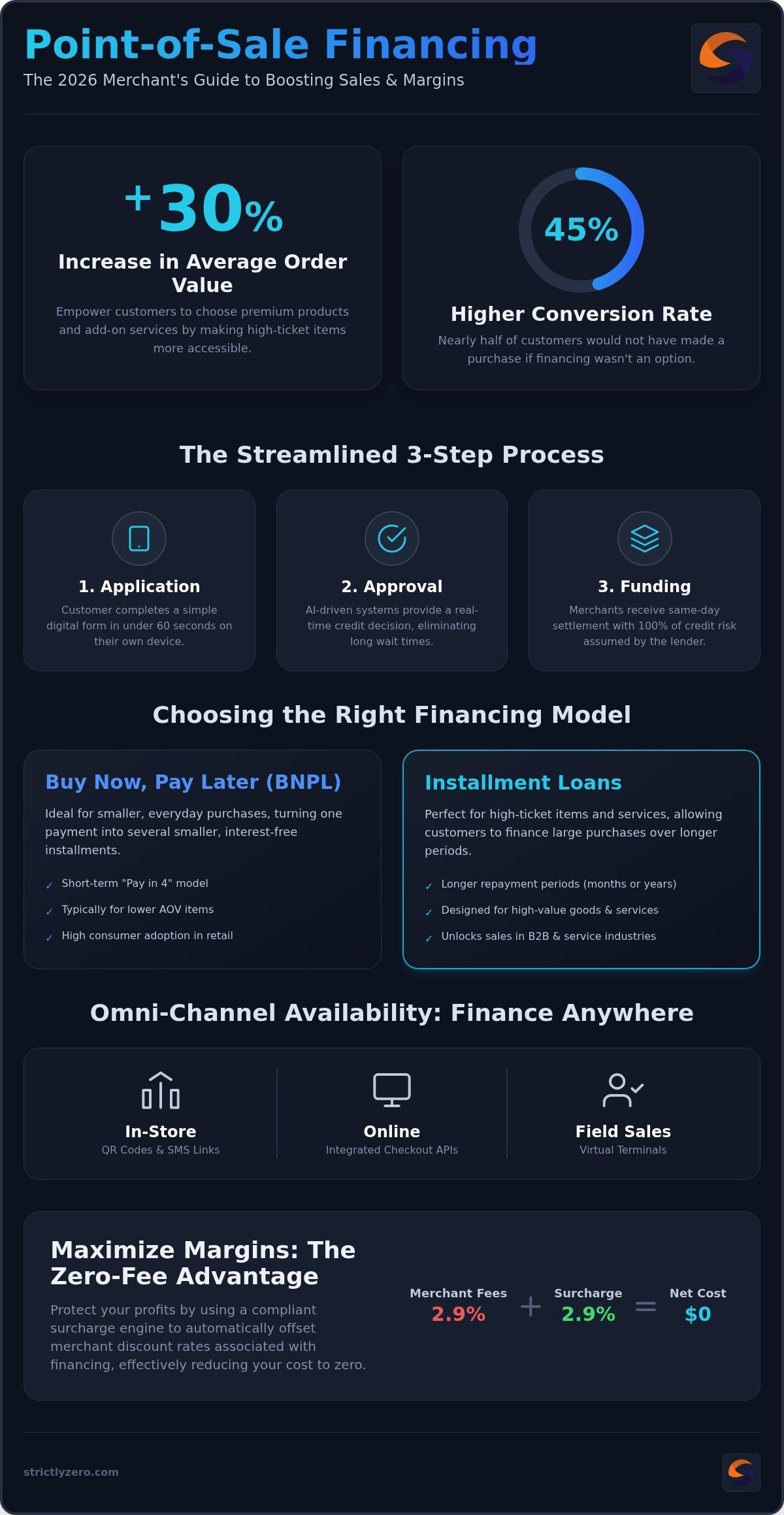
- Application: Customers complete a simple digital form in under 60 seconds on their own device, ensuring a friction-free experience.
- Approval: Systems use AI and alternative data to provide a real-time credit decision, bypassing the long wait times of traditional banking.
- Funding: The merchant receives the full purchase price immediately, often benefiting from the same-day settlement that has become a 2026 industry standard. The lender assumes 100% of the credit risk.
Financing Across All Channels
Omni-channel point of sale financing for merchants ensures that the option is available wherever the customer chooses to shop. In-store customers can scan a QR code or receive an SMS link to apply on the spot. Online shoppers see integrated options directly on the product page or at checkout via API-first platforms. For field sales teams, virtual terminals allow them to offer financing during a home visit or a consultation. For merchants operating in the UK, you can check out Shift4 Card Machine for terminals with no monthly rental fees that help bridge the gap between physical sales and flexible digital payments. This empowers staff to handle price objections instantly, closing deals that might otherwise be delayed by budget concerns or credit card limits.
The Strategic Benefits: Why Offer Financing in 2026?
Point of sale financing for merchants isn’t just a payment method anymore. It’s a growth engine. By 2026, businesses that ignore this tool risk falling behind as consumer expectations shift toward extreme flexibility. Integrating credit options at the checkout removes the “price shock” that often kills high-ticket sales. This strategy aligns perfectly with the best credit card processing for small business in 2026, where financing is treated as a core feature rather than a third-party add-on. By making expensive items accessible, you don’t just close the sale; you build long-term loyalty with customers who appreciate terms that match their cash flow.
Driving Conversion and AOV
The numbers tell a compelling story. Merchants offering financing report an increase in average order value (AOV) between 15% and 30%. In some high-ticket sectors, this jump can reach 40% as customers feel empowered to choose premium models or add-on services. This happens because of a psychological shift. When a shopper sees a $2,000 total, they might hesitate. When they see $170 a month, the purchase becomes a manageable cash flow decision rather than a major capital expense. It’s about shifting the conversation from “can I afford this total?” to “can I afford this monthly amount?”
This shift is vital for capturing younger demographics. Gen Z and the emerging Gen Alpha are credit-conscious, often preferring structured installment plans over traditional high-interest credit cards. Research indicates that up to 45% of customers who use these financing options would not have made the purchase at all if the choice wasn’t available. By providing these tools, you turn “window shoppers” into active buyers.
Competitive Advantage in Saturated Markets
In a crowded market, standing out requires more than just a good product. Providing point of sale financing for merchants allows you to lead with affordability in your marketing. You can run campaigns highlighting low monthly payments rather than just the sticker price, which lowers the barrier to entry for new customers. This is where embedded lending becomes critical. Embedded lending is the seamless integration of credit into the purchase journey, ensuring the customer never has to leave your site or store to secure funding.
By keeping the experience unified, you maintain control over the brand relationship. For those looking to protect their bottom line while offering these perks, it’s worth exploring how omni-channel payment solutions can offset these costs through smarter pricing models. This approach ensures you remain competitive without eroding your margins.
POS Financing Models: BNPL vs. Installment Loans
Selecting the right point of sale financing for merchants depends on your specific industry and average ticket size. You aren’t just choosing a lender; you’re picking a financial partner that directly impacts your bottom line. Most providers charge a merchant discount fee that typically ranges from 2% to 8% per transaction. While these fees are higher than standard card rates, businesses can protect their margins by implementing zero fee credit card processing. This strategy allows you to offset the cost of offering credit by eliminating other processing overheads, ensuring that your 2026 profit goals remain on track.
BNPL: The High-Velocity Option
The “Pay in 4” model has become the gold standard for high-velocity retail. In this structure, the customer pays 25% upfront and the remainder in three bi-weekly installments. It’s often interest-free for the consumer, which makes it incredibly attractive for fashion, beauty, and low-to-mid ticket items. Because there’s usually no hard credit pull, approval is nearly instantaneous. However, because the consumer pays no interest, the merchant often bears a higher fee to subsidize the loan. It’s a trade-off: you pay more per transaction to gain a massive boost in sales volume and speed.
Installment Loans: For Major Purchases
When the price tag reaches into the thousands, short-term BNPL isn’t enough. This is where installment loans shine. These are fixed-rate loans that can span anywhere from 6 to 60 months, making them the preferred choice for HVAC contractors, medical offices, and professional service providers. Unlike the “Pay in 4” model, these loans are often interest-bearing for the consumer. This usually results in a lower fee for the merchant because the lender generates revenue from the APR.
Compliance is a major factor here. By 2026, federal agencies have tightened disclosure requirements for all commercial financing. Merchants must ensure their lending partners provide transparent APR disclosures and clear terms at the point of sale. Using an integrated platform helps automate these disclosures, keeping your business compliant without slowing down the checkout process. Whether you’re selling a designer handbag or a whole-home generator, matching the loan model to the purchase size is the key to maximizing your point of sale financing for merchants.
Implementation Guide: Integrating Financing into Your Stack
Successfully launching point of sale financing for merchants requires more than just flipping a switch. It’s a multi-step process that aligns your financial infrastructure with your sales strategy. First, you must select an omni-channel processor that treats lending as a native feature. Once selected, you need to map your customer journey. This means making financing options visible on product pages, not just at the final checkout screen. Early visibility reduces sticker shock and keeps customers engaged longer.
Next, configure your Smart Pricing Engine to manage surcharges and financing simultaneously. This is crucial for protecting your margins. By using automated debit detection, you ensure you aren’t overcharging on debit transactions while still using credit surcharges to offset the merchant discount fees associated with lending. Finally, train your staff to present these options as a value-add. When a sales rep can explain monthly payment benefits confidently, conversion rates soar. Monitoring all this through a unified dashboard like Strictly’s allows you to see real-time performance of both cash and credit sales in one place.
The Technical Integration
The 2026 market demands flexibility. Using an API-first architecture allows you to embed financing options directly into your custom mobile app or web portal. This is especially vital for a payment processing platform for ISOs, where partners need to offer these tools to a wide variety of merchant types. Uptime and high availability are non-negotiable. If your financing application goes down during a peak sales period, you aren’t just losing a lead; you’re damaging your brand’s reputation for reliability.
Compliance and Transparency
Regulations have become more stringent. The 2026 updates to the Truth in Lending Act (TILA) now place greater emphasis on how digital financing is disclosed during the checkout flow. You must provide clear, easy-to-read disclosures regarding fees, interest rates, and late penalties before the customer signs. Automated state-by-state compliance is another hurdle, as laws like Texas H.B. 700 impose specific requirements on commercial financing providers. Your processor should handle the heavy lifting here, ensuring that your point of sale financing for merchants stays compliant across all jurisdictions without manual intervention. To ensure your stack is ready for these changes, schedule a demo with Strictly today.
Maximizing Margins: The Strictly Zero-Fee Advantage
Many business owners hesitate to implement point of sale financing for merchants because they fear the combined weight of lending fees and processing costs. If a BNPL provider charges 6% and your processor takes another 3%, a significant portion of your sale vanishes before it hits your bank account. Strictly solves this by positioning itself as the unified layer that handles both the transaction and the lending option. By using a compliant surcharge engine, you can offset your standard processing costs, creating a financial cushion that makes offering credit much more sustainable.
This “Trust Layer” approach means you aren’t just processing payments. You’re managing AI-driven fraud prevention, omni-channel processing, and POS lending in a single environment. In 2026, where inflation continues to pressure retail and service sectors, credit card processing for small business must be fee-optimized. By using dual pricing, you can offer cash discounts to one set of customers while providing flexible financing to others, ensuring every transaction remains profitable regardless of how the customer chooses to pay.
The Math of a Zero-Fee Strategy
To understand the value, you have to look at your effective margin. When you eliminate standard credit card overhead through surcharging, you free up capital that can be reinvested into your financing program. Strictly’s Smart Pricing Engine is the key to compliant fee elimination. This technology automatically identifies debit cards in real-time, ensuring surcharges are only applied to credit transactions. This precision keeps you compliant with card brand regulations while maximizing your savings on every high-ticket sale, effectively funding the cost of your point of sale financing for merchants.
Getting Started with Strictly
Moving to a more profitable model doesn’t require a total overhaul of your operations. Since Strictly is API-first, you can transition your current processing to a zero-fee omni-channel model without the need for physical hardware. Once your account is active, you can enable POS lending options directly within your dashboard. This allows you to offer installment loans or BNPL terms to your customers immediately, backed by the same-day settlement features that are now standard for 2026 merchants. Ready to protect your margins? Partner with Strictly to scale your sales and eliminate fees.
Secure Your Competitive Edge for 2026
The landscape of 2026 retail and service industries demands more than just a standard checkout button. You’ve seen how implementing point of sale financing for merchants can transform your average order value and turn hesitant browsers into loyal buyers. However, the real victory lies in balancing these flexible payment options with a strategy that protects your bottom line. By consolidating your lending, fraud prevention, and processing into a single, unified layer, you eliminate the technical friction and high costs that often plague high-ticket transactions.
Strictly makes this transition effortless. Our platform is compliant in all 50 states thanks to an automated Smart Pricing Engine that handles the complexities of surcharge regulations for you. Whether you’re a single business owner or an ISO partner, our API-first architecture ensures a seamless integration into your existing tech stack. It’s time to stop letting processing fees and cart abandonment eat your profits. Switch to Strictly and reclaim your 3% today. Your business is ready for growth, and we’re here to help you capture it.
Frequently Asked Questions
How much does point of sale financing cost for the merchant?
Point of sale financing for merchants typically involves a merchant discount fee ranging from 2% to 8% of the transaction value. While this is higher than standard credit card rates, the cost is often justified by a 20% to 30% increase in conversion rates. Businesses using Strictly can leverage a compliant surcharge engine to eliminate standard processing overhead, effectively freeing up capital to cover these lending fees without eroding their overall profit margins.
Is POS financing legal for all types of businesses in 2026?
Yes, POS financing is legal across the United States, though it is subject to strict 2026 regulatory disclosures. Laws such as Texas H.B. 700 and updated federal Truth in Lending Act requirements mandate transparent communication of terms to consumers at the time of purchase. It is essential to partner with a processor that provides automated, state-by-state compliance tools to ensure your lending offers remain within legal boundaries regardless of where your customers are located.
Do I need a special credit check to offer financing to my customers?
You do not need a personal or business credit check simply to offer financing options to your customers. The credit evaluation is performed on the shopper by the lending provider at the moment of purchase. Most 2026 providers use AI-driven decisioning to provide real-time approvals based on alternative data. This allows you to provide flexible payment terms without taking on personal financial risk or undergoing the rigorous underwriting required for traditional business loans.
Can I offer financing for both in-person and online transactions?
Absolutely. Modern omni-channel platforms allow you to offer point of sale financing for merchants across all sales channels. Customers shopping online can select financing at checkout, while in-person shoppers can apply via QR codes, SMS links, or virtual terminals. This unified approach ensures a consistent customer experience and helps capture high-ticket sales whether your sales team is working from a physical storefront, a custom mobile app, or a digital invoice.
How does POS financing affect my business cash flow?
POS financing actually improves business cash flow because the merchant is paid the full purchase amount upfront, usually within one to two business days. Even though the customer pays in installments over several months or years, the lending partner assumes the responsibility for collecting those payments. This eliminates the need for you to manage accounts receivable or chase late payments, providing immediate liquidity to reinvest in inventory or operations without waiting for installments.
What is the difference between BNPL and a traditional credit card?
The primary difference lies in the structure of the debt. Buy Now, Pay Later typically offers fixed installment plans, often with zero interest for the consumer if paid within a short window. In contrast, traditional credit cards provide revolving credit with variable interest rates that can compound over time. For merchants, BNPL often carries a higher transaction fee but attracts a younger, credit-conscious demographic that avoids traditional high-interest revolving debt models.
Can I use a surcharge program while also offering financing?
Yes, you can combine a surcharge program with financing to maximize your profitability. Strictly’s Smart Pricing Engine is designed to handle these simultaneous configurations by applying a compliant surcharge to standard credit transactions while managing the separate fee structure of a POS loan. This dual-strategy approach allows you to eliminate standard processing costs on everyday sales, which helps offset the merchant discount fees associated with providing long-term installment options to your customers.
What happens if a customer defaults on their POS loan?
In most cases, the lending provider assumes 100% of the credit risk, meaning a customer default does not affect your bottom line. Once the transaction is authorized and funded, the relationship for repayment exists solely between the customer and the lender. You keep the full amount of the sale regardless of whether the shopper completes their payment plan. This protection is a core benefit of using professional lending integrations rather than managing in-house credit programs.