
POS Payment Integration: The 2026 Guide to Omni-Channel Efficiency
Published:

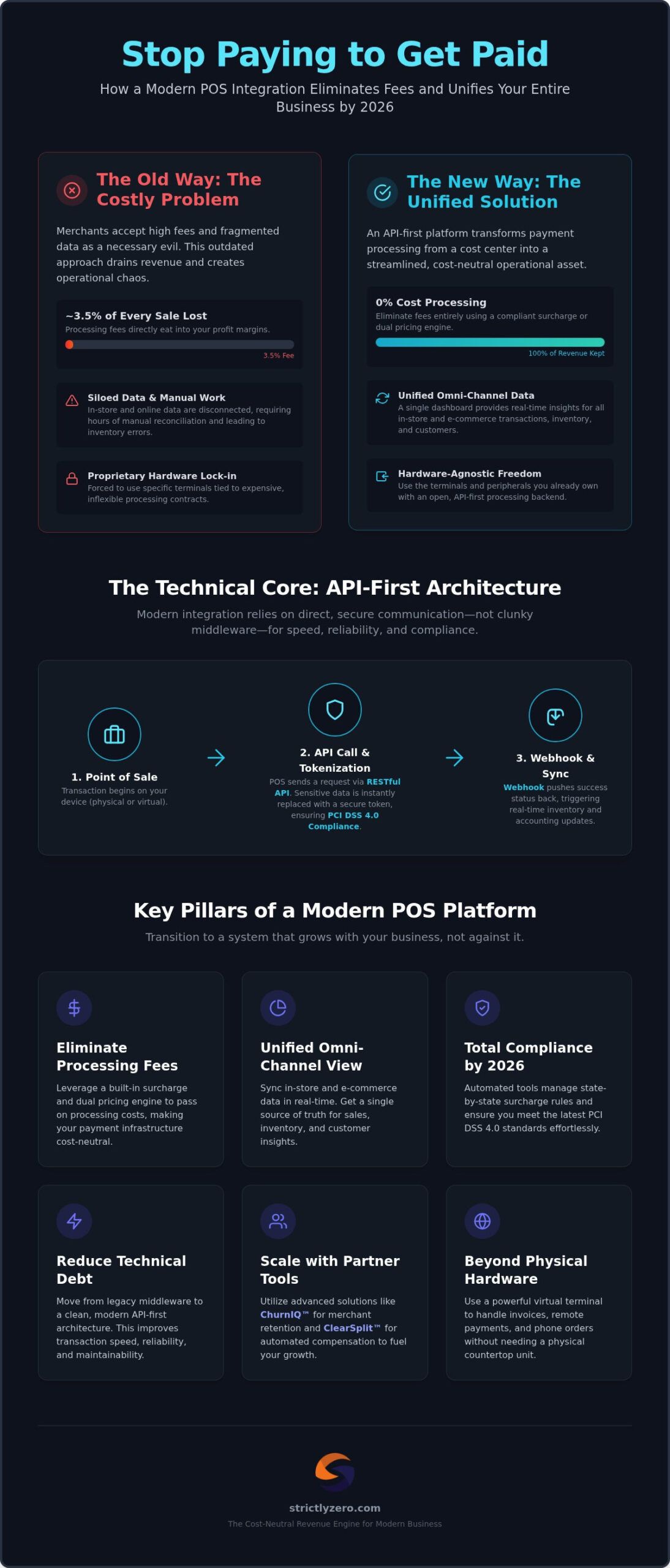
Why are you still paying thousands of dollars every month to process the payments your own business earned? It’s frustrating to watch nearly 3.5% of every sale vanish into thin air, especially when your online and in-store data feels like it’s living in two different worlds. You shouldn’t need an expensive team of developers just to get a modern pos payment integration talking to your backend. Most merchants accept these high fees as an unavoidable cost of doing business, but in 2026, that’s a choice rather than a requirement.
This guide shows you how to integrate your point of sale with a unified payment platform to streamline operations and eliminate processing fees entirely. You’ll learn how to deploy a “set it and forget it” infrastructure that works across every channel you use. We’ll explore how to build a cost-neutral revenue engine that provides a unified view of every transaction while keeping you fully compliant with the latest PCI DSS 4.0 standards. By the end of this article, you’ll have a clear roadmap to turn your payment processing from a heavy expense into a streamlined, omni-channel asset.
Key Takeaways
- Discover how a modern pos payment integration can eliminate processing fees by leveraging a surcharge and dual pricing engine.
- Transition from legacy middleware to an API-first architecture to reduce technical debt and improve transaction speed.
- Unify your in-store and online sales data into a single dashboard for real-time inventory and customer insights.
- Ensure total compliance with 2026 regulations using automated tools that manage state-by-state surcharge rules and PCI DSS 4.0 standards.
- Scale your operations using advanced partner tools like ChurnIQ™ for merchant retention and ClearSplit™ for automated compensation.
Table of Contents
- What is POS Payment Integration and Why It Matters in 2026
- The Technical Core: How API-First POS Integration Works
- Beyond the Hardware: Choosing a Cost-Neutral Integration Model
- A Step-by-Step Framework for Seamless POS Implementation
- Scaling with Strictly: The Unified Omni-Channel Advantage
What is POS Payment Integration and Why It Matters in 2026
At its core, pos payment integration is the digital bridge connecting your Point of Sale (POS) system to a secure payment gateway. It ensures that when a customer pays, the transaction data flows instantly into your accounting software and inventory logs. By 2026, the industry has moved far beyond standalone terminals that require manual entry. Businesses now demand a unified environment where every sale, whether it happens via a mobile reader or a virtual terminal, is tracked in one place.
This shift is largely driven by a desire to escape proprietary hardware locks. In the past, buying a specific terminal often meant you were stuck with their high processing rates for years. Now, smart merchants prioritize hardware-agnostic setups. This flexibility allows you to focus on finding a payment processor you can trust, rather than one that just happened to come with the box. For service-based businesses, this often includes using a virtual terminal to handle invoices and remote payments without needing a physical counter-top unit at all.
To better understand how these systems communicate, watch this helpful video:
The Evolution of Omni-Channel Processing
Modern retail doesn’t happen in a vacuum. You might sell a product in-store while another customer buys the last unit through your website. Without a unified integration, you risk overselling or spending hours on manual reconciliation at the end of the day. A robust setup syncs your in-store data with your ecommerce payment processing in real time. This synchronization provides a single source of truth for your sales reporting. It allows you to make better inventory decisions and catch discrepancies before they become expensive headaches.
The Financial Impact of “Hidden” Integration Fees
Many merchants don’t realize they’re paying twice for their integration. You might pay a monthly software subscription fee to your POS provider, only to find they’ve also added a markup on every transaction. These hidden costs can be devastating for high-volume businesses. Legacy flat-rate pricing models often mask these markups, making it difficult to see what you’re actually paying. Integrating a new system is the perfect time to audit your processing costs. By moving to a model that supports surcharging or dual pricing, you can often shift the burden of processing fees away from your margins entirely.
The Technical Core: How API-First POS Integration Works
Legacy middleware is a relic of the past. In 2026, a high-performing pos payment integration relies on API-first architecture. This design allows different software systems to communicate directly without clunky third-party bridges that often cause delays or system crashes. It’s faster, more reliable, and significantly easier to maintain over time. By utilizing advanced tokenization, the payment gateway replaces sensitive card data with unique digital identifiers. This process ensures your POS never “sees” or stores raw credit card numbers, which is essential for meeting the mandatory PCI DSS v4.0 compliance standards that became the industry baseline in 2025.
One major advantage of this approach is hardware-agnosticism. Unlike restrictive competitors who force you into their specific ecosystem, an open API allows you to connect your existing peripherals to a more efficient processing backend. You can keep the card readers your staff already knows while upgrading the underlying technology to a more cost-effective model. If you’re ready to modernize your stack without the hardware headache, you can explore how our API-first platform fits your business.
The Role of RESTful APIs and Webhooks
RESTful APIs act as the universal language for modern commerce. They allow your POS to send transaction requests to the Strictly platform and receive responses in milliseconds. Webhooks take this a step further by “pushing” data to your system. Instead of your POS constantly asking if a payment is finished, a webhook sends an instant notification the moment a transaction succeeds. This automation triggers immediate inventory updates and digital receipts, removing manual steps from your daily workflow.
Virtual Terminals vs. Physical Hardware
Physical readers aren’t always the best tool for every job. In 2026, many businesses use a virtual terminal to process payments via a web browser or mobile app. This is particularly useful for Buy Online, Pick Up In-Store (BOPIS) workflows. You can send secure payment links to customers before they arrive, ensuring the transaction is settled before the hand-off. Integrating virtual gateway features directly into your POS interface gives your team the flexibility to take payments anywhere on the floor, or even from a remote office, without needing a dedicated card reader for every staff member.
Beyond the Hardware: Choosing a Cost-Neutral Integration Model
While most discussions about pos payment integration focus on technical connectivity, the most significant shift in 2026 is the move toward cost-neutrality. Traditional models treat processing fees as an inevitable tax on revenue. However, modern businesses are increasingly adopting zero fee credit card processing to protect their margins. This model doesn’t just sync your sales; it uses a Smart Pricing Engine to automatically calculate and apply the cost of processing at the moment of sale, effectively bringing your effective rate down to 0%.
A major legal settlement in April 2026 reduced average credit interchange fees by 0.10% for five years, yet many traditional processors haven’t passed those savings to merchants. By integrating financial tools directly into your POS workflow, you stop relying on the generosity of processors. In an era where average credit card fees still range from 1.5% to 3.5%, reclaiming that percentage can be the difference between scaling your business or just breaking even. This integration allows you to pass the cost of convenience to the cardholder legally and transparently, ensuring your business keeps every dollar of the sticker price.
Automated Surcharge Compliance
Implementing a credit card surcharge requires precision. Regulations in 2026 vary significantly by state, and failing to follow specific disclosure rules can lead to heavy fines. An integrated system solves this by identifying the card type instantly. Since you cannot legally surcharge debit cards, the system automatically detects the BIN (Bank Identification Number) and applies the fee only to credit transactions. It also ensures that required signage and receipt disclosures are handled automatically, keeping your business compliant without extra staff training.
Dual Pricing: The Ultimate Transparency
Dual pricing is often the preferred choice for merchants who want maximum transparency. Instead of adding a fee at the end, the POS screen displays two separate prices: a “Cash Price” and a “Card Price.” This approach has been shown to improve customer sentiment because it frames the cash price as a discount rather than the card price as a penalty. When you implement dual pricing via a modern API integration, your system handles the complex math behind the scenes. It adjusts the total based on the customer’s chosen payment method in real time, ensuring that your accounting data remains accurate across all omni-channel touchpoints.
A Step-by-Step Framework for Seamless POS Implementation
Transitioning to a modern pos payment integration isn’t just about plugging in a new device; it’s a strategic overhaul of how your business handles revenue. To avoid technical debt and operational downtime, you need a structured framework. Start by auditing your current hardware and software compatibility. Since you’re likely moving toward a hardware-agnostic setup, you need to ensure your existing software can send custom data fields to an external API. Once you’ve confirmed compatibility, your next step is choosing an API-first processor that natively supports surcharge and dual pricing models. This choice is critical because it determines whether you’ll actually eliminate those 1.5% to 3.5% processing fees mentioned earlier.
After selecting your partner, you must map your data fields. This includes SKU data, tax rates, and customer profiles. Before going live, conduct rigorous Sandbox testing to ensure every transaction flow is secure and that your data reaches the gateway without errors. Finally, don’t overlook employee training. Your staff needs to feel comfortable navigating the new software interfaces and explaining dual pricing to customers. If you’re ready to begin this transition, contact Strictly to start your integration audit today.
Data Mapping and Synchronization
Selecting the right partner is a fundamental principle in any successful venture, whether in business or sports. For those in the rodeo community looking for the perfect match, you can check out Steer Me to find roping partners based on classification and proximity.
For a truly omni-channel experience, your POS inventory must match your online storefront perfectly. If a customer buys the last item in-store, your website should reflect that change in real time to prevent overselling. Data mapping ensures that SKU information, pricing tiers, and customer loyalty profiles are synced across every channel. This level of integration also simplifies the “back office” side of the business. Handling refunds and chargebacks becomes much easier when the transaction data is unified, as you won’t have to jump between different software platforms to find a single customer record.
Testing and Go-Live Procedures
Never skip the testing phase. Start by running “penny tests” to verify that your POS can successfully communicate with the payment gateway. These small transactions confirm that the connection is stable and that encrypted tokens are being passed correctly. During this phase, you should also check the Smart Pricing Engine logic. Ensure the system is correctly identifying credit vs. debit cards and applying the appropriate surcharge or dual price according to 2026 state regulations. Once you go live, monitor your initial transactions closely for any signs of data latency. Even a few seconds of delay at the checkout counter can impact the customer experience, so catching these errors early is vital for maintaining trust at the point of sale.
Scaling with Strictly: The Unified Omni-Channel Advantage
Scaling a business requires more than just a functional checkout; it requires a data ecosystem that grows with you. Strictly provides the infrastructure that allows developers and ISOs to scale their payments business by removing the technical barriers to entry. Instead of building a custom solution from scratch, partners can plug into a pre-built, compliant engine that handles the heavy lifting of a pos payment integration. This allows you to focus on merchant acquisition and retention rather than debugging API calls.
Success in 2026 is measured by how well you use your data. Management tools like ChurnIQ™ provide instant visibility into merchant health, allowing you to spot potential attrition before it happens. For those managing complex payout structures, ClearSplit™ automates partner residuals with surgical precision. This level of automation is why Strictly is the preferred choice for high-growth small business credit card processing. It turns a standard payment setup into a scalable revenue stream that requires minimal manual oversight.
Tools for Partners and Developers
Partners can white-label the entire integration experience, presenting a cohesive, branded interface to their own merchant clients. This professional touch is backed by an AI-driven fraud prevention suite that monitors integrated accounts for suspicious activity in real-time. Beyond security, you can offer POS lending options directly at the checkout. This feature helps merchants increase their average ticket sizes by providing customers with flexible payment options on the spot, creating a more competitive offering for your portfolio.
The Future of Zero-Fee Integration
The regulatory landscape for payments is constantly shifting. As we move through 2026, staying ahead of state-by-state surcharge rules is a full-time job. An API-first platform like Strictly is uniquely positioned to adapt to these changes automatically. It’s also designed to embrace the next generation of payment methods, from crypto-settlements to biometric verification. By choosing a flexible architecture today, you future-proof your business against the next wave of commerce innovation. Ready to eliminate your processing costs and unify your sales data? Start your zero-fee integration with Strictly today.
Take Control of Your Processing Margins
Modernizing your pos payment integration is about more than just faster checkout times; it’s about reclaiming the revenue your business deserves. By adopting an API-first architecture, you gain the flexibility to connect your preferred software to a high-performance backend without being locked into expensive, proprietary hardware. This unified approach ensures your sales data stays synchronized across every channel, from your physical storefront to your mobile virtual terminal. It’s the most effective way to eliminate the data silos that slow down growth.
The transition to a cost-neutral model is the final step in achieving true operational efficiency. With Strictly’s Smart Pricing Engine, you can navigate complex 2026 surcharge regulations automatically, ensuring 100% compliance while bringing your processing costs down to zero. You’ve worked hard to build your brand; don’t let hidden fees and legacy systems eat into your success. Take the next step toward a more profitable, data-driven operation by making the switch to a transparent payment partner you can trust.
Ready to transform your checkout experience? Eliminate your processing fees with Strictly’s integrated platform and start scaling your omni-channel business today.
Frequently Asked Questions
Is POS payment integration difficult for non-technical business owners?
Integration is much simpler than it used to be. While some technical setup is required, choosing a platform with a clear API-first architecture means your developers can connect systems quickly. For non-technical owners, the focus should be on selecting a partner that offers compatibility with popular sales software. This reduces the need for custom code and ensures your pos payment integration works seamlessly without requiring you to write a single line of script yourself.
Can I keep my current POS hardware when switching to Strictly?
Are surcharge programs legal in all 50 states in 2026?
Surcharge legality in 2026 depends on specific state statutes. While most states allow merchants to pass processing costs to customers, a few still have restrictions or specific disclosure requirements. You don’t have to track these changes manually. The Smart Pricing Engine automatically detects the customer’s location and card type. It then applies the correct surcharge or dual price according to local laws, ensuring your business stays compliant across all 50 states without any manual intervention.
What is the difference between a POS system and a payment gateway?
A POS system is the interface where you manage your inventory, staff, and sales. In contrast, a payment gateway is the secure digital tunnel that sends transaction data to the bank for authorization. Think of the POS as the storefront and the gateway as the armored truck that moves the money. A successful pos payment integration connects these two distinct components so that transaction details flow automatically from your screen to the financial networks without manual entry.
How long does it typically take to integrate a new payment processor?
The timeline for integration depends on the complexity of your current software stack. A standard setup using pre-built connectors can often be completed in three to five business days. However, if you’re building a highly customized omni-channel environment using our API, the process might take several weeks to ensure proper data mapping and security testing. We recommend starting with a thorough audit of your current systems to identify any potential technical bottlenecks before you begin the transition.
Does POS integration help with PCI compliance?
Integration is a critical tool for maintaining PCI compliance. By using tokenization through a secure gateway, sensitive cardholder data never actually enters or resides on your local POS hardware. This significantly reduces your compliance burden because you aren’t storing high-risk information. As of March 2025, all businesses must adhere to PCI DSS v4.0 standards. An integrated system helps you meet these strict requirements by automating encryption and providing secure, audit-ready transaction logs for your records.
Can I integrate my online store and my physical shop into one dashboard?
You can absolutely unify your physical and digital sales into a single dashboard. This is the primary goal of omni-channel payment processing. By connecting your web store and your brick-and-mortar registers to the same backend, you gain a real-time view of your total inventory and customer behavior. This integration eliminates the need to manually export data from two different systems, allowing you to manage your entire business from one central location with complete accuracy.
What happens if my internet goes down during an integrated transaction?
Most modern integrated systems include an offline mode or store-and-forward capability. If your internet connection drops, the system securely encrypts the transaction data and stores it locally on the terminal. Once the connection is restored, the POS automatically sends the queued payments to the gateway for processing. It’s important to note that offline transactions carry a slightly higher risk of decline, so many merchants set a maximum dollar limit for sales made while the system is disconnected.