
Retail Credit Card Processing: 2026 Zero-Fee Margin Guide
Published:

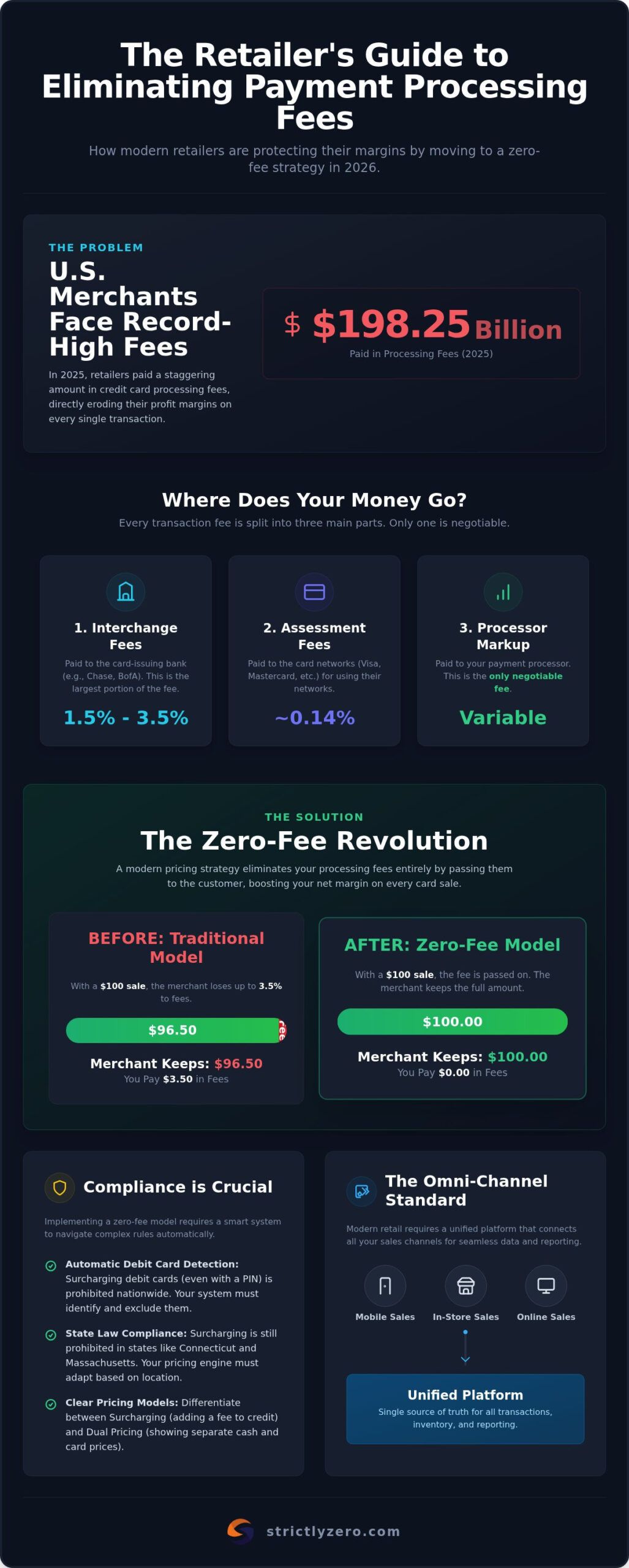
What if your most significant overhead cost simply disappeared? In 2025, U.S. merchants paid a staggering $198.25 billion in processing fees, a record high that continues to squeeze retail margins. If you’re tired of watching up to 3.5% of every transaction vanish before it hits your account, you aren’t alone. Managing credit card processing for retail has become a complex burden, especially with the mandatory transition to PCI DSS v4.0 and the confusing maze of state-level surcharge laws.
It’s frustrating to juggle fragmented systems between your physical storefront and your online shop while trying to stay compliant. You deserve a payment strategy that prioritizes your profit. This 2026 guide shows you how to implement a modern, omni-channel approach that protects your margins by eliminating processing fees entirely. We’ll explore how to unify your reporting, automate compliance with a smart pricing engine, and finally bridge the gap between your in-store and digital sales channels.
Key Takeaways
- Learn how to transition from a cost-heavy payment model to a zero-fee margin strategy that protects your bottom line.
- Understand the breakdown of interchange, assessment, and processor markup fees to identify where your revenue is being lost.
- Discover how a modern Surcharge & Dual Pricing Engine automates state-level compliance and accurately detects debit cards to prevent illegal fees.
- Implement a unified strategy for credit card processing for retail that syncs your in-store and online sales data for seamless reporting.
- Audit your current effective rate to uncover the true cost per transaction and find immediate opportunities to eliminate processing overhead.
Table of Contents
- The Evolution of Credit Card Processing for Retail in 2026
- Understanding Retail Processing Fees and Pricing Models
- How to Choose the Best Credit Card Processing for Retail
- Navigating Surcharge Compliance in 2026
- Maximizing Retail Profit with Strictly’s Unified Platform
The Evolution of Credit Card Processing for Retail in 2026
In the high-stakes environment of 2026, credit card processing for retail acts as the critical bridge between a customer’s intent to buy and your business’s liquidity. For decades, merchants viewed processing fees as an unavoidable tax on success. However, that passive mentality is failing modern retailers who face record-high processing costs, which hit a staggering $198.25 billion in 2025. Today, the focus has shifted toward margin-first processing strategies where every basis point saved is a direct injection into the bottom line. As a modern merchant aggregator, a payment processor in 2026 serves as a strategic partner that simplifies complex fee structures into a unified, transparent engine for growth.
The Core Components of a Retail Transaction
Understanding the mechanics of a transaction helps you spot where costs accumulate. It starts with Authorization, where the issuing bank verifies the customer’s available funds and runs fraud checks in milliseconds. Once the sale is approved, Settlement begins the journey of moving those funds from the customer’s bank to your merchant account. Throughout this cycle, the payment gateway plays a vital role by securing retail data and ensuring compliance with the strict PCI DSS v4.0 standards that became mandatory in early 2025. Without a secure gateway, your business remains vulnerable to both data breaches and non-compliance penalties.
Why Omni-Channel is the New Retail Standard
By 2026, the distinction between online and offline sales has largely evaporated. Modern credit card processing for retail must support a fluid customer journey, particularly with the continued rise of Buy Online, Pick Up In-Store (BOPIS). Leading retailers like Senukai.lt demonstrate that this model requires a unified platform that connects in-store sales with mobile and online inventory in real time. When your systems are fragmented, you lose more than just time; you lose the ability to see a holistic view of your business. A unified omni-channel approach reduces administrative overhead by providing a single source of truth for all transactions, regardless of where the customer chooses to swipe, dip, or click.
Deciphering your monthly statement shouldn’t require an advanced degree in finance. To master credit card processing for retail, you must first understand that every fee falls into one of three categories. First are interchange fees, which are paid to the card-issuing bank and typically range from 1.5% to 3.5%. Second are assessment fees, paid directly to card networks like Visa (0.14%) and Mastercard (0.1375%). Finally, there’s the processor markup, which is the only negotiable part of your rate. Many traditional contracts bury additional costs like PCI compliance fees or statement fees in the fine print, making it difficult to see your true effective rate.
Most retailers unknowingly overpay for the “convenience” of simple pricing. While flat-rate models seem easy to understand, they often mask high margins that the processor keeps for themselves. If your business processes more than $10,000 monthly, these small percentages quickly add up to thousands of dollars in lost revenue every year.
Flat-Rate vs. Interchange-Plus: The Pros and Cons
Flat-rate pricing is popular with micro-merchants because it offers a predictable cost for every transaction. However, it’s rarely the most cost-effective choice for established shops. Interchange-plus pricing is far more transparent because it passes the wholesale cost of the transaction directly to you with a fixed, visible markup. This model allows you to benefit from lower interchange rates on certain card types, such as basic debit cards, rather than paying a high blended rate across the board. Switching to an interchange-plus model is often the first step toward reclaiming your margins as your retail business scales.
The Zero-Fee Revolution: How Surcharging Works
The most significant shift in credit card processing for retail is the move toward zero-fee models. This strategy involves passing the cost of processing directly to the customer at the point of sale. It’s vital to stay compliant with state-specific surcharge laws, as states like Connecticut and Massachusetts still prohibit the practice. You must also distinguish between surcharging and dual pricing; surcharging adds a fee to credit transactions only, while dual pricing shows a “cash price” and a “card price” to the consumer.
Implementing this correctly requires a system that can automatically detect debit cards, as surcharging debit transactions is prohibited nationwide. If you want to stop losing revenue to swipe fees, you can learn more about zero fee credit card processing to see if it fits your business model. To ensure your transition is seamless and compliant, consider partnering with a processor like Strictly to manage the technical complexities for you.
How to Choose the Best Credit Card Processing for Retail
Selecting a partner for credit card processing for retail requires moving beyond a “low-cost” mindset toward a “zero-cost” strategy. Many merchants settle for traditional models because they’re familiar, but those models often lead to 3% of revenue leaking out of the business. To reclaim your margins, you need a systematic approach to evaluating potential providers. Don’t just look at the headline rate; look at the technology that powers the transaction and the automation that keeps you compliant.
- Step 1: Audit your effective rate. Divide your total monthly fees by your total sales volume to find the real cost per transaction. If your effective rate is higher than 2.5%, you’re likely paying for hidden markups.
- Step 2: Evaluate your sales channels. Your platform must unify in-person, mobile, and online sales into a single reporting dashboard to eliminate administrative headaches.
- Step 3: Verify compliance automation. If you’re implementing a surcharge program, your processor’s engine must automatically detect debit cards and adjust fees based on the customer’s state.
- Step 4: Check for API flexibility. Ensure the platform can integrate with your existing retail software or inventory management systems for a seamless workflow.
- Step 5: Review settlement times. In 2026, you shouldn’t have to wait three to five days for your money. Look for providers that offer rapid funding to keep your cash flow healthy.
Essential Features for Retail Payment Platforms
A robust platform should offer more than just a way to swipe a card. Virtual terminals are essential for processing phone orders or handling back-office management from any web browser without needing physical hardware. You should also look for the ability to send secure payment links for specialized retail services or custom deposits. If you’re just starting out, you can explore our guide on credit card processing for small business for more tailored advice on building your payment stack.
Security and Compliance Priorities
Meeting security standards isn’t optional. As of March 31, 2025, all merchants must meet the updated requirements of PCI DSS v4.0, which places a heavy emphasis on multi-factor authentication and continuous risk management. To protect your margins, look for AI-driven fraud prevention that stops suspicious transactions before they turn into costly chargebacks. In card-present environments, end-to-end encryption ensures that sensitive data is protected from the moment a card touches the reader until the transaction is fully settled.
Navigating Surcharge Compliance in 2026
“Is this actually legal?” is the first question most shop owners ask when they look into zero-fee credit card processing for retail. The answer is yes, but it comes with strict geographic and procedural rules. As of 2026, credit card surcharging is legal in 47 states. Only Connecticut, Massachusetts, and Maine, along with Puerto Rico, maintain total bans on the practice. In states like New York and New Jersey, you’re permitted to surcharge as long as you don’t exceed your actual cost of processing. Colorado merchants must adhere to a specific 2% cap. Recent court rulings have consistently upheld a merchant’s right to pass on these costs, provided they maintain total transparency with the consumer.
Staying compliant manually is nearly impossible for a busy retailer. Modern systems now use a Smart Pricing Engine to handle these geographic nuances automatically. This technology identifies the customer’s location and card type to apply the correct, legally compliant fee at the moment of sale. It removes the risk of human error that often leads to costly audits or merchant account suspensions. By automating the rules, you can focus on your customers instead of memorizing state statutes.
Debit Card Detection: The Compliance Safeguard
Federal law is crystal clear: you cannot surcharge a debit card, even if the customer chooses to run it as “credit” without a PIN. Surcharging a debit or prepaid card is a direct violation of federal law and can lead to immediate termination of your processing agreement. Reliable credit card processing for retail uses real-time BIN (Bank Identification Number) detection. This technology identifies a debit card the millisecond it’s swiped or tapped, ensuring the surcharge is bypassed entirely. This safeguard is your best defense against heavy card network fines and protects your merchant account from being flagged for non-compliance.
Customer Communication and Signage
Transparency is the key to maintaining customer loyalty while protecting your bottom line. Card network rules require you to post clear signage at the entrance and the point of sale notifying customers of the surcharge. Many retailers find the most success by framing their strategy through a “Dual Pricing” model. Instead of presenting a fee as a penalty, you show a “Card Price” and a “Cash Price.” This positions the cash price as a discount, which feels much more positive to the shopper. When you’re honest about how these savings help you keep your shelf prices stable, most customers are happy to support your local business. To ensure your shop is following every rule perfectly, you can get started with our Surcharge & Dual Pricing Engine.
Maximizing Retail Profit with Strictly’s Unified Platform
While understanding the mechanics of fees is essential, implementing a solution that actively protects your bottom line is where the real work begins. Strictly provides an integrated suite of tools designed to transform credit card processing for retail from a cost center into a profit driver. At the heart of this strategy is our Surcharge & Dual Pricing Engine. This tool allows you to implement a $0 fee strategy by passing processing costs to the cardholder, ensuring that your hard earned revenue stays in your business instead of being siphoned off by card networks.
Our omni-channel platform ensures your reports aren’t scattered across different systems. Whether you’re selling in person, on a mobile device, or through an e-commerce storefront, all data flows into a single, unified dashboard. This high level of visibility is powered by an API-first architecture, allowing Strictly to integrate seamlessly with your existing retail workflows and software. You don’t have to change how you do business; you just change how much you keep from every sale.
The Smart Pricing Engine handles the heavy lifting of compliance. As we discussed earlier, state laws and card network rules are constantly shifting. Our engine automatically adjusts for these variables in real time, detecting card types and geographic locations to ensure every transaction follows the latest regulations. This automation removes the burden of manual compliance from your staff and places it firmly in the hands of our technology.
The Strictly Advantage for Retailers
Switching to Strictly means eliminating the “fee anxiety” that comes with traditional monthly statements. You’ll no longer wonder how much of your margin will be eaten up by interchange markups. Beyond just savings, every transaction on our platform is protected by enterprise-grade, AI-driven fraud prevention. This proactive layer of security stops chargebacks before they happen, further protecting your profitability. You can find more details on how these features benefit your specific business model by reading our guide on credit card processing services.
Getting Started with Zero-Fee Processing
Transitioning to a modern credit card processing for retail model is simpler than most merchants realize. Our onboarding process is designed for speed and clarity, allowing you to move away from legacy processors without experiencing any downtime. We understand that your shop can’t afford to stop taking payments, so we prioritize a smooth handover that keeps your registers running. If you’re ready to reclaim your margins and stop paying for the privilege of accepting cards, you can switch to Strictly and start saving today.
Reclaiming Your Retail Margins in 2026
The landscape of credit card processing for retail has shifted from accepting fees as a burden to treating them as a strategic choice. By auditing your effective rate and embracing a zero-fee model, you’re no longer just managing overhead; you’re actively protecting your business’s future. Modern tools like automated debit detection and smart pricing engines have removed the manual labor from staying compliant with complex state laws.
You’ve seen how unified reporting and omni-channel integration can streamline your operations while keeping your revenue where it belongs. It’s time to stop letting swipe fees erode your profits. Strictly offers a transparent path forward with zero-fee merchant services that are compliant in all 50 states. Our platform handles the technical heavy lifting, from automated debit detection to secure virtual terminals, so you can focus on growing your brand.
Ready to make the switch? Eliminate Your Retail Processing Fees with Strictly and start seeing the difference in your next settlement. You’ve worked hard to build your retail business; you deserve to keep every dollar you earn.
Frequently Asked Questions
Is credit card surcharging legal for retail businesses in 2026?
Surcharging is legal for retail businesses in 47 states as of 2026, with Connecticut, Massachusetts, and Maine being the only exceptions. While it’s federally permitted, you must adhere to state-specific caps, such as the 2% limit in Colorado. Additionally, card networks like Visa currently limit these fees to a maximum of 3%. Using an automated engine ensures your shop follows these evolving geographic rules without manual calculations.
How does a zero-fee processing model actually work?
A zero-fee model works by passing the cost of credit card processing for retail directly to the customer at the point of sale. When a customer pays with a credit card, the system adds a small, compliant surcharge to the total. This fee covers the interchange, assessment, and processor costs, ensuring the merchant receives 100% of the original sale price. It effectively shifts the transaction cost from the business to the cardholder.
Can I surcharge debit card transactions in my retail store?
You cannot surcharge debit card transactions in your retail store because it’s a direct violation of federal law. This prohibition applies even if the customer runs the card as credit without entering a PIN. Our platform features automated debit detection to identify these cards instantly by their Bank Identification Number. If a debit card is used, the system automatically bypasses the surcharge to keep your business compliant.
What is the difference between surcharging and dual pricing?
Surcharging adds a fee only to credit card transactions, while dual pricing shows two distinct prices for every item. In a dual pricing model, customers see a Card Price and a lower Cash Price on labels or at the register. Many retailers prefer dual pricing because it frames the lower cost as a cash discount rather than a credit penalty. Both methods are effective strategies for protecting your business margins.
What retail hardware do I need to use Strictly?
Most customers accept surcharge fees when they’re communicated with total transparency and honesty. If you clearly post the required signage and explain that the fee helps you avoid raising shelf prices, shoppers are generally supportive. Many merchants find that using a dual pricing model is even better for customer relations. This approach emphasizes the cash discount, which feels like a reward for the customer rather than a penalty.
How long does it take to set up retail credit card processing?
Setting up credit card processing for retail with Strictly is a fast and efficient process that usually takes a few business days. Once your application’s approved, you can immediately access your virtual terminal or begin integrating our API into your existing systems. We prioritize a smooth transition to ensure your shop doesn’t experience any downtime. This speed allows you to start eliminating your processing fees and reclaiming your margins almost immediately.
Does Strictly provide PCI compliance support?
Strictly provides robust support to help your business meet the mandatory requirements of PCI DSS v4.0. Our platform handles the technical security of every transaction through end-to-end encryption and AI-driven fraud prevention. By processing payments through our secure gateway, you reduce the scope of your own compliance burden. We ensure that your customer data’s protected according to the latest 2026 industry standards, giving you and your shoppers peace of mind.