
Sandbox Environment for Payment Integration: The 2026 Developer’s Guide
Published:

Imagine it’s 2 AM on a Friday, and a minor API update just crashed your entire checkout flow because your test data didn’t match the live environment. It’s the nightmare every developer fears, especially when dealing with the high stakes of real-time financial data. You need a robust sandbox environment for payment integration that does more than just return a successful status code. It’s about ensuring your code respects the latest PCI DSS 4.0 standards and accurately handles complex surcharge rules, such as the 3% cap for merchants accepting both Visa and Mastercard.
You likely already know that inconsistent data between environments is the quickest way to lose sleep and customer trust. We promise to help you master the art of risk-free testing by simulating high-fidelity, omni-channel scenarios that perfectly mirror your live production environment. This guide provides a clear path forward, showing you how to validate dual pricing logic, integrate AI-driven fraud prevention, and build a stable bridge from your initial API calls to a successful, compliant deployment.
Key Takeaways
- Understand why an isolated testing ground is non-negotiable for meeting the mandatory PCI DSS 4.0 security standards in 2026.
- Learn how to use synthetic data to trigger specific ‘Success,’ ‘Decline,’ and ‘Fraud’ responses within a virtual terminal simulation.
- Master the complexity of a sandbox environment for payment integration by validating surcharge and dual pricing logic across different card types.
- Follow a structured checklist to secure your API keys and execute ‘Happy Path’ transactions for all major card brands.
- Discover how a unified, omni-channel API simplifies the transition from testing to a live, revenue-neutral pricing model.
Table of Contents
- What Is a Sandbox Environment for Payment Integration?
- Key Components of a High-Fidelity Testing Environment
- Validating Surcharge Compliance and Dual Pricing in a Sandbox
- The 2026 Developer’s Checklist for Payment Integration
- Scale Your Integration with Strictly’s API-First Platform
What Is a Sandbox Environment for Payment Integration?
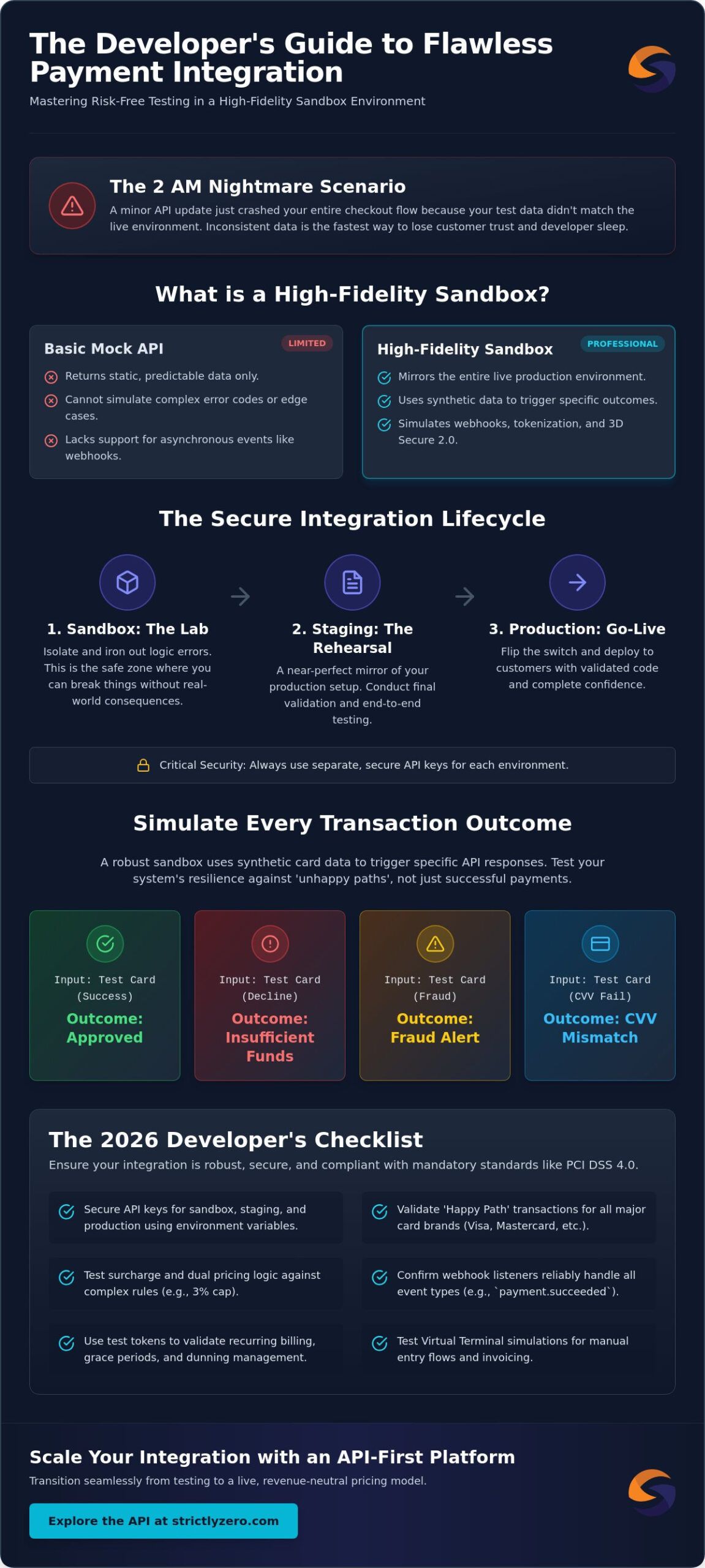
A sandbox environment for payment integration is an isolated testing ground that mimics a live payment gateway’s functionality without processing real money. It’s essentially a safe zone where developers can break things without consequences. Utilizing a professional sandbox testing environment allows you to verify that your code interacts correctly with complex payment logic before any customer ever sees a checkout screen. Unlike a simple “mock” API that just returns static data, a high-fidelity sandbox simulates the entire transaction lifecycle, from the initial request to the final webhook notification.
To better understand how this infrastructure supports your development cycle, watch this helpful overview:
Security is the primary reason this environment is non-negotiable. With PCI DSS 4.0 now fully active and its future-dated requirements having become mandatory on March 31, 2025, developers must validate security controls continuously. A modern sandbox environment for payment integration handles sensitive features like tokenization and 3D Secure 2.0 without exposing your servers to raw cardholder data. It also allows you to test how your system reacts to biannual interchange rate updates in April and October, or the specific 2026 assessment fees from Visa and Mastercard, ensuring your pricing engine remains accurate and compliant. For organizations that need to bolster their broader cybersecurity infrastructure alongside these payment controls, you can discover Klik Solutions and their managed security services.
The Core Purpose of Payment Testing
The main goal is eliminating financial risk. You don’t want an accidental code loop to trigger thousands of real-world fund transfers during a late-night debugging session. Beyond safety, testing allows you to refine the user experience. You can simulate specific error codes to see how your frontend handles a declined card versus a network timeout. It’s also the best way to verify that your webhooks are reliable under simulated load, ensuring your database stays in sync with every transaction status change.
Sandbox vs. Staging vs. Production
Think of the sandbox as the laboratory and staging as the dress rehearsal. You need a dedicated sandbox first to iron out logic errors. Once your code is stable, it moves to a staging environment that should be a near-perfect mirror of your production setup. Managing separate API keys for each stage is critical for security. Use environment variables to ensure your test scripts never point to live endpoints by mistake. This hierarchy ensures that when you finally flip the switch to production, the integration is already validated against the latest 2026 compliance standards.
Key Components of a High-Fidelity Testing Environment
A high-fidelity sandbox environment for payment integration goes far beyond simple request-response cycles. It provides a mirror of the actual production infrastructure, allowing you to test how your system interacts with a modern payment gateway. This includes using synthetic data where specific card numbers trigger unique outcomes like “Fraud” or “Declined.” You shouldn’t just test for success; you need to see how your UI reacts when a transaction fails due to a CVV mismatch or an expired card.
Testing manual entry via a Virtual Terminal simulation is equally vital. Many developers overlook this. Verifying that your invoicing flows and manual overrides work as intended prevents massive headaches during post-launch support. This level of detail is what defines a professional sandbox environment for payment integration. Additionally, your sandbox must include webhook listeners. Since payment statuses are often asynchronous, your backend needs to prove it can handle “payment.succeeded” or “dispute.created” events without dropping data.
Simulating Transaction Outcomes
Robust testing requires more than a single “test card.” You need to trigger specific error codes like “insufficient funds” or “partial authorization” to ensure your checkout logic doesn’t stall. In 2026, subscription models are dominant, making test tokens essential for validating recurring billing cycles. By using these tokens, you can simulate multiple billing periods within a few minutes. This confirms that your logic for grace periods and dunning management is airtight before you go live.
Omni-Channel Integration Testing
The biggest gap in standard documentation is how to bridge ecommerce payment processing with mobile and physical sales. A true omni-channel sandbox allows for cross-platform tokenization. This means a customer can save a card on your website and use it later within your mobile app or at a physical kiosk. Validating this unified reporting in the sandbox dashboard ensures your accounting remains consistent regardless of where the sale happens. Scaling these tests across multiple client accounts is much easier when you use organized Partner Management Tools to keep credentials secure and separated.
Validating Surcharge Compliance and Dual Pricing in a Sandbox
Testing surcharge logic is arguably the hardest part of building a modern payment stack. It’s the core of any zero fee credit card processing strategy. You aren’t just checking if a card is valid; you’re verifying that your system correctly identifies the card type in real-time. A high-quality sandbox environment for payment integration must allow you to test BIN ranges to distinguish between credit and debit cards instantly. Since surcharging debit cards is a violation of federal law, your code must be able to “zero out” any fees the moment a debit card is detected in the checkout flow.
Compliance isn’t just a suggestion; it’s a legal requirement with heavy penalties. In 2026, you must account for the fact that credit card surcharges are strictly prohibited in Connecticut, Massachusetts, and Maine. If your sandbox environment for payment integration doesn’t let you simulate transactions from these specific jurisdictions, you’re flying blind. You also need to validate that your code respects state-specific caps, like Colorado’s 2% limit, or the actual-cost restrictions found in New York, New Jersey, and Nevada. Testing these variables in a safe environment is the only way to ensure your “net zero” math actually works for the merchant.
Testing the Smart Pricing Engine
Verification of the ‘Smart Pricing Engine’ is where the math meets the code. Your sandbox should confirm that if a merchant accepts both Visa and Mastercard, the effective surcharge doesn’t exceed Visa’s 3% maximum, even though Mastercard allows up to 4% on its own. Every digital receipt and invoice generated in the test environment needs to display these fees transparently. This ensures the merchant’s net-zero structure remains intact regardless of whether the customer uses a premium rewards card or a standard credit card. If the math is off by even a single cent, the reconciliation process becomes a nightmare.
Compliance and Regulatory Validation
Regulatory validation requires testing the “unhappy path” for compliance. This means simulating a debit card transaction and ensuring the surcharge logic stays at zero. You also need to test disclosure requirements. Card brand rules require that customers are notified of the fee before they complete the purchase. Use your sandbox to confirm these notifications appear correctly on every interface, from the virtual terminal to the mobile checkout. Since dual pricing is allowed in all 50 states, use the sandbox to compare the “card price” versus the “cash price” to ensure the discount logic is applied accurately and clearly for the consumer.
The 2026 Developer’s Checklist for Payment Integration
Moving from a conceptual setup to a functional sandbox environment for payment integration requires a disciplined approach. It’s not enough to see a green checkmark on a single transaction. You need to know exactly how your database reacts when a transaction is flagged by AI-driven fraud prevention tools or when a network timeout occurs. This audit ensures your sandbox environment for payment integration is truly production-ready by following a structured path to deployment.
- Step 1: Secure your sandbox API keys and configure your environment variables. Never hardcode these secrets into your source code; use a secure vault or .env files.
- Step 2: Execute basic ‘Happy Path’ transactions. Test success states for all major card brands, including Visa, Mastercard, and Amex, to ensure your gateway routing is active.
- Step 3: Simulate ‘Edge Cases.’ Use specific test card numbers to trigger declines, timeouts, and AI-driven fraud triggers. This verifies that your frontend provides clear feedback to the user.
- Step 4: Audit your webhook responses. Check every field in your database against the webhook payload to ensure 100% data accuracy for reporting and reconciliation.
- Step 5: Perform a ‘Compliance Pass.’ Confirm that your surcharge logic is applying correctly based on the card type and that no sensitive PCI data is being stored on your local servers.
Advanced Edge Case Testing
Reliability in payment processing often depends on how you handle the unexpected. Simulate network latency by introducing a delay in your test calls. If the gateway takes 5000ms to respond, does your app time out gracefully or create a duplicate charge? This is where ‘Idempotency Keys’ become critical. By sending a unique key with every request, you prevent double-charging a customer during a retry. Additionally, ensure you handle ‘3D Secure’ challenges within the sandbox to maintain a smooth Strong Customer Authentication (SCA) flow for international or high-risk transactions.
Transitioning to Production: The Final Audit
The final step is the most nerve-wracking. You must rotate your API keys, moving from sandbox secrets to live production credentials. Before opening the floodgates, perform a ‘Penny Test.’ This involves executing a single real-dollar transaction to verify the entire pipe from the customer’s card to your merchant account. This is also the time to finalize your credit card processing for small business settings, ensuring the merchant profile matches the surcharge and dual pricing logic you’ve spent weeks testing. If you need assistance validating your setup, contact our support team for a technical walkthrough before you go live.
Scale Your Integration with Strictly’s API-First Platform
Scaling a payment solution requires more than just a functional gateway; it demands an ecosystem that grows with your transaction volume. Strictly’s unified, omni-channel API is built specifically for developers and payment processing platforms for ISOs who need to manage complexity at scale. Our sandbox environment for payment integration isn’t just a basic testing tool. It’s a high-fidelity replica of our production stack, designed to simplify the most difficult aspects of merchant services, including the “net zero” math of surcharge and dual pricing logic. By providing a sandbox with full feature parity, we ensure that your code behaves exactly the same way in production as it does during your initial API calls.
The Strictly Developer Experience
Accessing our robust sandbox environment for payment integration gives you immediate access to our Smart Pricing Engine API. This tool automates compliance across all 50 states, handling the nuances of state-specific bans and card brand caps without requiring you to write thousands of lines of conditional logic. It even accounts for the 2026 Visa assessment fee of 0.14% and the 0.10% interchange reduction from the recent industry settlement to ensure your pricing remains accurate. You can also integrate our AI-driven fraud prevention directly into your custom checkout flow. This allows you to test how your system handles high-risk flags or automated transaction blocks before they impact real revenue.
Partnering for Long-Term Growth
Strictly has become the preferred cc processing company for ISOs and software platforms because we prioritize the developer’s workflow. We understand that scaling from one merchant to thousands requires more than just a stable connection. It requires automated residuals and deep retention analytics to keep your portfolio healthy. Our partner management tools provide a single pane of glass for your entire merchant base, allowing you to monitor performance and growth in real-time. Whether you’re building a niche SaaS platform or managing a massive ISO office, our infrastructure is designed to support your growth through 2026 and beyond.
Get started with Strictly’s Sandbox today and experience the difference of a truly developer-centric payment platform.
Ready to Deploy Your Compliant Payment Stack?
Mastering your payment integration isn’t just about making successful API calls. It’s about building a system that remains compliant with PCI DSS 4.0 while navigating the complexities of state-specific surcharge laws across the country. By utilizing a high-fidelity sandbox environment for payment integration, you’ve ensured that every edge case, from network latency to automated BIN detection, is accounted for before a single real dollar moves through your system.
Strictly provides the infrastructure you need to scale from a single test merchant to a massive omni-channel portfolio. Our API-first platform offers automated state-by-state surcharge compliance and the power of ClearSplit™ to handle partner residuals without any manual intervention. You’ve followed the checklist and audited your webhooks; now you’re ready to flip the switch with total confidence.
Build your zero-fee payment solution with Strictly’s API and start scaling your platform today. You have the roadmap for success; we’re here to provide the engine that drives it forward. Happy coding!
Frequently Asked Questions
What is the difference between a payment gateway sandbox and a merchant account sandbox?
A payment gateway sandbox focuses on the technical handshake between your application and the processor’s API. In contrast, a merchant account sandbox validates business-specific logic, such as how funds are split or how specific surcharge rules apply to a merchant’s profile. You’ll use the gateway sandbox for basic connectivity and the merchant sandbox to confirm that your revenue-neutral pricing models are functioning correctly.
Can I use real credit card numbers in a sandbox environment for more accurate testing?
You should never use real credit card numbers in a sandbox environment for payment integration. Using live cards can trigger fraud alerts and potentially compromise your PCI DSS 4.0 compliance status. Instead, use the synthetic test card numbers provided in the developer documentation. These numbers are specifically designed to trigger various responses, such as successful authorizations, declines, or specific error codes, without any financial risk.
How do I test if my surcharge program is legally compliant in the sandbox?
To test surcharge compliance, you must simulate transactions using specific BIN ranges that represent different card types. Your code should automatically detect a debit card and remove the surcharge. You also need to test geolocation logic to ensure fees are blocked for customers in Connecticut, Massachusetts, and Maine. High-fidelity testing ensures you stay within state-specific caps, such as Colorado’s 2% limit.
Why are my webhooks not firing in the sandbox environment?
Webhooks often fail to fire in a sandbox environment for payment integration because the listener URL isn’t publicly accessible or is blocked by a firewall. Ensure your testing server is reachable via a tool like ngrok. You should also verify that the specific event triggers, such as “transaction.succeeded,” are enabled in your sandbox dashboard settings. If the endpoint returns anything other than a 200 OK, the gateway may stop sending notifications.
How long should I stay in the sandbox before moving to production?
You should remain in the sandbox until you’ve successfully cleared every item on your integration checklist. This includes the “Happy Path” transactions and complex edge cases like network timeouts or 3D Secure challenges. Most developers spend one to two weeks in the sandbox. This timeframe allows for thorough testing of the Smart Pricing Engine and ensures your backend handles webhooks with 100% data accuracy before going live.
What is a ‘Mock’ transaction and how does it differ from a sandbox transaction?
A ‘Mock’ transaction is a local simulation where your code returns a hardcoded response without ever leaving your server. A sandbox transaction is a real network request sent to the processor’s test environment. While mocking is useful for unit tests, sandbox testing is essential for validating the actual API handshake, network latency, and the asynchronous nature of webhooks. It provides a much more accurate representation of production behavior.
Does the Strictly sandbox support testing for both dual pricing and standard surcharging?
Yes, the Strictly sandbox fully supports testing for both dual pricing and standard surcharging models. You can use the API to toggle between these settings and verify that the “card price” and “cash price” are displayed correctly on digital receipts. This allows you to confirm that the merchant’s net-zero fee structure remains intact across all 50 states, including jurisdictions with specific surcharge restrictions.
How do I simulate a fraud decline in the sandbox to test my AI-driven prevention logic?
To test AI-driven fraud prevention logic, you must use specific test card numbers or CVV codes that are pre-configured to trigger a fraud decline. When these triggers are hit, the sandbox returns a specific fraud error code. This allows you to verify that your frontend provides the correct user feedback and that your backend logs the event for later analysis. It’s the safest way to refine your risk management settings without impacting real customers.