
Secure Payment Gateway for Developers: The 2026 Integration Guide
Published:

What if your next checkout implementation could eliminate processing fees entirely while managing the complex legal web of state-level surcharge rules? Most engineers dread the “payment sprint” because complex API documentation and the looming threat of PCI DSS v4.0 breaches turn a simple task into a month-long headache. Finding a secure payment gateway for developers shouldn’t mean choosing between clean code and enterprise-grade protection. You need a system that handles the heavy lifting of data integrity so you can focus on building your core product.
It’s frustrating when hidden fees eat into margins or rigid systems break under the weight of dual pricing logic. You deserve a solution that works across online and in-person channels without manual intervention. This guide shows you how to integrate a gateway that balances developer-friendly APIs with automated compliance and high-performance fraud prevention. We’ll explore the 2026 standards for omnichannel processing, AI-driven security, and the logic required to deploy zero-fee merchant models without the legal guesswork.
Key Takeaways
- Understand the shift toward holistic data sovereignty and how to meet the mandatory PCI DSS v4.0 standards for 2026.
- Learn to select a secure payment gateway for developers that offers a unified API for seamless e-commerce and in-person payment integration.
- Discover how to automate state-by-state surcharge rules and dual pricing logic to provide merchants with zero-fee processing options.
- Identify the critical security features needed for modern gateways, including real-time AI-driven fraud prevention and multi-factor authentication.
- Explore advanced partner management tools like ClearSplit™ and ChurnIQ™ to automate residuals and improve long-term merchant retention.
Table of Contents
- Defining the 2026 Standard for a Secure Payment Gateway
- Evaluating API-First Architectures for Integration Speed
- Automating Financial Logic: Surcharge and Dual Pricing Integration
- The Developer's Checklist for Secure Gateway Selection
- Why Developers Choose Strictly for Secure Scalability
Defining the 2026 Standard for a Secure Payment Gateway
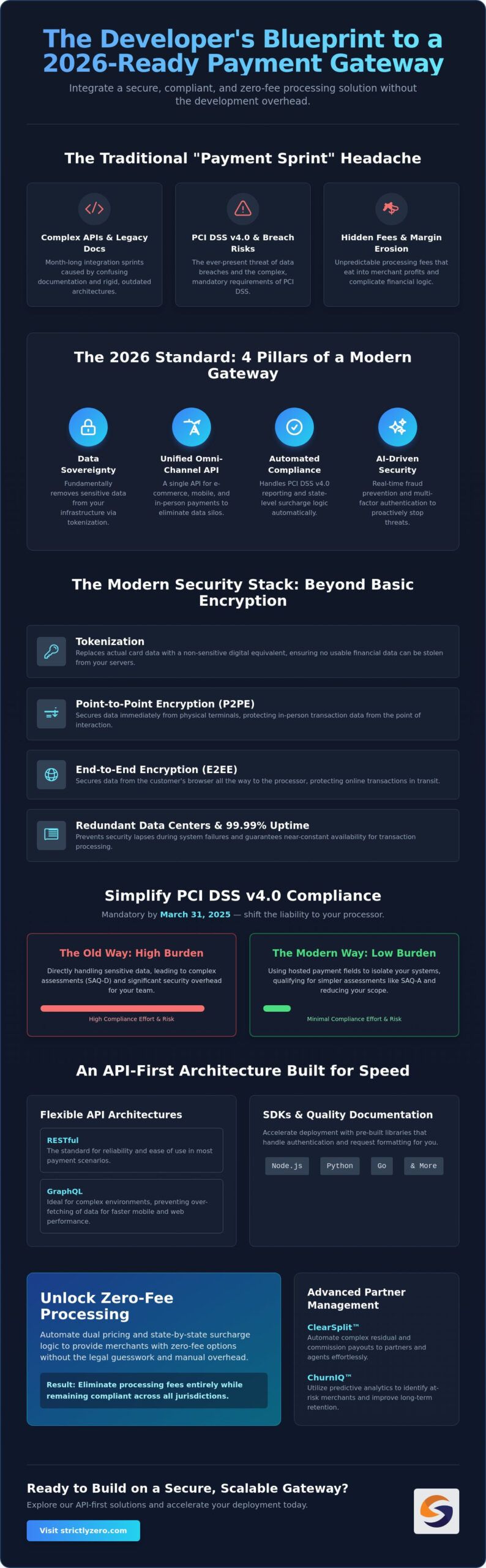
In 2026, security standards have moved far beyond simple encryption. It’s no longer enough to just scramble data during transit; developers now demand a secure payment gateway for developers that treats data sovereignty as a core architectural principle. This means sensitive information isn’t just hidden, it’s fundamentally removed from your local infrastructure. A secure developer gateway is an API-first ecosystem that automates both security and financial compliance.
When evaluating a Payment Service Provider (PSP), you’re looking for more than a simple transaction pipe. You need a partner that offers a unified security layer across every channel. Omni-channel support is now a mandatory part of the security definition. Data leaks often happen at the friction points where online and in-person systems meet, so a unified API is your best defense.
To better understand the mechanics of these systems, watch this helpful video:
Beyond Encryption: The New Security Pillars
Encryption is the baseline, but the 2026 standard demands more. While End-to-End Encryption (E2EE) secures data from the browser to the processor, Point-to-Point Encryption (P2PE) is vital for physical terminal interactions. Modern systems prioritize tokenization. This process replaces actual card data with a non-sensitive digital equivalent, ensuring that even if your servers are compromised, there’s no usable financial data to steal. Reliability is the final pillar. Redundant data centers are essential to maintain 99.99% uptime, which prevents the security lapses that often occur during system failures.
PCI DSS Compliance in a Modern Dev Environment
PCI DSS compliance is the floor, not the ceiling. With PCI DSS v4.0 requirements becoming mandatory on March 31, 2025, developers must move beyond basic checklists toward active risk management. Using hosted payment fields allows you to qualify for simpler assessments like SAQ-A or SAQ-A-EP, which shifts the bulk of the liability to the processor. A robust secure payment gateway for developers handles the heavy lifting of compliance reporting and real-time monitoring automatically. For a deeper dive into these requirements, check out this PCI DSS Compliance Guide to understand how modern processors protect your business.
Evaluating API-First Architectures for Integration Speed
Speed is the primary currency for engineering teams in 2026. While security is non-negotiable, the ability to deploy a secure payment gateway for developers without getting bogged down in legacy architecture determines how fast a product hits the market. Most modern gateways have shifted toward RESTful architectures for their reliability and ease of use. However, GraphQL is increasingly winning for complex payment environments where developers need to fetch specific transaction metadata without over-fetching data. This flexibility allows for more efficient mobile app performance and faster front-end rendering.
Documentation quality is the single biggest factor in developer adoption. If the API reference is outdated or lacks clear examples, integration delays are inevitable. A top-tier secure payment gateway for developers must provide SDKs in multiple languages like Node.js, Python, and Go. These pre-built libraries handle the heavy lifting of authentication and request formatting, allowing your team to focus on the user experience rather than low-level networking code. If you’re looking to streamline your build, you can explore our API-first solutions to see how clean documentation accelerates deployment.
The Power of Unified Omni-Channel Integration
Technical debt often accumulates when businesses use different providers for online and in-person sales. A unified API solves this by handling e-commerce, mobile, and physical POS data through a single logic layer. This architecture allows you to link virtual terminals with physical hardware seamlessly. By using one endpoint for all transaction types, you ensure that customer data and inventory levels remain synchronized across your entire ecosystem, reducing the risk of fragmented data silos.
Sandbox Environments and Testing Protocols
You can’t ship code with confidence if you can’t break it in a safe environment. Robust sandbox environments are essential for simulating edge cases like partial authorizations, expired tokens, or network timeouts. Modern gateways should provide specific test card numbers that trigger different response codes, helping you map out every possible failure state. Real-time webhooks are also vital. They allow your application to react instantly to events like successful subscriptions or chargeback alerts. For the latest requirements on maintaining a safe testing environment, the PCI Security Standards Council (PCI SSC) provides updated frameworks that every developer should review. Moving beyond generic 400 errors to descriptive, developer-centric error codes ensures that when something does go wrong, you know exactly how to fix it.
Automating Financial Logic: Surcharge and Dual Pricing Integration
Integrating a secure payment gateway for developers involves more than just passing tokens and handling 200 OK responses. In 2026, the rise of zero fee credit card processing has shifted the burden of complex financial logic onto the integration layer. You aren’t just building a checkout; you’re building a compliant pricing engine. This requires real-time calculations that determine whether a surcharge is legal based on the card type and the customer’s location. If your code doesn’t account for these variables, you’re leaving your merchants open to heavy fines and card network violations.
Hardcoding these rules is a recipe for disaster. While the PCI Security Standards Council focuses on technical data integrity, financial compliance is a moving target. Regulations vary significantly across the country. For example, Colorado has a 2% cap on surcharges, while states like Connecticut, Maine, and Massachusetts prohibit them entirely. A modern gateway API should automate these checks. It ensures your application remains compliant by dynamically adjusting fees without requiring constant manual updates to your codebase.
The Smart Pricing Engine API
The engine must perform a Bank Identification Number (BIN) lookup the moment a user enters their card details. This is a critical step because surcharging debit cards is a violation of federal law. The API identifies the card type in milliseconds and returns a flag indicating if the transaction is surcharge-eligible. This allows your UI to update dynamically, presenting the correct fee to the user before they click “Pay.” Automated disclosure isn’t just a legal requirement; it’s a vital part of a transparent user experience that maintains trust at the point of sale.
Surcharge vs. Dual Pricing: Technical Implementation
Dual pricing is often the more robust technical path for developers. Instead of adding a fee at the end, it presents a “Cash Price” and a “Card Price” simultaneously. Your database architecture must support tracking these distinct line items to ensure accurate ledgering and reporting. Handling refunds is where many integrations fail. If a merchant initiates a partial refund, the system must calculate whether to return a proportional amount of the surcharge or just the base price. Integrating these features into small business credit card processing frameworks ensures that even smaller merchants can access enterprise-level logic. This level of automation reduces technical debt and prevents the logic errors that lead to reconciliation nightmares during tax season.
The Developer’s Checklist for Secure Gateway Selection
Selecting a secure payment gateway for developers requires a rigorous vetting process that looks beyond basic connectivity. In 2026, your checklist must prioritize security at the administrative level. Multi-factor authentication (MFA) for developer dashboards is mandatory to prevent unauthorized API key access or accidental configuration changes. You should also evaluate the gateway’s global infrastructure. If your checkout experiences high latency during cross-border transactions, your conversion rates will drop. Speed and security must coexist to provide a seamless experience for the end user.
AI-Driven Fraud Prevention
Static fraud rules don’t work against sophisticated 2026 attack vectors. Modern machine learning models analyze transaction velocity, IP reputation, and behavioral biometrics in real-time to distinguish between legitimate customers and malicious bots. This shift significantly reduces false positives, ensuring that high-value sales aren’t blocked by outdated filters. A robust secure payment gateway for developers also integrates chargeback management tools directly into the API. This allows your application to respond to disputes programmatically, which saves time and protects your merchant’s bottom line.
Data Security and Tokenization
Latency during the authorization process can kill a sale in milliseconds. You need a provider that maintains low-latency endpoints globally, ensuring that a customer in London has the same fast experience as one in New York. High-performance gateways use edge computing to process security checks closer to the user, balancing heavy AI processing with rapid response times. If you’re ready to upgrade your stack with these advanced features, you can integrate our AI-driven fraud prevention tools into your next project today.
Why Developers Choose Strictly for Secure Scalability
Engineering teams often find themselves caught between two extremes: rigid, legacy systems that offer security without flexibility, or modern APIs that lack deep financial logic. Strictly bridges this gap by providing a secure payment gateway for developers that prioritizes clean code alongside enterprise-grade compliance. By leveraging an API-first approach to omni-channel payment processing, you can deploy a single integration that handles everything from high-volume e-commerce checkouts to physical point-of-sale interactions. This unified logic layer reduces technical debt and ensures that security protocols remain consistent across every customer touchpoint.
Building a payment solution is just the first step. For many engineering firms and ISOs and developers, the real challenge lies in scaling the business side of the platform. Strictly provides the infrastructure to not only process payments but also to manage the complex financial relationships that come with growth. Our built-in, compliant surcharge engine handles the state-by-state legal logic automatically, allowing you to offer zero-fee processing models without writing thousands of lines of custom regulatory code.
Partner Management and Scale
Scaling a dev-led payment platform requires tools that automate the “boring” parts of the business. ClearSplit™ is designed specifically to automate complex partner compensation and residual tracking. Instead of manually calculating payouts for different stakeholders, the system handles the math in real-time. To ensure long-term profitability, ChurnIQ™ uses data intelligence to monitor merchant health and identify accounts at risk of leaving. For developers looking to build their own brand identity, our white-labeling options allow you to wrap Strictly’s powerful infrastructure in your own UI, providing a seamless experience for your merchants.
Ready to Integrate?
Moving from a sandbox environment to live production should be a milestone, not a crisis. Strictly’s documentation is built by developers for developers, featuring clear error codes, robust SDKs, and a testing environment that accurately mirrors live conditions. We understand that payment issues don’t follow a 9-to-5 schedule. That’s why we provide 24/7 technical support for our integration partners, ensuring that you always have an expert to talk to when you’re troubleshooting complex flows or optimizing for performance. If you’re tired of fighting with rigid APIs and want a partner that understands the nuances of modern fintech, it’s time to switch. Partner with Strictly to build your secure payment business today.
Future-Proof Your Payment Integration
Transitioning from a sandbox to a live environment shouldn’t be a source of stress. When you have the right tools, like an API-first architecture and a built-in state compliance engine, you can focus on scaling your core product rather than managing compliance fires. It’s time to leverage systems that handle the heavy lifting of ClearSplit™ residuals and real-time fraud monitoring. Scale your payments business with Strictly’s secure developer platform. Your next project deserves a foundation built for the future of fintech.
Frequently Asked Questions
What makes a payment gateway ‘secure’ for developers in 2026?
A secure gateway must offer holistic data sovereignty through end-to-end encryption and advanced tokenization. In 2026, security is defined by the gateway’s ability to keep sensitive card data entirely out of the merchant’s environment. It should also include real-time AI monitoring to identify sophisticated bot attacks and behavioral anomalies that traditional static rules might miss during the authorization process.
How do I integrate a surcharge program into my existing checkout flow?
Integration requires a gateway with a built-in surcharge engine that performs millisecond Bank Identification Number (BIN) lookups. This allows your checkout logic to distinguish between credit and debit cards instantly. The API should then calculate the compliant fee based on the merchant’s location and the specific state laws, ensuring the final price is disclosed to the customer before they complete the transaction.
Is PCI compliance the responsibility of the developer or the gateway?
Compliance is a shared responsibility, but a secure payment gateway for developers should handle the technical heavy lifting. By using hosted payment fields or secure iframes, you ensure that card data never touches your servers. This approach significantly reduces your compliance scope, allowing you to qualify for simplified assessments like SAQ-A while the processor manages the complex data security requirements.
Can one API handle both in-person and online payments?
Yes, modern omni-channel APIs are designed to manage transactions across all sales channels through a single logic layer. This unified architecture allows you to link online virtual terminals with physical point-of-sale hardware seamlessly. Using one API for everything simplifies your codebase, reduces technical debt, and ensures that your transaction reporting and customer data remain synchronized across the entire business ecosystem.
What is the difference between a payment gateway and a payment processor?
The gateway acts as the secure digital bridge that encrypts and routes transaction data from the customer to the financial networks. The processor is the back-end service that communicates with the issuing and acquiring banks to authorize and settle the funds. Many developers now prefer “full-stack” providers that handle both roles to reduce integration complexity and improve overall system reliability.
How does AI-driven fraud prevention work in real-time?
AI-driven systems analyze thousands of variables, including IP reputation, device fingerprints, and behavioral biometrics, in the milliseconds it takes to authorize a payment. These machine learning models learn from global transaction patterns to identify fraud with high precision. This real-time analysis helps block malicious actors while ensuring that legitimate customers don’t face unnecessary friction or false declines at checkout.
Are there specific state laws developers need to code for in surcharging?
Developers must account for a complex patchwork of regulations, including total bans on surcharging in states like Connecticut, Maine, and Massachusetts. Other states, such as Colorado, have specific caps on the percentage a merchant can charge. A secure payment gateway for developers should automate these rules within the API, removing the need for you to manually track and update state-level legal changes in your code.
What are the best practices for testing a payment gateway integration?
Always start in a robust sandbox environment that provides specific test card numbers for simulating successful authorizations, declines, and network timeouts. You should also implement and test webhooks to ensure your application responds correctly to real-time events like subscriptions or chargebacks. Finally, conduct end-to-end testing with actual hardware if your integration includes in-person payments to verify that the data flows correctly through your unified API.