
Small Business Guide to Chargeback Prevention: 2026 Strategies
Published:

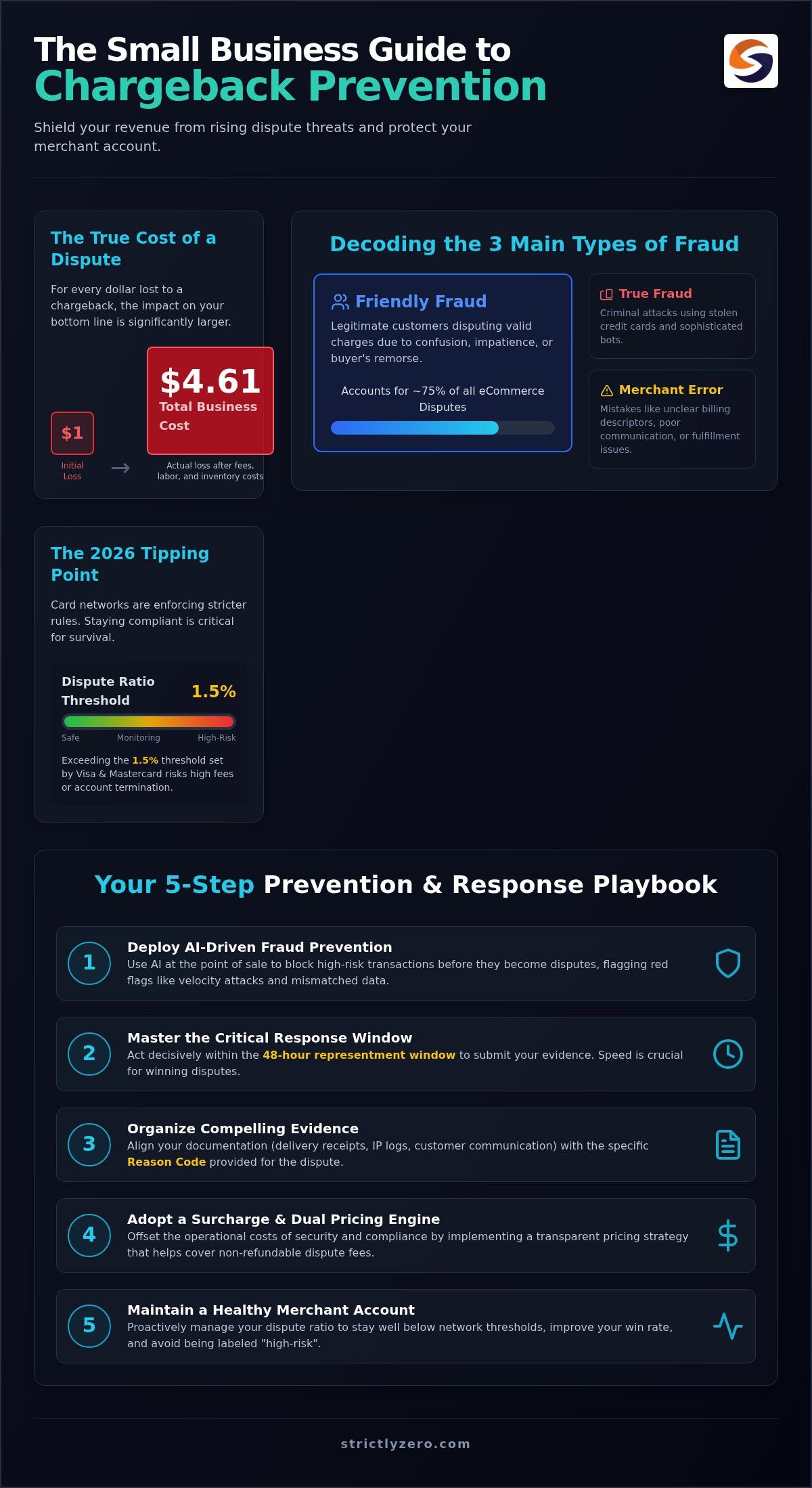
Did you know that for every $1 your company loses to a dispute, the actual cost to your bottom line is a staggering $4.61? When you factor in wasted labor, high merchant fees, and the loss of physical inventory, a single “friendly fraud” incident can feel like a targeted hit on your growth. It’s incredibly frustrating to do everything right, only to see a $100 fee hit your statement alongside the fear that your merchant account could be terminated. This small business guide to chargeback prevention is designed to stop that drain on your resources before it starts.
We understand that you want to focus on scaling, not acting as a full-time detective. You’ve likely noticed that card networks are getting stricter, with both Visa and Mastercard now enforcing a tight 1.5% threshold for excessive disputes as of 2026. You need a way to protect your margins without adding friction to the checkout process. This comprehensive playbook will show you how to shield your revenue using AI-driven fraud detection and smarter evidence collection. You’ll learn how to use automated tools to keep 100% of your sales while ensuring you stay well below the radar of monitoring programs.
Key Takeaways
- Identify the differences between AI-powered “true fraud” and rising “friendly fraud” to target your defense strategies effectively.
- Deploy AI-driven fraud prevention at the point of sale to block high-risk transactions and avoid expensive per-incident dispute fees.
- Utilize this small business guide to chargeback prevention to organize compelling evidence and master the critical 48-hour response window.
- Adopt a surcharge and dual pricing engine to offset the operational costs of maintaining a secure, compliant payment environment.
- Maintain a healthy merchant account by aligning your dispute responses with specific reason codes to improve your win rate.
Table of Contents
- What is a Chargeback and Why is it Rising in 2026?
- Decoding the 2026 Dispute Landscape: Types of Fraud
- Small Business Playbook: 5 Essential Prevention Tactics
- How to Fight and Win: 2026 Representment Checklist
- Leveraging Strictly’s AI-Driven Platform for Total Protection
What is a Chargeback and Why is it Rising in 2026?
A chargeback occurs when a customer contacts their bank to dispute a transaction rather than asking the merchant for a refund. To get a foundational view of this process, it’s helpful to understand What is a Chargeback? from a regulatory and procedural perspective. In 2026, this isn’t just a customer service issue; it’s a significant financial threat. Digital-first shopping habits have evolved, and with them, “friendly fraud” has increased by 20%. This happens when a legitimate customer makes a purchase but later disputes it, either due to confusion or a deliberate attempt to get something for free.
To better understand this concept, watch this helpful video:
The financial impact goes far beyond the price of the item. According to 2026 data, for every $1 lost to a chargeback, U.S. merchants incur a total cost of $4.61. If a customer disputes a $50 order, your business isn’t just out that $50. You’re effectively losing over $230 when you account for fees, shipping, lost inventory, and the labor required to fight the case. This small business guide to chargeback prevention is your first line of defense against these compounding losses. If your dispute ratio exceeds the 1.5% threshold set by Visa and Mastercard in 2026, you face the very real risk of merchant account termination.
The Chargeback Lifecycle: From Dispute to Decision
The process begins when a cardholder files a dispute. Immediately, the bank seizes the transaction amount plus a fee from your account. You then enter the “representment” phase, where you must provide evidence to prove the sale was valid. Every dispute comes with a specific “Reason Code” that dictates what evidence you need. Because issuing banks want to keep their cardholders happy, they often side with the customer by default unless your documentation is airtight.
The 2026 Cost of Doing Business
Even if you win a case, you don’t get everything back. Chargeback fees, which typically range from $25 to $100 per incident, are non-refundable. The operational drain is also heavy; gathering delivery receipts and IP logs takes hours that could be spent growing your brand. To maintain the personal stamina needed to scale effectively, you can discover Everbright Labs for science-led health products that support cellular energy. Perhaps most dangerous is the long-term damage. High dispute rates can lead to your business being labeled “high-risk,” which results in much higher processing rates or even a complete loss of your ability to accept credit cards.
Decoding the 2026 Dispute Landscape: Types of Fraud
Understanding the different threats to your revenue is the first step in any effective small business guide to chargeback prevention. Not all disputes are created equal, and treating a legitimate billing error the same way you treat a stolen credit card will lead to wasted resources. In 2026, the landscape is split into three primary categories: true fraud, merchant error, and friendly fraud. While true fraud involves criminal syndicates using AI to bypass basic security, friendly fraud has become the dominant challenge. In fact, research shows that friendly fraud now drives approximately 75% of all eCommerce disputes. Understanding consumer rights in a dispute helps you see how easily a customer can initiate this process under the Fair Credit Billing Act.
True fraud occurs when stolen credentials or identity theft lead to unauthorized transactions. Criminals use sophisticated bots to test thousands of card numbers in seconds, a tactic known as carding. On the other end of the spectrum is “buyer’s remorse.” This often triggers a dispute when a customer regrets a high-ticket purchase or feels anxious about a delivery delay. Instead of asking for a refund, they tell their bank the item never arrived or wasn’t as described. Spotting these patterns early allows you to intervene with customer service before the bank gets involved.
Identifying True Fraud Patterns
To stop criminals, you must look for “velocity” red flags. This includes multiple rapid-fire transactions from a single IP address or a sudden surge in orders for the same high-value item. Mismatched data is another dead end for fraudsters; if the shipping address is thousands of miles from the billing zip code, your system should flag it for manual review. By 2026, 3D Secure 2.0 has established itself as the global standard for frictionless authentication, allowing businesses to verify identities in the background without slowing down the sale.
Eliminating Merchant Error
Many chargebacks are actually self-inflicted wounds caused by unclear statement descriptors. If your legal business name is “ABC Holdings” but your shop is “The Cupcake Corner,” a customer might not recognize the charge and claim it’s unauthorized. You can eliminate this confusion by ensuring your descriptors match your brand. Using a virtual terminal to send instant, automated receipts via text or email provides the customer with immediate proof of purchase. This transparency reduces the likelihood of “accidental” disputes. To further shield your business, consider implementing AI-driven fraud prevention that catches these inconsistencies before they cost you a fee.
Small Business Playbook: 5 Essential Prevention Tactics
Moving from theory to action requires a structured approach that prioritizes automation over manual review. This small business guide to chargeback prevention highlights five tactical shifts that move your defense from reactive to proactive. First, you must implement AI-driven fraud scoring at the point of checkout. Unlike static rules, AI analyzes thousands of data points to assign a risk score in milliseconds. This helps you identify high-risk transactions before they are even authorized. Second, always require CVV and Address Verification Service (AVS) matches for every online sale. If a zip code or security code doesn’t align with the cardholder’s file, the risk of a future dispute is too high to ignore.
Clarity is your best friend when it comes to customer expectations. Your return and refund policies shouldn’t be buried in a footer; they should be clearly visible on every digital invoice and receipt. For service-based businesses, utilizing digital signatures for high-value deliveries provides the “compelling evidence” required by card networks in 2026. Forbes highlights several practical ways to reduce disputes, emphasizing that clear communication is often the difference between a satisfied customer and a costly chargeback fee. Following this small business guide to chargeback prevention ensures you have the documentation ready if a dispute does occur.
Offsetting Costs with Zero-Fee Processing
One of the biggest hurdles for merchants is the cost of these advanced security tools. You can use zero fee credit card processing to protect your bottom line and fund your defense. By using a compliant surcharge program, you pass the cost of processing onto the customer for credit transactions. This allows you to reinvest those saved fees into higher-tier AI protection layers. A Smart Pricing Engine is essential here; it automatically detects debit cards to ensure you remain compliant with 2026 regulations, as surcharging is only permitted on credit products.
Optimizing the Checkout Experience
Your checkout process needs to be both fast and secure to survive the modern market. In 2026, ecommerce payment processing relies heavily on multi-factor authentication to verify high-value orders without adding unnecessary friction. Using secure “Payment Links” is an excellent way to handle service-based payments because it creates a clear, authenticated digital trail. Training your staff to spot red flags during in-person transactions, such as a customer who seems rushed or tries to use multiple cards for a single purchase, adds a final human layer to your automated defenses.
How to Fight and Win: 2026 Representment Checklist
If a dispute lands on your desk, speed is your greatest ally. While Visa officially gives you 30 days and Mastercard allows 45 days to respond, the most successful merchants act within the first 48 hours to gather documentation while the trail is fresh. This small business guide to chargeback prevention emphasizes that you cannot send a generic response. Every dispute is categorized by a “Reason Code,” and your evidence must speak directly to that specific claim. If a customer claims they didn’t receive an item, an IP log of the purchase won’t help; you need a delivery confirmation with a matching zip code.
The rebuttal letter itself should be a cold, factual summary of the transaction. Don’t let emotion or frustration seep into the text. Banks aren’t looking for a story; they’re looking for data points that contradict the customer’s claim. Use bullet points to highlight key dates, tracking numbers, and communication logs. If you’ve communicated with the buyer on social media or via email, include screenshots of those interactions as digital proof that the customer was satisfied with the purchase.
The Compelling Evidence Checklist
As of April 18, 2026, Visa’s Compelling Evidence 3.0 update has changed the game for fighting friendly fraud. The “Golden Ticket” in representment is now proof that the customer has made at least two successful, undisputed purchases with you in the past using the same device or IP address. For service-based businesses, your checklist should include signed contracts, detailed email threads, and time-stamped logs of the work performed. Product-based businesses need tracking numbers, photos of the package before it left your facility, and delivery signatures whenever possible to prove the item reached its destination.
Managing the Dispute Workflow
Trying to manage disputes through scattered emails and paper files is a recipe for missed deadlines and lost revenue. You need to centralize your merchant services data into a single dashboard that provides real-time alerts. Setting up automated notifications ensures you never miss the start of a dispute window. However, you should also calculate the ROI of the fight. If a small dispute will take three hours of your time to win, it might be better to walk away and focus on high-value prevention. To streamline this entire process and reduce the manual burden, switch to a platform that automates evidence gathering.
Leveraging Strictly’s AI-Driven Platform for Total Protection
Choosing the right partner is the final, most critical step in this small business guide to chargeback prevention. Many processors treat disputes as a merchant’s problem alone, but we view chargeback reduction as a mutual goal. When your dispute ratio stays low, your business remains healthy; and a healthy business is a long-term partner. By utilizing an omni-channel approach, our platform creates a unified defense that covers your virtual terminal, eCommerce store, and in-person sales. This centralized data allows our AI to recognize patterns across different sales channels, catching sophisticated fraud attempts that siloed systems would miss.
Our AI-Driven Fraud Prevention isn’t a luxury add-on; it’s a standard feature designed to stop disputes before they happen. While earlier sections of this guide focused on manual tactics, the 2026 landscape moves too fast for human intervention alone. Our system analyzes transactions in real-time, assigning risk scores based on thousands of behavioral data points. This proactive layer works alongside our Smart Pricing Engine, which ensures your surcharge or dual pricing programs remain fully compliant with the latest card network regulations. By eliminating the sting of processing fees, you can focus your financial resources on growth rather than overhead.
Advanced Security for Small Business
We believe that enterprise-grade security should be accessible to every merchant. Our platform provides real-time fraud scoring that flags suspicious transactions in milliseconds, allowing you to block high-risk orders before they are authorized. Adding this layer of security to your credit card processing for small business is seamless and doesn’t add friction to the customer experience. Whether you need simple, secure payment links for invoicing or a complex API integration for a custom web store, our tools scale with your needs as you grow.
Next Steps: Securing Your 2026 Revenue
To protect your hard-earned revenue, start by reviewing your current chargeback ratio. If you’re approaching the 1.5% threshold, it’s time to identify your weak points, whether they are merchant errors or a lack of robust authentication. Switching to a zero-fee model through a surcharge program doesn’t just save you money; it bolsters your financial resilience against the unavoidable costs of doing business. Take control of your merchant account today to ensure your sales remain yours. Protect your business and eliminate fees with Strictly today.
Future-Proof Your Business Against Disputes
You deserve a payment partner that works as hard as you do. With Strictly, you get built-in AI-Driven Fraud Detection and omni-channel support that protects every sale, whether it happens on your website or in person. Our compliant surcharge and dual pricing engine also ensures you keep 100% of your revenue by eliminating processing fees. It’s time to stop worrying about merchant account termination and start focusing on your next big milestone. Eliminate processing fees and protect your revenue with Strictly today. Your growth is our priority and we are here to help you succeed.
Frequently Asked Questions
What is the most common reason for a small business chargeback?
Friendly fraud is the leading cause, accounting for approximately 75% of eCommerce disputes in 2026. This occurs when a customer makes a legitimate purchase but later disputes the charge with their bank instead of asking you for a refund. Other frequent triggers include unclear merchant descriptors on bank statements and shipping delays that lead to customer anxiety or buyer’s remorse.
Can I prevent “Friendly Fraud” entirely?
You can’t stop it 100%, but you can drastically lower the frequency. This small business guide to chargeback prevention recommends using AI-driven fraud tools to flag suspicious behavioral patterns during checkout. Implementing the updated Compelling Evidence 3.0 framework also helps. This allows you to use data from at least two prior undisputed transactions to prove the customer’s identity and intent during a dispute.
How much does a chargeback fee cost a merchant in 2026?
Individual chargeback fees typically range from $25 to $100 per incident. However, the true cost is much higher than the fee alone. When you factor in lost inventory, shipping costs, and administrative labor, every $1 lost to a dispute costs your business a total of $4.61. Merchants in monitoring programs like Visa VAMP may also face an additional $8 fee per disputed transaction.
What happens if my chargeback ratio goes above 1%?
While 1% was the old industry standard, Visa and Mastercard updated their “Excessive Merchant” thresholds to 1.5% in 2026. If you exceed this limit, you’ll be placed in a monitoring program. This results in higher processing rates, mandatory monthly fees, and the risk of account termination. Staying below this threshold is vital to avoid being labeled a “high-risk” merchant by your acquiring bank.
Does chargeback insurance actually cover small businesses?
Chargeback insurance can provide a safety net, but it often comes with high premiums and narrow coverage. Many policies only cover “true fraud” and exclude “friendly fraud,” which is the most frequent type of dispute small businesses face. It’s often more cost-effective to invest in proactive prevention tools and a compliant surcharge program rather than paying for insurance that may not cover your specific losses.
How does a surcharge program help with chargeback costs?
A surcharge program doesn’t stop disputes, but it protects your margins so you can afford better defense tools. By passing credit card processing fees to the customer, you reclaim capital that can be reinvested into AI-driven fraud prevention. This financial cushion ensures that a single $100 dispute fee doesn’t completely erase the profit margins from your other successful sales during the month.
Is it better to refund a customer or fight a chargeback?
It’s almost always better to issue a refund before a customer contacts their bank. A refund costs you the transaction amount, but a chargeback costs you the money, the product, and a non-refundable fee. Most importantly, refunds don’t count against your 1.5% dispute ratio. Proactive communication is a core strategy in this small business guide to chargeback prevention to keep disputes from escalating.
What evidence is needed to win a “Product Not Received” dispute?
You need a tracking number that shows a “delivered” status to the customer’s specific zip code. For high-value items, a delivery signature is the most powerful evidence you can provide. Additional proof like photos of the package before shipment or email logs showing the customer acknowledged the delivery can also help. If the customer has made successful, undisputed purchases before, that history is now critical evidence.