
Square Credit Card Processing Fees: 2026 Guide and Zero-Fee Alternatives
Published:

Square’s flat-rate pricing was once the gold standard for simplicity, but in 2026, that convenience has transformed into a heavy tax on your bottom line. With online transaction fees climbing to 3.3% plus $0.30 and manual entries hitting 3.5%, many merchants are watching their profit margins evaporate under the weight of square credit card processing fees. It’s exhausting to feel like you’re working for your processor instead of your business, especially when you have no control over these rising costs.
You deserve a payment strategy that protects your revenue rather than draining it. This guide will demystify Square’s 2026 fee structure and show you exactly how to pivot toward a more profitable model. You’ll learn how to implement a compliant surcharge or dual pricing program that can effectively bring your processing costs down to zero. We’ll explore how an omni-channel platform with a built-in smart pricing engine ensures you stay compliant with state-by-state regulations while finally reclaiming your hard-earned margins.
Key Takeaways
- Understand the 2026 updates to square credit card processing fees, including the new 3.3% baseline for online transactions and increased fixed costs for in-person sales.
- Identify the “break-even” volume of $10,000 per month where Square’s flat-rate model begins to cost your business significantly more than an interchange-plus alternative.
- Learn why Square’s current surcharge limitations and beta status make it difficult to recoup costs on virtual terminals or mobile payments without risking account suspension.
- Discover how to implement a compliant “Zero-Fee” program that uses automated state-by-state logic to eliminate processing costs across all sales channels.
- Explore the benefits of moving to an omni-channel platform that integrates AI-driven fraud prevention and automated partner compensation into your payment workflow.
Table of Contents
- Comprehensive Breakdown of Square Credit Card Processing Fees in 2026
- The Convenience Tax: Why Square's Simple Pricing Costs More Long-Term
- Square Surcharging vs. Professional Zero-Fee Programs
- Is Your Business Ready to Move Beyond Square?
- Eliminating Processing Fees with Strictly’s Smart Surcharge Engine
Comprehensive Breakdown of Square Credit Card Processing Fees in 2026
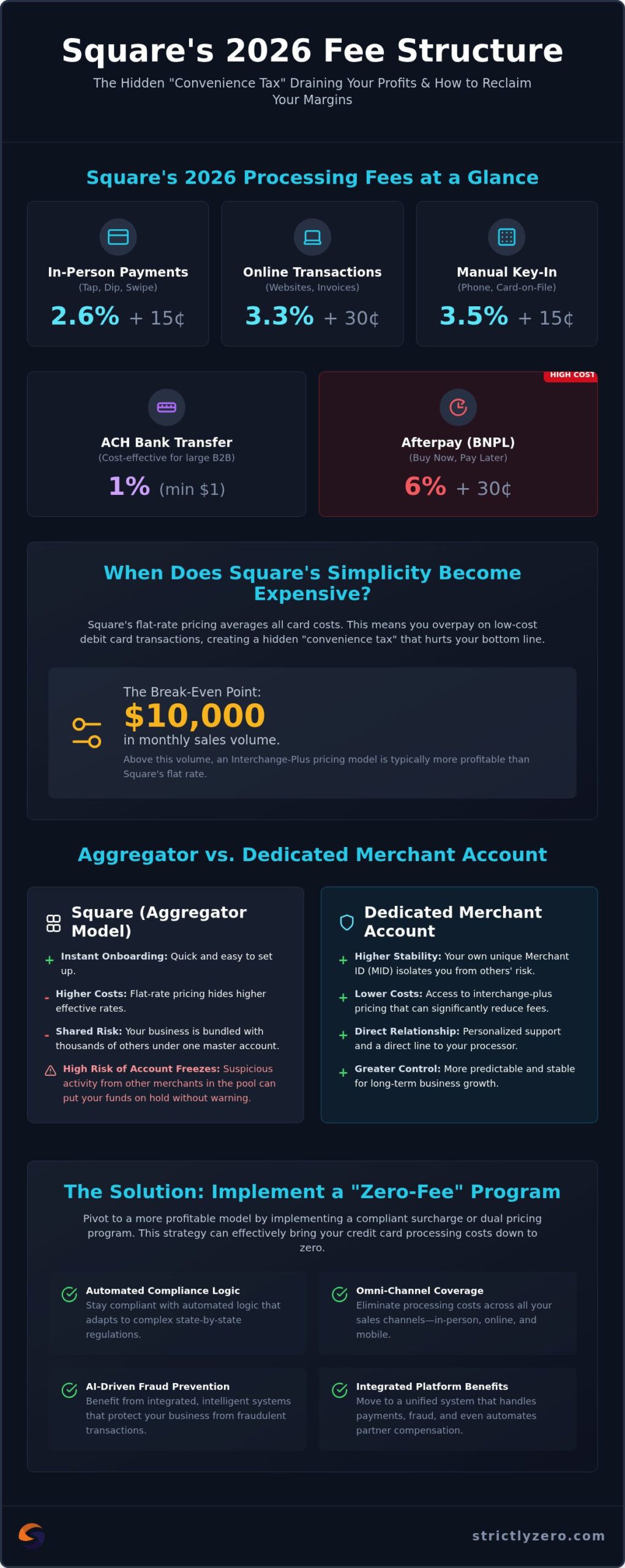
Square’s reputation for simplicity often masks a growing financial burden for small businesses. In 2026, the baseline for square credit card processing fees sits at 2.6% plus 15¢ for every tapped, dipped, or swiped transaction. While a 5¢ increase in the fixed fee might seem small, it adds up quickly for high-volume coffee shops or retail boutiques with small average tickets. If you move your business online or send invoices, the cost jumps to 3.3% plus 30¢ on the standard Free plan. This reflects a significant increase from previous years, making web-based sales a primary driver of shrinking margins.
Manual entry transactions remain the most expensive category at 3.5% plus 15¢. This rate applies whenever you key in a card number or use a card-on-file for recurring billing. For service providers like HVAC technicians or consultants who often take payments over the phone, these square credit card processing fees for non-swiped transactions can consume a massive portion of the total revenue.
Square’s 2026 Rate Schedule by Transaction Type
Understanding the nuances of each payment method is vital for controlling your overhead. Beyond standard card payments, Square offers specialized services with their own price tags. For instance, ACH bank transfers cost 1% per transaction with a $1 minimum, which is a cost-effective choice for large B2B invoices. However, if you offer Buy Now, Pay Later options through Afterpay, you’ll pay a steep 6% plus 30¢. This high cost for consumer financing can be a shock to merchants who don’t realize the markup involved in installment payments.
The Difference Between Square Free and Square Plus
To mitigate high transaction costs, Square offers a Plus plan at $49 per month and a Premium plan at $149 per month. On the Plus plan, in-person rates drop to 2.5% plus 15¢, while online rates fall to 2.9% plus 30¢. This creates a volume threshold where you must process enough monthly sales to justify the subscription fee. Most businesses don’t reach the break-even point until they surpass approximately $25,000 in monthly volume; below that, you’re simply paying a monthly fee for a marginal discount. Much of this structure is tied to Square’s business model as a payment aggregator. An aggregator model bundles thousands of merchants under a single master account, which simplifies onboarding but often leads to higher flat-rate costs and increased risk of sudden account freezes compared to a dedicated merchant account.
The Convenience Tax: Why Square’s Simple Pricing Costs More Long-Term
Flat-rate pricing is often marketed as the ultimate solution for small business owners who want to avoid complex math. However, this simplicity comes with a hidden “convenience tax.” By charging a single percentage for every transaction, Square effectively averages out the cost of all card types. This means when a customer pays with a basic debit card that costs very little to process, you’re still paying the full premium rate. For businesses with thin margins, such as retail shops, grocery stores, or HVAC contractors, losing 3% or more of every sale to square credit card processing fees isn’t just an expense; it’s a direct hit to your ability to scale.
Another overlooked cost is the link between “free” software and expensive processing. Many merchants choose Square because the point-of-sale software doesn’t have a monthly fee. But this software is essentially a loss leader designed to lock you into a proprietary ecosystem where you cannot shop around for better rates. Over time, the thousands of dollars lost to high transaction fees far outweigh the cost of a professional, dedicated software suite.
Aggregators vs. Dedicated Merchant Accounts
Square operates as a payment aggregator, which means it groups your business with thousands of others under one master merchant ID. While this allows for instant setup, it introduces significant stability risks. If other businesses in your “group” see a spike in fraud or chargebacks, the aggregator may freeze accounts across the board to mitigate risk. In contrast, a dedicated merchant account provides you with your own unique identifier and a direct relationship with the processor. This structure offers much higher levels of account stability and personalized support. If you want to understand the full landscape of your options, check out our Credit Card Processing for Small Business: The 2026 Essential Guide.
Calculating Your True Effective Rate
To find out what you’re actually paying, you need to calculate your effective rate. You do this by dividing your total processing fees by your total sales volume. While the marketing materials focus on a 2.6% baseline, many merchants find their real-world cost is much higher. This happens because corporate cards, international cards, and rewards-heavy credit cards often carry higher interchange costs that the aggregator passes on to you through their flat-rate buffer. An analysis of Square’s processing fees shows that once a business surpasses $10,000 in monthly sales, the “simple” model usually results in paying 0.5% to 1% above current market rates.
If you’re tired of watching your margins erode, it might be time to look at a zero-fee alternative that uses a smart pricing engine to eliminate these costs entirely.
Square Surcharging vs. Professional Zero-Fee Programs
Square’s attempt to help merchants offset square credit card processing fees through its surcharge beta is a step in the right direction, but it remains severely limited. Currently, Square’s surcharging capabilities are restricted to in-person transactions. This means if your business relies on a virtual terminal for phone orders or an e-commerce store for online sales, you’re still forced to absorb those high 3.3% or 3.5% rates. This fragmented approach leaves a massive hole in your profitability strategy and creates an inconsistent experience for your customers.
Compliance is another major hurdle that manual setups often fail to clear. Federal and card brand rules are strict; you cannot legally surcharge debit or prepaid cards. If your system can’t distinguish between a credit and debit card instantly, you’re likely violating merchant agreements. Manually managing these rules is a recipe for legal trouble, especially since states like Connecticut, Massachusetts, and Maine have outright bans on surcharging. A professional credit card processor comparison often reveals that while aggregators offer ease of use, they lack the sophisticated, automated compliance tools needed for true fee elimination.
Automated Surcharge Compliance in 2026
Modern merchants are moving toward automated systems that remove the guesswork from fee management. A Smart Pricing Engine acts as a gatekeeper, identifying the card type in real-time. If a customer dips a debit card, the system automatically bypasses the surcharge to keep you compliant with Visa and Mastercard rules. It also manages state-by-state rule automation, ensuring you don’t accidentally charge a fee in a restricted jurisdiction. For a deeper dive into how this works, read our Zero Fee Credit Card Processing: The 2026 Merchant Guide to $0 Fees.
Dual Pricing: The Modern Alternative to Surcharging
Dual pricing has emerged as the most robust way to reach $0 in processing costs without the friction of a surcharge. Instead of adding a line item at the end of a transaction, you present a “Cash Price” and a “Card Price” for every item. This model is often more palatable to consumers because it frames the lower price as a discount for cash or debit users rather than a penalty for credit card users. Because dual pricing doesn’t technically involve a surcharge on a specific card type, it elegantly solves the debit card compliance headache. It provides a clear, transparent path to eliminating your square credit card processing fees across every sales channel, from your physical storefront to your mobile app.
Is Your Business Ready to Move Beyond Square?
Graduating from a flat-rate model is a natural part of business growth. While Square is an excellent entry point for new ventures, its utility often peaks once a merchant hits a specific volume milestone. In 2026, processing more than $10,000 per month is the clear signal that you’ve outgrown the aggregator model. At this level, the spread between what you pay in square credit card processing fees and the actual cost of interchange becomes a significant leak in your cash flow. It’s no longer just a small expense; it’s a barrier to hiring your next employee or expanding your inventory.
Moving beyond basic retail tools requires advanced features like professional virtual terminals, automated recurring billing, and deep API integrations. Many growing businesses find that Square’s ecosystem, while user-friendly, can be restrictive for those needing custom payment workflows. Don’t let the “switching cost” myth hold you back. Modern transitions to a dedicated processor are often completed in a few days, not weeks, and rarely involve the technical headaches merchants fear. Communicating this shift to your customers is also simpler than you might expect. Most consumers understand that small businesses need to manage costs, and being transparent about a move to a zero-fee model actually builds trust.
Evaluating Your Omni-Channel Needs
As you scale, your payment needs become more complex. You might need to accept payments via phone, secure links, and your website simultaneously. A unified dashboard is essential for tracking these disparate streams without losing your mind in spreadsheets. Complementing your payment data with a solution like 123Corporation2023 ensures that tax-related expenses for landlords and small businesses are also tracked seamlessly, providing a complete picture of financial health. Unlike Square’s closed-loop system, an API-first approach allows you to plug payment processing into your existing software stack without friction. This flexibility is vital for businesses that want to maintain their brand identity while scaling their operations across multiple channels without being locked into a single vendor’s hardware or software limitations.
Protecting your bottom line starts with identifying “fee leaks” on your processing statements, such as high-cost manual entries or unoptimized international card rates. These small percentages add up to thousands of dollars over a fiscal year. Implementing POS lending can also help by providing customers with financing options for high-ticket items, which often offsets the psychological barrier of card fees for larger purchases. Zero-fee models protect net profit during inflationary periods by shifting the rising cost of card acceptance away from the business owner. If you’re ready to stop paying for your customers’ rewards points and start keeping more of what you earn, it’s time to explore a more sustainable payment model.
Eliminating Processing Fees with Strictly’s Smart Surcharge Engine
While Square is built to collect fees, Strictly is engineered to eliminate them. This fundamental difference is why many high-volume merchants are making the switch. Instead of being stuck with a flat-rate model where square credit card processing fees take a predictable but painful chunk of every sale, you can leverage a Smart Pricing Engine. This technology automates the entire zero-fee process by identifying card types in real-time. It ensures that credit card surcharges are applied correctly while automatically bypassing debit cards to keep your business in total compliance with card brand rules.
The Strictly advantage lies in its omni-channel flexibility. Unlike Square’s current limitations that often restrict surcharging to specific in-person apps, Strictly allows you to implement fee-free models across e-commerce platforms, mobile devices, and virtual terminals. This is backed by “Compliance as a Service,” which means the platform handles automated state-by-state legal updates for you. You don’t have to worry about changing regulations in New York or Colorado; the system adjusts itself to keep your processing legal and your margins protected. By moving from an aggregator to a dedicated payment processor, you also gain AI-driven fraud prevention and a level of account stability that Square’s shared model simply can’t match.
The Strictly Zero-Fee Implementation Process
Integrating a zero-fee model into your business is designed to be a friction-free experience. You can plug Strictly into your existing web or mobile workflow using an API-first architecture, allowing for a customized checkout that reflects your brand. Setting up dual pricing is a popular choice for merchants who want to offer a “Cash Price” and a “Card Price,” creating a transparent environment for the customer. To help you manage the broader health of your business, you can utilize tools like ChurnIQ™ for merchant retention and ClearSplit™ for automated partner compensation. These features ensure that as you eliminate fees, you’re also optimizing your internal operations for long-term growth.
Taking the Next Step Toward $0 Fees
If you’re ready to see the numbers for yourself, you can request a comprehensive cost savings analysis. This side-by-side comparison shows exactly how your current square credit card processing fees stack up against a zero-fee model. For many businesses, setting up a virtual terminal for immediate fee-free processing is the fastest way to reclaim lost revenue on phone and invoice orders. It’s time to stop treating processing costs as an unavoidable tax and start treating them as a controllable variable. Scale your business and eliminate fees with Strictly to ensure your net profit stays in your bank account where it belongs.
Reclaim Your Profit Margins in 2026
Square’s simple pricing model served its purpose when you first launched, but as your business scales, the cost of that simplicity becomes harder to justify. Navigating the 2026 landscape of square credit card processing fees requires more than just accepting the status quo. It demands a proactive strategy that uses automation to protect your bottom line. By shifting to a model that leverages a compliant Smart Pricing Engine, you can eliminate these costs across every sales channel while keeping your business safe from complex regulatory risks.
You don’t have to settle for shrinking margins or unpredictable aggregator risks. With a unified omni-channel platform and AI-driven fraud prevention, you can focus on scaling your operations instead of deciphering merchant statements. Eliminate your processing fees today with Strictly and take full control of your revenue. Your business deserves a payment partner that works as hard for your profit as you do. It’s time to stop absorbing the cost of doing business and start keeping every dollar you earn.
Frequently Asked Questions
What are the Square credit card processing fees for 2026?
Square’s standard rates for 2026 depend on how the transaction is processed. For in-person payments like taps, dips, or swipes, you’ll pay 2.6% plus $0.15 per transaction. Online payments through invoices or e-commerce checkouts are higher at 3.3% plus $0.30. If you manually key in a card number, the rate reaches 3.5% plus $0.15. These square credit card processing fees represent the baseline for their standard Free plan users.
Can I pass Square’s credit card fees to my customers?
Square’s current terms of service generally restrict your ability to add a surcharge to transactions. While they’ve introduced a limited surcharge beta for in-person payments, it doesn’t support online sales, virtual terminals, or mobile invoices. Attempting to add a manual surcharge outside of their specific beta tools could lead to account suspension. Most merchants find that a dedicated processor with a built-in surcharge engine provides a more stable way to recoup these costs.
What is the difference between a surcharge and dual pricing?
A surcharge is an additional fee added to a credit card transaction at the checkout to cover processing costs. Dual pricing is a model where you present two different prices for every item: a “Card Price” and a “Cash Price.” Many customers prefer dual pricing because it frames the lower cost as a discount for cash or debit users rather than a penalty for using a credit card. Both methods help eliminate fees effectively.
Is it legal to add a surcharge to credit card transactions in every state?
Surcharging is legal in most of the U.S., but there are important exceptions you must know. As of 2026, states like Connecticut, Massachusetts, and Maine have outright bans on surcharging credit cards. Other states have specific disclosure requirements or caps on the amount you can charge. It’s vital to use a payment platform that offers automated state-by-state compliance to ensure you don’t accidentally violate local laws when processing payments from different regions.
How does Strictly’s zero-fee model differ from Square’s pricing?
Strictly’s model is designed to eliminate costs rather than just simplify them. While square credit card processing fees are flat rates that you must pay out of your own pocket, Strictly uses a Smart Pricing Engine to shift those costs to the cardholder. This system works across all channels, including virtual terminals and websites. Unlike Square’s aggregator model, Strictly provides a dedicated merchant account with AI-driven fraud prevention and more personalized support for growing businesses.
Does Square charge a monthly fee in addition to transaction fees?
Square offers a “Free” plan with no monthly subscription cost, but they also provide paid tiers for businesses needing more features. The Square Plus plan costs $49 per month per location and offers slightly lower transaction rates for in-person and online sales. There’s also a Premium plan at $149 per month. For many merchants, these monthly fees only make sense if their processing volume is high enough that the fractional rate savings exceed the subscription cost.
Can I surcharge debit card transactions with Square?
No, you cannot legally surcharge debit card transactions under Visa and Mastercard rules, even if the card is run as “credit.” This rule applies to all processors, including Square. If you attempt to add a fee to a debit transaction, you risk heavy fines or losing your merchant account entirely. A professional zero-fee system will automatically detect the card type and only apply a fee to credit cards, ensuring your business stays compliant with card brand regulations.
How can I calculate my savings if I switch from Square to a zero-fee processor?
To find your potential savings, you first need to determine your “effective rate.” Divide your total monthly processing fees by your total sales volume. Many Square users find their real cost is much higher than 2.6% due to expensive manual entries and online transactions. By switching to a zero-fee model, you can bring that effective rate down to near zero. You can request a professional cost savings analysis to see the exact impact on your net profit.