
Surcharge Laws by State: The 2026 Merchant Guide to Compliance
Published:

What if the fee you’re charging to offset processing costs is actually a ticking legal time bomb? Most merchants feel the sting of interchange fees that can reach 3.5% per sale, and it’s only natural to want to protect your margins. However, the shifting landscape of surcharge laws by state has turned a simple business decision into a complex legal puzzle. You’re likely exhausted from trying to track whether your checkout process in New York matches the latest 2026 mandates in California or the strict bans still active in Connecticut and Massachusetts.
We understand that you’d rather focus on growth than manual compliance research. This guide provides the definitive roadmap you need to navigate these regulations with confidence. We’ll give you a clear “Yes/No” breakdown for every state, explain the current 3% cap enforced by major card brands, and show you how to automate your pricing to avoid heavy legal fines. By the end of this article, you’ll know exactly how to implement a zero-fee model that keeps you safe from audits and manual errors. It’s time to stop worrying about conflicting court rulings and start using a pricing strategy that works for your bottom line.
Key Takeaways
- Understand the major shift in 2026 regulations as more states transition from total bans to complex regulatory frameworks for credit card fees.
- Access a definitive 2026 breakdown of surcharge laws by state to identify exactly where you can legally pass on processing costs to your customers.
- Learn why card brand rules now enforce a strict 3% cap on surcharges and how to properly notify networks to avoid costly audits.
- Discover why dual pricing has emerged as the “gold standard” for national compliance across all 50 states compared to traditional surcharging models.
- See how automating your checkout with a smart pricing engine eliminates the manual burden of tracking fifty different sets of state rules.
Table of Contents
- Understanding Credit Card Surcharge Laws: The 2026 Landscape
- Surcharge Laws by State: The 2026 Compliance Map
- Card Brand Rules: Visa and Mastercard Requirements
- Surcharging vs. Dual Pricing: Which Strategy Wins?
- Automate Your Compliance with Strictly’s Smart Pricing Engine
Understanding Credit Card Surcharge Laws: The 2026 Landscape
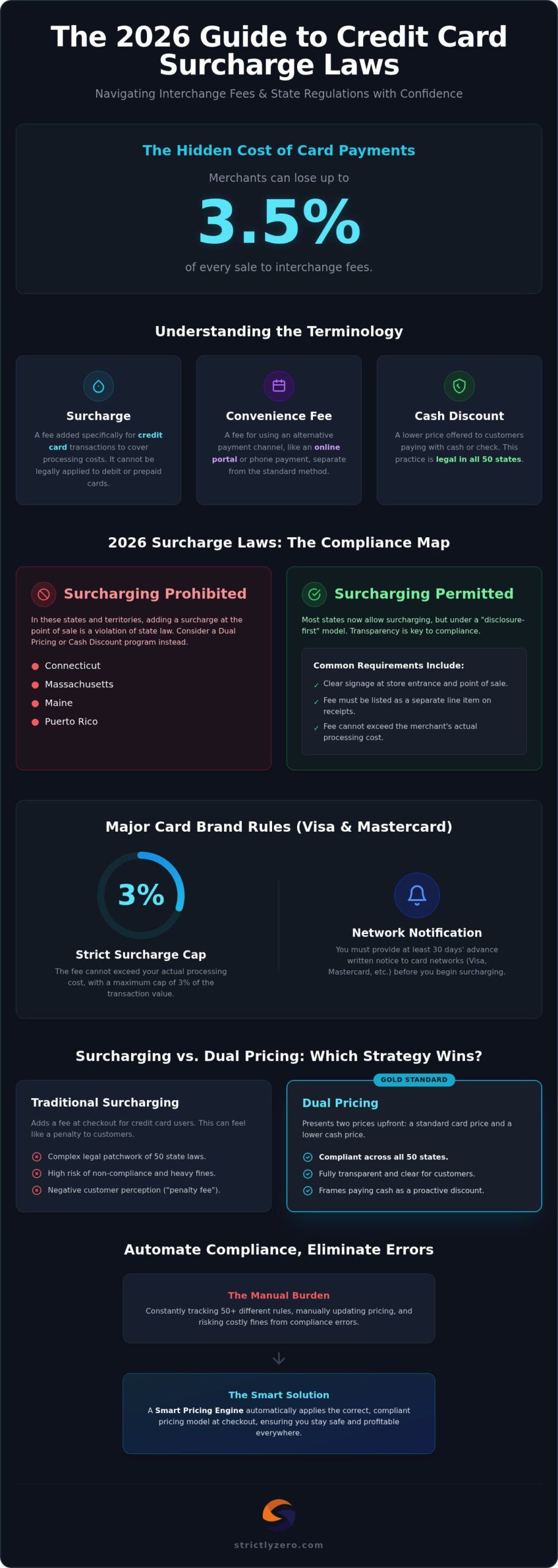
A surcharge is a fee that you, as a merchant, add to a credit card transaction to cover the cost of processing. In the past, these fees were often prohibited by state law or card network rules, but 2026 marks a significant turning point in the “Zero Fee” revolution. Most businesses now pay a substantial interchange fee on every swipe; these costs can eat up to 3.5% of your total revenue. To combat this, more states are shifting their stance on surcharge laws by state, moving away from outright bans and toward regulated transparency that allows businesses to protect their margins.
To better understand the legal foundations of these fees, watch this educational overview:
The shift toward widespread acceptance started with a massive 2013 court settlement between merchants and card networks, followed by several Supreme Court rulings. These legal battles established that merchants have a right to pass on costs, provided they follow strict disclosure rules. Instead of banning the practice, many states now focus on how you communicate the price to your customers. This change allows you to reach a true “Zero Fee” model, where the cost of processing is no longer an expense on your balance sheet but a cost covered by the transaction itself. However, staying compliant requires more than just adding a fee; it requires understanding the specific nuances of your local jurisdiction.
Surcharge vs. Convenience Fee vs. Cash Discount
It’s easy to mix these terms up, but the legal differences are vital for compliance. Surcharges apply specifically to credit card transactions. You can’t legally apply them to debit or prepaid cards, even if they’re run as “credit” at the terminal. Convenience fees are different; they’re charged for the privilege of using a specific payment channel, such as an online portal, rather than a physical storefront. Finally, cash discounts involve offering a lower price to customers who pay with cash or check. This practice is legal in all 50 states and remains the simplest way to avoid the complexities of surcharge laws by state while still reducing your overhead.
Why Surcharge Laws Are Changing Rapidly
Court cases like Expressions Hair Design v. Schneiderman changed the legal landscape by framing surcharge bans as free speech issues. The Supreme Court ruled that these bans often restricted merchant speech by dictating how prices were displayed. Consequently, states like New York and California have recharacterized their old bans as “price disclosure” requirements. They now require you to show the total price including the fee rather than hiding it until the final step of checkout. There’s also a growing trend of states capping these fees at your actual cost of processing. This prevents merchants from profiting off the fee and ensures the system remains fair for consumers. Using a Smart Pricing Engine can help you stay on the right side of these shifting rules without the burden of manual research.
Surcharge Laws by State: The 2026 Compliance Map
The legal map for surcharge laws by state is a patchwork of shifting statutes, federal court injunctions, and specific consumer protection acts. As of 2026, the trend has moved away from total prohibitions toward a “disclosure first” model. While most states now allow you to pass on credit card processing costs, the rules governing how you display those prices vary wildly. Understanding these nuances is the only way to protect your business from hefty fines and card brand audits. You can find detailed statutory references on state surcharge laws to see how individual legislatures have historically handled these fees.
States with Explicit Surcharge Bans
Connecticut and Massachusetts remain the strictest holdouts in the nation. In these states, adding a surcharge at the point of sale is still a violation of state law. Maine and Puerto Rico also maintain similar prohibitions. If you operate in these jurisdictions, traditional surcharging isn’t an option. Instead, many merchants are turning to dual pricing or cash discount programs. These models are legally distinct because they offer a lower price for cash rather than adding a penalty for credit. It’s a subtle but vital legal difference that keeps you compliant while still protecting your margins.
The “Gray Area” States: NY, CA, and FL
New York and California represent the most complex “gray areas” for merchants. In New York, you must follow a strict “Price Posting” requirement. This means you can’t just post a sign saying “3% fee for credit.” You must display the total credit price in dollars and cents. California’s landscape was shaped by the Italian Colors ruling, which challenged the state’s ban on free speech grounds. However, the new SB 478 law, which took effect in mid-2024, requires that any advertised price must include all mandatory fees. Effectively, this means you cannot add a surcharge at the end of a transaction; it must be baked into the displayed price from the start. Florida follows a similar path where disclosure is your primary defense against litigation.
Recent Legislative Wins: Colorado and Kansas
Colorado and Kansas have recently moved from “banned” to “regulated” status, providing much-needed relief for local businesses. Colorado now permits surcharges but caps them at 2% of the transaction amount. This is lower than the 3% cap set by Visa, so Colorado merchants must be extra careful not to overcharge. Kansas has also transitioned to a capped model, allowing fees that don’t exceed the actual cost of processing. Illinois has joined this group with a unique cap of 1% or the actual processing fee, whichever is lower. Keeping track of these specific percentages is a manual nightmare, which is why many businesses now use a Surcharge & Dual Pricing Engine to handle these calculations automatically. This technology ensures that your POS system always knows which state-specific cap to apply in real-time.
Card Brand Rules: Visa and Mastercard Requirements
While understanding surcharge laws by state is your first step, you also have to answer to the card brands themselves. Visa and Mastercard have their own set of non-negotiable rules that often supersede merchant preferences. The most critical update for 2026 is the 3% cap. Following a significant rule change in 2023, Visa lowered the maximum allowable surcharge from 4% down to 3%. This means even if your total processing costs are higher, you cannot pass on more than 3% to the consumer. Charging above this limit is a fast track to a brand audit and potential suspension of your merchant account.
Before you ever collect a single cent in fees, you must provide a 30-day written notice to the card networks. This isn’t just a courtesy; it’s a requirement for compliance. You also have to ensure your receipts are perfectly formatted. Every customer slip must clearly show the surcharge amount as a separate line item, expressed in dollars and cents. This transparency ensures that the consumer knows exactly what they’re paying for the convenience of using credit. If your current POS doesn’t break this down automatically, you’re likely out of compliance.
BIN Detection: The Technical Necessity
The “Debit Card Trap” is the most common reason merchants face heavy fines. Federal law and card brand rules strictly prohibit surcharging debit cards, regardless of whether the transaction is processed via PIN or “run as credit.” The challenge is that many debit cards look identical to credit cards. This is where Bank Identification Number (BIN) detection technology becomes essential. A Smart Pricing Engine uses the first six to eight digits of a card to identify its type in milliseconds. If the system detects a debit card, it automatically suppresses the fee. Relying on manual detection or asking customers is a recipe for disaster; a single accidental debit surcharge can trigger a network violation.
Signage and Disclosure Standards
Transparency doesn’t stop at the receipt. You must also notify customers of the fee before they reach the counter. For physical storefronts, Visa requires clear signage at the point of entry and the point of sale, printed in at least 10-point font and placed where it is clearly visible to all customers. Online merchants face similar scrutiny. You must disclose the surcharge on the checkout page before the transaction is finalized. This prevents “sticker shock” and ensures the customer has the option to switch to a different payment method, like a debit card or ACH, to avoid the fee. Navigating these requirements alongside varying surcharge laws by state is a full-time job, which is why automated compliance tools have become the industry standard for 2026.
Surcharging vs. Dual Pricing: Which Strategy Wins?
Deciding how to recoup your processing costs often comes down to a choice between two primary models: traditional surcharging or dual pricing. While both aim to protect your bottom line, they navigate the maze of surcharge laws by state very differently. A surcharge is an “add-on” fee that appears at the end of a transaction, whereas dual pricing presents two distinct price points for every item. This distinction isn’t just semantics; it’s a strategic move that can determine whether your business stays compliant in more restrictive jurisdictions.
Customer perception plays a huge role in which model you choose. Psychologically, customers tend to react more positively to an “incentive” for paying cash than a “penalty” for using credit. When a shopper sees two prices on a tag, they feel they have a choice. When they see a surprise fee at the register, they often feel frustrated. To dive deeper into these mechanics, you can learn more about the difference between surcharging and dual pricing to see which fits your brand identity best.
The Mechanics of Dual Pricing
Dual pricing is widely considered the “gold standard” for 50-state compliance because it technically avoids the legal definition of a surcharge. By displaying both a “Card Price” and a “Cash Price” on every shelf tag or menu item, you aren’t adding a fee to a base price; you’re simply offering two different price points. This model is particularly effective because it bypasses the 30-day notification requirement for card brands like Visa and Mastercard. Most importantly, it’s the only reliable way to implement a “Zero Fee” model in states like Connecticut and Massachusetts, where traditional surcharging remains strictly prohibited. It effectively eliminates the legal risk of trying to interpret complex surcharge laws by state on your own.
Choosing Based on Your Business Type
Your industry often dictates which strategy will feel most natural to your clients. In retail and restaurant environments, dual pricing usually leads to higher customer satisfaction because it mirrors the familiar “cash discount” gas station model. It’s transparent and easy to understand at a glance. Conversely, B2B companies and professional services often prefer traditional surcharging. In these sectors, processing fees are a widely accepted cost of doing business, and adding a line-item fee to an invoice is standard practice. If you’re still unsure which path to take, check out our guide on choosing the right processing for small business.
Regardless of your choice, you need a system that handles the heavy lifting of compliance for you. You can secure your margins today by switching to a Surcharge & Dual Pricing Engine that updates automatically as laws change.
Automate Your Compliance with Strictly’s Smart Pricing Engine
Trying to track surcharge laws by state manually is no longer feasible for a growing business. With fifty different jurisdictions and the constant threat of card brand audits, a single mistake can lead to devastating fines. Strictly’s Smart Pricing Engine acts as your safety net, removing human error from your payment strategy. Our technology automatically adjusts for state-specific caps, such as the 2% limit in Colorado or the 1% cap in Illinois, ensuring you never overcharge a customer. Whether you’re processing in-person at a retail counter, through an online store, or via a virtual terminal, our omni-channel system maintains perfect compliance across every touchpoint.
The “Zero Fee” model is only a competitive advantage if it stays within the lines of the law. Relying on staff to remember which states allow fees or which cards are exempt is a recipe for disaster. Our Smart Pricing Engine handles the heavy lifting, allowing you to reclaim your margins without the legal headache. We’ve built our platform to be the definitive solution for merchants who want to eliminate processing costs while staying 100% compliant with both state statutes and card network rules.
Real-Time BIN Detection and Compliance
The “Debit Card Trap” is the primary reason merchants find themselves in hot water with federal regulators. Since surcharging a debit card is strictly prohibited, even when run as credit, your system must know the difference instantly. Strictly’s Smart Pricing Engine uses BIN-level detection technology to identify the card type the moment it’s swiped or entered. If the system recognizes a debit card, it suppresses the fee automatically. This keeps your business safe from network violations that can lead to merchant account termination.
We also remove the administrative burden of staying current. When a state legislature passes new rules or a court issues an injunction, our software updates your settings in real-time. We even manage the mandatory 30-day notifications to Visa and Mastercard on your behalf. This level of automation allows you to focus on your operations while we handle the legal complexities of 2026 mandates.
Getting Started with $0 Processing Fees
Our onboarding process is designed for speed and simplicity. From the moment you submit your application, our team works to integrate our Surcharge & Dual Pricing Engine into your existing workflow. For larger organizations, we offer a robust API that allows for custom enterprise solutions. This ensures our compliance engine fits perfectly into your proprietary software or e-commerce platform.
It isn’t just merchants who benefit from this technology. Independent Sales Organizations (ISOs) can leverage our platform to offer a superior, compliant product to their clients. With tools like ClearSplit™ for partner residuals, ISOs can scale their portfolios with confidence. You can partner with Strictly to scale your payment business and provide a truly compliant zero-fee solution that navigates the shifting landscape of surcharge laws by state automatically.
Secure Your Margins with Compliant Pricing
The regulatory environment for credit card processing is no longer static. Between the strict 3% cap from major card brands and the nuanced shift in surcharge laws by state, merchants must move beyond manual tracking. Whether you choose traditional surcharging or the 50-state flexibility of dual pricing, the key to success in 2026 is transparency and technical precision. Failing to detect a debit card or missing a state-specific disclosure requirement can lead to costly audits and fines that far outweigh any potential savings.
You don’t have to navigate these legal complexities alone. By using an automated solution, you can ensure your business remains protected across every channel. Eliminate your processing fees today with Strictly’s Smart Surcharge Program. Our unified omni-channel platform provides real-time BIN-level debit detection and automated state-by-state compliance to keep your revenue secure. It’s time to stop worrying about shifting statutes and start focusing on growing your business with total peace of mind.
Frequently Asked Questions
Is it legal to surcharge credit cards in all 50 states in 2026?
No, it’s not legal in every state. Connecticut and Massachusetts continue to enforce outright bans on credit card surcharging as of 2026. While the legal landscape for surcharge laws by state has shifted toward broader acceptance elsewhere, you must also watch for specific regional caps. For instance, Colorado limits fees to 2%, while Illinois caps them at 1% or the actual processing cost, whichever is lower.
Can I surcharge a debit card if the customer chooses “Credit” at the terminal?
No, you cannot surcharge a debit card under any circumstances. Federal law and network rules prohibit fees on debit and prepaid cards, even if the customer selects “credit” at the POS terminal. The underlying card type determines the legality, not the processing method. Using BIN-level detection is the only reliable way to prevent accidental debit surcharging, which can lead to severe network violations and account termination.
What is the maximum surcharge fee allowed by Visa and Mastercard?
The maximum surcharge fee allowed by Visa and Mastercard is currently 3%. This is a decrease from the previous 4% cap and applies nationwide. However, you must always follow the stricter rule if a conflict exists. If your specific surcharge laws by state mandate a lower ceiling, such as the 2% cap in Colorado, you must adhere to that lower state limit to remain fully compliant with both law and card brand rules.
Do I have to notify my customers before I start surcharging?
Yes, you must provide proper notice to both the card brands and your customers. Visa and Mastercard require a 30-day written notice before you implement any surcharge program. For customers, you must display clear signage at the point of entry and the point of sale. This signage must be in at least 10-point font to ensure transparency and give the consumer a chance to choose an alternative payment method.
What happens if I surcharge in a state where it is prohibited?
Surcharging in a prohibited state exposes your business to heavy legal fines and state-level enforcement actions. Beyond government penalties, you risk “cease and desist” orders and the immediate termination of your merchant processing agreement. Since card brands monitor compliance closely, an illegal fee in a state like Connecticut could result in permanent blacklisting from the payment networks, making it impossible for your business to accept cards in the future.
Is a convenience fee the same thing as a surcharge?
No, a convenience fee and a surcharge are distinct legal concepts. A surcharge is a fee added specifically for the use of a credit card. A convenience fee is charged for the “convenience” of using a non-traditional payment channel, such as an online portal for a business that typically takes payments in person. These fees have different disclosure rules and cannot be used interchangeably to bypass state-level restrictions on credit card surcharges.
How do I legally implement a surcharge program for an online store?
To legally surcharge online, you must disclose the fee clearly on the checkout page before the transaction is finalized. The fee must be listed as a separate line item and cannot exceed 3% or your actual processing cost. You also need a system that identifies debit cards in real-time to ensure they aren’t charged. Compliance for e-commerce requires the same 30-day brand notification and strict adherence to the laws of the state where the customer is located.
Does Dual Pricing require a 30-day notice to card brands?
No, Dual Pricing does not require a 30-day notice to card brands. Because Dual Pricing presents two separate prices for every item, it isn’t classified as a surcharge under card network rules. This makes it a faster and simpler “Zero Fee” model to implement. It also bypasses many of the restrictive state laws that specifically target the addition of a fee at the end of a transaction, making it a preferred choice for national merchants.