
Surcharge Program vs. Cash Discount Program: 2026 Merchant Guide
Published:

U.S. businesses paid a record $198.25 billion in swipe fees in 2025, a staggering figure that highlights exactly why your monthly processing statements feel like such a heavy burden on your bottom line. It’s exhausting to watch 1.5% to 3.5% of every sale vanish before it even hits your bank account. You want to reclaim those margins, but the fear of state-level legal penalties or driving away loyal customers often stands in the way. Understanding the nuances of a surcharge program vs cash discount program is the first step toward financial freedom and long-term stability for your business.
We’re here to help you move through these complex requirements with confidence. You’ll learn how to eliminate credit card processing fees entirely while maintaining a seamless, positive checkout experience for every shopper. We’ll break down the 2026 regulatory environment, including the 3% practical surcharge cap and specific prohibitions in states like Connecticut, Massachusetts, and Maine. This guide provides a clear roadmap for implementing a compliant, automated pricing strategy that protects your profits and ensures you stay on the right side of card network rules in all 50 states.
Key Takeaways
- Learn the fundamental legal differences between applying a line-item fee for credit transactions and providing incentives for cash payments.
- Navigate the 2026 regulatory environment by evaluating a surcharge program vs cash discount program to ensure compliance with state bans and card network rules.
- Identify how different pricing models impact customer satisfaction by applying psychological principles that reduce the friction of added fees.
- Determine the best fit for your business based on ticket size and sales volume to effectively eliminate processing costs.
- Explore how automated pricing engines can handle complex state laws and multi-channel fee management to protect your bottom line effortlessly.
Table of Contents
- Surcharge Program vs. Cash Discount Program: Defining the Zero-Fee Models
- The 2026 Regulatory Landscape: Compliance Rules for Surcharging and Cash Discounts
- Customer Psychology: How Surcharges vs. Cash Discounts Impact Sales
- Operational Comparison: Which Model Fits Your Business Best?
- Automating Zero-Fee Processing with Strictly’s Smart Pricing Engine
Surcharge Program vs. Cash Discount Program: Defining the Zero-Fee Models
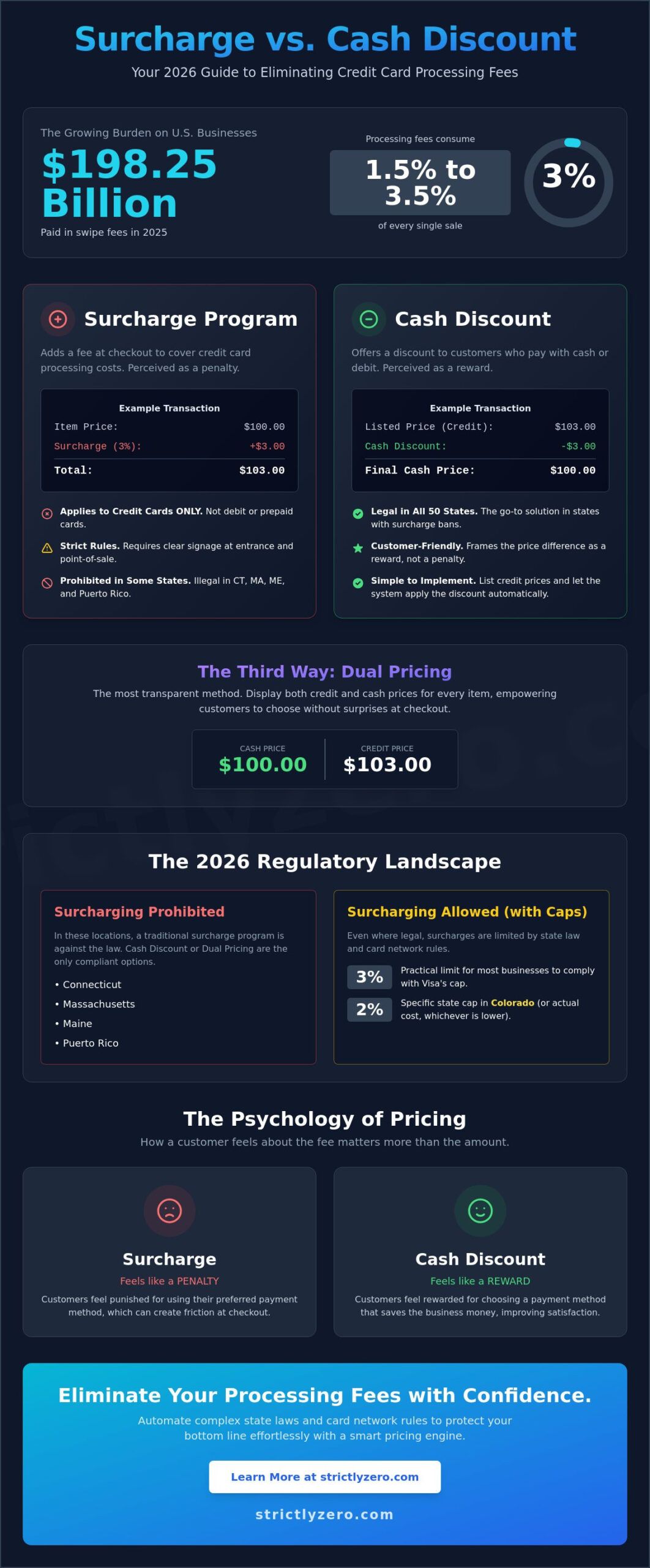
Business margins are under constant pressure. In 2025, U.S. merchants paid nearly $198.25 billion in swipe fees. This economic reality has sparked a massive shift toward zero-fee processing. When comparing a surcharge program vs cash discount program, the difference boils down to a simple mathematical direction. One adds a fee to the sticker price. The other subtracts a discount from it. Both models aim to protect your revenue. However, they navigate legal and psychological waters differently.
A Surcharge (payment systems) is a specific fee added to the cost of a transaction to cover the merchant’s processing costs. In 2026, many businesses are adopting these models to offset fees that can range as high as 3.5% for e-commerce transactions. By shifting this cost, you can effectively bring your processing expenses down to zero.
To better understand the practical differences between these two models, watch this helpful breakdown:
What is a Surcharge Program?
A surcharge program involves adding a percentage-based fee specifically to credit card transactions. You can’t apply this fee to debit or prepaid cards. Federal law and card network rules are very clear on this point. Even if a customer chooses credit on the terminal using a debit card, you can’t charge them the extra fee. You’re also required to provide clear signage at your entrance and at the point of sale to ensure transparency. Most businesses today cap this fee at 3% to stay in compliance with the major card networks.
What is a Cash Discount Program?
Cash discount programs work in reverse. You list your prices at the credit rate and offer a lower price for those who pay with cash or other non-credit methods. This model is legally distinct from surcharging because it’s framed as a reward rather than a penalty. Because of this framing, cash discounting is legal in all 50 states. It’s the go-to solution for businesses in Connecticut, Massachusetts, or Maine where traditional surcharges are currently restricted by state law. It’s an incentive-based approach that many customers find more palatable.
While the industry often debates the surcharge program vs cash discount program, a third option called Dual Pricing is gaining ground. Dual pricing involves listing two separate prices for every item: one for credit and one for cash. It’s incredibly transparent. It removes the surprise line-item fee that can sometimes frustrate customers. By showing both prices upfront, you’re giving the customer the choice. This ensures your business doesn’t eat the cost of the high-end credit card reward points your customers are earning.
The 2026 Regulatory Landscape: Compliance Rules for Surcharging and Cash Discounts
The legal foundation for merchant fee programs rests largely on the Durbin Amendment. This federal law protects your right to offer incentives to customers who pay with cash, debit cards, or checks. While the amendment opened the door for cost-saving strategies, the rules for a surcharge program vs cash discount program differ significantly once you look at state-specific legislation. As of June 2026, credit card surcharges are explicitly prohibited in Connecticut, Massachusetts, and Maine. Puerto Rico also maintains a strict ban. If you operate in these areas, a cash discount model is your only legal path to eliminating processing fees.
Even in states where surcharging is permitted, you must follow specific caps. Colorado, for example, limits credit card surcharges to 2% of the transaction or the merchant’s actual cost, whichever is lower. Major card brands also enforce their own limits. Visa currently caps surcharges at 3%, while Mastercard allows up to 4%. Since most businesses accept both, you’re practically limited to a 3% cap to remain in total compliance. You’re also required to notify your processor and the card networks at least 30 days before you begin any surcharge program. Failing to meet these deadlines or exceeding these caps can lead to heavy fines or the loss of your merchant account.
The Debit Card Trap: Why Manual Surcharging is Risky
Surcharging a debit card is a violation of federal law and card network rules. This applies even if a customer chooses the “credit” option on your payment terminal. Card brands actively monitor transactions for these violations, and the penalties are steep enough to wipe out your annual savings. A Smart Pricing Engine is a technology-driven solution that automatically detects debit cards at the point of sale to prevent illegal surcharging. Using an automated Surcharge & Dual Pricing Engine removes the human error that often leads to compliance failures.
Disclosure and Signage Requirements
Transparency keeps you compliant and preserves customer trust. You must place clear signage at your business entrance and at every point of sale explaining that a fee applies to credit transactions. This isn’t just a legal hurdle; it’s an opportunity to communicate value. Research into the impact of cash discounts on small businesses shows that customers are more accepting of fees when they understand the costs of doing business. Finally, the surcharge must appear as a separate line item on the customer’s receipt. It cannot be hidden within the price of the goods or services, ensuring the shopper knows exactly what they’re paying for at the moment of checkout.
Customer Psychology: How Surcharges vs. Cash Discounts Impact Sales
The way a customer perceives a transaction often matters more than the final dollar amount. Behavioral economists refer to this as the “Pain of Paying,” which is the psychological sting felt when a consumer sees money leaving their possession. When you evaluate a surcharge program vs cash discount program, you’re deciding which psychological trigger to pull. A surcharge can trigger “loss aversion.” This is the tendency for people to prefer avoiding losses rather than acquiring equivalent gains. To a shopper, a surcharge feels like a penalty for their choice of payment, whereas a discount feels like a hard-earned reward.
The Pros and Cons of Surcharging
- Pro: It provides a direct, dollar-for-dollar offset of your credit card processing expenses, protecting your margins instantly.
- Con: It can create friction at checkout, especially if the customer wasn’t expecting an additional line-item fee.
- Pro: Surcharging is often easier to implement because you don’t have to change every price tag or menu item in your store.
The Pros and Cons of Cash Discounting
- Pro: Customers generally have a positive reaction to “earning” a discount, which can actually build brand loyalty.
- Con: This model requires more operational work. You’ll need to update shelf prices, menus, and digital catalogs to reflect the “credit price.”
- Pro: It’s the safest legal bet. Cash discounting is compliant in all 50 states when executed correctly, making it ideal for businesses with locations in multiple jurisdictions.
Choosing the right path depends on how well you know your audience. If your customers are highly price-sensitive, the “reward” of a cash discount might be the better play. If you run a B2B operation where credit card use is for convenience on large bills, a surcharge is often accepted as a standard cost of doing business. The goal is to eliminate your fees without losing the trust you’ve worked so hard to build.
Operational Comparison: Which Model Fits Your Business Best?
Operational efficiency is where the theoretical debate between a surcharge program vs cash discount program meets the reality of your daily workflow. While legal compliance is the starting point, your business model determines which system will actually stick. Ticket size is the primary driver here. If your average transaction is $10, a 3% surcharge is only 30 cents. For a customer, that’s a minor annoyance. If your average invoice is $10,000, that same 3% is $300. In high-ticket environments, the fee is substantial enough that the customer may consider switching to an ACH or check payment, which is exactly the behavior these programs are designed to encourage.
Technical requirements can make or break your implementation. You need a system that can distinguish between credit and debit cards in real-time. Since surcharging a debit card is a violation of card brand rules, your POS software must be smart enough to suppress the fee automatically when a debit card is swiped. This is where the role of your payment processor becomes critical. A partner who provides a robust Surcharge & Dual Pricing Engine ensures your hardware and software are communicating correctly. This prevents human error at the register and keeps your business safe from network audits.
Accounting and reconciliation also look different under each model. Surcharging requires you to track the collected fees as a separate revenue stream, which can complicate daily reporting if your software isn’t integrated. Dual pricing and cash discounting are often cleaner for bookkeeping. Since you’re essentially listing two prices, the transaction is recorded at the value the customer chose to pay. This simplifies your end of day numbers and makes tax season much less of a headache for your accountant.
When to Choose Surcharging
Surcharging is the ideal choice for B2B companies and professional services with high average order values. In these industries, credit card use is often a matter of convenience or cash flow management for the client. They’re usually willing to pay a small percentage to keep their capital liquid. By implementing this model in states with clear, permissive laws, you can reach the ultimate goal of zero fee credit card processing. It allows you to keep your quoted prices competitive while ensuring that processing costs don’t erode your project margins.
The Case for Dual Pricing and Cash Discounts
Retailers and restaurateurs are moving toward dual pricing because it offers the most transparency. It removes the need for employees to perform mental math or explain line-item fees to frustrated diners. When both the cash and credit prices are displayed clearly on the terminal, the surcharge shock disappears. The customer sees the choice as a benefit rather than a penalty. This model is particularly effective in high-volume retail where speed and customer satisfaction are the top priorities. It’s a seamless way to protect your profits without slowing down the line.
Find the perfect fit for your transaction volume by exploring our Surcharge & Dual Pricing Engine solutions.
Automating Zero-Fee Processing with Strictly’s Smart Pricing Engine
Managing the technical side of a surcharge program vs cash discount program shouldn’t be a full-time job for your staff. Manual compliance is a high-risk game that often leads to human error and expensive network fines. Strictly’s unified omni-channel platform changes this dynamic by providing a Surcharge & Dual Pricing Engine that thinks for you. This technology monitors state-by-state regulations in real-time. Whether you operate a single storefront or a national franchise, the engine automatically adjusts to ensure your business stays 100% compliant with the specific laws of every jurisdiction where you process payments.
The real power of the Smart Pricing Engine lies in its ability to protect you from the “debit card trap” mentioned earlier. Since surcharging debit cards is illegal nationwide, our system uses real-time detection to identify the card type before the transaction is finalized. If a customer swipes a debit card, the engine suppresses the fee instantly. This automation removes the burden from your cashiers and ensures you never face a card brand audit. For our partners, Strictly provides advanced tools like ClearSplit™ for transparent residual tracking and ChurnIQ™ for merchant retention. These tools allow ISOs to manage zero-fee accounts with a level of data-driven precision that was previously impossible.
Compliance Without the Complexity
One of the biggest hurdles for any merchant is the mandatory 30-day notification required by card brands like Visa and Mastercard. Strictly handles this entire notification process on your behalf, allowing you to focus on running your business instead of filing paperwork. For our ISO partners, the administrative relief is even greater. Strictly handles automated partner compensation for ISOs to ensure every residual is calculated and paid with precision. This makes us the premier payment processing platform for ISOs looking to scale their portfolios in 2026.
Getting Started: Transitioning to Zero Fees
Transitioning your business to a zero-fee model is a straightforward process that integrates directly with your existing workflow. You can deploy Strictly’s technology through our secure virtual terminal or integrate it into your own software via our robust API. Before you make the switch, it’s helpful to see the potential impact on your bottom line. You can use our cost of credit card processing calculator to estimate exactly how much you’ll save by moving to an automated pricing model. Once you see the numbers, the path forward is clear.
Don’t let swipe fees continue to erode your hard-earned margins. By automating your compliance and pricing strategy, you can protect your revenue and provide a better experience for your customers. Partner with Strictly today to eliminate your processing fees and take control of your business’s financial future.
Take Control of Your Processing Costs in 2026
Reclaiming your profit margins starts with choosing the right strategy for your unique customer base. We’ve explored how state laws in Connecticut and Maine dictate your legal options, and why dual pricing often provides the most transparent experience for your shoppers. Deciding on a surcharge program vs cash discount program is no longer a manual burden when you have the right tools in place. By shifting the focus from manual calculations to automated systems, you protect your revenue without risking customer trust or legal standing.
You don’t have to navigate these complex regulations alone. Strictly provides a sophisticated Surcharge & Dual Pricing Engine that handles the heavy lifting for you. Our automated state-by-state compliance engine ensures you’re always following the latest rules, while real-time debit card detection and protection keeps you safe from costly card brand fines. For those managing portfolios, our ClearSplit™ automated partner compensation makes reporting and residuals effortless. It’s time to stop letting swipe fees dictate your business’s success.
Eliminate your processing fees with Strictly’s Smart Surcharge Program today. Your bottom line deserves total protection, and the right technology makes it possible.
Frequently Asked Questions
Is it better to use a surcharge or a cash discount for my small business?
The choice between a surcharge program vs cash discount program depends on your location and operational capacity. Surcharging is often easier for service businesses because it doesn’t require changing individual product labels or menus. However, retail shops often prefer cash discounting or dual pricing because it avoids the friction of a surprise fee at the end of the transaction. Both models effectively eliminate your processing costs when implemented with the right technology.
Can I surcharge a debit card if the customer chooses “credit” at the terminal?
No, you can’t surcharge a debit card transaction even if the customer chooses the “credit” button. Federal regulations and card brand rules prohibit adding fees to any debit or prepaid card purchase. If you accidentally apply a fee to these cards, you risk heavy fines or losing your merchant account. Using an automated system with real-time card detection is the safest way to prevent these costly compliance errors.
What are the signage requirements for a compliant surcharge program in 2026?
You must place clear, conspicuous signage at both the entrance of your business and at every point of sale. These disclosures must inform customers about the surcharge percentage and clarify that the fee isn’t greater than your actual cost of card acceptance. Additionally, the surcharge must appear as a separate, clearly labeled line item on every customer receipt to ensure total transparency throughout the entire checkout process.
Are surcharge programs legal in all 50 states?
No, surcharges aren’t legal in all 50 states. While most jurisdictions have moved toward allowing them, states like Connecticut and Massachusetts maintain strict bans as of mid-2026. If your business has locations in multiple states, you must tailor your strategy to each local law. This is why many national retailers choose a cash discount model, which remains legal and compliant across the entire United States. Understanding the surcharge program vs cash discount program legal landscape is essential for staying compliant across different state lines.
How much can I legally charge as a credit card surcharge?
You’re practically limited to a 3% cap. Even though Mastercard permits up to 4%, Visa’s lower 3% ceiling means you must stay at or below that level to accept both card types safely. Additionally, your surcharge can’t exceed your actual merchant discount rate for that card. Some states have even tighter rules. Colorado, for instance, mandates a 2% maximum, making it vital to check local statutes before setting your rates.
What is the difference between Dual Pricing and a Cash Discount?
Dual Pricing shows both the cash and credit prices simultaneously on your price tags or terminal screen. A Cash Discount program typically advertises the “credit price” and then subtracts a discount for customers who choose to pay with cash. Dual pricing is gaining popularity in 2026 because it provides the highest level of transparency. It allows customers to see exactly what they’ll pay before they ever reach the checkout counter.
How do I notify Visa and Mastercard before I start surcharging?
You’re required to provide written notice to your payment processor and the card brands at least 30 days before you begin surcharging. This gives the networks enough time to update your merchant profile. If you skip this step, you’re at risk of being flagged for non-compliance. Most modern processing partners will manage this filing as part of your onboarding process, which takes the stress out of managing these strict industry deadlines.
Will a surcharge program cause me to lose customers?
Most businesses find that clear communication prevents customer churn. While some shoppers might prefer not to pay a fee, offering a fee-free alternative like debit or cash usually satisfies their concerns. Transparency is the most important factor here. When you explain that the program allows you to keep your base prices lower, most loyal customers are happy to support your business and its long-term financial health.