
Surcharging Debit Cards vs. Credit Cards: The 2026 Legal & Compliance Guide
Published:

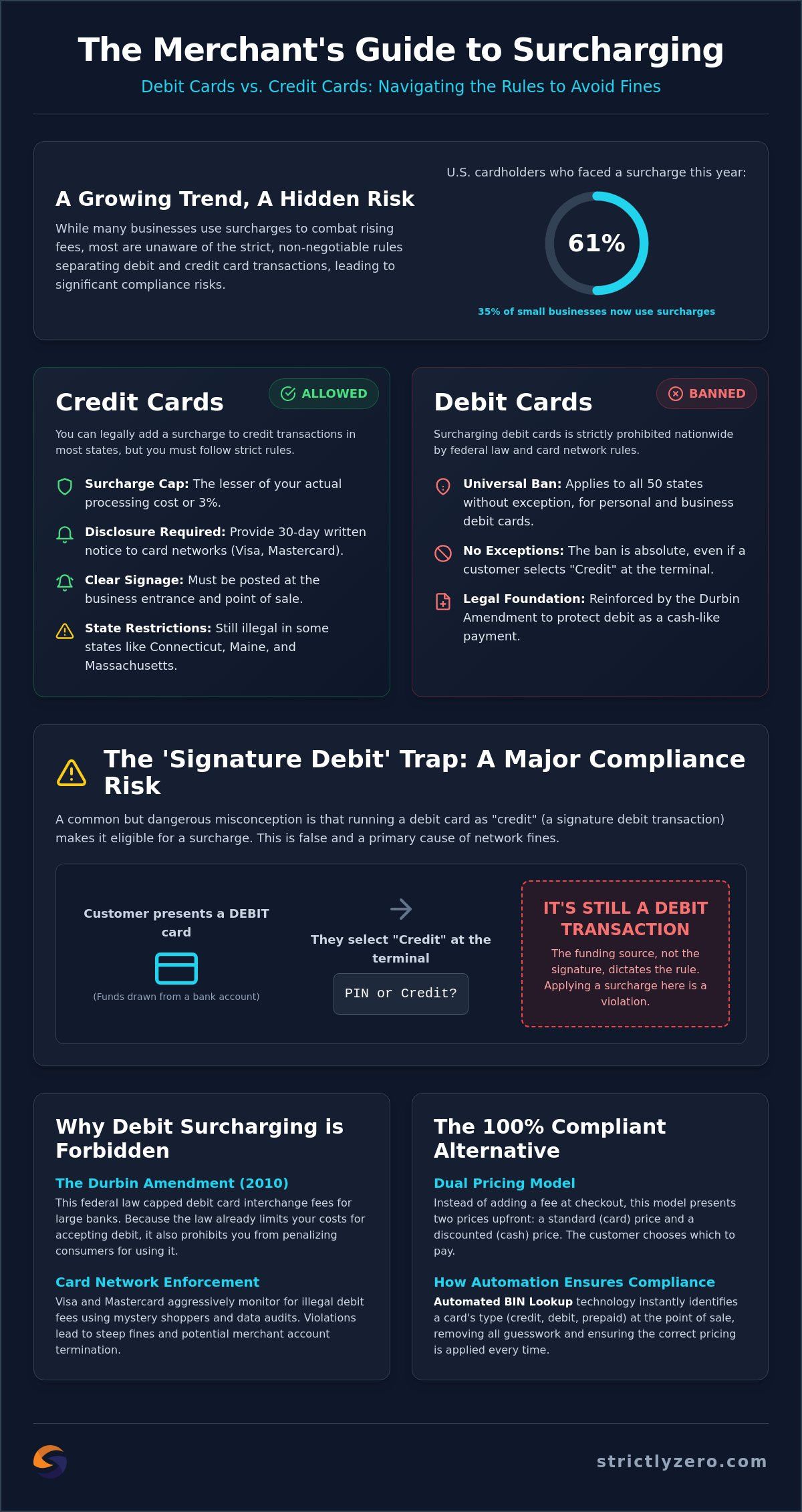
Did you know that over 61% of U.S. credit card holders have already encountered a surcharge at the register this year? While 35% of small businesses now use these fees to fight back against rising costs, many are unknowingly walking into a legal minefield. Understanding the strict rules for surcharging debit cards vs credit cards is no longer just a recommendation for 2026; it’s a survival requirement to avoid devastating network fines. Even if a customer chooses “credit” at your terminal, surcharging that signature debit transaction is still illegal under major card network rules.
You’ve likely watched processing fees eat 3% to 4% of every sale, feeling like you’re paying a tax just to stay in business. It’s frustrating to choose between losing your profit margin and risking an accidental compliance violation that could cost you even more. We’ll show you exactly how to eliminate those fees while staying on the right side of the law. This guide provides a clear “Yes/No” framework for every card type, covers new 2026 regulations in states like Louisiana and Illinois, and explains how to lower your processing costs to zero safely.
Key Takeaways
- Master the legal distinction between surcharging debit cards vs credit cards to avoid the “Signature Debit” trap that leads to heavy network fines.
- Identify the specific 2026 state-level regulations in places like Louisiana and Illinois that could make your current fee structure illegal.
- Understand why the Durbin Amendment and card network rules prohibit surcharging any debit product, regardless of whether a PIN is used.
- Learn why Dual Pricing is the only 100% compliant model for offsetting processing costs across all card types in every state.
- Discover how automated BIN lookup technology removes manual guesswork by identifying card types in real-time to ensure point-of-sale compliance.
Table of Contents
- Understanding the Core Difference: Surcharging Debit Cards vs. Credit Cards
- Why Debit Card Surcharging is Forbidden: Laws and Network Rules
- The 'Signature Debit' Trap: A Major Compliance Risk
- Compliant Alternatives: Dual Pricing and Cash Discounting
- Strictly: Automating Compliance with the Smart Pricing Engine
Understanding the Core Difference: Surcharging Debit Cards vs. Credit Cards
Merchants often ask if they can apply a single fee to every card swipe to simplify their bookkeeping. The short answer is no. When looking at the rules for surcharging debit cards vs credit cards, the law makes a sharp distinction that every business owner must respect. You can legally surcharge credit card transactions in most states, provided you follow strict disclosure rules. However, surcharging debit cards is strictly prohibited nationwide by both federal law and card network agreements.
A surcharge is a checkout fee added to a transaction specifically to cover the merchant’s cost of acceptance. These payment surcharges are designed to help business owners protect their profit margins from high interchange fees. Federal regulators and card networks view debit cards as a direct substitute for cash. They believe consumers should have access to their own bank funds without paying a penalty. Because of this, the legal surcharge cap in 2026 is set at the lesser of your actual processing cost or 3% for credit transactions.
The Legal Status of Credit Card Surcharges
As of July 2026, surcharging credit cards has become a standard business practice in the majority of the country. While New York now allows the practice, you must still be careful in states like Connecticut, Maine, and Massachusetts, where credit card surcharges remain illegal. Before you begin, you’re required to provide a 30-day written notice to your card networks, including Visa and Mastercard. Compliance also requires clear signage at your business entrance and at the point of sale to ensure transparency for every customer.
The Universal Ban on Debit Card Surcharges
Why Debit Card Surcharging is Forbidden: Laws and Network Rules
Understanding the hierarchy of rules is vital for any merchant. While state laws vary, federal regulations and card network mandates create a universal ceiling that you cannot cross. When comparing the regulations for surcharging debit cards vs credit cards, the most important takeaway is that federal law effectively pre-empts more permissive state rules. Even in a state that fully allows credit surcharges, you cannot legally apply a fee to a debit card transaction. This isn’t just a suggestion; it’s a fundamental requirement of the American payment ecosystem.
The Durbin Amendment Explained
The Durbin Amendment, a key part of the 2010 Dodd-Frank Act, changed the landscape of merchant processing forever. It capped interchange fees for issuers with over $10 billion in assets to $0.21 plus 0.05% of the transaction value. This law ensures that debit remains a low-cost, cash-like payment method for the public. Because the government limited what banks can charge you for these swipes, the law also prohibits you from penalizing consumers for using them. This legal framework is why debit cards remain the most affordable electronic payment for your business to accept in 2026.
Some merchants try to bypass these rules by using “convenience fees” instead of surcharges. This is a dangerous gamble. While a convenience fee is technically meant for a “special” payment channel, such as an online portal for a business that usually takes payments in person, it rarely applies to standard retail transactions. According to Visa’s official surcharging rules, any fee added specifically to a debit or prepaid card is a violation. Card networks are aggressive about protecting the “debit” brand from any extra costs at the register.
Card Network Enforcement in 2026
Enforcement has reached a new peak this year. Visa now employs sophisticated compliance monitoring programs that use mystery shoppers and automated data audits to find illegal debit fees. Mastercard also maintains a strict stance on “product level” surcharging. You can’t treat a debit card like a credit card just because the customer didn’t enter a PIN. If you’re caught, you won’t just face a one-time fine. Repeat offenders risk merchant account termination, which can effectively blacklist your business from accepting any major card brand ever again.
Staying compliant doesn’t have to be a manual headache for your staff. You can protect your business by using a surcharge and dual pricing engine that automatically differentiates between card types at the moment of the swipe. This technology ensures you never accidentally charge a debit user, keeping your merchant account safe while you maximize your savings on credit transactions.
The ‘Signature Debit’ Trap: A Major Compliance Risk
The single biggest misconception in the payment industry is the belief that “Credit” on a terminal screen means the same thing as a “Credit Card.” When a customer swipes their card and selects the “Credit” option to avoid entering a PIN, many merchants assume they can legally apply a surcharge. This is a dangerous myth. When you are balancing the rules for surcharging debit cards vs credit cards, you must understand that the authorization method does not change the legal status of the card. If the funds are being pulled from a checking account, it is a debit transaction. Adding a fee to these “signature debit” sales is a direct violation of federal law and card network agreements.
Relying on manual surcharge buttons at the register is a liability that most modern businesses can’t afford. If an employee accidentally hits that button for a debit user, your business is just as liable as if you had done it intentionally. Regulators and card networks don’t distinguish between a clerical error and a deliberate attempt to bypass the rules. In the eyes of the law, an “accidental” surcharge is still an illegal fee that can trigger immediate audits and heavy financial penalties.
PIN vs. Signature: Why it Doesn’t Matter
The technical reality is that your payment processor knows exactly what kind of card is in the machine before the customer even decides how to sign. Every card carries a Bank Identification Number (BIN), which consists of the first few digits on the card face. This BIN identifies the funding source instantly. Even if the terminal is set to “Credit” mode, the system recognizes the card as a debit product. As noted in State guidance on card surcharges, Visa and Mastercard rules are absolute: you cannot surcharge a debit card, period. Customers in 2026 are more aware of these rules than ever before. Many use mobile banking apps to check their receipts in real time, and a single report to their issuing bank can trigger a compliance investigation against your merchant account.
Fines and Penalties for Debit Surcharging
The financial stakes for non-compliance have never been higher. In 2026, a first-time violation for surcharging a debit card typically results in a $5,000 fine from the card networks. If the practice continues, you risk being placed on the MATCH list, which is essentially a permanent blacklist for merchant accounts. Once a business is on this list, it becomes nearly impossible to find a reputable processor to handle your payments. Beyond the fines, you face significant reputational damage. In an era of viral social media, a photo of a receipt showing an illegal fee can destroy customer trust in a single afternoon, labeling your business as one that takes advantage of its patrons.
While navigating US-based compliance is a priority, businesses with international operations must also maintain legal oversight in other regions. For those needing to monitor judicial records or verify legal statuses in South America, you can visit Verifica Processo to search for Brazilian legal processes using standard identification numbers.
Compliant Alternatives: Dual Pricing and Cash Discounting
If the legal complexities of surcharging debit cards vs credit cards feel like a liability you’d rather avoid, you aren’t alone. Many merchants are moving away from traditional surcharges in favor of Zero Fee Credit Card Processing models. This shift isn’t just about avoiding fines; it’s about better customer service. While a surcharge feels like a penalty to your patrons, a cash discount feels like a reward. This psychological difference can be the deciding factor in whether a customer returns to your store or leaves a frustrated review online.
Dual pricing has emerged as the gold standard for compliance in 2026. In states like New York, the law now requires a “two-price” display where both the cash price and the card price are clearly visible to the consumer before the transaction begins. This transparency eliminates the “sticker shock” that often accompanies a surprise surcharge at the end of a sale. By presenting the higher price as the standard and offering a discount for cash, you stay compliant with both state laws and card network rules without having to worry about the specific card type in the customer’s hand.
How Dual Pricing Solves the Debit Dilemma
The beauty of dual pricing lies in its simplicity. Instead of adding a fee, you list two prices for every item: a “Card Price” and a “Cash Price.” Because you aren’t adding a surcharge to the transaction, the rules regarding debit cards are much easier to follow. In this model, debit cards are simply treated as “Card” payments. You don’t need to worry about BIN lookups or “Signature Debit” traps because you’re offering a discount for cash, not penalizing a specific card type. This framework is 100% compliant in all 50 states because it follows the legal definition of a discount rather than a surcharge.
Implementing a Compliant Cash Discount Program
Setting up credit card processing for small business with a discount model requires attention to detail. You must place clear signage at your entrance and at every point of sale to inform customers of the two-tier pricing. Your receipts must also be itemized, showing exactly how much the customer saved by choosing a lower-cost payment method. This level of detail protects you from claims of “hidden fees” and ensures that your business remains a “compliance-first” operation.
Ready to stop worrying about the legal risks of manual fee entries? You can protect your profit margins and your reputation by switching to a surcharge and dual pricing engine that handles the math and the compliance for you.
Strictly: Automating Compliance with the Smart Pricing Engine
Strictly’s Smart Pricing Engine provides the technical answer to the compliance headaches discussed in earlier sections. While other providers offer static hardware, Strictly delivers a dynamic engine built for the complex 2026 regulatory environment. When managing credit card processing services, you shouldn’t have to guess if a swipe is a credit card or a signature debit card. Strictly automates the logic behind surcharging debit cards vs credit cards, ensuring your business stays protected without any manual intervention from your staff. It’s a “set it and forget it” solution that works for local shops and multi-state enterprises alike.
Real-Time BIN Detection Technology
Every card has a story told through its Bank Identification Number (BIN). Strictly’s technology reads this story in milliseconds. Before the customer even finishes their transaction, the system identifies the card type with 100% accuracy. If the card is a debit product, the surcharge is instantly and automatically removed. This real-time detection is the only way to reliably follow 2026 card network rules while maintaining a zero-fee model on credit transactions. It eliminates the risk of “accidental” illegal surcharging that leads to the $5,000 fines mentioned earlier, keeping your merchant account in good standing.
Omni-Channel Fee Management
Compliance shouldn’t stop at the physical counter. Strictly applies the same intelligent logic to your online checkouts and virtual terminals. Whether you’re sending an invoice or selling through an e-commerce store, the Smart Pricing Engine keeps your business compliant across all channels. You can also use ChurnIQ™ to monitor if your fee programs are impacting customer retention. This data-driven approach ensures you aren’t just saving on processing costs, but also maintaining a healthy relationship with your patrons. It’s about protecting your profit margins while ensuring your checkout experience remains professional and transparent.
Choosing the best credit card processing for small business in 2026 means choosing a partner that prioritizes your legal safety. Strictly provides the trust and technology needed to navigate a shifting legal landscape with confidence. You don’t have to choose between profitability and compliance. Eliminate your processing fees legally with Strictly and get back to growing your business without the fear of unexpected audits or penalties.
Protect Your Profits and Stay Compliant in 2026
The landscape of payment processing is shifting faster than ever. You’ve seen how the “Signature Debit” trap can lead to massive fines and why dual pricing offers a much safer path forward for modern merchants. Mastering the nuances of surcharging debit cards vs credit cards isn’t just about saving a few dollars anymore; it’s about protecting the legacy of the business you’ve worked so hard to build. With complex new state laws in Louisiana and Illinois taking effect in 2026, relying on manual guesswork at the register is a risk that your bottom line simply cannot afford to take.
You deserve a processing partner that handles the technical heavy lifting for you. Strictly’s Smart Pricing Engine is already fully updated for the latest 2026 federal and state regulations. By using automated BIN detection, we ensure 100% debit compliance while helping you reduce your processing overhead to $0 safely. It’s time to focus on your customers instead of constantly checking your compliance manual. Stop Guessing on Compliance-Switch to Strictly Zero-Fee Processing today and take total control of your profit margins. Your path to worry-free, zero-fee processing starts here.
Frequently Asked Questions
Is it legal to surcharge a debit card in 2026?
No, it is not legal to surcharge a debit card in 2026. Major card networks like Visa and Mastercard, along with federal regulations under the Durbin Amendment, strictly prohibit adding fees to any debit transaction. This rule applies to all 50 states without exception. If you attempt to surcharge a debit card, you risk heavy fines and the potential loss of your merchant processing account.
What is the difference between a surcharge and a cash discount?
A surcharge is an additional fee added to a transaction at checkout to cover processing costs. In contrast, a cash discount is a reduction in price offered to customers who choose to pay with cash rather than a card. While surcharges are often viewed as a penalty, cash discounts are framed as a reward for the consumer. This makes the cash discount model legal in states where surcharging is restricted.
Can I charge a fee if the customer runs their debit card as credit?
No, you cannot charge a fee even if the customer selects “credit” or provides a signature instead of a PIN. When evaluating the rules for surcharging debit cards vs credit cards, the law looks at the funding source of the card. Since the funds come from a bank account, it remains a debit card in the eyes of regulators. Misidentifying signature debit as credit is one of the most common ways merchants face compliance audits.
What are the fines for illegally surcharging a debit card?
Fines for illegal debit surcharging typically start at $5,000 for a first-time violation in 2026. Beyond the immediate financial penalty, repeat offenders risk being placed on the MATCH list. This is a permanent industry blacklist that makes it nearly impossible for a business to secure a new payment processor. You also face significant reputational damage if customers report your business to their bank or state attorney general.
Does the 3% surcharge cap apply to all types of cards?
The 3% cap only applies to credit card transactions. For debit cards, the legal cap is effectively 0% because surcharging them is prohibited. While Mastercard technically allows a 4% surcharge on credit cards, Visa’s lower 3% cap usually dictates the maximum rate for merchants who accept both card brands. It is vital to ensure your system doesn’t accidentally apply these percentages when surcharging debit cards vs credit cards.
Which states have specific disclosure laws for credit card fees in 2026?
In 2026, New York, Massachusetts, Connecticut, Maine, Colorado, and New Jersey have the most specific regulations. New York requires a two-price display showing the total cost for both cash and card. Massachusetts, Connecticut, and Maine still maintain bans on credit card surcharging. Colorado has a 2% limit or actual cost cap. Understanding these local nuances is critical for businesses operating across state lines to avoid legal challenges.
How does a BIN lookup help with surcharge compliance?
A BIN lookup identifies the specific type of card being used by checking the first six to eight digits of the card number. This technology allows your payment terminal to distinguish between a credit card and a debit card in milliseconds. By using an automated BIN lookup, you can ensure that a surcharge is only applied to eligible credit cards, removing the risk of human error at the point of sale.
Is dual pricing legal in states that ban surcharging?
Yes, dual pricing is legal in all 50 states, including those that ban surcharging. Because dual pricing establishes a standard card price and offers a cash price discount, it doesn’t fall under the legal definition of a surcharge. This makes it an ideal solution for merchants who want to offset their processing costs while remaining 100% compliant with both state laws and card network rules.