
The Best Merchant Services Agent Opportunities in 2026: A Growth Guide
Published:

Why settle for chasing one-time bonuses when the average merchant services professional in 2026 is pulling in nearly $100,000 through long-term residuals? If you’ve been searching for the best merchant services agent opportunities, you’ve likely realized that the old way of selling is dead. Merchants are tired of outdated tech and hidden fees, while agents are fed up with opaque reporting and high churn rates. It’s a frustrating cycle that makes building a stable portfolio feel like an uphill battle.
You deserve a partner program that provides transparency and tools that actually save your clients money. In this guide, you’ll discover how to build a high-residual payments business using modern zero-fee technology and automated partner management tools. We will break down the latest 2026 industry shifts, including the impact of the Illinois Interchange Fee Prohibition Act and the rise of dual pricing engines. You’ll learn exactly how to position yourself as a trusted advisor while securing the recurring revenue you need to scale.
Key Takeaways
- Learn how to transition from a traditional salesperson to a tech consultant who helps businesses navigate complex payment ecosystems.
- Evaluate merchant services agent opportunities by understanding the nuances of residual splits and identifying hidden fees that can erode your long-term profit.
- Master the dual pricing and surcharge revolution to offer merchants a solution that eliminates their processing costs while maximizing your conversion rates.
- Discover the five essential steps to launch your business, from selecting a high-growth niche to implementing omni-channel payment processing tools.
- Gain access to automated partner management tools and AI-driven fraud prevention to scale your portfolio with minimal manual overhead.
Table of Contents
- What are Merchant Services Agent Opportunities?
- How to Evaluate Residual Splits and Commission Structures
- Why $0 Fee Processing is the Highest-Converting Opportunity
- 5 Steps to Launching Your Merchant Services Business
- Partnering with Strictly: Advanced Tools for Modern Agents
What are Merchant Services Agent Opportunities?
In 2026, the payments industry has moved far beyond simple card swiping. A merchant services agent acts as a vital bridge between a business and a payment processor. Rather than being a traditional salesperson, you’re a tech-consultant. You help business owners implement complex solutions like omni-channel payment processing and AI-driven fraud prevention. These merchant services agent opportunities allow you to solve real problems for merchants while building a portfolio that pays you every month.
To understand the scope of this role, it helps to look at the foundational definition of What are Merchant Services. This category covers everything from the settlement of funds to the security protocols that protect customer data. As an agent, you aren’t just selling a service; you’re managing a relationship. You find the merchant, set them up with the right processing engine, and ensure they have the tools to grow. In return, the processor shares a portion of the transaction profit with you.
To better understand this concept, watch this helpful video:
The 2026 market specifically favors agents who specialize. With the recent Visa and Mastercard settlements reducing interchange rates, merchants are looking for transparency. They want to know why they’re paying what they’re paying. Successful agents now use specialized tech stacks, such as surcharge and dual pricing engines, to offer clear value. This shift from transactional sales to high-value consulting is why merchant services agent opportunities are more lucrative now than in previous decades.
Agent vs. ISO: Understanding the Hierarchy
New entrants often start as independent agents because it carries less risk. An Independent Sales Organization (ISO) typically has more overhead and liability, often requiring its own registration with card brands. Agents, however, can focus entirely on sales and relationship management without the heavy administrative burden. As your portfolio grows, you can eventually transition to using payment processing platforms for ISOs to scale your operations and manage your own sub-agents.
The Revenue Model: Upfront Bonuses vs. Lifetime Residuals
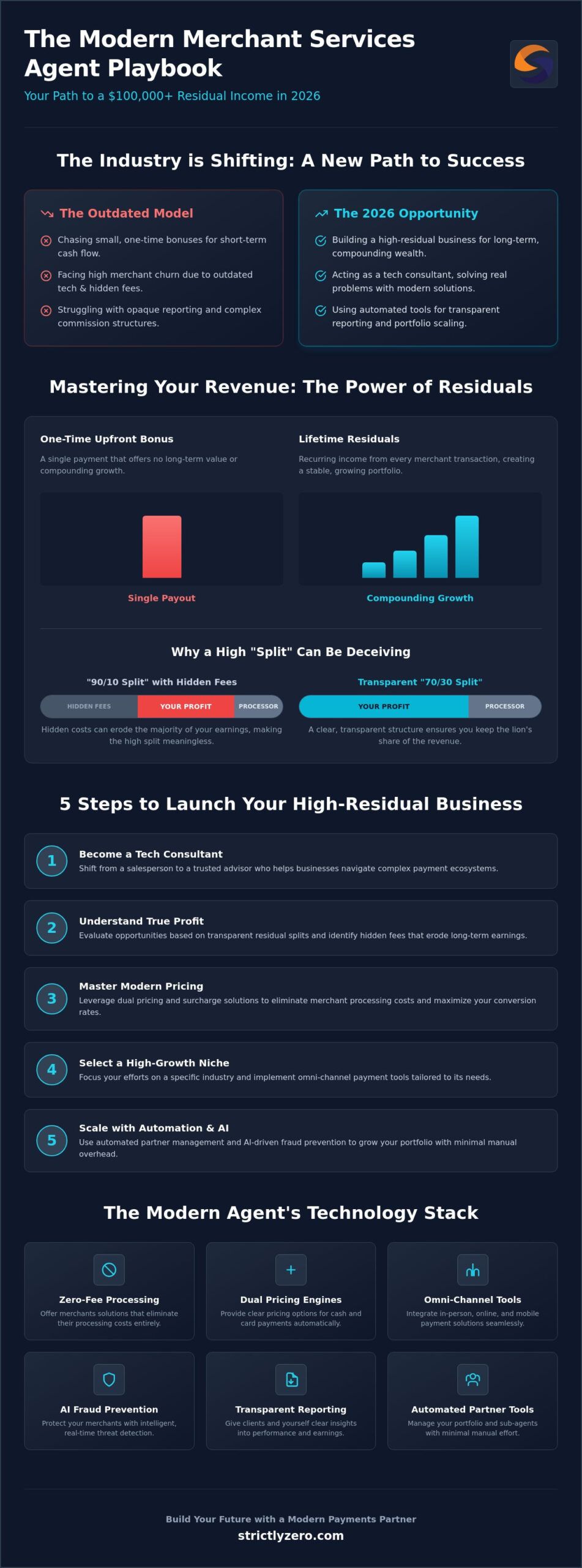
The financial appeal of merchant services lies in how you get paid. Most programs offer a mix of upfront bonuses and long-term residuals. While a quick bonus is nice for cash flow, the real wealth is in the “buy rate” and revenue sharing. This is the difference between what the processor charges and the final rate the merchant pays. By securing lifetime residuals, you earn a percentage of every transaction your merchants process, creating a compounding income stream that lasts for years. This recurring revenue is what allows agents in cities like Dallas to see average earnings near $100,000 annually.
How to Evaluate Residual Splits and Commission Structures
Finding the right split is often the first thing new agents look for, but it’s rarely the most important factor in long-term wealth. In 2026, you’ll see splits ranging from 60/40 for beginners up to 90/10 for those with massive portfolios. However, a high percentage means nothing if the underlying math is skewed by hidden costs. When you evaluate residual splits and commission structures, you must look at the net versus the gross margin. Many processors lure agents in with an 80% split but then subtract junk fees like high BIN sponsorship costs or inflated gateway charges before you ever see a dime.
The health of your business depends on merchant retention. If your processor has poor support, your churn rate will skyrocket, and your residuals will evaporate. This is why the best merchant services agent opportunities focus on value-added services like AI-driven fraud prevention and POS lending. These tools keep merchants happy and locked into your portfolio. A 2026 J.D. Power study found that small businesses are increasingly using zero-fee payment processing, and agents who provide these high-satisfaction solutions see significantly lower churn rates.
Transparency in Reporting: Avoiding the Black Box
A black box approach to reporting is a major red flag. If you can’t see exactly how much profit each merchant generated and what fees were deducted in real-time, you’re at risk of residual shaving. This is a practice where processors quietly adjust calculations to keep more of the profit. Modern agents demand real-time dashboard access to ensure every penny is accounted for. You can explore how advanced partner management tools provide this level of clarity, allowing you to audit your portfolio with a single click.
ClearSplit™: The New Standard for Partner Compensation
ClearSplit™ represents the next evolution in partner compensation. Instead of waiting weeks for a manual accounting team to cut a check, this technology automates the entire process. It ensures that payouts are accurate and instant. For agents looking to grow, ClearSplit™ is a game-changer because it allows you to recruit and manage sub-agents without the administrative headache. The system automatically handles the splits for your team, letting you focus on scaling your sales efforts instead of auditing spreadsheets. These automated merchant services agent opportunities make it easier than ever to build a multi-tiered agency from scratch.
Why $0 Fee Processing is the Highest-Converting Opportunity
Selling a product that literally pays for itself is the ultimate sales advantage. In the past, agents fought over fractions of a percentage point in a “race to the bottom” on pricing. Today, the most lucrative merchant services agent opportunities revolve around eliminating the merchant’s processing bill entirely. By leveraging a surcharge or dual pricing engine, you can offer a solution where the business owner pays nothing to accept credit cards. This shift turns you from a solicitor into a hero who can instantly add thousands of dollars back to a merchant’s bottom line.
Adopting zero fee credit card processing doesn’t just make the initial sale easier; it creates incredibly “sticky” clients. When a merchant sees their processing fees vanish, they’re far less likely to entertain a competitor’s offer for a slightly lower traditional rate. This loyalty is the foundation of a stable, high-residual portfolio. However, merchants are often hesitant to implement these models on their own due to the dense web of state and federal regulations. This is where your expertise as a specialized consultant becomes your greatest asset.
The Smart Pricing Engine and Compliance
Compliance is the biggest hurdle for merchants, and it’s your biggest selling point. As of July 2026, surcharging remains prohibited in Connecticut, Massachusetts, and Maine, while Colorado imposes a strict 2% cap. Additionally, federal law prohibits surcharging on debit cards. A modern agent must provide a smart pricing engine that automatically detects the card type and applies the correct pricing based on the merchant’s location. Using an automated system protects both you and the merchant from legal pitfalls, ensuring that “zero fee” doesn’t turn into “heavy fine.”
Overcoming the “Fee” Objection with Dual Pricing
Some merchants worry that passing fees to customers will drive away business. You can overcome this by presenting dual pricing as a “cash discount” model. Instead of adding a surprise fee at the end, the merchant displays two prices: a standard price and a discounted price for cash. This transparency aligns with California’s SB 478 requirements and feels fairer to the consumer. When a merchant is skeptical, show them the data. A 2026 J.D. Power study confirmed that small businesses using zero-fee models actually see higher satisfaction scores because they can keep their base prices stable. For specific talk tracks to use in these conversations, refer to our essential guide for small business processing. This framework helps you pivot the conversation from “fees” to “business sustainability,” making the merchant services agent opportunities in this niche the most profitable in the industry.
5 Steps to Launching Your Merchant Services Business
Success in this industry isn’t just about working long hours; it’s about following a repeatable, technical system. Many people who explore merchant services agent opportunities struggle because they lack a clear roadmap for scaling. To build a portfolio that generates six figures in residuals, you need to move beyond traditional sales and start operating like a fintech consultant. This process starts with choosing the right foundation and ends with automated retention.
- Identify your niche: Focus on sectors like high-ticket home services, specialized e-commerce, or professional services where businesses value expert advice over the lowest possible rate.
- Select a partner platform: Ensure your partner provides omni-channel payment processing, virtual terminals, and invoicing tools so you can serve clients both online and in-person.
- Complete compliance training: Since $0-fee models are high-demand, you must master the state-by-state regulations for surcharging and dual pricing to protect your merchants from legal risks.
- Use data-driven prospecting: Stop cold calling every business on the block. Use merchant intelligence tools to identify high-volume businesses that are currently overpaying for outdated technology.
- Implement a retention strategy: Use automated software to monitor your portfolio’s health and intervene before a merchant considers switching to a competitor.
Niche Selection: Why Specialization Wins in 2026
Being a generalist is a losing strategy because you’re forced to compete with big banks on price alone. When you specialize in a high-growth sector like professional services, you can offer tailored solutions that banks often ignore. For example, providing POS lending options allows your merchants to close larger deals by offering financing to their own customers. This added value makes you an indispensable partner rather than a replaceable vendor. By focusing on specific merchant services agent opportunities within a niche, you build authority and earn higher margins.
Reducing Churn with ChurnIQ™ Intelligence
Every merchant who leaves your portfolio represents a permanent pay cut to your monthly residuals. Most agents don’t realize a merchant is unhappy until the account is already closed. ChurnIQ™ changes this by using predictive analytics to monitor merchant behavior. If a client’s processing volume drops or they stop using certain features, the system alerts you immediately. This proactive intervention allows you to address issues before they escalate, often doubling the lifetime value of your accounts. To start building a more stable and predictable income, apply to join our partner program and gain access to these advanced retention tools.
Partnering with Strictly: Advanced Tools for Modern Agents
Choosing a partner is the most critical decision you’ll make when pursuing merchant services agent opportunities. Many processors treat their agents as temporary lead generators, but Strictly views its partners as long-term business owners. This partnership is built on the philosophy of “Trust as a Payment Processor.” By providing a stable, transparent, and tech-forward environment, we ensure that your hard-earned residuals are protected for years to come. Our platform isn’t just a way to process cards; it’s a comprehensive growth engine designed for the 2026 economy.
What sets Strictly apart is our unified omni-channel platform. Whether your merchants sell online, in-person, or through a mobile app, they can manage everything from a single dashboard. For agents who work with developers or tech-savvy businesses, our API-first approach allows for seamless integrations into existing software. We also prioritize security through AI-driven fraud prevention. This technology doesn’t just protect the merchant; it protects your portfolio by reducing chargebacks and ensuring your clients stay operational and profitable.
The Strictly Tech Stack: Beyond the Virtual Terminal
The modern merchant needs more than a simple terminal. Our tech stack includes advanced tools like payment links for quick social media sales, recurring billing for service-based businesses, and robust invoicing features. The centerpiece of this stack is our Smart Pricing Engine. As discussed earlier, compliance with state-level surcharging rules is complex. Our engine handles this automatically, detecting card types and geographic restrictions in real-time. This “Partner-First” culture means we handle the technical heavy lifting so you can focus on building relationships. You’ll also have access to dedicated support teams that understand the urgency of your merchants’ needs.
How to Get Started with Strictly Today
Launching your agency shouldn’t involve weeks of red tape. Our application process for new agents and ISOs is streamlined and efficient. Once you’re onboarded, you’ll gain immediate access to a library of marketing materials, sales scripts, and technical training. We provide everything you need to position yourself as a consultant rather than a salesperson. If you’re ready to stop chasing one-off commissions and start building a scalable payments business, now is the time to act. Join the Strictly Partner Program and Scale Your Business to secure your place in the future of merchant services agent opportunities.
Build Your Future in Payments Today
The payments landscape is evolving rapidly, and the agents who thrive in 2026 are those who embrace high-value technology over low-price bidding. By focusing on zero-fee models and automated management, you’re not just selling a service; you’re building a sustainable financial legacy. The most successful merchant services agent opportunities now rely on transparency and advanced tools to maintain merchant loyalty and ensure accurate, long-term residuals. You’ve seen how the right niche and a compliant tech stack can transform your conversion rates and keep your clients happy for years.
Don’t let manual accounting or merchant churn hold your business back. With access to ClearSplit™ Automated Residuals, ChurnIQ™ Retention Intelligence, and a Smart Pricing Compliance Engine, you have everything you need to scale with confidence. It’s time to take control of your portfolio and offer the modern solutions that businesses are actively seeking. Partner with Strictly: Scale Your Payments Business Today and start turning your sales efforts into a high-residual reality. The opportunity to dominate your niche and secure your financial future is waiting for you.
Frequently Asked Questions
How do I become a merchant services agent?
You become an agent by partnering with a payment processor or an Independent Sales Organization (ISO). Most programs require you to submit an application and complete a background check before granting access to their sales tools and merchant agreements. Once you’re approved, you can start leveraging merchant services agent opportunities by identifying local or online businesses that need better processing rates or updated technology. It’s a straightforward path for those with strong sales skills.
What is the average residual income for a merchant services agent?
The average yearly pay for a merchant service professional in 2026 is approximately $99,154. High-performing agents often earn over $117,000 annually through a combination of upfront bonuses and recurring residuals. Your specific income depends on the profitability of your merchant accounts and the percentage split you negotiate with your partner. Residuals typically range from 25% to 70% of the account’s profit, making it a lucrative long-term career path for dedicated professionals.
Do I need a license to sell merchant services?
You don’t need a specific individual license to sell merchant services in the United States. However, the processing companies you partner with must be registered with card brands like Visa and Mastercard. While you don’t need a personal permit, you’re still required to follow federal regulations and state-specific laws regarding surcharging and data security. Staying informed about these rules is essential for maintaining your reputation and protecting your merchants from legal issues.
What is the difference between an independent agent and an ISO?
An independent agent is a salesperson who works under the umbrella of a larger company to find merchants. An Independent Sales Organization (ISO) is a registered entity that often manages its own branding, support, and team of agents. ISOs usually have higher revenue potential but also face greater financial liability and registration costs with the card networks. Starting as an agent is often the best way to learn the industry before scaling into a full ISO.
How does a surcharge program help me sign more merchants?
Surcharge programs help you sign more merchants by offering a product that eliminates their credit card processing fees entirely. When you show a business owner that they can save thousands of dollars every month by passing the cost to the consumer, the sales pitch becomes much easier. This model is particularly effective for businesses with tight margins. It’s a high-converting solution that provides immediate financial relief and builds long-term loyalty with your clients.
What are the most profitable niches for merchant services in 2026?
High-ticket home services, specialty retail, and professional services like law firms are the most profitable niches in 2026. These sectors often have higher transaction volumes or larger average tickets, which leads to more significant residual profit. For example, the mortgage industry relies on specialized support from firms like Orchestrate for title and settlement services, making them high-value prospects for tailored payment solutions. Focusing on these merchant services agent opportunities allows you to provide specialized value, such as POS lending or virtual terminal solutions. These niches are less saturated and offer higher loyalty from business owners who value expert advice.
How do I handle state-specific surcharge compliance rules?
Use an automated smart pricing engine that detects a merchant’s location and applies the correct rules instantly. Since states like Connecticut and Massachusetts prohibit surcharging as of 2026, your technology must be able to disable these features for merchants in those areas. Trying to manage these rules manually is dangerous and could lead to legal issues for your business. A compliant engine ensures you stay within the law without requiring constant manual monitoring of regulatory changes.
Can I sell merchant services part-time?
You can sell merchant services part-time, but building a significant residual portfolio usually requires a consistent, dedicated effort. Many agents start by selling to their existing professional network while keeping their current career. While the flexibility is a major benefit, the most successful agents eventually transition to full-time work. This allows them to provide better support to their merchants and scale their portfolio more effectively using advanced partner management tools.