
The Best Payment Gateway for SaaS Platforms in 2026: A Founder’s Guide
Published:

In 2026, the standard model of losing a slice of every transaction is no longer just a cost of doing business; it’s a choice to let your margins bleed out. If you feel like your monthly recurring revenue is being nibbled away by high percentage based fees and involuntary churn from failed credit card updates, you’re not alone. Selecting the right payment gateway for SaaS platforms has evolved from a simple API integration into a high stakes strategic decision that directly impacts your valuation. Most founders accept these fees as inevitable, but the landscape has shifted in favor of the platform owner.
To achieve this level of precision, many platforms utilize AI-powered business intelligence to analyze their Monthly SaaS Subscription Fees within their ERP data, ensuring every transaction is accounted for and optimized for profitability.
We know the frustration of building a great product only to see your hard earned profit vanish before it hits your bank account. This guide will help you master the complexities of modern SaaS payment infrastructure while discovering how to eliminate processing fees entirely through surcharge and dual pricing engines. We’ll explore how to implement AI driven fraud prevention and omni-channel processing to protect your revenue from every angle. By the end of this article, you’ll have a clear roadmap to transform your payment setup from a utility expense into a powerful profit center that fuels your global growth.
Key Takeaways
- Learn why traditional checkouts fail subscription models and how to bridge the gap between software access and recurring revenue.
- Discover how to protect your MRR using AI-driven fraud prevention and API-first infrastructure designed for modern development teams.
- Find out how to calculate your true “Effective Rate” and identify where high percentage-based fees are eroding your platform’s valuation.
- Master the shift to a zero-fee model by implementing a surcharge and dual pricing engine into your payment gateway for SaaS platforms.
- Explore a 5-point evaluation framework to ensure your payment processor scales alongside your growth without compromising performance.
Table of Contents
- Why SaaS Payment Gateways Require More Than Just a Checkout Page
- Core Infrastructure: APIs, Security, and Global Reach
- The SaaS Profitability Gap: Processing Fees vs. Zero-Fee Models
- A 5-Point Evaluation Framework for SaaS Gateways
- Scaling Your SaaS with Strictly: Profitability Meets Performance
Why SaaS Payment Gateways Require More Than Just a Checkout Page
A Payment Service Provider (PSP) does more than just move money from point A to point B. For a software founder, the payment gateway for SaaS platforms acts as the digital bridge between user access and recurring revenue. While a standard retail store needs a simple checkout, a SaaS platform needs an engine that manages the entire customer relationship. This infrastructure is the heartbeat of your business, ensuring that every login is backed by a valid, active payment method.
In 2026, credibility is your most valuable currency. Using a provider that offers Trust as a Payment Processor ensures your brand looks professional at every touchpoint. Standard e-commerce gateways often collapse under the weight of subscription logic because they aren’t built to handle the constant flux of a growing user base. You need a system that understands the difference between a one-time purchase and a lifelong subscriber who expects seamless service every month.
To better understand how modern platforms monetize these transactions, watch this helpful video:
The Subscription Lifecycle: Beyond the Initial Transaction
Subscription billing is a living, breathing entity. You aren’t just processing a single charge; you’re managing free trials, grace periods, and the constant threat of involuntary churn. Your gateway must handle mid-cycle upgrades or pro-rated downgrades without breaking your accounting. It serves as the single source of truth for your MRR. This ensures your financial data matches your user database perfectly, which is critical during investor due diligence or rapid scaling phases. Without this alignment, your dev team will waste hundreds of hours manually fixing billing discrepancies.
The Omni-Channel Shift in 2026
Modern SaaS isn’t confined to a web browser anymore. Many platforms now include professional services, hardware components, or high-touch consulting. This reality requires ecommerce payment processing that works seamlessly across web, mobile, and even virtual terminals for manual invoicing. Whether you’re billing a client for a custom implementation or running a high-volume automated subscription, your infrastructure needs a unified omni-channel approach. An API-first architecture allows your developers to build custom workflows that traditional, rigid gateways simply cannot support. This flexibility is what separates a basic payment tool from a true growth platform.
Core Infrastructure: APIs, Security, and Global Reach
Building a platform on shaky infrastructure is a recipe for technical debt and lost revenue. For modern founders, the technical distinction between a payment gateway vs. payment processor is more than just semantics. It defines how your software interacts with the global financial ecosystem. An API-first payment gateway for SaaS platforms ensures your developers spend their time building features rather than wrestling with legacy banking protocols. By 2026, the baseline for global reach includes not just credit cards, but ACH and digital wallets, which are projected to reach 5 billion users worldwide this year.
Developer-First Integration Mechanics
Great documentation is the first sign of a healthy gateway. You should look for robust SDKs that support your specific tech stack and offer clear versioning. Webhooks are particularly vital for SaaS. They provide real-time updates on subscription states, allowing your app to instantly react when a payment succeeds, fails, or requires customer intervention. An API-first gateway reduces development sprints by automating compliance and streamlining core billing logic. This automation allows your team to focus on the user experience instead of tedious backend maintenance. If your gateway doesn’t offer a sandbox environment that mirrors your production setup, your deployment cycles will inevitably slow down.
Advanced Fraud Prevention and PCI Compliance
Protecting your recurring revenue requires more than a simple firewall. AI-driven fraud prevention now identifies “friendly fraud” patterns before they hurt your merchant score or lead to costly chargebacks. This proactive approach is crucial for protecting long term profitability. Security standards have also tightened significantly. As of March 31, 2025, all organizations must be fully compliant with PCI DSS 4.0 requirements. Modern platforms use advanced tokenization to keep sensitive cardholder data off their servers entirely. This shift drastically reduces your security footprint while ensuring your credit card processing services meet 2026 global security standards.
Scaling internationally means supporting the local payment methods that users trust in different regions. With digital wallets expected to account for 53% of global online purchases in 2026, your gateway must be ready to handle more than just plastic. If you’re looking for a partner that prioritizes this level of technical depth and global readiness, you might consider how strictlyzero.com balances high performance with rock solid security. Choosing a gateway that scales with your ambition prevents the need for a painful migration as you enter new markets.
The SaaS Profitability Gap: Processing Fees vs. Zero-Fee Models
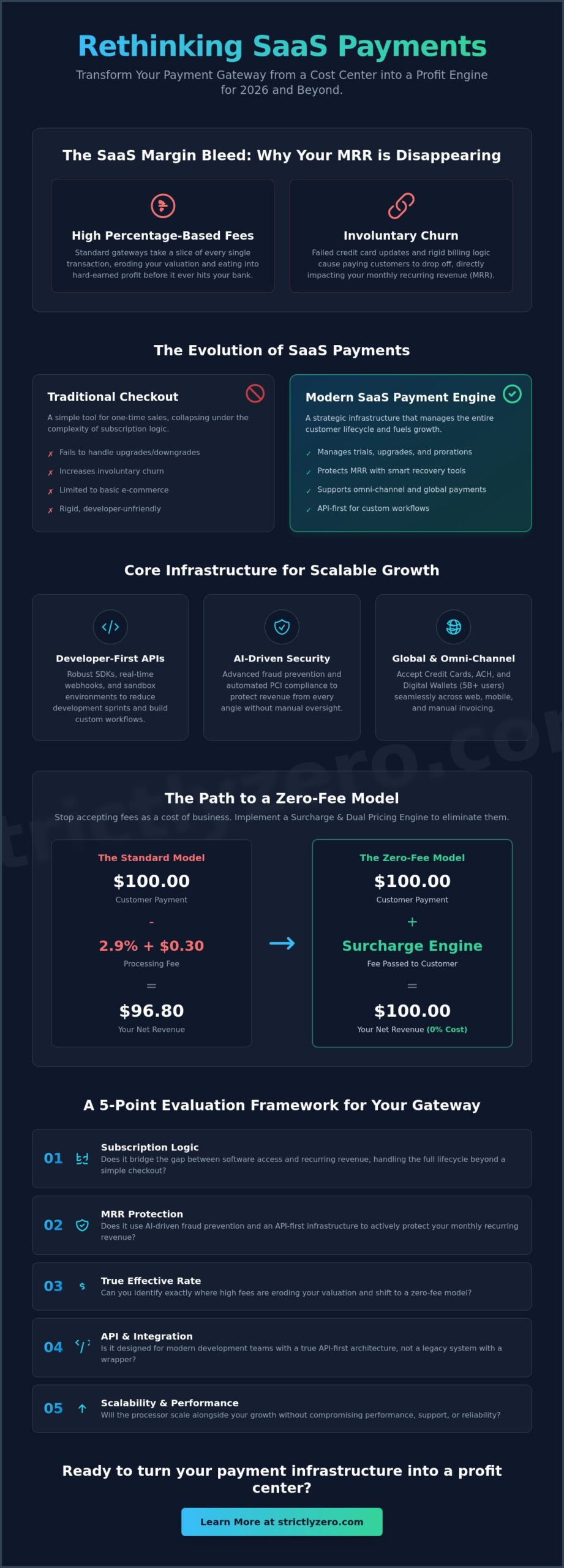
Most founders view transaction fees as an unavoidable tax on growth. They don’t realize that as a platform scales, a standard 2.9% fee plus a fixed per-transaction cost creates a massive leak in the bucket. When you’re processing millions in ARR, these costs compound and directly lower your EBITDA and overall company valuation. Choosing a modern payment gateway for SaaS platforms allows you to move beyond this utility model. By implementing a Surcharge & Dual Pricing Engine, you can effectively recoup your processing costs and turn your payments infrastructure into a profit center.
The most common objection to this model is the fear of increased churn. Founders worry that passing a fee to the customer will drive them away. However, in a B2B or high-value SaaS environment, transparency is the key to retention. When users are presented with a clear choice between a standard price and a credit card convenience price, the vast majority accept it as a standard cost of doing business. When you use a professional framework for evaluating payment gateways, you’ll see that the most successful platforms in 2026 are those that offer these flexible pricing options without sacrificing the user experience.
Understanding the Zero-Fee Merchant Model
A dual pricing model presents a “Cash vs. Card” choice to the subscriber, where “cash” often translates to ACH or bank transfers in the software world. This is managed by a Smart Pricing Engine that detects the card type in real time. If a user enters a debit card, the system must automatically disable the surcharge to remain compliant with federal regulations. The long term ROI of zero fee credit card processing is staggering when compared to traditional flat-rate models. Instead of losing tens of thousands of dollars every month to the card brands, that capital stays in your business to fund product development or customer acquisition.
Compliance and Transparency in Surcharging
Managing a national or global SaaS footprint means navigating a patchwork of state and regional laws regarding surcharges. You cannot simply flip a switch and apply a fee to every transaction. Automated compliance engines protect SaaS founders from regulatory fines by applying the correct rules based on the customer’s location and the specific card being used. These systems handle the legal complexity of debit card detection and state level nuances automatically. This ensures your platform remains on the right side of the law while you focus on scaling your user base. It’s about having the right logic built into your checkout flow so you never have to worry about a compliance audit.
A 5-Point Evaluation Framework for SaaS Gateways
Selecting a payment gateway for SaaS platforms based on brand recognition alone is a gamble that rarely pays off as you scale. You need a structured approach to ensure your financial stack supports your growth rather than hindering it. Start by auditing your current effective rate. This is the only number that truly matters. Take your total monthly fees and divide them by your total processing volume. If that number is significantly higher than your quoted headline rate, you are likely overpaying for international cards, currency conversions, or hidden surcharges. Next, evaluate the ease of implementing recurring billing. If your developers are spending weeks on custom logic for pro-rated upgrades, your gateway is too rigid for a modern software business.
The fourth and fifth steps require looking at the total cost of ownership and partner potential. Beyond the transaction fee, look for monthly gateway access fees, PCI compliance charges, and payout costs. If your business model involves a marketplace or a reseller network, you must prioritize partner management tools. These tools allow you to manage the complexity of multiple stakeholders without adding manual overhead to your finance department. A gateway that scales with you will offer clear visibility into every transaction while providing the flexibility to adjust your pricing model as the market shifts.
Dunning and Retention Intelligence
Involuntary churn is the silent killer of SaaS platforms. It occurs when a customer wants to pay, but their card is declined due to an expiration or a new chip. By 2026, manual outreach is far too slow to keep up with these failures. Modern gateways use automated card account updaters to refresh card details behind the scenes. Tools like ChurnIQ™ provide deep intelligence on why payments fail. This allows you to optimize your retry logic based on specific decline codes. This level of retention intelligence can save a significant portion of your MRR without any manual intervention from your customer success team.
Platform and Partner Capabilities
If you are an ISO or ISV, look for payment processing platforms for ISOs that offer ClearSplit™. This functionality allows you to automate residual payments for your own partners or resellers without relying on manual spreadsheets. White-labeling the gateway experience is also vital. It ensures a unified brand feel from the first sign-up to the final invoice, which reinforces the Trust as a Payment Processor you’ve worked hard to build. If you want to see how these tools can transform your profitability, explore our partner-ready payment infrastructure here. Managing a global network of resellers becomes much simpler when your gateway handles the heavy lifting of residual calculations and brand consistency.
Scaling Your SaaS with Strictly: Profitability Meets Performance
Choosing a payment gateway for SaaS platforms is one of the few decisions that affects both your engineering roadmap and your bottom line simultaneously. Most founders start with a generic provider because it’s easy, but they eventually hit a wall where fees and rigid infrastructure stifle growth. Strictly is built specifically to break down that wall. By combining an API-first architecture with a Surcharge & Dual Pricing Engine, we enable you to stop viewing payments as a tax and start seeing them as a strategic advantage. It’s the logical conclusion for any founder who wants to reclaim their MRR and reinvest it into what matters: the product.
The primary differentiator in 2026 is our Smart Surcharge engine. As we explored in previous sections, the legal landscape for surcharging is complex, but Strictly handles that logic automatically at the gateway level. It identifies card types and geographic regulations in milliseconds. This ensures your platform remains compliant while you eliminate the 2.9% friction that usually eats into your margins. You get the stability of an enterprise-grade backend with the flexibility of a modern, developer-friendly interface.
The Strictly Advantage for High-Growth Platforms
We believe that a payment processor should earn your trust every day. That’s why we offer a model that allows for $0 processing fees, putting capital back into your development budget. While other providers treat you like a ticket number in an automated queue, our 24/7 support model treats you as a partner. We provide the backend stability required for high-volume platforms, wrapped in a UI that rivals the most polished consumer apps. This combination of performance and profitability is why high-growth tech companies are migrating their infrastructure to our ecosystem.
Getting Started: From Sandbox to Live
Speed is a feature. Strictly’s integration process mirrors the best-in-class standards your dev team expects. You can start in a robust sandbox environment to test your recurring billing logic and dunning workflows before going live. Our documentation is clear, concise, and built for modern software teams who don’t have time for legacy integration hurdles. If you’re curious about how much revenue you’re currently leaving on the table, you can request a custom savings analysis to see the immediate impact of a zero-fee model. Scale your SaaS platform with Strictly’s zero-fee payment gateway today.
Future-Proof Your Platform’s Profitability
The landscape of 2026 demands that founders stop accepting transaction fees as a fixed cost of doing business. By shifting to a modern payment gateway for SaaS platforms, you can turn a major expense into a direct driver for growth. We’ve explored how an API-first approach simplifies your development sprints while automated compliance engines remove the legal headaches of surcharging. Protecting your recurring revenue also requires deep retention intelligence, like ChurnIQ™, to fight involuntary churn before it impacts your valuation.
Your infrastructure should work for you, not against you. By implementing a Smart Surcharge Engine and seamless omni-channel integration, you can finally reclaim the capital needed to outpace your competition and reinvest in your product roadmap. It’s time to move beyond the utility model and embrace a system built for high-growth tech. With the right tools in place, your payments become a strategic asset rather than a monthly drain on your resources.
Eliminate your processing fees and scale your SaaS with Strictly.
Building a world-class platform is a monumental challenge. Your payment system should be the wind at your back, helping you scale with confidence and total financial clarity as you reach your next milestone.
Frequently Asked Questions
Is it legal to surcharge for SaaS subscriptions in every state?
Surcharging is legal in the vast majority of U.S. states. However, certain jurisdictions like Connecticut and Massachusetts have historically restricted the practice. Using an automated engine ensures your platform detects the customer’s location and applies the correct regional rules. This prevents legal friction while allowing you to recoup costs where permitted by law.
What is the difference between a payment gateway and a payment processor for SaaS?
The gateway is the digital interface that encrypts and routes transaction data, while the processor handles the actual movement of funds between banks. For a payment gateway for SaaS platforms, the gateway must manage recurring billing logic and API calls before the processor finalizes the settlement. This distinction is vital for maintaining a clean, developer-friendly infrastructure.
How does a zero-fee processing model affect the customer experience?
A zero-fee model provides transparency by giving customers a clear choice between payment methods. Most B2B users are familiar with credit card convenience fees and appreciate the option to pay a lower cash price via ACH. When the UI is professional and integrated seamlessly, it reinforces your brand’s credibility rather than causing friction at checkout.
Can I integrate Strictly with my existing subscription management software?
Yes, you can integrate our API-first infrastructure with most major subscription management tools. The system is built to be flexible, allowing you to keep your existing billing UI while swapping the backend for a more profitable processing model. This ensures a smooth transition that doesn’t disrupt your current development roadmap or customer experience.
What happens if a customer uses a debit card on a surcharge-enabled platform?
The system automatically identifies the card type and removes the surcharge if a debit card is used. Federal regulations prohibit surcharging on debit transactions, even if they are processed as credit at the point of sale. A smart pricing engine ensures you stay compliant by only applying fees to eligible credit card transactions during the checkout flow.
How does ChurnIQ™ help reduce subscriber turnover?
ChurnIQ™ targets involuntary churn by providing intelligence on why specific payments fail. It analyzes decline codes and uses automated card account updaters to refresh expired credentials behind the scenes. This proactive approach ensures that your active subscriber base remains stable without requiring your customer success team to manually chase down new payment details.
Does Strictly support ACH payments for B2B SaaS platforms?
Yes, Strictly supports ACH as part of its omni-channel payment processing suite. This is particularly useful for B2B platforms that handle high-ticket annual contracts or enterprise-level billing. Offering bank transfers alongside credit cards allows you to provide the flexibility that corporate procurement departments require while significantly lowering your overall transaction costs.
What are the PCI compliance requirements for a SaaS using an API-first gateway?
All SaaS platforms must now comply with the PCI DSS 4.0 standards that became mandatory on March 31, 2025. By using an API-first payment gateway for SaaS platforms that prioritizes tokenization, you keep sensitive data off your servers. This reduces your security footprint and makes the annual compliance audit much simpler for your engineering team to manage.