
The Modern Business Model to Avoid Card Fees: A 2026 Strategy Guide
Published:

What if the 3% to 4% of gross revenue you hand over to banks every month wasn’t actually a mandatory cost of doing business, but a choice? It’s a heavy burden when you consider that American businesses paid $224 billion in swipe fees in a single year. Adopting a modern business model to avoid card fees is no longer just a trend for small shops; it’s a critical strategy for any professional enterprise looking to protect its margins in 2026.
You probably agree that losing a significant chunk of every sale to merchant service fees feels like an unfair tax on your success. You want to eliminate those costs, but you also need to stay compliant with complex state laws and keep your customers happy at the same time. This article will show you how to restructure your payment strategy to reach a zero-fee reality without a clunky checkout process. We’ll explore how automated engines can handle the legal heavy lifting of surcharging and dual pricing across different jurisdictions, from New York to Colorado, so you can focus on your business instead of bank statements.
Key Takeaways
- Understand how a 3% processing fee compounds to drain annual growth and why traditional negotiation rarely yields significant savings.
- Explore the mechanics of a business model to avoid card fees through compliant surcharging and dual pricing strategies.
- Learn the specific registration requirements for Visa and Mastercard to keep your zero-fee program fully legal and professional.
- Discover how automated technology identifies debit cards instantly to prevent illegal surcharging and ensure a seamless customer experience.
- Identify how a smart pricing engine can automate state-by-state compliance and eliminate the administrative burden of manual fee management.
Table of Contents
- The Impact of Transaction Costs on Modern Business Growth
- Evaluating Business Models to Minimize or Eliminate Fees
- The Zero-Fee Model: Surcharging and Dual Pricing Explained
- Implementing the Model: Compliance and Technology Requirements
- Why Strictly is the Logical Conclusion for Your Zero-Fee Strategy
The Impact of Transaction Costs on Modern Business Growth
Losing 3% of your gross revenue might seem like a small tax on convenience, but for a scaling company, it’s a silent growth killer. When you process $1 million in sales, you’re handing $30,000 to $40,000 directly to banks instead of reinvesting in your team or product. In 2023 alone, American businesses paid $224 billion in swipe fees. This massive financial friction is why many leaders are re-evaluating their business model to avoid card fees. In 2026, absorbing these costs is no longer the default standard; it’s a strategic disadvantage that compounds every year your business grows.
To better understand how these costs impact your bottom line and who should ultimately be responsible for them, watch this helpful video:
Many providers suggest that moving to an interchange-plus model is the ultimate solution for transparency. While it does strip away some of the mystery found in tiered pricing, it still forces the merchant to pay the base Interchange fee set by card networks. These fees average 1.97% for Visa and 1.79% for Mastercard in the U.S., which is significantly higher than the 0.30% cap seen in Europe. Even with transparent pricing, you’re still footing the bill for your customers’ premium rewards and airline miles. Traditional negotiation rarely moves the needle because you can only negotiate the processor’s markup, not the non-negotiable fees set by Visa and Mastercard.
The Psychology of Absorbing Processing Costs
For decades, businesses hid transaction costs within their general markup. They feared that being transparent about fees would drive customers away. However, the 2026 market shows a massive shift. Consumers are more aware of payment costs than ever before. When you use a business model to avoid card fees, you’re choosing transparency over hidden markups. You also protect your margins from rewards-heavy premium credit cards. These high-end cards carry much higher fees that can quickly erode the profit on a single sale if you’re the one paying for them. Modern shoppers often prefer a clear choice between a cash price and a card price rather than paying an inflated price that covers everyone’s rewards points.
Identifying Hidden Profit Leaks in Your Statements
Merchant statements are often designed to be intentionally confusing. You’ll see line items for batch fees, monthly minimums, and PCI compliance charges that add up quickly. These junk fees can inflate your costs well beyond the base percentage you were quoted. Your effective rate is the only metric that truly matters for cost analysis because it represents your total fees divided by your total sales volume. To calculate your true cost of acceptance, look at the bottom line of your statement rather than the teaser rate your processor promised. Look for these specific leaks:
- Review daily batch header fees that shouldn’t be there.
- Check for non-qualified surcharges on rewards cards that weren’t disclosed.
- Identify monthly service or statement fees that provide no actual value.
This total cost is the figure you can eliminate by switching to a compliant zero-fee model. Once you stop paying for the privilege of being paid, those funds can be redirected into hiring, marketing, or scaling your operations.
Evaluating Business Models to Minimize or Eliminate Fees
Most business owners start their cost-cutting journey by trying to negotiate with their current processor. They spend hours on the phone hoping to shave off a few basis points. The hard truth is that processors can only lower their own markup. They can’t touch the base interchange rates set by the card networks, which usually make up the bulk of your bill. While B2B companies can sometimes lower costs using Level 2 or Level 3 data processing, this requires capturing extensive line-item detail for every transaction. It’s often more administrative work than the savings are worth. To truly protect your margins, you need a structural change rather than a minor discount. Switching to a zero fee credit card processing model is the only way to reach a $0 cost of acceptance.
The Negotiation Myth vs. Structural Change
Negotiation is a surface-level fix for a deep-rooted problem. Because the Interchange fee is non-negotiable, your processor is essentially fighting over pennies while the banks keep the dollars. A modern business model to avoid card fees focuses on shifting the cost of the transaction away from the business entirely. This isn’t about getting a better rate; it’s about changing who pays for the convenience of using credit. By implementing a surcharge or dual pricing strategy, you stop viewing processing as an overhead expense and start treating it as a pass-through cost.
Comparing ACH, Surcharging, and Dual Pricing
Choosing the right path depends on your industry and how your customers prefer to pay. ACH and E-checks are popular for B2B transactions because they replace percentage-based fees with small, flat amounts. However, they can create friction for customers who want to earn credit card rewards. Surcharging and dual pricing offer more flexibility for retail and service-based businesses. Before you implement these, you must check state-by-state surcharge laws to ensure your program is compliant with local regulations. The following table compares the most common strategies for 2026:
| Model | Implementation Difficulty | Cost Savings Potential | Best Industry Fit |
|---|---|---|---|
| ACH / E-check | Moderate | High (Fixed Fee) | B2B, Wholesalers |
| Surcharging | Low | Total Credit Fees | Retail, Home Services |
| Dual Pricing | Moderate | 100% of Processing | High-Volume Retail |
Modern “Smart Pricing” technology takes the guesswork out of this decision. Instead of manually choosing a model for every sale, an automated engine can detect the card type and apply the correct compliant fee structure instantly. This ensures you never accidentally surcharge a debit card, which is a major compliance risk. If you want to see how these models look in practice, you can explore our surcharge and dual pricing engine to find the best fit for your workflow.
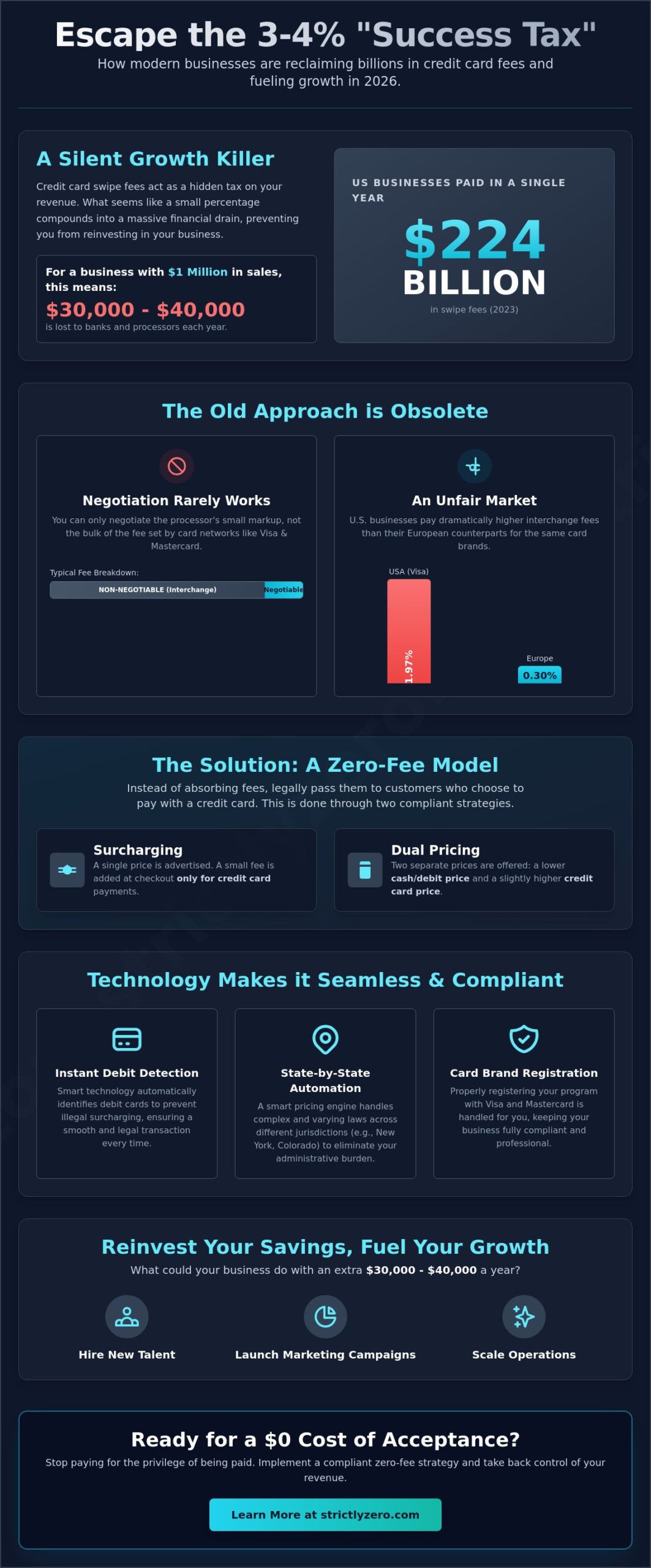
The Zero-Fee Model: Surcharging and Dual Pricing Explained
Implementing a business model to avoid card fees requires a shift from passive acceptance to active price management. While many merchants confuse surcharges with convenience fees, they serve very different purposes. A convenience fee is a flat charge for using an alternative payment channel, like paying online instead of in-person. A surcharge is a percentage-based fee added specifically to credit card transactions to cover the merchant’s processing costs. Success in 2026 depends on understanding credit card processing fees and how they break down between interchange and network assessments.
Critics often claim these models drive away customers, but the reality is more nuanced. When communication is clear and professional, shoppers rarely switch brands over a small fee. They already see these models at gas stations and local restaurants. When your staff is backed by automated technology that detects card types instantly, the process becomes invisible. The terminal handles the math, the compliance, and the disclosure, leaving your team to focus on service rather than explaining bank costs.
How Surcharging Works in 2026
Legally, surcharging comes with strict transparency requirements. You must display clear signage at the entrance and the point of sale at least 30 days before starting. Each receipt must show the surcharge as a separate line item so the customer knows exactly what they paid. Crucially, you cannot surcharge debit cards, regardless of whether they are run as “debit” or “credit” through the network. A surcharge must never exceed the actual cost of acceptance. If your effective rate is 2.5%, you cannot charge 3.5% just to generate extra profit. Failing to follow these rules can lead to heavy fines or the loss of your merchant account.
Dual Pricing: The Customer-Friendly Alternative
Dual pricing is often the superior business model to avoid card fees because it frames the transaction positively. Instead of adding a “penalty” to a credit card sale, you present two distinct prices for every item: a “Card Price” and a “Cash Price.” This is legally distinct from surcharging because it offers a discount for cash rather than a fee for credit. It’s often easier to implement across all 50 states because it follows standard retail discounting rules. For a deeper look at which path fits your specific sales volume, check this Surcharging vs. Dual Pricing comparison.
- Transparency: Customers see both prices upfront, eliminating surprises at the end of the transaction.
- Compliance: It bypasses many of the complex state-level surcharge restrictions.
- Simplicity: There’s no need to calculate percentages on the fly; the prices are already set.
By moving to one of these models, you stop the 3% leak in your revenue. The technology available today ensures that your terminal recognizes the difference between a high-cost rewards card and a standard debit card in milliseconds. This automation protects you from accidentally surcharging a debit user, which is the most common cause of compliance failures.
Implementing the Model: Compliance and Technology Requirements
Implementing a business model to avoid card fees requires more than just a change in your pricing philosophy. It demands a technical infrastructure that can handle the nuances of card brand rules and state legislation in real time. Before you process your first zero-fee transaction, you must register your intent with Visa and Mastercard. This 30-day notice period is a mandatory requirement that ensures your business stays compliant with network standards. Without this formal registration, you risk heavy penalties or the permanent loss of your processing privileges.
The 5-Step Roadmap to Zero-Fee Implementation
Success depends on a structured rollout. First, audit your current processing volume and card mix. If your customer base primarily uses debit cards, you’ll need to focus on a dual pricing model rather than a surcharge, as debit cards are legally exempt from surcharges. Second, update your physical and digital disclosures. Transparency isn’t just a legal requirement; it’s a trust-builder. Third, deploy a Smart Pricing Engine that identifies card types the moment they’re swiped or entered. Fourth, train your staff to explain the model clearly. Finally, integrate these tools into your existing workflow to ensure a seamless experience for your customers.
Technology Must-Haves for Compliance
Manual entry is the biggest compliance risk in the industry. If a cashier manually adds a fee to a debit card transaction, they’ve just committed a violation that could lead to massive fines. Modern terminals must use automated debit detection. This technology reads the card’s data instantly to determine if a surcharge is legal. Additionally, your software must be location-aware. Rules in New York differ from those in Colorado, and your system should automatically adjust based on where the sale happens.
To keep your operations streamlined, look for an omni-channel payment processing platform. This ensures that whether a customer buys from your website or your physical storefront, your reporting and compliance remain unified. High-quality systems also include AI-driven fraud prevention to protect your recovered profit margins from the cost of chargebacks. If you aren’t sure if your current hardware can handle these requirements, you can speak with a compliance specialist to audit your existing system.
Why Strictly is the Logical Conclusion for Your Zero-Fee Strategy
Strictly provides the infrastructure needed to turn your payment processing from a monthly liability into a neutral utility. By choosing a business model to avoid card fees, you’re reclaiming thousands of dollars that used to vanish into bank coffers. Our Surcharge & Dual Pricing Engine does the heavy lifting so you don’t have to manually monitor the interchange rates or state law updates. Whether you’re selling in-person, through a virtual terminal, or via an omni-channel e-commerce setup, the platform ensures every transaction is optimized for zero cost. This shift moves your merchant services from a “cost center” to a “profit center” by protecting your margins on every single swipe.
The technical complexity of modern payments can be overwhelming. Strictly simplifies this by offering a unified platform that works wherever you do business. You get AI-driven fraud prevention and partner management tools that work in the background to keep your revenue safe. You won’t need to juggle multiple providers for your mobile sales and your brick-and-mortar storefront. Everything is consolidated into one dashboard, giving you a clear view of your savings and your scaling potential.
Automating Compliance Across Every State
Managing credit card surcharge rules across different states is a nightmare for manual accounting. Strictly automates this by being location-aware. If a customer pays in a state with a 2% cap, the system knows. If they’re using a debit card, the system switches to a dual pricing or no-surcharge flow instantly. It’s a “set it and forget it” solution that reduces the administrative burden on your accounting team. You don’t have to worry about the legal nuances of New York versus Maine; the software handles the compliance logic for you.
Getting Started with Zero-Fee Merchant Services
Onboarding is designed to be seamless and supportive. We handle the mandatory 30-day registration with Visa and Mastercard, ensuring you’re fully compliant before you go live. We also provide the necessary digital and physical disclosures to keep your checkout experience professional and transparent. Using the best credit card processing for small business means having access to enterprise-grade tools that help you scale without the friction of rising bank fees. You can focus on hiring, marketing, and expansion while we handle the technical side of your payment strategy. It’s time to stop paying for the privilege of accepting payments. Eliminate your processing fees today with Strictly and keep your hard-earned profit where it belongs.
Future-Proof Your Profit Margins Today
The era of letting swipe fees erode your bottom line is over. You now have the roadmap to transition from a passive merchant to a strategic business leader who protects every dollar. By adopting a business model to avoid card fees, you’re choosing to reinvest that 3% back into your own growth instead of funding rewards for others. You’ve seen how automated compliance and clear communication remove the friction from the checkout experience for both your staff and your customers.
It’s time to take action. Whether you’re processing sales online, on the move, or in a physical store, you need a system that handles the technical heavy lifting for you. Our Smart Pricing Engine ensures you stay compliant with state laws while offering professional no-cost surcharge and dual pricing programs. With omni-channel support across web, mobile, and in-person channels, your reporting stays unified and your margins stay protected.
Stop Paying Card Fees Today—Switch to Strictly Zero
You’re ready to reclaim your revenue and scale your business with confidence. The transition is simpler than you think, and the long-term impact on your profitability will be massive.
Frequently Asked Questions
Is it legal to pass credit card fees to customers in all states?
No, it isn’t legal in every jurisdiction. As of 2026, Connecticut, Massachusetts, Maine, and Puerto Rico explicitly prohibit credit card surcharging. Other states have specific restrictions; for example, Colorado caps surcharges at 2%, while New York and New Jersey require that the fee doesn’t exceed your actual cost of card acceptance. You should always verify your local statutes before launching a program.
What is the difference between a surcharge and a convenience fee?
A surcharge is a percentage-based fee added to a credit card transaction to cover processing costs, whereas a convenience fee is a flat charge for using an alternative payment channel. For instance, a utility company might charge a flat fee for paying online instead of by mail. Surcharging is specifically tied to the card brand and the cost of the transaction itself.
Can I add a surcharge to debit card transactions?
No, you can’t legally add a surcharge to debit card transactions under any circumstances. This federal rule applies even if the customer chooses to run their debit card as “credit” at the terminal. Because debit interchange fees are capped much lower than credit fees, card networks prohibit merchants from adding extra charges to these transactions to protect consumers.
How do I tell my customers about the new zero-fee model?
You must provide clear, transparent disclosure at the entrance of your business and at the point of sale. Most merchants use professional signage that explains the rising cost of card processing and highlights the availability of a cash discount. Being upfront about your pricing helps maintain customer trust and prevents surprises when the final total appears on the screen.
Does surcharging affect my PCI compliance requirements?
Surcharging doesn’t change your core PCI DSS requirements, but it does require your payment technology to be more sophisticated. Adopting a modern business model to avoid card fees usually involves using an integrated engine that calculates fees automatically. This automation ensures that your transaction data remains secure and that your surcharge math is accurate and compliant with industry standards.
What happens if a customer complains about the surcharge?
The best strategy is to explain that the fee covers the high cost of credit card rewards and bank processing. You should immediately offer them a fee-free alternative, such as paying with a debit card or cash. Most customers accept the fee when they realize it’s an optional cost for the convenience of using a high-rewards credit card.
How does a dual pricing program actually look on a receipt?
A dual pricing receipt displays two distinct totals: the “Card Price” and the “Cash Price.” This transparency allows the customer to see exactly how much they saved by choosing a non-credit payment method. It’s often viewed more favorably than a surcharge because it frames the transaction as a discount for cash rather than an added penalty for credit.
Can I use a zero-fee model for online e-commerce payments?
Yes, you can implement a business model to avoid card fees for online sales using a virtual terminal or e-commerce plugin. The system uses real-time card detection to identify if a customer is entering a credit or debit card number. If it’s a credit card, the system applies the compliant surcharge or dual price instantly before the customer clicks the final “pay” button.