
The Ultimate Payment Processing Platform for ISOs: Scale Your Portfolio in 2026
Published:

What if your ISO could scale to thousands of merchants without adding a single person to your back-office team? In the high-stakes market of 2026, relying on manual spreadsheets for residual tracking is a recipe for human error and lost revenue. You know that winning new accounts is only half the battle; the real challenge is keeping them when competitors are knocking on their doors with lower rates every day. This is why zero fee processing for ISOs has become the essential tool for professionals looking to eliminate merchant costs while protecting their own margins.
It’s frustrating to watch your hard-earned residuals dip because of fragmented reporting or the complexity of staying compliant with 2026 surcharge laws in states like Illinois or Colorado. You’re about to learn how the right payment processing platform can transform these operational headaches into a distinct competitive advantage. This guide covers how to automate partner compensation with ClearSplit, use ChurnIQ to stop merchant attrition before it happens, and leverage a smart pricing engine to maintain a zero-fee edge that wins more business.
Key Takeaways
- Learn how automated residual management removes the scalability bottlenecks caused by manual tracking and human error.
- Discover why zero fee processing for ISOs is the most effective sales lever for closing merchants in a high-inflation market.
- Understand how to maintain total compliance across all 50 states using a smart pricing engine that adapts to 2026 surcharge regulations.
- See how AI-driven portfolio health data can help you identify at-risk merchants and stop churn before it impacts your bottom line.
Table of Contents
- The Evolution of Payment Processing Platforms for ISOs in 2026
- Core Features of a High-Performance ISO Platform
- Residual Management and Retention: The Profitability Gap
- Zero Fee Processing for ISOs: The Ultimate Sales Lever
- Scaling Your Payments Business with Strictly
The Evolution of Payment Processing Platforms for ISOs in 2026
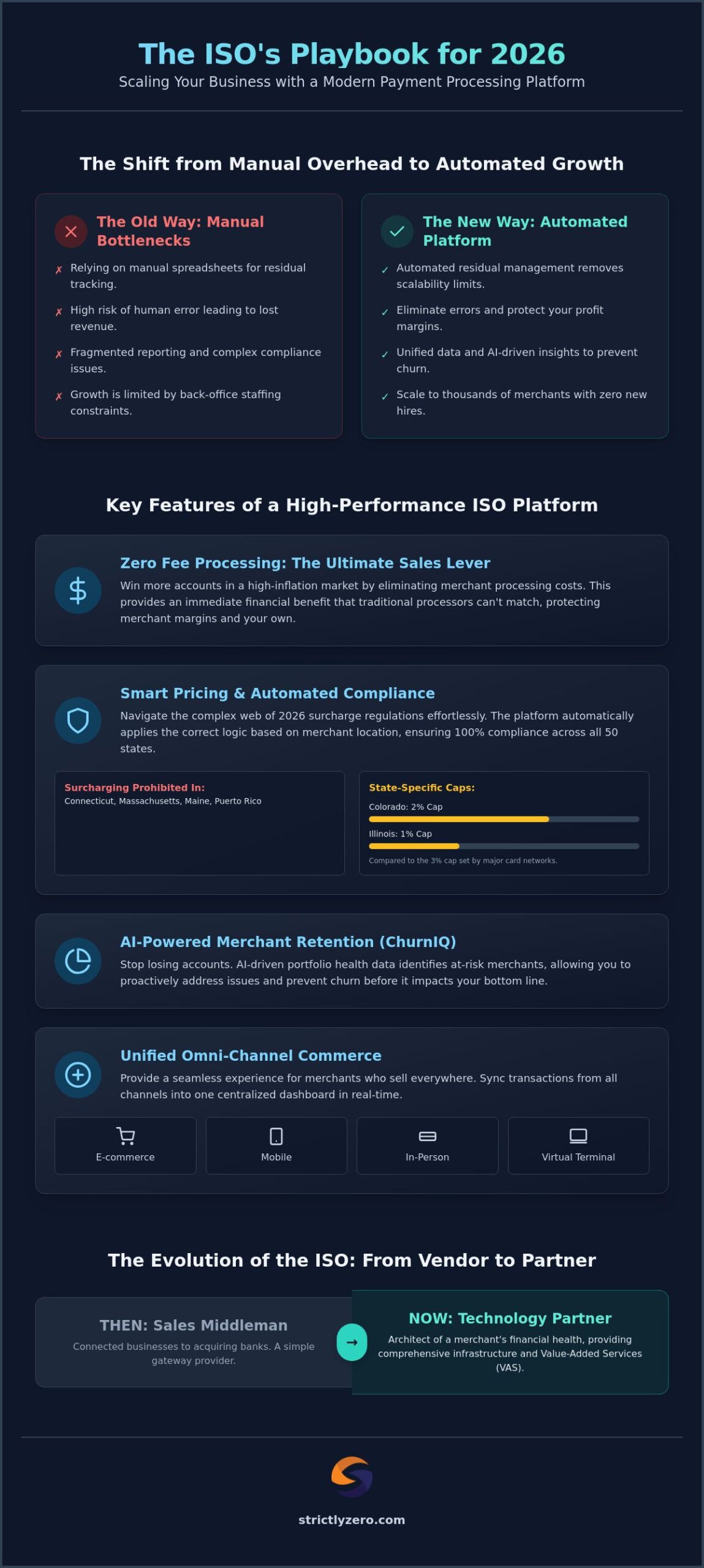
The role of the Independent Sales Organization has shifted dramatically. In the past, an ISO was primarily a middleman connecting businesses to an acquiring bank. By 2026, this model has become obsolete. Merchants no longer want a simple gateway connection; they want a technology partner that provides a comprehensive infrastructure. This shift is driven by the need for transparency and the massive popularity of zero fee processing for ISOs. Small organizations can now leverage the same sophisticated tools as global giants, leveling the playing field in a way that was impossible a decade ago. You’re now expected to be the architect of a merchant’s financial health, not just a vendor.
To better understand how these fee structures impact your sales strategy, watch this helpful video:
What is a Payment Processing Platform for ISOs?
A modern platform serves as the critical operational layer within the payment processing ecosystem. It isn’t just a place to view basic transactions. It’s a unified tech stack that combines a high-performance CRM, a robust gateway, and automated residual reporting. For high-growth portfolios, having ecommerce payment processing capabilities integrated into the same dashboard as retail sales is no longer optional. This infrastructure allows you to handle everything from virtual terminals to complex state-by-state surcharge compliance without hiring a massive back-office team. It’s the engine that lets you scale your business while keeping overhead low.
The Shift from Sales to Technology Partners
Merchants in 2026 expect their ISO to provide software solutions that solve real business problems. They aren’t just looking for a card reader; they want Value Added Services (VAS) like POS lending, AI-driven fraud prevention, or even compliant asset tokenization through the STO Foundation. This is why the industry is moving toward “Partner Infrastructure” where the ISO provides the tools to run the entire business. If you don’t offer omni-channel capabilities that sync in-person sales with online storefronts, you’ll likely lose those accounts to more agile competitors. By offering a zero fee processing for ISOs model, you provide an immediate financial benefit that traditional processors struggle to match. You’re no longer just selling a service; you’re providing the technology that protects their margins during inflationary cycles.
Core Features of a High-Performance ISO Platform
To lead the market in 2026, your infrastructure must do more than just record sales. A high-performance platform acts as a centralized command center that bridges the gap between complex banking back-ends and the merchant’s daily operations. This requires an API-first architecture, allowing enterprise-level ISOs to build custom integrations or embed payment flows directly into third-party software. When you own the technology stack through white-labeling, you aren’t just selling another processor’s service; you’re building equity in your own brand. This control is vital for explaining the nuances of Credit Card Processing Fees to merchants who are tired of hidden markups and unpredictable monthly statements.
The most successful agents currently use a Smart Pricing Engine to manage zero fee processing for ISOs. This technology automates the heavy lifting of state-level compliance. For instance, as of 2026, surcharging is strictly prohibited in Connecticut, Massachusetts, Maine, and Puerto Rico. In states where it is legal, the rules are increasingly granular. Colorado caps surcharges at 2%, while Illinois has implemented a 1% cap. A manual approach to these variations is a liability. A high-performance platform automatically detects the merchant’s location and applies the correct logic, ensuring they never exceed the actual cost of acceptance or the 3% cap set by major card networks.
Omni-Channel Versatility and Virtual Terminals
Modern merchants rarely sell in just one place. Your platform must provide a unified dashboard that syncs e-commerce, mobile, and in-person transactions in real time. Virtual terminals are essential for remote businesses, allowing them to process keyed-in orders securely without physical hardware. By offering integrated payment links and recurring billing, you help merchants stabilize their cash flow. This unified view makes troubleshooting simple. When a merchant calls with a question, you can see their entire history across every channel, rather than hunting through fragmented reports across multiple gateways. If you’re looking to streamline these operations, checking out modern Partner Management Tools can give your team the visibility they need.
Compliance as a Service
Compliance shouldn’t be the merchant’s burden. A top-tier platform handles PCI DSS requirements automatically, reducing the scope and risk for the business owner. Beyond basic security, the system must enforce the Durbin Amendment rules, which prohibit surcharging on debit card transactions nationwide. High-performance platforms also integrate AI-driven fraud prevention. This technology analyzes transaction patterns to stop chargebacks before they happen, protecting your portfolio’s health. By automating these legal and security hurdles, you position yourself as a protector of the merchant’s revenue, making it much harder for a competitor to lure them away with a slightly lower rate.
Residual Management and Retention: The Profitability Gap
Scaling an ISO portfolio usually reveals a painful truth: your back-office can’t keep up with your sales team. Manual spreadsheets were fine for your first fifty merchants, but they become a liability when you’re managing hundreds. Human error in residual tracking leads to missed payments, frustrated agents, and a lack of clear insight into your actual profit margins. In 2026, the gap between a struggling ISO and a market leader is defined by how they handle this data. By automating the residual lifecycle, you distance your brand from the deceptive practices that plague the industry and erode agent trust. Transparency isn’t just a moral choice; it’s your most effective recruitment tool for attracting top-tier sales talent.
ClearSplit™ solves the “residual headache” by providing automated partner compensation. Instead of waiting weeks for a manual report, your agents get real-time visibility into their earnings. This level of clarity is especially important when marketing zero fee processing for ISOs, as agents need to see exactly how the service fee translates into their monthly residuals. When your team trusts the numbers, they spend more time selling and less time auditing their statements. This infrastructure allows you to act like a large-scale processor while maintaining the agility of a lean sales organization.
Automating the Residual Lifecycle
In 2026, speed is the ultimate currency. Real-time residual reporting gives agents the immediate feedback they need to stay motivated. Managing complex multi-level splits for sub-agents and referral partners used to take days of administrative work; now, it happens instantly. Providing detailed insights into credit card processing services builds a foundation of loyalty that prevents your best agents from being poached by competitors. When the math is always right and always on time, your retention rates for both agents and merchants naturally climb.
Predictive Analytics for Portfolio Health
Winning a merchant is expensive, but losing one is devastating to your long-term residuals. ChurnIQ™ changes the game by using predictive intelligence to identify merchants at risk of leaving before they ever pick up the phone to cancel. It spots “red flag” behaviors, such as a sudden drop in transaction volume or a spike in chargebacks. This data allows you to be proactive. Instead of reacting to a cancellation notice, you can offer a feature upgrade or a rate adjustment that keeps the merchant happy. The ROI of retaining an existing account is significantly higher than the cost of acquiring a new one, making portfolio health data a critical asset for zero fee processing for ISOs who want to protect their bottom line.
Zero Fee Processing for ISOs: The Ultimate Sales Lever
In an economy where every basis point counts, the ability to offer zero fee credit card processing is your most powerful door-opener. Merchants are currently facing rising operating costs, and the prospect of saving $18,000 annually on a $50,000 monthly processing volume is often enough to close a deal on the first visit. However, the “zero-fee” pitch only works if you can back it up with a bulletproof compliance strategy. This is where zero fee processing for ISOs becomes more than a sales tactic; it’s a specialized service that requires a high-performance technical infrastructure to manage the legal nuances across different regions.
The “Smart Pricing Engine” discussed earlier is the key to maximizing your margins while eliminating merchant costs. By passing the processing fees to the consumer, you protect the merchant’s bottom line and secure a more stable residual stream for your agents. Skeptical merchants often worry about customer pushback, but data shows that transparency is the best remedy. When a fee is clearly disclosed or presented as a cash discount, consumers are far more likely to accept it as a standard business practice in 2026. Your job is to provide the technology that makes this transition seamless and compliant.
How to Implement a Compliant Surcharge Program
Success starts with a structured onboarding process. If your agents aren’t following these steps, you’re exposing your portfolio to significant regulatory risk:
- Step 1: Assessing Eligibility: Verify the merchant’s location. As of 2026, you cannot implement surcharging in Connecticut, Massachusetts, Maine, or Puerto Rico.
- Step 2: Configuring the Engine: Set specific caps based on state laws. For instance, Colorado requires a 2% cap, while Illinois limits surcharges to 1% or the actual cost of the transaction.
- Step 3: Training Agents: Ensure your team can articulate the value of zero fee merchant services. They should focus on the “reward” of cash discounts rather than the “penalty” of a surcharge.
Dual Pricing vs. Surcharging: Expert Guidance
Understanding the technical differences between these models is vital for portfolio retention. Surcharging adds a fee specifically to credit card transactions at the point of sale. Dual pricing, however, presents two separate prices to the customer: one for cash and one for card. Retailers often prefer dual pricing because it feels like a transparent choice for the consumer. Professional services might lean toward surcharging to maintain a single listed rate on invoices. Regardless of the model, your terminal configuration must include automatic debit card detection. Under the Durbin Amendment, surcharging debit cards remains prohibited nationwide. If your hardware can’t distinguish between a credit and debit card in real-time, you’re non-compliant.
Ready to equip your agents with the ultimate sales tool? Explore our Surcharge & Dual Pricing Engine to start scaling your portfolio with confidence.
Scaling Your Payments Business with Strictly
Choosing the right payment processing platform for ISOs is the most consequential decision you’ll make for your portfolio this year. Strictly provides the technical infrastructure that allows your organization to function with the efficiency of a global processor while maintaining the personal touch of a boutique sales firm. By integrating ClearSplit and ChurnIQ into your daily operations, you solve the two biggest problems in the industry: administrative bottlenecks and merchant attrition. This unified approach to zero fee processing for ISOs ensures that your residuals grow consistently without your overhead spiraling out of control.
The synergy between these tools creates a growth flywheel. ClearSplit handles the complex, multi-level partner compensation discussed earlier, freeing your team to focus on acquisition. Simultaneously, ChurnIQ monitors your portfolio health in real-time, alerting you to potential cancellations before they happen. When you combine this with our Smart Pricing Engine, you have a complete ecosystem designed to win, manage, and retain high-volume merchants across all 50 states. We don’t just provide a gateway; we provide the partner management tools you need to lead the market.
The Strictly Partner Advantage
Our partner program is built specifically for the needs of ISOs, MSPs, and developers who require deep integration and reliable support. You get access to a dedicated team that understands the nuances of the ISO business model. We provide white-label marketing resources that help your agents effectively pitch the zero-fee revolution to merchants who are tired of high processing costs. As the industry moves toward the ISO 20022 standard and adapts to new state-level regulations in late 2026, our platform updates automatically. This ensures your merchants stay compliant and your agents stay ahead of the competition without you having to manually track every legislative shift.
Your Growth Roadmap
Future-Proof Your ISO Portfolio
The payment landscape of 2026 demands more than just a gateway connection. It requires a partner ecosystem that handles the heavy lifting of compliance and administrative tasks so you can focus on high-level growth. You’ve seen how manual residual tracking and merchant churn can stall your progress. By implementing automated systems and leveraging zero fee processing for ISOs, you can spend your time on recruitment and strategy rather than back-office firefighting.
Success in this competitive market comes down to the specific tools you provide your agents and merchants. ClearSplit™ ensures your partners are paid accurately and instantly, while ChurnIQ™ provides the retention intelligence needed to protect your portfolio from attrition. Most importantly, a state-compliant Smart Pricing Engine allows you to offer zero-fee models with total confidence across every jurisdiction, including those with strict 2026 regulations. The infrastructure you choose today will define your profitability for years to come.
Ready to transform your operations and lead the market? Scale your portfolio with the ultimate ISO platform at Strictly. The opportunity to dominate the payments space has never been greater, and it’s time to build a business that scales as fast as your ambition.
Frequently Asked Questions
What is an ISO in payment processing?
An ISO, or Independent Sales Organization, is a third-party company that partners with acquiring banks to provide payment processing services to merchants. These organizations act as the sales and support arm of the processor, handling merchant acquisition and ongoing relationship management. In 2026, ISOs have evolved into technology providers that offer unified platforms, including virtual terminals and fraud prevention tools, rather than just basic merchant accounts.
How does an ISO platform handle residual payments?
Modern platforms handle residual payments through automated calculation engines that track every transaction in real-time. Instead of manual spreadsheets, systems like ClearSplit™ automatically manage complex multi-level splits for sub-agents and referral partners. This automation ensures that compensation is accurate and transparent, allowing sales teams to view their earnings through a dedicated portal without waiting for end-of-month manual reports.
Can ISOs offer zero-fee credit card processing?
Yes, ISOs can offer zero fee processing for ISOs by implementing surcharge or dual pricing models that pass processing costs to the consumer. These programs allow merchants to eliminate their monthly card fees while the ISO maintains its margins through the service fee collected at the point of sale. It’s a powerful sales lever that helps agents close more deals by offering immediate cost savings to business owners.
What is the difference between an ISO and an ISV?
The main difference lies in the core product; an ISO focuses on selling payment processing services, while an ISV (Independent Software Vendor) provides specialized software that has payments integrated into it. For example, a company selling a restaurant management system is an ISV. In 2026, the lines are blurring as ISOs increasingly provide their own technology stacks and white-labeled software to compete with software-first providers.
How do I choose the best payment processing platform for my ISO?
You should prioritize a platform that offers unified omni-channel processing, API-first architecture, and robust residual automation. The best choice for 2026 will include a smart pricing engine that automatically handles state-by-state surcharge compliance and predictive analytics to monitor portfolio health. It’s also essential to find a partner that supports white-labeling, allowing you to own the merchant experience under your own brand.
Is surcharging compliant in all 50 states in 2026?
No, surcharging is not legal in every jurisdiction; as of 2026, it remains strictly prohibited in Connecticut, Massachusetts, Maine, and Puerto Rico. In states where it is allowed, there are varying restrictions, such as a 2% cap in Colorado and a 1% cap in Illinois. Using a smart pricing engine is the only reliable way to ensure your zero fee processing for ISOs remains compliant with these shifting state laws and card network rules.
What tools do ISOs need to reduce merchant churn?
To reduce churn, ISOs need predictive intelligence tools like ChurnIQ™ that identify at-risk merchants based on transaction patterns and volume drops. These tools allow you to be proactive by offering rate adjustments or new features before a merchant decides to cancel. Additionally, providing a unified dashboard for troubleshooting and automated fraud prevention adds value that makes it difficult for merchants to switch to a basic competitor.