
Tools for Managing a Merchant Portfolio: The 2026 ISO Tech Stack
Published:

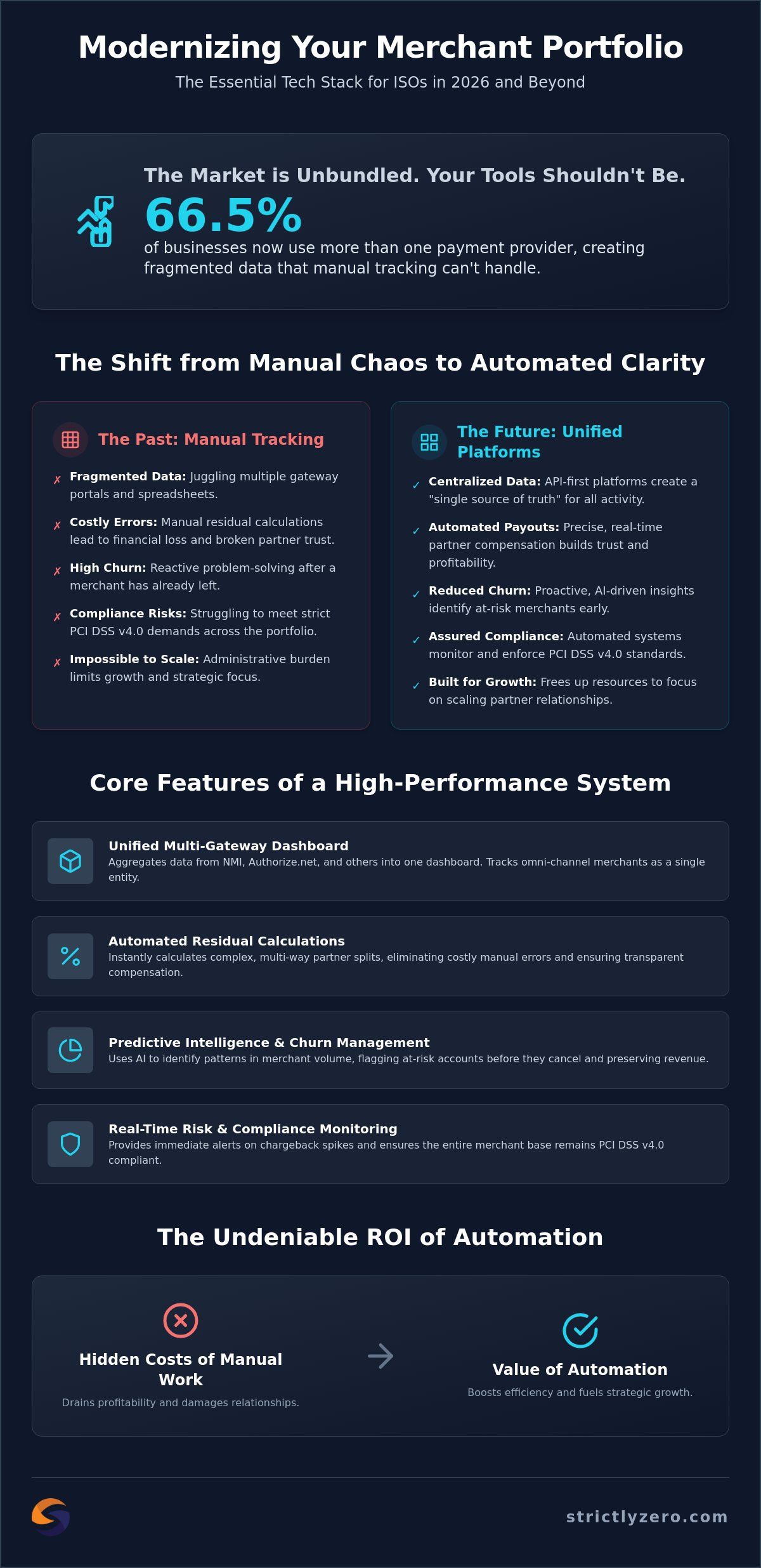
Did you know that 66.5% of businesses now use more than one payment provider? In this unbundled market, relying on manual spreadsheets to track residuals and merchant activity is no longer just a headache; it’s a significant financial risk. If you’re struggling with fragmented data across multiple gateways or the strict new demands of PCI DSS v4.0 compliance, you’re not alone. Finding the right tools for managing a merchant portfolio is the only way to stay competitive as interchange adjustments and digital wallet adoption continue to shift the landscape.
We understand that manual tracking errors and high churn rates are draining your team’s resources. You deserve a system that works as hard as you do. This article will show you how to build a modern tech stack that automates partner compensation, reduces churn, and provides a unified view of your entire portfolio. We’ll explore the essential software and automated systems you need to achieve real-time monitoring and transparent partner splits, ensuring your ISO is ready for the specific operational demands of 2026.
Key Takeaways
- Understand why the shift to API-first platforms is essential for modernizing your tech stack and centralizing fragmented data.
- Identify the essential features of high-performance tools for managing a merchant portfolio, including automated residual calculations and multi-gateway dashboards.
- Calculate the ROI of automation by discovering how to eliminate the hidden financial costs of manual tracking errors.
- Learn the specific integration requirements needed to ensure your management tools play well with gateways like NMI and Authorize.net.
- Discover how unified infrastructure provides the real-time transparency necessary to scale your partner relationships and reduce merchant churn.
Table of Contents
- What Are Tools for Managing a Merchant Portfolio?
- Core Features of High-Performance Portfolio Management Systems
- Automated Residuals vs. Manual Tracking: The ROI of Automation
- How to Choose the Right Management Tool for Your Business
- Scaling with Strictly: The Ultimate Partner Platform for ISOs
What Are Tools for Managing a Merchant Portfolio?
Tools for managing a merchant portfolio are specialized software platforms designed to aggregate transaction data, automate residual payouts, and monitor merchant risk in real time. While traditional Merchant Banking historically relied on manual ledger entries and delayed monthly statements, the payments industry in 2026 operates at a much higher velocity. These modern tools serve as the central nervous system for an Independent Sales Organization (ISO), pulling data from various sources to provide a clear picture of profitability.
Legacy CRM systems often fail high-growth payments businesses because they weren’t built to handle the complex, multi-layered data of modern processing. A standard CRM might track a lead or a contact, but it can’t calculate a three-way partner split or flag a sudden spike in chargebacks across multiple processing environments. Without specialized tools for managing a merchant portfolio, ISOs are forced into a cycle of manual data entry that’s prone to error and impossible to scale.
To better understand how these merchant assets are valued and managed during transitions, watch this helpful video:
The Evolution of the ISO Tech Stack
The ISO tech stack has moved far beyond the era of static spreadsheets and local databases. Current industry standards favor API-first unified platforms that create a “data lake” for all merchant activity. This shift is essential because most businesses now use more than one payment provider to ensure redundancy. Modern reporting bridges the gap between online checkouts and in-person transactions, ensuring that omni-channel merchants are tracked as a single entity rather than fragmented accounts across different processing platforms.
Why Real-Time Visibility is Non-Negotiable
In 2026, waiting for a monthly statement to check your portfolio health is a recipe for high churn. Real-time visibility allows you to identify “red flag” merchants who show signs of leaving or financial distress before they actually close their accounts. This immediate insight is vital when managing specific programs like zero fee credit card processing, where monitoring thin margins is necessary to maintain profitability. Furthermore, with PCI DSS v4.0 now mandatory, automated systems are the only way to ensure your entire merchant base remains compliant and avoids non-compliance penalties from major processors.
Core Features of High-Performance Portfolio Management Systems
High-performance systems aren’t just digital filing cabinets; they’re active engines that drive growth. The most effective tools for managing a merchant portfolio create a “single source of truth” by aggregating data from every gateway your merchants use. Since research shows over 66% of businesses now rely on multiple payment providers, having a unified dashboard is the only way to maintain a clear view of your portfolio’s health. Without this integration, ISOs are forced to jump between various third-party portals, leading to fragmented data and missed opportunities for optimization.
Beyond visibility, automation is the backbone of these systems. Manual residual tracking is a liability that often leads to errors, damaging partner trust and draining profitability. Modern platforms use automated engines like ClearSplit™ to handle complex partner splits and residual calculations instantly. This level of precision is a vital component of modern merchant risk management. It ensures transparency and reduces the administrative burden on your back office, allowing your team to focus on strategy rather than spreadsheets.
Predictive Intelligence and Churn Management
Acquiring a new merchant is significantly more expensive than retaining an existing one. High-performance tools now utilize AI through features like ChurnIQ™ to identify patterns in merchant volume before a cancellation occurs. If a merchant’s processing volume drops by a specific percentage over a week, the system triggers an automated retention workflow. This proactive approach allows your team to reach out with personalized solutions, like POS lending or dual pricing options, before the merchant considers a competitor. It transforms your data from a historical record into a predictive asset.
Automated Underwriting and Onboarding
The “time to first transaction” is a critical metric for any ISO. Modern management tools streamline the credit card processing for small business setup process by integrating KYC and KYB checks directly into the digital application. Automated underwriting workflows can approve low-risk merchants in minutes rather than days. This speed doesn’t just improve the merchant experience; it allows your sales partners to move on to the next lead faster. If you’re looking to scale your operations, adopting advanced partner management tools can help you handle 10,000+ merchants without a proportional increase in headcount.
- Universal Gateway Sync: Pull data from all major third-party and proprietary platforms into one view.
- Automated Splits: Eliminate manual errors in partner compensation.
- Risk Alerts: Get notified of sudden spikes in chargebacks or volume drops.
- Digital Vault: Securely store merchant documents and PCI compliance records.
Automated Residuals vs. Manual Tracking: The ROI of Automation
Relying on manual spreadsheets to calculate commissions is a silent profit killer. Many ISOs lose thousands of dollars every month due to simple calculation errors, missed buy-rate adjustments, or forgotten equipment revenue. These hidden costs quickly outweigh the price of professional tools for managing a merchant portfolio. When you automate these processes, you don’t just save money; you reclaim time. Industry data shows that switching to an automated system can reduce administrative overhead by as much as 40%.
Trust is the most valuable currency in the payments industry. If an agent has to dispute their residual statement every month, they’ll eventually look for a new partner. ClearSplit™ eliminates these friction points by automating complex partner compensation structures. This creates a level of transparency that acts as a powerful recruitment tool. High-performing sales agents gravitate toward platforms where they can see their earnings in real time, knowing every split is calculated with mathematical precision.
The Complexity of Multi-Level Splits
Modern portfolios aren’t flat. They’re often deep hierarchies involving ISOs, sub-ISOs, and individual agents with varying buy-rates. Managing these layers manually is a logistical nightmare. Automated tools handle these multi-level splits effortlessly, accounting for surcharges, dual pricing margins, and monthly service fees. By providing agents with their own transparent portals, you eliminate the back-and-forth emails that usually follow residual day. This allows your team to focus on growth instead of accounting disputes.
Financial Accuracy and Compliance
As tax season approaches, the value of automation becomes even clearer. Manual tracking makes 1099 reporting a high-stress event prone to regulatory risk. Automated systems maintain a permanent audit trail for every penny of residual income, ensuring your financial records are bulletproof. This visibility is especially important when integrating ecommerce payment processing data. Since online transactions often involve different fee structures and gateway costs, having an automated engine to parse this data ensures your total portfolio remains profitable and compliant without the need for constant human intervention.
- Eliminate Errors: Stop losing money to spreadsheet typos and formula mistakes.
- Agent Retention: Keep your top producers happy with real-time income tracking.
- Scalable Growth: Add hundreds of new merchants without hiring more accountants.
- Audit Readiness: Maintain precise records for tax reporting and partner audits.
How to Choose the Right Management Tool for Your Business
Selecting the right tools for managing a merchant portfolio requires looking beyond the surface-level features to the underlying architecture. You must ask if the platform can handle 10,000 or even 50,000 merchants without performance degradation. Scalability isn’t just about data storage; it’s about the speed of your real-time reporting and the stability of the interface during peak processing hours. If a dashboard hangs when you try to pull a portfolio-wide report, it’s not a high-performance tool.
Integration is the next critical pillar for any growing ISO. Your management tool has to play well with industry staples like Authorize.net and various proprietary platforms. A tool that restricts you to a single ecosystem limits your ability to offer diverse solutions to your merchants. You need a system that acts as a universal data translator, pulling information from every processing environment into a cohesive view that your team can actually use.
The ‘API-First’ Requirement
Modern payments businesses often need custom solutions that a standard “out-of-the-box” tool can’t provide. This is why developers prioritize platforms with robust API documentation. An API-first approach allows you to build custom dashboards or integrate new financial products, such as POS lending, directly into your existing infrastructure. It ensures your tech stack can evolve alongside changing consumer preferences and new payment rails without requiring a total system overhaul every few years.
Security and Data Portability
Security isn’t optional, especially with the strict requirements of PCI DSS v4.0. Your management platform should adhere to PCI Level 1 security standards and offer granular access controls for sub-agents. Beyond protection, you must consider data portability. Always confirm that you own the merchant data and can export it easily. “Vendor lock-in” can be a significant hurdle if you ever decide to move your portfolio, so ensure your contract guarantees your right to your own data at any time.
Balancing SaaS fees against administrative savings is the final step. While professional software requires an investment, the cost is usually a fraction of what you’d spend on a team of manual accountants. Ready to upgrade your operations? Explore our advanced partner management tools to see how we help ISOs scale efficiently.
- Verify Scalability: Test the tool’s performance with large datasets before committing.
- Check Integrations: Ensure compatibility with your existing gateways and legacy systems.
- Review Security: Confirm PCI Level 1 compliance and data encryption protocols.
- Assess Support: Look for a dedicated partner success team with actual industry experience.
Scaling with Strictly: The Ultimate Partner Platform for ISOs
Strictly provides the unified infrastructure ISOs need to manage omni-channel growth without the typical technical friction. Our platform integrates the most advanced tools for managing a merchant portfolio into a single, cohesive ecosystem. By leveraging ClearSplit™, you can offer your agents instant transparency and automated residuals. This builds a foundation of trust that is impossible to achieve with manual tracking. When your partners know their compensation is accurate and immediate, they focus more on selling and less on auditing.
Protecting your portfolio is just as vital as growing it. ChurnIQ™ acts as an early warning system, using behavioral data to flag merchants at risk of leaving. This allows you to intervene with personalized retention strategies before the revenue is lost. Additionally, our Smart Pricing Engine simplifies the complex world of surcharge compliance. It automatically adjusts for state-by-state regulations, ensuring your merchants stay within legal boundaries while you maximize your margins. This automation removes the compliance burden from your team, allowing you to scale across borders with confidence.
A Partnership Built for Growth
We believe a partnership should provide more than just a gateway. ISOs working with us gain access to white-label tools and comprehensive marketing support to help build their own brand identity. You can provide your clients with enterprise-grade payment technology, including virtual terminals and invoicing, without the high costs of developing proprietary software. One of the most effective ways to attract new clients in 2026 is by offering zero fee merchant services. We provide the engine that makes these dual pricing and surcharge programs easy to implement and manage at scale.
Getting Started with Strictly
Transitioning to a new platform often feels daunting, but we’ve refined the migration process to ensure you can move your portfolio without downtime. Our dedicated partner success team provides the training and resources your sales team needs to hit the ground running. By adopting our tools for managing a merchant portfolio, you’re not just switching software; you’re upgrading your entire business model for the 2026 landscape. We handle the technical heavy lifting so you can focus on building relationships and increasing your residual income.
Partner with Strictly to scale your payments business today and see how our unified infrastructure can transform your operations.
- White-Label Ready: Put your brand front and center with our customizable tools.
- Automated Trust: Use ClearSplit™ to eliminate residual disputes forever.
- Risk Protection: Keep your merchants longer with ChurnIQ™ predictive analytics.
- Global Standards: Stay ahead of PCI DSS v4.0 and local surcharge regulations automatically.
Future-Proof Your ISO Operations
Strictly provides that foundation. Our platform combines ClearSplit™ automated residuals with ChurnIQ™ predictive analytics to keep your operations precise and your churn rates low. With our Smart Surcharge compliance engine, you can expand into new territories without the headache of manual regulatory checks. It’s time to stop fighting with spreadsheets and start focusing on your vision.
Scale your ISO portfolio with Strictly’s advanced partner tools and take the first step toward a more automated, profitable future. You’ve built a great business; now let’s give it the technology it deserves to reach the next level.
Frequently Asked Questions
What are the most essential tools for an ISO starting in 2026?
An ISO starting today needs an API-first management platform, automated residual engines, and predictive churn tools. These tools for managing a merchant portfolio allow you to scale without adding expensive administrative staff. You also need a surcharge engine that handles compliance automatically. This ensures you’re ready for the strict PCI DSS v4.0 standards and annual interchange adjustments that define the current landscape.
How can I automate my merchant residual payments?
You can automate residuals by using a specialized partner management platform that integrates directly with your processing data. Systems like ClearSplit™ pull transaction records and apply your specific buy-rates and partner splits instantly. This eliminates the need for manual spreadsheet entry. It also reduces errors that could lead to partner disputes or lost revenue, ensuring your agents are paid accurately and on time.
Can I manage multiple payment gateways in one dashboard?
Yes, high-performance portfolio tools are designed to aggregate data from multiple gateways like NMI and Authorize.net into a single dashboard. This provides a “single source of truth” for your merchant activity. Since over 66% of businesses use more than one provider, this unified view is the only way to track total volume and profitability accurately across your entire merchant base.
What is merchant churn intelligence and why do I need it?
Merchant churn intelligence is an AI-driven system, such as ChurnIQ™, that identifies patterns in merchant volume before they close their accounts. It monitors for red flags like sudden drops in transaction count or frequency. Having this data allows you to trigger automated retention workflows. It’s much cheaper to save a merchant than to acquire a new one in a competitive market.
How do I ensure my surcharge program is compliant across all 50 states?
Compliance is maintained through a Smart Pricing Engine that automatically updates based on state-by-state regulations. These engines detect the merchant’s location and apply the correct surcharge or dual pricing rules. This removes the risk of manual setup errors. It also ensures you stay compliant with the latest card brand rules and legal requirements across all 50 states without constant manual monitoring.
What is the difference between a CRM and a merchant portfolio management tool?
A CRM is primarily for tracking leads and sales pipelines, while a portfolio management tool focuses on post-onboarding data and financial splits. CRMs don’t typically handle complex residual calculations or multi-gateway data aggregation. Using specialized tools for managing a merchant portfolio provides the deep financial insights and automated partner compensation that a standard CRM lacks, making it essential for long-term growth.
How does ClearSplit™ handle complex partner compensation?
ClearSplit™ handles complex compensation by managing multi-level splits between ISOs, sub-agents, and referral partners. It accounts for buy-rates, equipment revenue, and monthly fees automatically. Every partner gets access to a transparent portal. This visibility builds trust because agents can see exactly how their earnings are calculated in real time, which reduces the need for monthly support inquiries.
Is it possible to integrate my existing merchant data via API?
Yes, you can integrate existing merchant data via robust API documentation. Modern platforms are built with an API-first philosophy. This allows you to migrate your current data without downtime. It also lets you build custom dashboards or connect other business software to your management infrastructure for a more seamless workflow that matches your specific business needs.