
What Is a Virtual Terminal? A Guide to Remote Credit Card Processing
Published:

Your computer is already the most powerful point-of-sale system in your office, yet you’re likely still paying thousands for clunky, physical hardware that ties you to a single desk. It’s a common struggle for modern business owners who need flexibility but find themselves trapped by high equipment costs and the anxiety of handling phone orders securely. If you’ve ever wondered what is a virtual terminal, you’re likely looking for a way to turn any internet-connected device into a secure payment portal without the technical headache.
We know that navigating merchant account fees feels like a full-time job, especially with card-not-present rates often reaching up to 3.0% in 2026. This guide will show you how to accept credit card payments from any device without physical hardware or a dedicated website. You’ll learn how a virtual terminal simplifies remote processing, helps you implement zero-fee models through smart surcharge engines, and keeps your customer data PCI-compliant. From reducing your overhead to securing every phone order, here’s how to modernize your payment strategy.
Key Takeaways
- Turn your computer or smartphone into a secure payment hub to accept credit card transactions without the high cost of physical hardware.
- Understand exactly what is a virtual terminal and how it serves as the digital interface for manually entering card-not-present orders.
- Learn the critical differences between virtual terminals and payment gateways to ensure you have the right tools for manual versus automated sales.
- Discover how to eliminate processing costs by using a virtual terminal equipped with a smart surcharge and dual pricing engine.
- Identify the essential security standards and AI-driven fraud prevention tools needed to maintain PCI compliance in 2026.
Table of Contents
- What Is a Virtual Terminal for Credit Card Processing?
- Key Benefits: Why Businesses Choose Virtual Terminals
- Virtual Terminal vs. Payment Gateway: Key Differences
- Essential Features for a 2026 Virtual Terminal
- The Strictly Solution: Zero-Fee Virtual Processing
What Is a Virtual Terminal for Credit Card Processing?
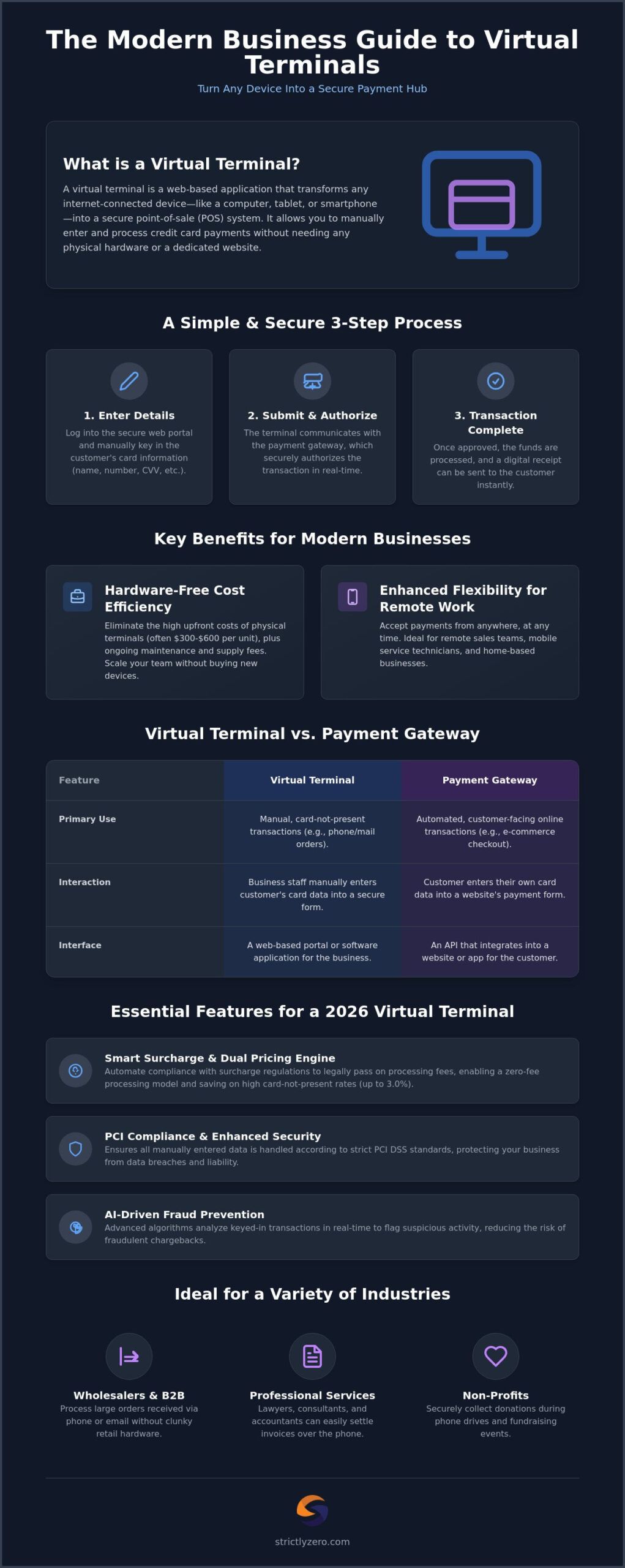
A virtual terminal is a web-based software application that allows you to process credit card payments without any physical hardware. If you’ve ever keyed in a customer’s card number on your computer to close a sale, you’ve likely used one. It functions as a digital version of a physical POS terminal, accessible through any standard web browser on your laptop, tablet, or smartphone. This technology is the backbone of What Is a Virtual Terminal for Credit Card Processing? because it bridges the gap between traditional retail and remote commerce.
Most businesses use these systems for MOTO (Mail Order/Telephone Order) transactions. Since the customer isn’t standing in front of you, you can’t swipe or dip a physical card. Instead, you enter the details manually. This flexibility makes it an ideal solution for home-based businesses or service providers who don’t want the high cost of physical hardware. In a market where card-not-present transactions often carry effective rates between 2.4% and 3.0% as of July 2026, having a streamlined digital interface is essential for keeping operations efficient.
To better understand this concept, watch this helpful video:
How a Virtual Terminal Works
The process is straightforward but relies on high-level security behind the scenes. First, you log into a secure payment portal provided by your processor using any internet-connected device. Once you’re in, you’ll see a digital form where you manually enter the customer’s name, card number, expiration date, and CVV code. After you click submit, the terminal communicates with the payment gateway to authorize the transaction in real-time. Leading processors now integrate AI-driven fraud prevention at this stage to flag suspicious keyed-in data before the transaction completes.
Who Should Use a Virtual Terminal?
Key Benefits: Why Businesses Choose Virtual Terminals
Choosing a digital solution over physical equipment isn’t just about saving desk space. It’s about fundamentally changing how your business handles revenue. When you understand the Key Benefits: Why Businesses Choose Virtual Terminals, you see that the primary advantage is removing the barrier between your customer and your bank account. By using a browser-based system, you bypass the friction of traditional retail setups and gain a more agile way to get paid.
When deciding what is a virtual terminal’s true value for your specific workflow, consider the sheer cost efficiency of going hardware-free. Modern physical terminals often cost between $300 and $600 per unit. That doesn’t include the ongoing maintenance, paper rolls, or software update fees that processors often bake into your monthly statement. A virtual terminal eliminates these overhead costs entirely, allowing you to allocate those funds toward growing your operations instead.
Hardware-Free Cost Efficiency
Enhanced Flexibility for Modern Work
Modern business happens everywhere. Whether you have remote sales teams or mobile service technicians, a virtual terminal ensures they can close deals on the spot. By utilizing integration with ecommerce payment processing, you can create a unified view of every dollar coming in. This means your phone orders, email invoices, and online sales all live in one centralized dashboard. You no longer have to log into three different systems to see your daily totals.
Beyond saving on equipment, these systems offer a layer of security that physical terminals often lack. Because the data is entered directly into a secure, encrypted portal, you reduce the risk of sensitive card information being stored locally or written down on paper. If you’re ready to modernize your checkout process while protecting your margins, exploring an omni-channel payment platform is the most effective way to start a zero-fee processing model.
Virtual Terminal vs. Payment Gateway: Key Differences
Many business owners use the terms “payment gateway” and “virtual terminal” interchangeably, but they serve distinct roles in your digital tech stack. If you’re trying to understand what is a virtual terminal compared to a gateway, think of the gateway as the invisible plumbing. It’s the secure tunnel that carries encrypted data from the point of entry to the processing networks. The virtual terminal, however, is the actual interface or “digital keypad” where you or your staff manually enter that data. You can’t have a functional terminal without a gateway working in the background to handle the heavy lifting of authorization.
Modern processing platforms in 2026 typically bundle these tools together into a single dashboard. This allows for a seamless flow where a phone order taken through a terminal and an online sale through a gateway both end up in the same reporting view. While the gateway works automatically for web sales, the virtual terminal gives you the control to handle off-site transactions manually.
The Role of the Merchant Account
A virtual terminal acts as the front door, but the merchant account is the vault where your money actually lands. You can’t process a single dollar through a browser-based portal without this backend account. When you enter a card number, the terminal encrypts the data instantly. It then passes that information through the gateway to the card networks, which charge assessment fees of 0.14% for Visa or 0.1375% for Mastercard as of 2026. Once approved, the funds are routed into your merchant account before being deposited into your business bank account.
Manual Entry vs. Customer-Facing Checkouts
The biggest difference lies in who is providing the payment information. A payment gateway is designed for automated, customer-facing checkouts on a website. The customer enters their own info, and the system handles the rest. In contrast, you use a virtual terminal for manual entry. This is vital for “card-not-present” scenarios like taking a deposit over the phone or settling a mail-order invoice. It’s the primary tool for any business that doesn’t rely solely on a traditional e-commerce storefront.
Handling this data manually requires strict adherence to security protocols to protect your business from liability. Relying on omni-channel payment processing allows you to switch between these methods safely. You might use a payment link for one client and a manual terminal entry for another, ensuring every transaction is captured securely. This unified approach is the most efficient way to manage diverse revenue streams without juggling multiple providers.
Essential Features for a 2026 Virtual Terminal
By now, you understand that a virtual terminal is more than just a digital keypad. It’s a comprehensive revenue management tool. When evaluating what is a virtual terminal for your 2026 business operations, looking for a basic entry form isn’t enough. You need a system that actively protects your data, automates your billing, and provides deep insights into your cash flow. Modern platforms now offer integrated invoicing, allowing you to send a secure payment link directly from the terminal if a customer prefers to enter their own details rather than sharing them over the phone.
Beyond simple entry, your terminal should act as a hub for long-term customer relationships. Support for recurring billing and automated subscription management is no longer optional for service providers. Instead of manually re-entering data every month, your system should securely store payment tokens to handle repeat transactions automatically. This efficiency, paired with real-time transaction analytics, allows you to spot trends and manage your merchant account with precision.
PCI Compliance and Data Security
Security is the most critical component of any remote processing tool. A high-quality terminal uses tokenization, which means it replaces sensitive card numbers with a unique digital identifier. This ensures that raw card data is never stored on your computer or within your business network. By using a secure, hosted interface, you significantly reduce the complexity of your annual PCI audit. PCI DSS is the gold standard for 2026 payment security. Utilizing a terminal that meets these rigorous standards protects your business from the devastating financial and reputational costs of a data breach.
Surcharge and Dual Pricing Capabilities
The most significant advancement in 2026 is the integration of smart pricing directly into the terminal interface. To stay compliant with evolving state laws and the latest card network rules, your terminal must be able to distinguish between debit and credit cards automatically. This is where a Smart Pricing Engine becomes indispensable. It calculates the correct surcharge in real-time, ensuring you never overcharge a customer while still protecting your margins.
This technology is the easiest way to implement zero fee credit card processing within your daily workflow. When you enter a transaction, the system applies the appropriate dual pricing model, clearly showing the customer the difference between cash and credit costs. This transparency builds trust while effectively eliminating the processing fees that typically eat into your profits. If you’re ready to stop losing 3% on every remote sale, it’s time to upgrade your tech. Explore our omni-channel payment solutions to start saving today.
The Strictly Solution: Zero-Fee Virtual Processing
Managing a business in 2026 requires tools that work as hard as you do. Most payment providers treat your revenue like a pie they’re entitled to slice. Strictly offers a different path through a unified platform that makes remote payments both seamless and free. When you consider what is a virtual terminal in the Strictly ecosystem, it isn’t just a manual entry portal. It’s a strategic tool designed to protect your margins while providing top-tier security for every transaction.
Our virtual terminal is built specifically for the $0 processing fee model. Instead of accepting the standard 3% loss on every phone or mail order, you can use our built-in Smart Pricing Engine to offset those costs. Every transaction also comes backed by AI-driven fraud prevention. This doesn’t just mean you’re saving money; it means you’re building trust as a payment processor with your customers, knowing their data is shielded by the most advanced technology available.
Eliminating Merchant Fees
The core of the Strictly solution is our ability to pass processing costs to the customer through compliant surcharging. While a standard terminal forces you to absorb interchange and assessment fees, our system calculates these in real-time based on state-by-state regulations. This transparency allows you to offer a dual pricing model where customers who choose the convenience of credit cards cover the associated costs. It’s the primary reason many are switching to the best credit card processing for small business model available today. By automating this at the point of entry, you can save thousands of dollars annually that would otherwise go to card networks and banks.
Getting Started with Strictly
We’ve stripped away the complexity usually found in merchant services. There are no clunky hardware configurations to manage or long-term contracts that trap your business. Our onboarding process is designed for speed, allowing merchants and partners to get up and running in a fraction of the time. Once you’re live, the virtual terminal integrates directly into your existing workflow. You can take a payment on your laptop while talking to a client, or send a secure link from the same dashboard. If you’re tired of watching your profits vanish into processing fees, it’s time for a change. Eliminate your processing fees today with Strictly and take full control of your business revenue.
Modernize Your Payment Strategy for 2026
Modernizing your payment strategy is about more than just convenience; it’s about protecting every dollar your business earns. Now that you understand what is a virtual terminal, you can see how removing physical hardware barriers allows for a more agile and profitable operation. By utilizing a unified omni-channel platform, you bring all your remote and digital transactions into one secure dashboard, eliminating the need for fragmented reporting or expensive maintenance contracts.
The real power of this shift lies in the ability to neutralize merchant fees entirely. With a compliant surcharge engine, you can pass the cost of credit card processing back to the customer, ensuring your margins stay intact regardless of how you get paid. Every transaction is further secured by AI-driven fraud prevention, giving you the peace of mind that your remote sales are protected against modern security threats. It’s time to stop letting interchange rates dictate your success and start using a system built for growth.
Start Processing for $0 Today with Strictly
Taking control of your revenue has never been easier. Move your business forward with a processing solution that puts your profitability first.
Frequently Asked Questions
Do I need special hardware to use a virtual terminal?
You don’t need any special hardware or physical card readers to use a virtual terminal. It functions entirely through your web browser, allowing you to turn your existing computer, tablet, or smartphone into a secure payment portal. This approach eliminates the upfront costs of buying traditional POS equipment and the recurring maintenance of physical peripherals. It’s the most efficient way to scale your sales team without increasing your equipment budget.
Is a virtual terminal safe for my customers?
Virtual terminals are highly safe when they include features like tokenization and end-to-end encryption. These systems ensure that sensitive card data is never stored locally on your device or business network. Leading platforms also integrate AI-driven fraud prevention to monitor transactions in real-time. This technology identifies suspicious patterns before they result in a chargeback, providing a level of security that often exceeds traditional physical terminals.
What is the difference between a virtual terminal and a payment gateway?
A virtual terminal is the front-end interface you use to manually enter payment details, while a payment gateway is the back-end technology that transmits that data. If you’re trying to define what is a virtual terminal in terms of its primary role, it’s essentially a digital keypad for phone or mail orders. The gateway works silently in the background of both the terminal and your website checkout to authorize the funds.
Can I use a virtual terminal on my phone?
You can absolutely use a virtual terminal on your phone through any standard mobile web browser. This flexibility allows mobile service technicians or remote sales teams to process payments securely from the field without carrying a separate card reader. Since the platform is web-based, it’s compatible with both iOS and Android devices. You only need an active internet connection to log in and start accepting customer payments securely.
Are virtual terminal transaction fees higher than in-person fees?
Transaction fees for virtual terminals are typically higher than in-person rates because they’re classified as “card-not-present” sales. As of July 2026, these effective rates often range from 2.4% to 3.0% per transaction. However, you can effectively eliminate these costs by using a terminal with a built-in surcharge and dual pricing engine. This technology automatically calculates and applies the processing fee to the customer’s total at the point of sale, protecting your margins.
Does a virtual terminal support recurring billing?
Most modern virtual terminals support recurring billing and automated subscription management. This allows you to securely store a customer’s payment token and schedule future charges for ongoing services or memberships. By automating this process, you reduce the need for manual data entry each month and ensure a more predictable cash flow for your business. It’s an essential feature for service providers who handle monthly retainers or subscription-based products.
How do I remain PCI compliant when using a virtual terminal?
You remain PCI compliant by using a hosted virtual terminal solution that utilizes tokenization to handle sensitive data. When you use a secure, browser-based portal, the card information never touches your local servers, which significantly reduces your PCI audit scope. Understanding what is a virtual terminal in the context of security helps you choose a provider that automates compliance and protects your business from the liability of a data breach.