
What Is Omnichannel Payment Processing? The 2026 Business Guide
Published:

In 2026, paying high transaction fees on every sale is no longer a mandatory cost of doing business; it’s a choice. Many merchants find themselves buried under fragmented reporting and rising interchange fees that can reach as high as 3.5% per transaction. If you’re struggling to reconcile online sales with in-person swipes while worrying about state-by-state surcharge compliance, you aren’t alone. Implementing a robust omnichannel payment processing strategy is the only way to bridge these gaps without sacrificing your bottom line.
We understand how frustrating it is to watch your margins shrink across different platforms. This guide will help you master the complexities of unified payments and show you how to integrate every sales channel into a single, cost-efficient ecosystem. You’ll learn how to leverage smart pricing engines to reduce or even eliminate processing fees while maintaining a seamless experience for your customers. We’ll preview the latest PCI DSS 4.0 requirements, AI-driven fraud prevention, and how to turn your transaction data into a single source of truth for your entire operation.
Key Takeaways
- Understand the critical difference between siloed multichannel systems and a unified infrastructure that synchronizes data across every sales touchpoint.
- Learn how API-first architecture and tokenization secure your customer data while providing a single, reliable source of truth for all transaction reporting.
- Discover how omnichannel payment processing eliminates the “complexity tax” of managing multiple vendors and reduces the risk of fraud and chargebacks.
- Explore how to use a smart surcharge and dual pricing engine to offset transaction fees and build a more cost-efficient payment ecosystem.
- Identify the must-have features for a 2026 provider, including developer-friendly integration tools and support for flexible options like POS lending.
Table of Contents
- What is Omnichannel Payment Processing?
- How Omnichannel Payment Systems Work
- Omnichannel vs. Multichannel: The Cost of Disconnection
- Choosing an Omnichannel Provider in 2026
- Maximizing Profit: The Strictly Zero-Fee Omnichannel Model
What is Omnichannel Payment Processing?
At its core, omnichannel payment processing is a unified infrastructure that synchronizes transaction data across every sales channel your business operates. It moves beyond simply offering multiple ways to pay. Instead, it creates a single, cohesive ecosystem where your online store, mobile app, and physical storefront all talk to each other in real time. By using a central merchant account to manage these diverse streams, you eliminate the friction that usually slows down scaling. This strategy stems from the broader concept of Omnichannel, which focuses on providing a seamless customer experience regardless of the touchpoint. In 2026, this isn’t just a tech upgrade; it’s a fundamental shift in how businesses handle money.
To better understand how this technology transforms the checkout experience, watch this helpful video:
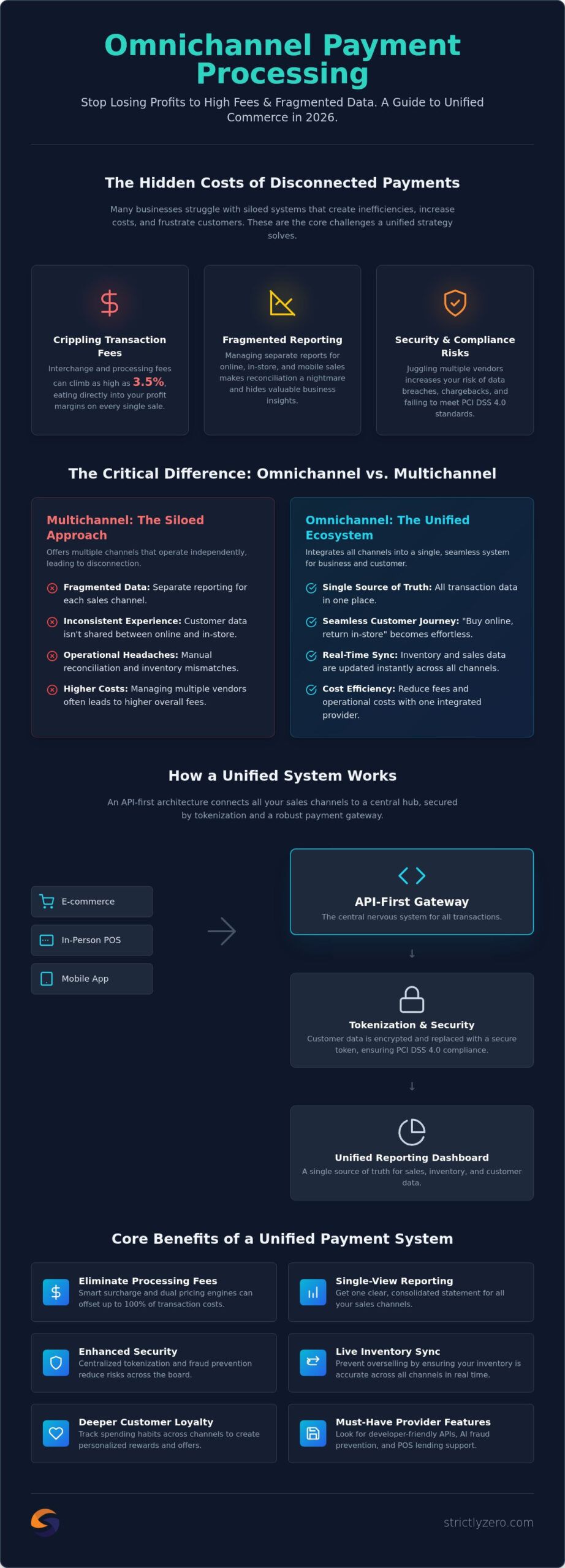
The biggest mistake many businesses make is confusing “multichannel” with “omnichannel.” In a multichannel setup, your systems are siloed. You might have one processor for your website and a completely different terminal provider for your brick-and-mortar shop. This leads to fragmented reporting and a complexity tax on your time. Omnichannel systems break those walls down. Consumers in 2026 expect a “buy anywhere, return anywhere” experience. They want to purchase an item on their phone and return it at a physical retail location without your staff needing to hunt through multiple software logins to find the original transaction.
The Core Channels of Modern Commerce
- E-commerce and mobile apps: Your digital storefront must handle everything from standard credit cards to digital wallets like Apple Pay and Google Pay instantly.
- In-person POS: Whether it’s a permanent retail location or a weekend pop-up, your physical point-of-sale should feed data into the same dashboard as your website.
- Virtual terminals: These allow you to process phone or mail orders securely through a web browser, ensuring even manual entries stay within your unified omnichannel payment processing system.
Why Businesses are Switching to Unified Systems
Modern commerce moves too fast for manual spreadsheets. Switching to a unified system provides single-view reporting, which means you get one statement instead of five. It also ensures inventory synchronization. If you sell your last unit online, your in-person POS should reflect that immediately to prevent overselling. Finally, it powers deeper customer loyalty. When you can track spending habits across every channel, you can offer personalized rewards that actually keep people coming back. You aren’t just processing payments; you’re building a complete picture of your customer’s journey without the headache of manual reconciliation between your online gateway and a local POS.
How Omnichannel Payment Systems Work
The technical engine behind omnichannel payment processing isn’t just a single piece of software. It’s a layered architecture designed to move data securely between disparate endpoints. At the heart of this system sits the API layer. This developer-friendly interface acts as the central nervous system, allowing you to connect your e-commerce site, mobile app, and physical card readers to a single processing hub. Instead of managing three different integrations, you manage one. This unified approach is fueled by rapid industry growth as businesses move away from legacy silos. According to the Omnichannel Payments Market Research Report, merchants are increasingly prioritizing these integrated systems to meet modern consumer demands for flexibility and speed.
The Role of the Payment Gateway
The gateway is responsible for more than just passing data. It uses tokenization to protect sensitive information. When a customer pays, their card number is replaced with a unique digital token. This allows a customer to use a saved card from your website at your physical store without you ever storing their actual credit card details. This process ensures high-level encryption from the moment of a tap, dip, or click. It’s a critical component of maintaining compliance with PCI DSS 4.0 standards. While the transition from older versions was completed in 2024, additional future-dated requirements became mandatory on March 31, 2025, making robust gateway security more important than ever.
Unified Data and Reporting
When every transaction flows through the same gateway, your reporting becomes a single source of truth. You can monitor transaction volume across all locations and websites in real time from a single merchant dashboard. This transparency allows for advanced automation that older, siloed systems can’t handle. For example, tools like ClearSplit™ can automate residuals and partner compensation without manual spreadsheet work. Meanwhile, retention intelligence from ChurnIQ™ helps you identify at-risk customers across your entire ecosystem before they stop buying. If you want to see how a unified dashboard can simplify your month-end reconciliation, you can explore our integrated platform and see the data for yourself.
Security in a distributed environment requires constant vigilance. By centralizing your payments, you reduce the surface area for potential breaches. Instead of securing five different entry points, you focus your AI-driven fraud prevention on one unified stream. This doesn’t just protect your revenue; it builds long-term trust with your customers who expect their data to be handled with the highest standards of care regardless of where they shop.
Omnichannel vs. Multichannel: The Cost of Disconnection
Many businesses mistakenly believe that offering multiple payment options is the same as having a unified strategy. This is the multichannel trap. While you might give customers the choice to pay via a website, an app, or a physical terminal, these channels often operate as isolated silos. This disconnection creates a hidden “complexity tax” that drains your resources. When you manage three different payment processors, you aren’t just paying three sets of monthly fees. You’re also losing out on the volume aggregation that could lower your overall rates. Consolidated omnichannel payment processing eliminates this waste by bringing all transaction volume under a single contract with a simplified fee structure.
Fragmented data is a significant security risk. If your online fraud detection doesn’t communicate with your in-person POS system, you’re vulnerable to sophisticated cross-channel attacks. Fraudsters often test stolen credentials on a digital storefront before attempting a high-value purchase in person. Without a unified view, your team won’t see the pattern until the chargebacks start rolling in. Integrated systems provide a holistic view of customer behavior, allowing AI-driven fraud prevention to flag suspicious activity across every touchpoint simultaneously. Switching to a unified platform allows businesses to reduce administrative overhead by at least 20% by consolidating reconciliation and reporting tasks into one dashboard.
Why Multichannel is Failing Modern Merchants
Operating in a multichannel environment often leads to “spreadsheet gymnastics” at the end of every month. Your accounting team has to manually download reports from different gateways and try to match them against bank deposits. This manual process is prone to errors and delays. Beyond the back office, the customer experience suffers too. If a customer buys a product online but can’t see their order history when they visit your physical store, it creates brand distrust. In 2026, consumers expect your business to recognize them regardless of how or where they choose to interact with you.
The Strategic Advantage of Integration
- Digital Anchoring: Use ecommerce payment processing as the central hub for all sales, ensuring digital and physical data stay in sync.
- Remote Billing: Implement a virtual gateway to handle phone orders or professional invoicing without needing a dedicated website for every transaction.
Integration isn’t just about convenience; it’s about agility. When your payment data is unified, you can pivot faster. If a specific product is flying off the shelves on social media, you can adjust your in-store inventory and marketing spend based on real-time data. You stop guessing and start growing based on a single source of truth.
Choosing an Omnichannel Provider in 2026
Selecting the right partner for omnichannel payment processing is a strategic decision that affects your operational speed and your profit margins. In 2026, a provider shouldn’t just be a vendor; they should be a technology partner that offers a unified “Trust” layer between your business and your customers. As you evaluate your options, look beyond the basic ability to swipe a card. You need a platform that handles the heavy lifting of compliance, security, and data synchronization across every sales touchpoint you manage.
- Requirement 1: API flexibility and ease of integration. Your developers need a clean, well-documented API that allows for custom workflows without weeks of troubleshooting.
- Requirement 2: Support for diverse payment methods. Beyond standard cards, your system must handle Apple Pay, Google Pay, and modern options like POS Lending to capture every possible sale.
- Requirement 3: Compliance-first surcharging. The provider must offer a dual pricing engine that automatically adjusts based on the customer’s location and card type.
- Requirement 4: Robust partner tools. For ISOs and MSPs, the platform must provide management tools that make it easy to scale across multiple merchant accounts from a single interface.
Evaluating the Smart Pricing Engine
Automated state-by-state compliance is non-negotiable for any merchant operating across state lines. Regulations regarding surcharging are constantly shifting; your processor should handle these updates automatically so you don’t have to. A high-quality engine detects the difference between debit and credit cards in real time. This is crucial because surcharging a debit card is illegal in many jurisdictions, even if the customer chooses “credit” at the terminal. By using a sophisticated engine, you can implement zero fee credit card processing across both your online and offline channels while remaining fully compliant with network rules and local laws.
Technical Compatibility and Scalability
Your chosen platform must be built to grow with you. This means having access to a virtual terminal for secure manual entries and phone orders, ensuring that even off-site sales are captured in your central dashboard. For those managing a portfolio of merchants, the underlying infrastructure must be a dedicated platform for ISOs and developers that prioritizes high-speed gateway reliability. When your omnichannel payment processing is built on an API-first architecture, you can add new storefronts or mobile apps in hours rather than days. This technical agility is what separates market leaders from those struggling with legacy hardware. If you’re ready to see how a unified engine can transform your bottom line, contact us for a platform walkthrough and discover the power of smart pricing.
Maximizing Profit: The Strictly Zero-Fee Omnichannel Model
While previous sections explored the technical architecture of omnichannel payment processing, the ultimate goal for any business owner is protecting the bottom line. Historically, merchants have viewed payments as an unavoidable tax. Every sale meant losing a percentage to interchange fees and processor markups. Strictly transforms this narrative by turning your payment infrastructure into a profit-center. By utilizing a smart surcharge and dual pricing engine, you can pass the cost of credit card convenience to the consumer. This strategy effectively reaches a zero-fee ecosystem across every channel you operate, from your digital storefront to your physical counter.
The logic behind a surcharge program is simple: it offers transparency to the customer while protecting your margins. In 2026, with interchange fees ranging from 1.5% to 3.5%, these costs can quickly erode the profits of a growing business. Strictly’s platform unifies e-commerce and in-person payments into one $0-fee stream. This isn’t just about saving money; it’s about reducing merchant churn. When you use retention intelligence like ChurnIQ™, you gain the data needed to keep your business healthy and your customers happy. Moving from a fragmented, expensive system to an integrated, zero-fee model is the most significant operational upgrade a modern merchant can make.
Eliminating the Cost of Credit Card Processing
Achieving true fee elimination requires a dual-pronged approach. You must implement dual pricing at the physical POS and compliant surcharging on the web. This ensures that customers who choose the convenience of credit cards cover the processing costs, while those paying with cash or debit aren’t unfairly penalized. Strictly automates this compliance heavy-lifting, detecting card types in real time to ensure you stay within state and network regulations. Implementing the best credit card processing for small business isn’t just a luxury for enterprise retailers anymore. It is a fundamental tool for any business that wants to scale without watching its margins disappear into transaction fees.
Partnering for Success
For ISOs and MSPs, providing a robust omnichannel payment processing solution is the key to building a long-term portfolio. High fees are the primary reason merchants switch providers. By offering a superior product that eliminates those fees entirely, you position yourself as a trusted advisor rather than just another vendor. Our platform includes partner management tools like ClearSplit™, which automates residuals and partner compensation. This allows you to focus on growth and acquisition rather than manual accounting. If you’re ready to modernize your offering and provide real value to your clients, you should partner with Strictly to scale your payments business today.
Future-Proof Your Revenue with Unified Payments
Modern commerce demands more than just multiple ways to pay; it requires a single, frictionless ecosystem. By moving away from disconnected multichannel systems, you eliminate the complexity tax and gain a holistic view of your customer journey. Implementing omnichannel payment processing isn’t just a technical upgrade. It’s a strategic shift that protects your margins through compliant surcharging and dual pricing while providing the API-first architecture your developers need to scale. You no longer have to choose between customer convenience and company profitability.
You have the power to turn your payment processing from a shrinking cost center into a stable profit center. With real-time ChurnIQ™ retention intelligence and automated compliance, you can focus on building your brand instead of managing fragmented reports. It’s time to stop letting transaction fees eat your hard-earned profits and start leveraging a system built for the speed of 2026. Eliminate your processing fees across every channel with Strictly and reclaim your margins today. Your business deserves a payment partner that prioritizes your growth as much as you do.
Frequently Asked Questions
What is the difference between omnichannel and multichannel payments?
Multichannel payments involve using separate, disconnected systems for each sales path, while omnichannel integrates every transaction into a single data stream. In a multichannel setup, your online store and physical terminal operate as silos, often requiring manual reconciliation. Omnichannel systems synchronize this data in real time, allowing a customer to buy online and return in-store without any technical friction.
Is omnichannel payment processing more expensive than traditional methods?
No, it is generally more cost-effective because it consolidates your transaction volume and reduces the administrative overhead of managing multiple vendors. While some legacy providers charge high integration fees, a unified system lowers the complexity tax on your accounting team. When paired with a surcharge model, omnichannel payment processing can actually bring your net processing costs down to zero.
Can I use a surcharge program with omnichannel processing?
Yes, you can implement a surcharge program across all your digital and physical storefronts simultaneously. This allows you to pass the cost of credit card processing to the customer whether they pay on your website or at a physical terminal. Modern platforms automate the disclosure and calculation process to ensure your business remains compliant with card network rules and state laws.
Do I need new hardware to switch to an omnichannel payment system?
Not necessarily, as many modern systems allow you to use existing smartphones for “Tap to Pay” or integrate current card readers via an API. The requirement depends on whether your current equipment supports the latest encryption and tokenization standards. Many merchants find they can transition using a virtual terminal for manual entries while keeping their existing physical infrastructure for in-person sales.
How does omnichannel processing help with PCI compliance?
It simplifies compliance by centralizing your data security and reducing the number of entry points for sensitive cardholder information. By using a single gateway that tokenizes data at the point of entry, you minimize the amount of actual card data that touches your servers. This unified approach makes it much easier to meet the rigorous requirements of PCI DSS 4.0.
Is surcharging legal in all states for online and in-person sales?
Surcharging is legal in the vast majority of states, but specific regulations and disclosure requirements vary by jurisdiction. Some states have specific limits on the percentage you can charge or require clear signage at the point of sale. Using omnichannel payment processing with a built-in compliance engine ensures your system automatically adjusts based on the customer’s location and card type.
What is a Smart Pricing Engine in payment processing?
A Smart Pricing Engine is an automated tool that identifies card types and geographic locations in real time to apply the correct pricing. It distinguishes between debit and credit cards instantly, which is vital because surcharging debit cards is prohibited by law. This technology ensures your business stays compliant while maximizing your ability to offset transaction fees across every channel.
Can ISOs benefit from offering omnichannel solutions to their merchants?
ISOs benefit significantly by offering a high-value, integrated product that reduces merchant churn and increases portfolio stickiness. Providing a unified platform makes it much harder for merchants to leave for a competitor who only offers a single-channel solution. Additionally, automated tools like ClearSplit™ make managing partner residuals simpler, allowing ISOs to focus on scaling their business instead of manual math.