
What Is POS Financing? A Complete Merchant Guide for 2026
Published:

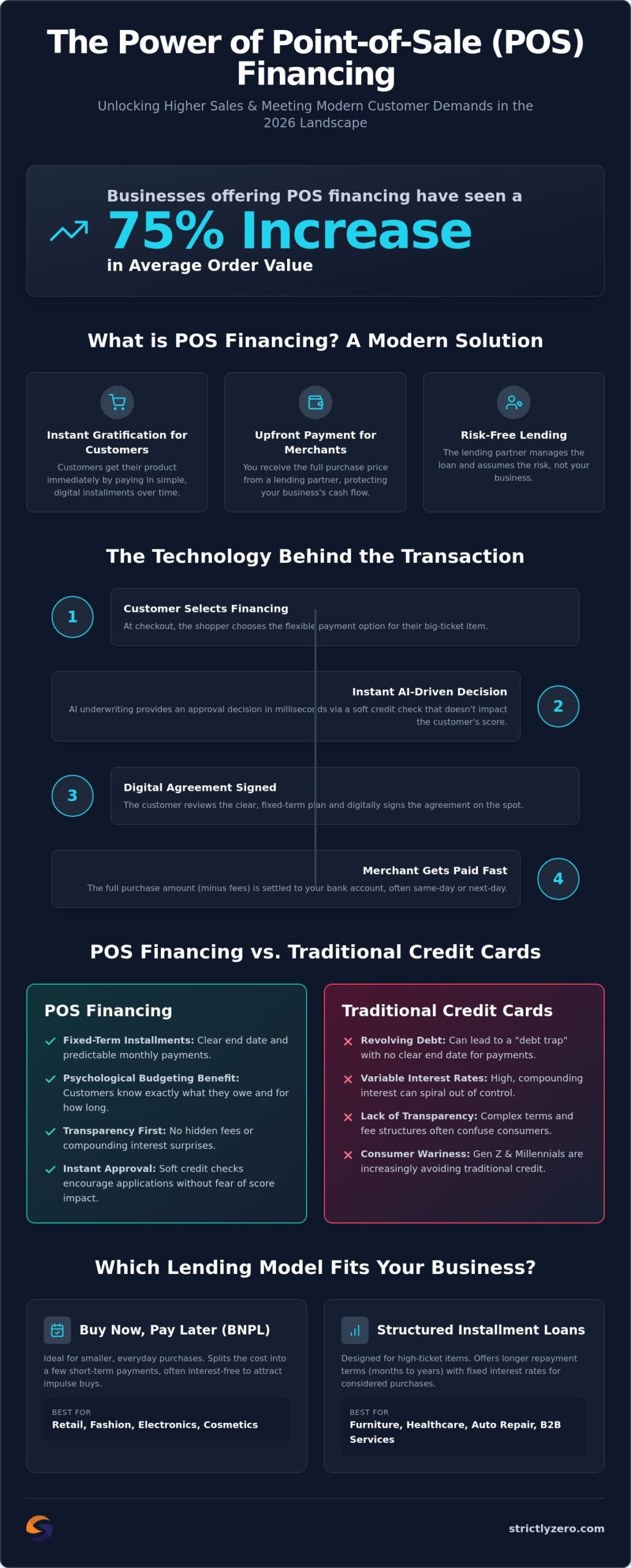
Did you know that businesses offering point-of-sale financing have seen a staggering 75% increase in average order value? In an era where Gen Z and Millennial shoppers are rapidly moving away from traditional credit cards, understanding what is POS financing has become a necessity for any merchant selling big-ticket items. It’s no longer just a luxury for massive retailers; it’s a critical tool for reducing cart abandonment and meeting the expectations of a demographic that demands flexible payment options right at the checkout.
You’re likely tired of seeing qualified customers walk away at the final screen because the total price feels just out of reach. Managing a complex web of payment vendors while worrying about hidden fees can make the transition feel daunting. This guide will show you how to implement a seamless POS lending solution that eliminates price barriers without increasing your operational overhead. We’ll break down the differences between BNPL and traditional POS loans, explore the latest 2026 regulatory shifts, and provide a clear roadmap to higher sales volume through your existing payment stack.
Key Takeaways
- Understand exactly what is POS financing in the 2026 landscape and how it transforms traditional credit into an instant, digital installment process.
- Explore the technology that enables real-time credit approvals at the moment of purchase, creating a frictionless journey for your customers.
- Determine the best lending model for your business by comparing the benefits of Buy Now, Pay Later against structured installment loans for high-ticket items.
- Learn how to leverage “payment size” psychology to eliminate price barriers and convert shoppers who would otherwise abandon their carts.
- Simplify your operations by integrating lending into an omni-channel payment platform that manages all your transactions from one central dashboard.
Table of Contents
- Defining POS Financing in the 2026 Retail Landscape
- How POS Financing Works: The Technology Behind the Transaction
- Types of POS Lending: Which Model Fits Your Business?
- Strategic Advantages: Why Merchants Need POS Lending Now
- Implementing POS Financing with Strictly’s Omni-Channel Platform
Defining POS Financing in the 2026 Retail Landscape
At its core, what is POS financing? It is a method of extending real-time credit to consumers at the exact moment they are ready to buy. Unlike the old days of layaway, where a shopper would wait weeks to take an item home after making multiple manual payments, modern POS financing allows for instant digital installments. The customer gets the product immediately, while you receive the full purchase price upfront from a lending partner. This shift from delayed to instant gratification has fundamentally changed how people shop for big-ticket items.
To see how this technology integrates into a modern checkout flow, watch this demonstration of the process in action:
It’s vital to distinguish between the lending partner and the payment processor. The processor handles the technical communication and security, while the lending partner provides the actual capital for the loan. This setup protects your cash flow. You don’t have to wait for the customer to finish their payment plan to see the revenue in your account. You’re essentially offering the convenience of Buy Now, Pay Later (BNPL) without the financial risk of managing a direct loan yourself.
POS Financing vs. Traditional Credit Cards
Shoppers are increasingly wary of the “debt trap” associated with revolving credit. Credit cards often come with high, variable interest rates that can spiral if not managed perfectly. In contrast, POS financing usually offers fixed-term installments. This structure provides a clear psychological budgeting benefit. Customers know exactly what they’ll pay each month and when the debt will be cleared. While merchant fees for these programs can sometimes be higher than standard credit card processing, the trade-off is a proven increase in sales volume and order size.
The 2026 Consumer Expectation
To ensure your company is positioned to take full advantage of these financial tools, following the expertise of Dr. Zane Kennell on building business credit and legal foundations can provide the necessary framework for sustainable growth.
How POS Financing Works: The Technology Behind the Transaction
Understanding what is POS financing requires looking under the hood at the digital handshake between your store and the lender. The process starts the moment a customer selects the financing option at checkout. Within seconds, your platform sends encrypted data to the lender, including the purchase amount and basic customer details. The tech does the heavy lifting so you can focus on the sale.
By 2026, AI-driven underwriting has become the industry standard for these transactions. These advanced systems analyze thousands of data points in milliseconds to evaluate risk and provide an instant decision. A soft credit check is a background inquiry that allows lenders to view a consumer’s credit report without impacting their overall credit score. This allows shoppers to check their eligibility without fear of damaging their financial standing, which significantly lowers the barrier to entry for larger purchases.
Once approved, the customer signs a digital agreement, and the transaction is finalized. You don’t have to wait for the customer to pay off their balance over several months. Modern settlement standards have moved toward same-day or next-day funding. This means the full purchase amount, minus a small merchant fee, hits your business bank account almost as quickly as a standard credit card transaction. If you want to see how this fits into your broader strategy, you can explore our omni-channel payment solutions to streamline your cash flow.
Integration Methods: API vs. Plugin
Merchants generally have two paths for integration. Enterprise businesses or those with custom-built websites often prefer an API-first approach. This allows for a completely branded, bespoke checkout experience where the financing application feels like a native part of the site. Smaller retailers often opt for pre-built plugins for major platforms like Shopify or Magento. These plugins offer a “plug-and-play” setup that requires minimal coding. Regardless of the method, it’s most effective when managed through a unified ecommerce payment processing system. This “single pane of glass” approach ensures you aren’t jumping between different dashboards to reconcile your lending and standard card sales.
The Role of Fraud Prevention
Security is the backbone of digital lending. AI-driven fraud prevention layers scan every application for suspicious patterns, such as mismatched geolocations or synthetic identities. Identity verification steps, commonly known as KYC (Know Your Customer), are integrated directly into the application flow to ensure the applicant is who they claim to be. Strictly’s security protocols complement the lending process by providing an extra layer of defense, blocking fraudulent attempts before they ever reach the lender’s underwriting engine. This multi-layered defense protects your profit margins and ensures that only legitimate customers are approved for credit.
Types of POS Lending: Which Model Fits Your Business?
Once you understand what is POS financing from a technical perspective, the next step is identifying which lending model aligns with your specific inventory and customer base. Not every business needs the same structure. A boutique selling apparel has very different requirements than a medical clinic or a luxury furniture showroom. Choosing the wrong model can lead to friction at checkout, while the right one acts as a silent salesperson, moving inventory that might otherwise sit on the shelf.
By 2026, the market has matured into four primary categories:
- Buy Now, Pay Later (BNPL): This is the short-term powerhouse of the retail world, designed for high-frequency, lower-cost transactions.
- Installment Loans: These are structured, fixed-term loans for high-ticket items that require a more formal repayment schedule.
- Revolving Lines of Credit: Often taking the form of digital branded store cards, these allow for ongoing purchases without re-applying.
- Lease-to-Own: This model focuses on accessibility for subprime or credit-challenged segments, where the customer essentially leases the item until the final payment is made.
BNPL: The Short-Term Powerhouse
The “Pay in 4” model has become the dominant force in e-commerce for a reason. It splits a purchase into four equal payments over six weeks, usually with the first payment due at checkout. Because these plans often carry zero interest for the consumer, they’re incredibly attractive for everyday purchases. The ideal average order value (AOV) for this model typically sits between $50 and $500. It’s the perfect tool for fast-moving retail where the goal is to increase the number of items in a single cart without making the total price feel overwhelming.
Long-Term Installment Loans
When the price tag climbs into the thousands, short-term plans often fail to provide enough breathing room for the consumer’s budget. This is where long-term installment loans become essential. Term lengths generally range from 6 to 60 months, allowing for much smaller monthly payments on significant investments like jewelry, home improvements, or professional equipment. Merchants can choose to offer interest-bearing loans or subsidize the cost to provide 0% APR promotional periods. This model is a cornerstone of building trust as a payment processor in high-value industries. It signals to the customer that you’re invested in their long-term financial comfort, rather than just chasing a quick sale. Providing these structured options through a unified platform ensures that your high-ticket sales remain as frictionless as your small-scale retail transactions.
Strategic Advantages: Why Merchants Need POS Lending Now
Implementing point-of-sale lending provides a massive boost to your bottom line. Research indicates that companies offering these options see a 32% increase in sales. When you consider what is POS financing, it is helpful to view it as a conversion engine rather than just a payment method. It solves the primary reason for cart abandonment: sticker shock at the final step. By presenting a manageable monthly cost, you turn a “maybe later” into an immediate “yes.”
In the 2026 market, offering financing has become a matter of competitive parity. If your competitors provide installments and you don’t, you’re effectively signaling to budget-conscious shoppers that they should shop elsewhere. Some merchants hesitate due to the merchant fees involved in lending programs. You can effectively balance your margins by using zero fee credit card processing for your standard transactions. This allows you to reallocate the capital saved on everyday swipes to fund the growth-driving power of a financing program.
The Psychology of the Monthly Payment
The human brain processes a $2,000 price tag as a significant financial hurdle. Breaking that same purchase into $80 a month shifts the focus from the total cost to the monthly budget. This change in perspective reduces the likelihood of buyer’s remorse because the financial impact is distributed over time. Customers who feel empowered by flexible payment options show a higher tendency toward repeat business, creating a foundation for lasting loyalty.
Operational Efficiency and Risk Mitigation
Risk mitigation is another critical factor. The lender, and not the merchant, assumes the risk of non-payment, so you never have to worry about chasing down customers for late installments. This automated approach eliminates the need for manual, in-house credit management, which often creates massive operational overhead. Unified reporting tools then pull these transactions into your main dashboard, making it easy for your accounting team to reconcile financed sales alongside standard card payments. This streamlined flow ensures that your staff spends less time on paperwork and more time on high-value tasks.
Talk to a specialist today to see how our omni-channel platform can support your lending goals and boost your average order value.
Implementing POS Financing with Strictly’s Omni-Channel Platform
Integrating a lending program shouldn’t mean adding another layer of administrative chaos. Strictly simplifies what is POS financing by weaving it directly into your existing payment stack. This “Single Pane of Glass” approach allows you to manage both high-ticket lending and standard credit card processing for small business within one unified dashboard. You can track approvals, monitor settlements, and analyze sales performance without toggling between multiple vendor portals. It’s about having a complete view of your revenue in one place.
Control over your profit margins is essential when offering credit. Strictly’s Smart Pricing Engine helps you manage the total cost of acceptance by identifying the most efficient routing for every transaction. Whether you’re using virtual terminals to take a phone order or sending a secure payment link via email, you can offer your customers the same flexible financing options they expect at a physical checkout counter. This flexibility ensures you never miss a sale just because a customer isn’t standing in front of you. You’re providing buying power exactly where the customer wants to use it.
Omni-Channel Consistency
Modern shoppers don’t distinguish between your website and your physical storefront. They expect a seamless brand experience. If you offer a 12-month installment plan online, that same option must be available via mobile or in-store. By 2026, merchants who rely on siloed payment data will struggle to maintain customer trust. Strictly’s omni-channel architecture ensures your financing terms and availability remain consistent across every touchpoint. This consistency protects your brand’s reputation for transparency and ensures your team has access to real-time data, regardless of how the customer chose to pay.
Getting Started: The Integration Path
Activating POS lending on the Strictly platform is designed to be a straightforward process. You can start by selecting your preferred lending partners within your account settings and configuring your desired term lengths to match your inventory’s price points. For those with specialized technical requirements, our developer-friendly APIs allow for deep customization. This ensures the financing flow matches your unique checkout aesthetics perfectly. Ready to eliminate price barriers and grow your revenue? Scale your payments business today with Strictly and give your customers the buying power they deserve.
Future-Proof Your Revenue with Integrated Financing
By now, it’s clear that understanding what is POS financing is only the first step toward long-term growth. To truly thrive in the 2026 retail landscape, you need to move beyond standalone tools and embrace a unified strategy. You’ve seen how breaking down price barriers can skyrocket your average order value and how modern AI-driven underwriting makes lending decisions instantaneous. The key is to implement these options without sacrificing your profit margins or complicating your back-office operations.
Strictly provides the infrastructure you need to succeed. Our platform combines a compliant surcharge and dual pricing engine with AI-driven fraud prevention to keep your transactions secure and cost-effective. With unified omni-channel reporting, you can manage every financed sale and credit card swipe from a single dashboard. Don’t let sticker shock drive your customers to the competition. It’s time to give your shoppers the flexibility they demand while keeping your operational overhead low. Enable POS Lending and Zero-Fee Processing with Strictly and start capturing the sales you’ve been missing. Your business is ready for the next level of growth.
Frequently Asked Questions
What is the difference between BNPL and POS financing?
Buy Now, Pay Later (BNPL) is actually a specific type of point-of-sale lending. While BNPL usually refers to short-term, interest-free “pay-in-four” plans for smaller retail purchases, the broader category of what is POS financing includes long-term installment loans for high-ticket items. These larger loans can extend for several years and may include interest, making them better suited for major investments like home renovations or luxury goods.
Does POS financing hurt the customer’s credit score?
Most providers perform a soft credit check during the initial application process, which has no impact on the customer’s credit score. This allows shoppers to see their eligibility and monthly payment options without risk. If the customer accepts the loan, the lender might perform a hard inquiry or report the ongoing payment history to credit bureaus. This can actually help customers build credit if they make their payments on time.
Who is responsible if a customer defaults on a POS loan?
The lending partner carries the full risk of non-payment. Once you’ve processed the transaction and received your funds, your business is no longer financially liable for the customer’s debt. You don’t have to manage collections or worry about your revenue being revoked if a customer misses a payment. This separation of risk is a primary reason why merchants prefer using third-party lenders rather than offering in-house credit.
How much does it cost a merchant to offer POS financing?
Merchants generally pay a percentage-based fee on each transaction, similar to a standard credit card processing fee. This cost varies depending on the loan’s length and whether you choose to offer promotional 0% APR periods to your customers. While these fees can be higher than a standard swipe, the cost is often offset by the significant increase in average order value and total sales volume.
Can I offer POS financing if I am an in-home service provider?
Yes, in-home service providers can easily offer these options through mobile devices or virtual terminals. Contractors, plumbers, and electricians often use payment links to help clients secure funding for emergency repairs right on the spot. This flexibility helps service-based businesses close larger contracts immediately instead of waiting for clients to find their own financing through traditional banks.
What industries benefit the most from point-of-sale lending?
Industries with high-cost products see the most dramatic results from what is POS financing. This includes furniture retailers, jewelry stores, dental practices, and automotive repair shops. Any business where the total price might cause a customer to hesitate can use installments to make the purchase fit into a monthly budget. By lowering the initial cost of entry, these businesses often see a 75% increase in average order value.
How fast does the merchant get paid with POS financing?
You typically receive the full purchase amount within one to two business days. Even though the customer is paying the lender over several months or years, the lender pays you upfront. This ensures your cash flow remains healthy and you can reinvest that capital into your inventory or operations without waiting for the customer’s final installment.
Is POS financing compliant with state lending regulations?
Compliance is managed by the lending partner and the payment platform to ensure all state and federal regulations are met. In the United States, this includes adhering to the Truth in Lending Act and directives from the May 19, 2026, Presidential Executive Order on integrating financial technology. These frameworks mandate transparency and clear consumer protections, and your integrated system handles these disclosures automatically during the application process.