
White Label Payment Gateway: 2026 Guide for ISOs & Partners
Published:

Did you know that building a proprietary payment infrastructure from the ground up can cost upwards of $1 million before you ever process a single transaction? For many ISOs and partners, this massive financial barrier often leads to a difficult compromise: handing over your brand visibility to a third-party processor. It’s frustrating to work hard for a merchant only to have their loyalty shift toward the name on the checkout screen. Choosing a white label payment gateway solves this by letting you own the brand experience while we handle the heavy lifting of PCI DSS v4.0 compliance and the looming ISO 20022 deadlines.
We understand that you want to be the face of your business, not just a middleman. The good news is that you don’t have to choose between high development costs and losing your identity. You can launch a fully branded payments business that keeps your name front and center while eliminating the overhead of software engineering. This 2026 guide will show you how to take full control of the customer journey, automate partner compensation with tools like ClearSplit™, and increase merchant lifetime value through integrated retention features like ChurnIQ™.
Key Takeaways
- Learn how a white label payment gateway allows you to launch a fully branded payments business without the massive overhead of custom software development.
- Explore how to maintain strict compliance with 2026 standards like PCI DSS v4.0 and ISO 20022 while keeping your brand at the forefront of every transaction.
- Discover how to increase merchant “stickiness” and lifetime value by offering a unified, omni-channel payment experience across online and mobile platforms.
- Find out how to automate complex partner compensation and revenue splits using advanced tools like ClearSplit™ to scale your operations efficiently.
- Get actionable criteria for evaluating providers, focusing on API-first architecture and the flexibility of merchant portal customization.
Table of Contents
- What Is a White Label Payment Gateway?
- Key Benefits of Using a White Label Solution
- Technical Features and Integration Strategies
- Evaluating White Label Payment Gateway Providers
- Scaling Your Payments Brand with Strictly
What Is a White Label Payment Gateway?
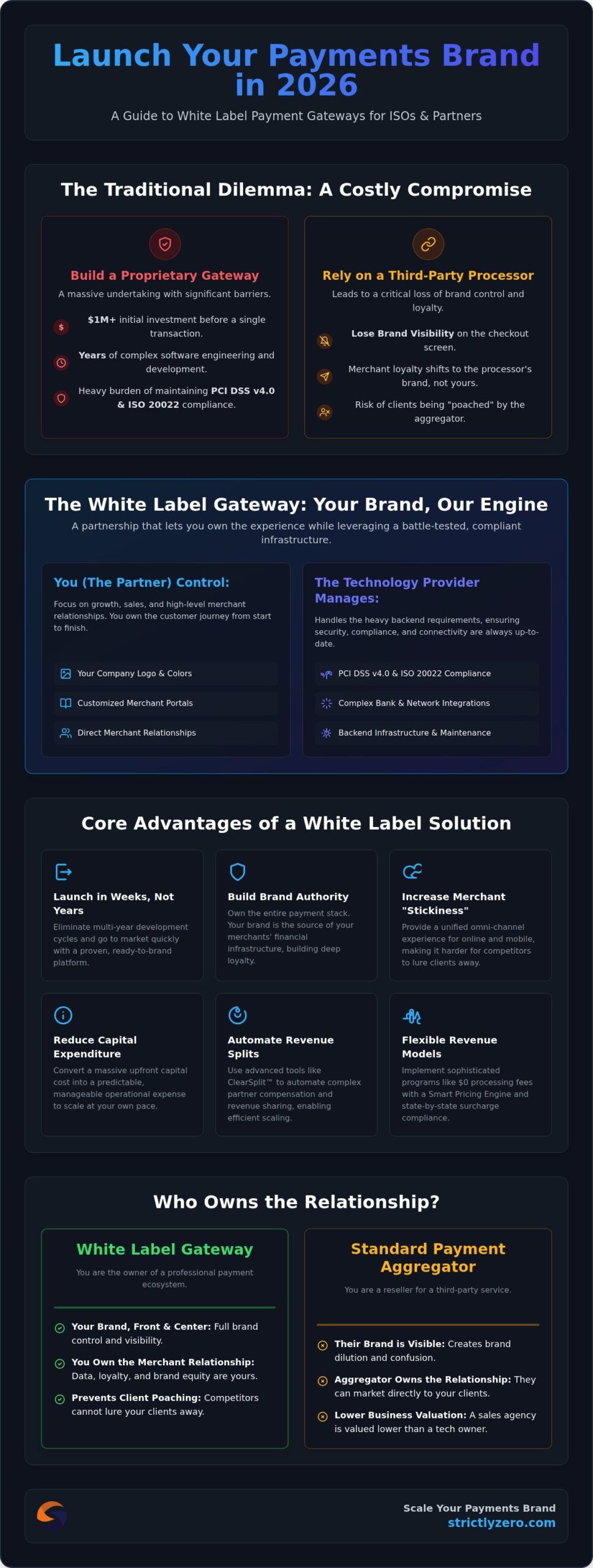
A white label payment gateway is a specialized software platform that allows you to provide secure payment processing under your own brand. Instead of spending years and millions of dollars developing a proprietary engine, you license a battle-tested platform from a technology partner. This infrastructure is “white labeled” because the original developer’s branding is completely removed. You replace it with your company’s logo, color schemes, and unique user interface. For Independent Sales Organizations (ISOs) and software developers, it’s the fastest way to become a full-service provider without the crushing weight of technical debt.
Building a gateway from scratch isn’t just about writing code. It involves maintaining rigorous security protocols and securing complex bank relationships. A white label payment gateway eliminates these hurdles. You get to focus on sales and high-level merchant relationships while the backend technology remains invisible to your clients. It turns a massive capital expenditure into a manageable operational cost, allowing you to scale your business at your own pace.
How White Labeling Works in 2026
The division of labor in a white label partnership is clear and efficient. The technology provider manages the heavy backend requirements. This includes maintaining PCI DSS v4.0 compliance and adapting to the new ISO 20022 messaging standards. They handle the “pipes” that connect to various banks and card networks. You, as the partner, control the frontend experience. You customize the login portals, merchant dashboards, and branded invoices. When a merchant logs in to check their daily sales, they see your brand. This reinforces your value as their primary Payment service provider (PSP) and keeps your business at the center of their operations.
White Label vs. Payment Aggregators
Choosing between a white label solution and a standard payment aggregator often comes down to who owns the relationship. Aggregators are convenient, but they usually keep their own branding front and center. When a merchant uses an aggregator, they know they’re using a third-party service. This creates a risk where the aggregator can eventually market directly to your clients. With a white label payment gateway, you own the merchant relationship from start to finish. You keep the data, the loyalty, and the brand equity. It prevents your clients from being “poached” by the platform you’re using to serve them. You aren’t just a reseller; you’re the owner of a professional payment ecosystem.
Key Benefits of Using a White Label Solution
Adopting a white label payment gateway offers more than just a shortcut to market. It’s a strategic move that shifts your business from a simple reseller to a comprehensive fintech provider. According to recent payment gateway market projections, the industry is seeing a massive surge in demand for integrated solutions. This growth is driven by businesses that want to avoid the multi-year development cycles and high capital costs associated with building proprietary tech. By leveraging existing infrastructure, you can go live in weeks rather than years.
One of the most significant advantages in 2026 is the ability to offer sophisticated revenue models like $0 processing fees. With a Smart Pricing Engine, you can implement state-by-state surcharge compliance automatically. This allows you to provide dual pricing or surcharge programs that eliminate merchant fees while increasing your own residuals. Most standard aggregators don’t offer this level of granular control. A white label solution gives you the tools to build custom fee structures that align perfectly with your merchants’ specific industries and locations.
Building Brand Authority
Owning the payment stack instantly elevates your brand’s perceived value. When merchants interact with a branded dashboard or receive support from your team, there’s no brand dilution. You aren’t just a middleman for a larger corporation; you’re the source of their financial infrastructure. This “stickiness” makes it much harder for competitors to lure your clients away. Furthermore, a business that owns its payment experience and merchant data is often valued much higher during a merger or acquisition than a standard sales agency.
Cost and Time Efficiency
Building a gateway is expensive, but maintaining it is where many companies fail. By 2026, compliance requirements like PCI DSS v4.0 and the new ISO 20022 messaging standards have made the technical burden even heavier. A white label partner handles these updates for you. This gives you instant access to advanced ecommerce payment processing features without hiring a massive DevOps team. You get to focus your resources on acquisition and merchant success while your partner ensures the system remains fast, secure, and compliant.
Offloading operational risk is another critical factor. The security landscape is constantly shifting, and the cost of a single data breach can be catastrophic. When you use a white label platform, the provider takes on the primary responsibility for safeguarding sensitive cardholder data. If you’re looking for a partner that prioritizes trust as a payment processor, choosing a platform that manages these complex security layers is the smartest way to scale your payments brand safely.
Technical Features and Integration Strategies
Modern ISOs need more than just a terminal. They need a tech stack that fits into any software environment. A robust white label payment gateway provides an API-first architecture, allowing developers to embed payment functionality directly into SaaS platforms or mobile apps. This omni-channel approach ensures that whether a merchant takes payments online, via a mobile device, or in-person at a storefront, the data flows through a single, branded portal.
Understanding the technical nuances of What Is A Payment Gateway is essential for developers who need to bridge the gap between a customer card and a merchant bank account. By choosing a white label solution, you get a pre-built bridge that is already optimized for performance. This includes a Smart Pricing Engine that handles the complex logic of state-by-state surcharge and dual pricing compliance. Instead of manually checking local regulations, the system automatically applies the correct fees, protecting you and your merchants from legal risks.
API and NMI Gateway Integration
While platforms like Stripe focus heavily on their own proprietary documentation, they often miss the NMI gateway compatibility that is standard for ISOs. A flexible white label payment gateway often leverages NMI for its superior routing capabilities and merchant management tools. This integration allows you to manage multiple merchant accounts through a single interface while offering flexible transaction routing to various processors. Customizable webhooks provide real-time data for every transaction, giving your developers the power to build custom reporting tools or trigger automated workflows. Comprehensive, developer-friendly documentation is a must, as it significantly reduces the time it takes to board new merchants and get them processing.
Security and PCI Compliance
Security is the foundation of your reputation. When you partner with a provider, you inherit their PCI Level 1 certified infrastructure. This offloads the most difficult parts of data security from your shoulders. Sensitive cardholder data is protected through advanced tokenization, which replaces actual card numbers with unique identifiers that are useless to hackers. AI-driven fraud prevention stops chargebacks before they happen by identifying high-risk transaction patterns in real-time and blocking them before authorization. This proactive approach ensures you maintain your standing as a partner who provides genuine trust as a payment processor. By combining these technical layers, you create a secure, scalable ecosystem that merchants can rely on for years to come.
Evaluating White Label Payment Gateway Providers
Picking the right white label payment gateway isn’t just about comparing feature lists. It’s about finding a partner that understands the high-stakes environment of 2026. You need to look beyond the surface level to ensure the platform can actually support your long-term growth. Start by assessing the depth of customization. A simple logo swap isn’t enough. You need a merchant portal that feels like a native extension of your brand. If your merchants have to jump between different looking interfaces, it erodes the trust you’ve built.
Reliability is the next pillar. Uptime and transaction processing speeds are the lifeblood of your merchants’ businesses. In an era where cross-border payments are projected to hit $320 trillion by 2032, even a few minutes of downtime can result in massive revenue loss. You should also look for a payment processing platform for ISOs that specifically supports zero-fee models. As of 2026, surcharge and dual pricing regulations vary significantly from state to state. Your provider must offer an automated engine that handles these legal nuances without you having to manually update settings every time a local law changes.
Scalability and Partner Support
Growth happens fast in the payments world. You need to know if the provider can handle a sudden influx of thousands of merchants without sacrificing performance. Ask about their dedicated support for your internal team. If you’re out there selling, you don’t want to be stuck in a generic support queue. Ideally, the provider should offer white-labeled support portals. This allows your clients to get help through a system that still carries your branding, maintaining that unified experience we discussed earlier. It ensures that your brand remains the primary contact point for every merchant inquiry.
Pricing and Residual Transparency
Transparency is where many partnerships sour. Look for a provider that offers clear buy-rates with no hidden technology fees or maintenance surcharges tucked away in the fine print. Residual reporting needs to be frequent and, more importantly, accurate. Setting up complex commission structures for sub-agents can be a nightmare if the software isn’t built for it. This is why tools like ClearSplit™ are essential. They automate the compensation process, ensuring everyone gets paid correctly and on time without manual spreadsheet work. Clear reporting allows you to focus on strategy rather than accounting.
If you’re ready to stop being a middleman and start owning your brand, it’s time to partner with a team that prioritizes trust as a payment processor.
Scaling Your Payments Brand with Strictly
Scaling an ISO or a software platform requires more than just a great sales pitch. It requires an operational backbone that can handle the complexity of hundreds of merchant accounts and a growing network of sales agents. Strictly provides a unified platform that removes the friction typically associated with rapid growth. By leveraging our white label payment gateway, you gain access to a suite of partner management tools that allow you to focus on expansion rather than administrative maintenance.
Growth requires more than just software. It requires a partner that helps you maintain trust as a payment processor. We provide the infrastructure that allows you to scale your brand with confidence, knowing that the backend is secure, compliant, and optimized for performance. This focus on operational excellence is what differentiates a standard reseller from a true market leader in the 2026 payments landscape.
ClearSplit™: Automating Your Residuals
The most common bottleneck for growing ISOs is the manual management of partner compensation. Spreadsheets are prone to errors and consume hours of valuable time every month. ClearSplit™ solves this by providing instant, automated partner compensation. It offers real-time visibility into your portfolio performance, allowing you to track margins and residuals with total accuracy. The system is built to handle complex ISO hierarchies. Whether you’re paying a single agent or a multi-tiered sales organization, everyone gets paid correctly and on time without manual intervention.
ChurnIQ™: Merchant Retention Intelligence
Acquiring a new merchant is significantly more expensive than keeping an existing one. Most providers only notice a merchant is unhappy when the processing volume hits zero. ChurnIQ™ gives you a proactive advantage by identifying “at-risk” merchants before they cancel their service. ChurnIQ™ uses transaction patterns and volume fluctuations to predict merchant behavior, flagging accounts that show signs of dissatisfaction. This data-driven insight allows your support team to intervene early, improving merchant satisfaction and protecting your long-term residual income.
Beyond retention and residuals, our platform empowers you to offer the most competitive pricing models in the industry. With our Smart Pricing Engine, you can confidently market zero fee credit card processing to your clients. The engine handles all the complex logic required for state-by-state surcharge compliance, ensuring your merchants stay within legal boundaries while eliminating their processing costs. By combining these operational tools with a powerful white label payment gateway, Strictly positions you as a leader in the next generation of payment processing.
Own Your Future in the Payments Industry
The 2026 payments landscape demands more than just a generic processing relationship. It requires a strategic foundation where you own the brand equity and the customer experience. By choosing a robust white label payment gateway, you bypass million-dollar development cycles while gaining the tools needed to compete with industry giants. You’ve seen how rebranding a proven infrastructure allows you to maintain full visibility with your merchants and protect your portfolio from third-party poaching.
Now is the time to transition from a simple reseller to a complete fintech provider. With Strictly, you get more than just software. You gain access to ClearSplit™ for automated partner compensation, ChurnIQ™ for proactive merchant retention, and our Smart Pricing Engine for compliant zero-fee surcharge programs. These tools ensure your business is efficient, compliant, and ready for rapid scale. Ready to take control of your brand and your residuals? Partner with Strictly: Scale Your White Label Payments Business Today. Your path to ownership starts here.
Frequently Asked Questions
Can I really put my own logo on the payment gateway?
Yes, you can fully customize the interface to match your company identity. A white label payment gateway is built so your logo, brand colors, and company name appear on every merchant dashboard and login portal. This ensures your brand stays at the center of the merchant relationship instead of being overshadowed by a third-party processor.
How much does a white label payment gateway cost?
Pricing for these solutions is typically quote-based and depends on your transaction volume and specific feature needs. It’s significantly more cost-effective than building a proprietary system from scratch, which can exceed $1 million in initial development costs. Most providers use a scalable model that aligns with your business growth and portfolio size.
Do I need to be PCI compliant to use a white label gateway?
You still have compliance responsibilities, but the provider handles the most complex technical requirements. The platform is usually PCI Level 1 certified, covering the secure storage and transmission of card data. Since March 2025, all entities must adhere to PCI DSS v4.0 standards, and a white label partner makes this ongoing process much simpler for your team.
What is the difference between white label and private label?
These terms are often used interchangeably in the payments industry, but there’s a slight distinction. A white label solution is a standard product that multiple companies can rebrand and use. Private label usually implies a more bespoke version of the software that’s been specifically tailored or modified to meet one partner’s unique functional requirements.
Can a white label gateway support surcharge and dual pricing?
Yes, advanced platforms include a Smart Pricing Engine to manage these specific programs. This technology allows you to offer $0 processing fees by automatically applying the correct surcharge or dual pricing logic based on state-by-state regulations. It’s a powerful tool for increasing your merchant’s bottom line while simultaneously growing your own residual income.
How long does it take to set up a white label payment gateway?
You can typically launch your branded platform in just a few weeks. This is a massive advantage compared to the multi-year development cycles required to build your own software from the ground up. Most of the setup time involves customizing your brand assets and configuring your merchant boarding workflows within the existing infrastructure.
Will my merchants know that I am using a third-party provider?
No, your merchants will see your brand as the primary interface for their business. The goal of a white label payment gateway is to make the underlying technology provider invisible to the end user. From the initial login screen to the monthly statements, the merchant interacts with your company identity, which helps build long-term loyalty.
Does a white label gateway support mobile and in-person payments?
Modern platforms are designed for omni-channel payment processing. This means you can support online checkouts, mobile app payments, and in-person transactions through a single, unified system. Your merchants get a consistent experience regardless of how their customers choose to pay, and you can manage all those data streams from one branded portal.