
Zero Fee Ecommerce Payment Processing: The 2026 Merchant Guide
Published:

What if the 3.5% you lose on every transaction wasn’t an inevitable cost of doing business, but a choice you no longer had to make? With global e-commerce sales hitting $7.4 trillion in 2026, it’s more painful than ever to watch your revenue vanish into interchange fees. You’ve likely seen your margins shrink, especially after Visa increased Level 2 interchange rates for small business credit cards by 0.75% in January. Many merchants assume that zero fee ecommerce payment processing is a myth or a legal risk, but it’s actually a compliant strategy that’s becoming the new industry standard.
You already know that every penny counts in a competitive market, and you’re right to be wary of the complexity involved in state-by-state surcharge laws. This guide will show you how to eliminate your processing overhead using a smart pricing engine that handles the heavy lifting for you. We’ll look at how to navigate the legal landscape in 2026, including specific restrictions in states like Connecticut and Maine. You’ll discover how to create a seamless checkout experience that keeps your customers happy while ensuring your profit margins stay entirely intact.
Key Takeaways
- Learn how to shift transaction costs away from your bottom line by implementing a compliant surcharge or dual pricing model.
- Master the legal requirements for zero fee ecommerce payment processing, including 2026 card network caps and specific state prohibitions.
- Identify the best pricing strategy for your brand by comparing the customer impact of credit card surcharges versus cash-discounting options.
- Discover how a Smart Pricing Engine automates state-by-state compliance to ensure your online store stays within legal limits without manual oversight.
- See how an API-first platform integrates zero-fee logic into your existing checkout flow, virtual terminals, and mobile invoicing.
Table of Contents
- What is Zero Fee Ecommerce Payment Processing?
- Surcharging vs. Dual Pricing: Choosing the Right Model
- Integrating Zero Fee Processing into Your Ecommerce Stack
- Compliance and Legality: Staying Safe in 2026
- Why Strictly is the Best Zero Fee Merchant Service for 2026
What is Zero Fee Ecommerce Payment Processing?
Zero fee ecommerce payment processing isn’t about credit card fees disappearing into thin air. Instead, it’s a strategic merchant service model where the costs of processing are offset through a compliant surcharge or dual pricing program. In this setup, the merchant moves from paying an average of 3% in net processing costs to $0. It’s a shift that treats payment processing as a pass-through cost rather than a fixed business expense. While the term “free” is often thrown around, “zero fee” is more accurate because the fee still exists; it’s simply paid by the customer choosing the convenience of a credit card.
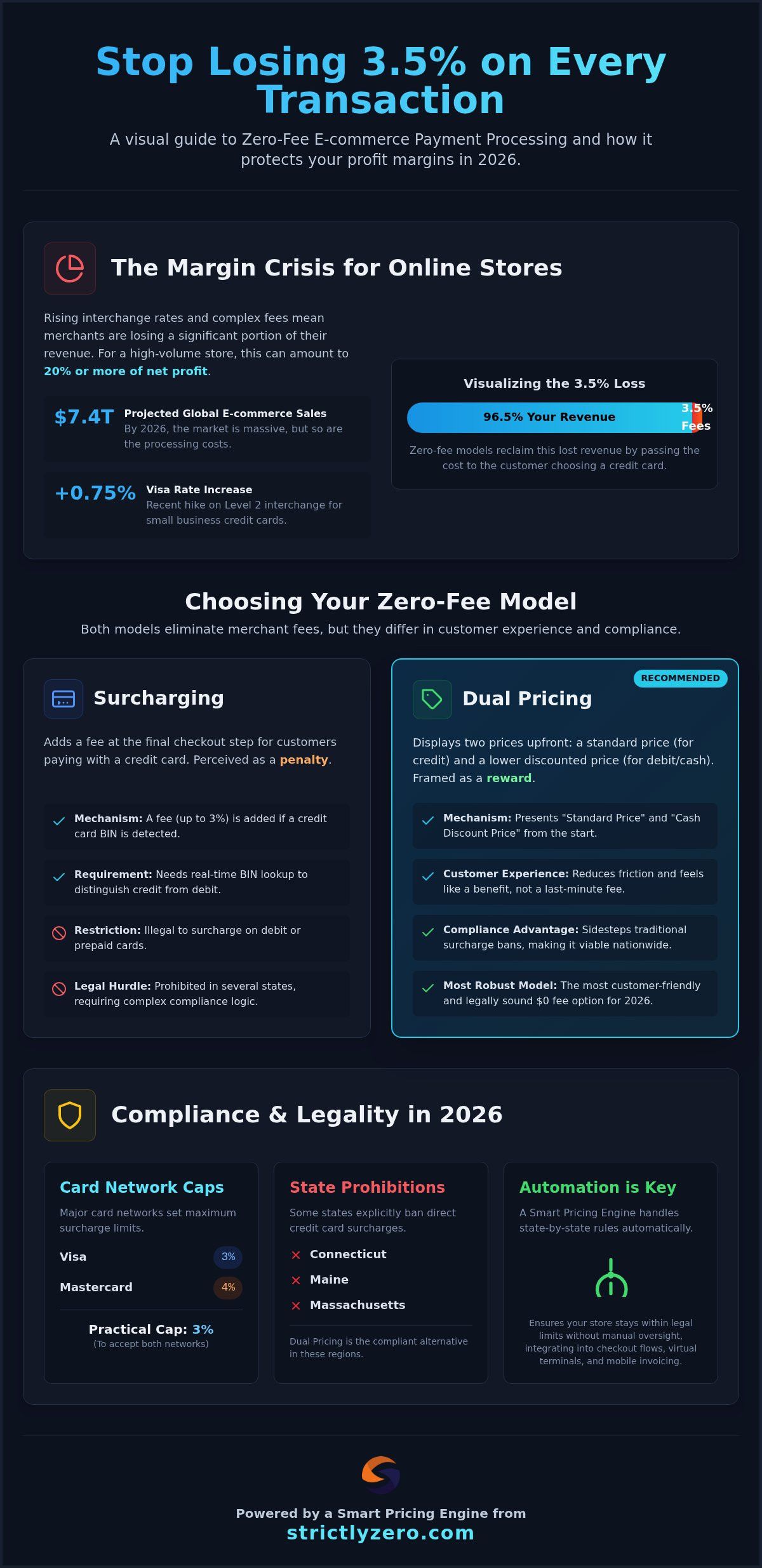
By 2026, online stores are facing a margin crisis. Global e-commerce sales are projected to reach $7.4 trillion, but rising interchange rates and complex network rules make it harder to keep a profit. Implementing a surcharge on card payments allows merchants to protect their bottom line without raising prices for every single customer. This model has become the standard for businesses that refuse to let 3% of their top-line revenue vanish into the pockets of card issuers.
The True Cost of Traditional Ecommerce Processing
Traditional processing is a labyrinth of hidden expenses. Every time a customer clicks “buy,” you’re hit with interchange fees, assessment fees, and processor markups. Visa currently charges a 0.14% assessment fee for credit transactions, while Mastercard sits at 0.1375%. On top of that, Visa increased Level 2 interchange rates for small business credit cards by 0.75% in early 2026. While flat-rate pricing models seem simple, they often hide significantly higher costs for growing brands. For a high-volume store, losing 3% on every order doesn’t just hurt; it can represent 20% or more of your actual net profit. You’re essentially paying for the privilege of being paid.
How Zero Fee Models Solve the Margin Crisis
Switching to a zero fee model changes the fundamental math of your business. It represents a psychological shift where you stop “paying for a service” and start “enabling a transaction.” By using a smart pricing engine to automate compliance, you can ensure that the credit card fee is added only when appropriate. This protects your margins instantly. If you want to dive deeper into the mechanics of these programs, check out our comprehensive guide on Zero Fee Credit Card Processing: The 2026 Merchant Guide to $0 Fees. This transition turns a variable expense into a predictable, pass-through cost, giving you the capital needed to reinvest in growth rather than bank fees.
Surcharging vs. Dual Pricing: Choosing the Right Model
Selecting the right path for zero fee ecommerce payment processing requires a clear understanding of how your customers interact with your checkout page. While both models aim to eliminate merchant costs, they approach the transaction from different angles. Surcharging adds a fee at the final step for credit card users. Dual pricing displays two distinct prices from the start. For most merchants, Dual Pricing stands as the most robust and customer-friendly $0 fee model for 2026. This approach minimizes friction by framing the lower price as a benefit for using cash or debit, rather than a penalty for using credit.
The Mechanics of Surcharging in Ecommerce
Surcharging is a precise technical process. When a customer enters their card information, the system must perform a real-time Bank Identification Number (BIN) lookup to distinguish between credit and debit cards. This is vital because federal law prohibits surcharging on debit or prepaid cards. In 2026, Visa caps these fees at 3%, while Mastercard allows up to 4%. Since most merchants accept both, the practical cap remains 3%. You must also provide clear disclosure during the checkout process to remain compliant with state-by-state surcharge laws, ensuring the customer sees the fee before they finalize the payment. If you’re unsure which rules apply to your region, our Surcharge & Dual Pricing Engine automates these calculations for you.
The Dual Pricing Advantage for Online Stores
Dual pricing offers a significant strategic advantage in states where traditional surcharging is restricted or prohibited. In 2026, states like Connecticut, Maine, and Massachusetts still maintain strict bans on credit card surcharges. Dual pricing sidesteps these hurdles by presenting a “Standard Price” (for credit) and a “Cash Discount Price” (for debit or ACH). This model is often perceived more favorably by shoppers. It feels like a reward for choosing a lower-cost payment method rather than an unexpected tax at the end of the journey.
Implementation is straightforward but requires an API-first approach to display both values accurately in the cart. By showing the two options side-by-side, you empower the customer with choice. This transparency builds trust and reduces cart abandonment. It effectively moves the cost of acceptance to the consumer without the negative psychological impact of a “fee” added at the last second. In a market where every basis point matters, this model ensures you keep 100% of your revenue while keeping your customers satisfied.
Integrating Zero Fee Processing into Your Ecommerce Stack
Most payment processors focus on shipping physical hardware, but for an online brand, the real battle happens in the code. Achieving zero fee ecommerce payment processing requires a tech stack that communicates with your checkout flow in real-time. Whether you’re running a store on Shopify, WooCommerce, or Magento, you need a gateway that doesn’t just process cards but also calculates compliance on the fly. This ensures that the right price is shown to the right customer every time without manual intervention.
Understanding the gap between your current costs and your potential savings is the first step toward reclaiming your revenue. While standard credit card processing fees often eat up 1.5% to 3.5% of every sale, a properly integrated system shifts this cost entirely. By using an API-first approach, your platform can identify card types and apply the correct logic before the transaction is even submitted. This level of automation is what separates a modern e-commerce operation from a legacy business struggling with shrinking margins.
API-First Integration for Developers
Developers need more than just a simple “Buy” button; they need control over the transaction logic. Our unified platform provides an API-first architecture designed for custom checkout builds. The Smart Pricing Engine acts as the brain of the operation, providing instant logic in the API response to determine if a surcharge or a dual price should be applied. This allows your UI to update dynamically. If a customer enters a credit card number, the price adjusts; if they switch to a debit card, the system removes the fee instantly to stay compliant with federal regulations.
Virtual Terminals and Payment Links
Not every e-commerce sale happens through a traditional shopping cart. For service-based businesses or B2B distributors, a Virtual Terminal is essential for processing payments over the phone or via email without a website. You can also generate one-click payment links that carry your zero-fee logic automatically. This means your invoices always reflect the correct compliant pricing without manual calculations. To see how this fits into a broader strategy, you can learn more about Ecommerce Payment Processing: The Ultimate Omni-Channel Guide. This omni-channel flexibility ensures your revenue is protected whether you’re selling a single product online or managing a complex B2B contract.
Compliance and Legality: Staying Safe in 2026
Legal compliance is the biggest hurdle for merchants looking into zero fee ecommerce payment processing. In 2026, the rules aren’t just complex; they’re constantly shifting. While card brands like Visa and Mastercard have set their own caps, 3% and 4% respectively, state laws often take precedence. For instance, Connecticut, Maine, and Massachusetts still prohibit credit card surcharges entirely. In states like Colorado, you’re limited to a 2% surcharge. If you try to apply a blanket fee across all fifty states, you’re inviting a regulatory nightmare.
Federal law and card network rules also strictly prohibit surcharging on debit and prepaid card transactions. This creates a massive technical challenge for online stores. You can’t just guess which card is which. Your system must identify the card type in milliseconds before the transaction completes. Strictly’s Smart Pricing Engine automates state-by-state compliance to remove merchant liability. This automation ensures you never accidentally surcharge a customer in a restricted state or on a restricted card type.
Automated Compliance vs. Manual Risks
Relying on static surcharge settings is a dangerous gamble. If your checkout page applies a flat 3% fee to every order, you’re likely violating laws in several jurisdictions. Manual updates are slow and prone to human error, especially when 2026 regulatory changes occur. Our platform handles these updates automatically through firmware and cloud-based logic. This keeps your business within the safe harbor of PCI DSS compliance while maintaining your zero-fee status. You don’t need to be a legal expert to keep your margins; you just need the right engine. Learn how our Smart Pricing Engine protects your business.
Communicating with Your Customers
Transparency is your best tool for maintaining customer trust. Card networks require you to disclose surcharging practices at least 30 days in advance to your acquirer and clearly at the point of sale. For e-commerce, this means placing notices on your homepage, product pages, and checkout screen. Framing is everything. Instead of an extra fee, present Dual Pricing as a way to give customers a choice. When customers see they can save money by using a debit card, it feels like a discount rather than a penalty. This clarity reduces cart abandonment because there are no surprises at the final click, making zero fee ecommerce payment processing a win for both you and your shoppers.
Why Strictly is the Best Zero Fee Merchant Service for 2026
Sustainable growth requires more than just saving on fees. It requires intelligence. ChurnIQ™ leverages AI to analyze transaction patterns and predict merchant attrition before it happens. This allows you to stay proactive rather than reactive in your business strategy, ensuring your merchant relationships remain strong and profitable. For those working with ISOs or multiple partners, ClearSplit™ provides automated residual management. It handles complex partner compensation with absolute precision, removing the manual headache of tracking splits or calculating monthly payouts. You can see how these proprietary tools stack up against the competition in our guide to the Best Credit Card Processing for Small Business in 2026.
The Strictly Implementation Journey
Starting your journey toward $0 fees shouldn’t be a weeks-long ordeal. Our onboarding process is designed for speed, taking you from application to your first transaction with minimal friction. Once active, you’ll gain access to a unified omni-channel dashboard. This central hub lets you manage online sales, mobile payments, and virtual terminal invoices in one place. You’ll have total visibility into your savings and compliance status across every channel your business uses. This omni-channel approach ensures that your brand remains agile, whether you’re selling through a custom web build or a simple payment link.
The shift to zero fee ecommerce payment processing is the smartest move you can make for your brand’s longevity in a high-cost environment. By removing the burden of interchange fees, you free up capital to reinvest in marketing, product development, and customer acquisition. Stop letting rising fees dictate your success and start keeping the revenue you’ve already earned. Eliminate your fees with Strictly today.
Reclaim Your Revenue in 2026
By now, you understand that zero fee ecommerce payment processing isn’t just a trend; it’s a necessary evolution for protecting your margins. You’ve seen how choosing between surcharging and dual pricing depends on your specific checkout flow and how an API-first integration ensures a seamless experience for your customers. Most importantly, you’ve learned that automated compliance is the only way to navigate the shifting legal landscape of 2026 without risking your business or customer trust.
It’s time to stop letting interchange fees dictate your profit potential. Strictly provides an AI-Driven Smart Pricing Engine that ensures you remain compliant in all 50 states while maintaining a robust, API-first omni-channel platform. You don’t have to manage the complexity of state laws or card network rules on your own. Start Eliminating Your Ecommerce Fees with Strictly and take full control of your online store’s financial future today. You’ve worked hard to build your brand; it’s time you kept every dollar you earn.
Frequently Asked Questions
Is zero fee ecommerce payment processing legal in all 50 states?
Surcharging is legal in most jurisdictions, but Connecticut, Maine, and Massachusetts prohibit the practice as of August 2026. Merchants in these areas typically use Dual Pricing to achieve zero fee ecommerce payment processing instead. This model is compliant nationwide because it frames the price difference as a discount for non-credit payments. Our engine automatically detects the customer’s location to apply the correct legal logic for every specific transaction.
How does the system know not to surcharge a debit card?
The platform uses a real-time Bank Identification Number (BIN) lookup the moment a customer enters their card details. This identifies the card as credit, debit, or prepaid instantly. Federal law and card network rules strictly ban surcharging on debit cards. Our Smart Pricing Engine automates this check to ensure you don’t violate these regulations during the checkout process, protecting you from potential fines or network penalties.
Will my customers stop shopping with me if I add a surcharge?
Transparency is the key to maintaining your conversion rates. Most shoppers in 2026 are familiar with these models, but the way you frame the cost matters. Using a Dual Pricing model allows you to present the lower price as a “Cash Discount,” which feels like a reward rather than a penalty. Clear communication at the start of the checkout journey prevents the surprises that often lead to cart abandonment.
Can I use zero fee processing on platforms like Shopify or WooCommerce?
Yes, zero fee ecommerce payment processing integrates with major platforms through our API-first gateway. Many merchants use our Smart Pricing Engine to bypass the high flat-rate fees typical of standard platform processors. This setup allows your checkout page to update prices in real-time based on the card type entered. You get to keep your preferred store builder while reclaiming the profit margins that high interchange fees usually consume.
What is the difference between a surcharge and a convenience fee?
A surcharge is a percentage-based fee added specifically to credit card transactions to cover processing costs. A convenience fee is a flat charge for the privilege of using a non-standard payment channel, like an online portal instead of a physical office. Surcharges are capped by card networks at 3% in 2026 and are prohibited on debit cards. Convenience fees have different requirements and generally apply to all payment methods used in that channel.
How long does it take to set up zero fee processing for my online store?
Our onboarding process is designed to be efficient and fast. Most merchants can complete the application and gain access to their dashboard within a few business days. Once your account is active, integrating the API or generating one-click payment links can happen almost immediately. We focus on moving you from the initial setup to your first zero-fee transaction without the long wait times typical of legacy banking services.
Does Strictly provide the API documentation for custom integrations?
We provide comprehensive, developer-friendly API documentation to support custom e-commerce builds. Our platform is built with an API-first architecture, meaning every feature of our Smart Pricing Engine is accessible via code. This allows your development team to build a bespoke checkout experience that handles complex surcharge logic and state-by-state compliance automatically. You can maintain full control over your user interface while leveraging our robust, secure backend.