

What if your monthly merchant statement arrived with a balance of exactly $0.00? For most entrepreneurs, seeing 1.5% to 3.5% of every transaction vanish into thin air feels like an unavoidable tax on growth. You’ve likely spent hours squinting at confusing statements, wondering why your thin profit margins are being eaten by fees you never agreed to. Learning how to eliminate credit card processing fees for small business is no longer a pipe dream; it’s a strategic necessity in 2026.
We agree that you shouldn’t have to choose between accepting digital payments and keeping your hard-earned money. You’ll discover the exact strategies and compliant programs used by modern merchants to reach $0 in processing costs while staying on the right side of the law. We will explore the shift from merchant-pay models to automated smart-pricing systems. This guide covers how to implement seamless dual pricing, navigate the 2026 Visa and Mastercard settlement rules, and ensure your signage meets every regulatory requirement across different states.
Key Takeaways
- Stop letting 1.5% to 3.5% of every sale vanish and learn why traditional merchant fee reductions don’t protect your long-term profit margins.
- Compare surcharge models and dual pricing strategies to find the most effective way to shift costs while maintaining a great customer experience.
- Master the 2026 legal landscape by using automated tools that manage state-by-state surcharge bans and debit card detection for you.
- Follow our five-step implementation guide on how to eliminate credit card processing fees for small business through a structured audit and seamless integration.
- Use advanced intelligence like ChurnIQ™ to track merchant health and ensure your transition to zero-fee processing remains profitable and compliant.
The Hidden Cost of Growth: Why Small Businesses Are Rethinking Processing Fees
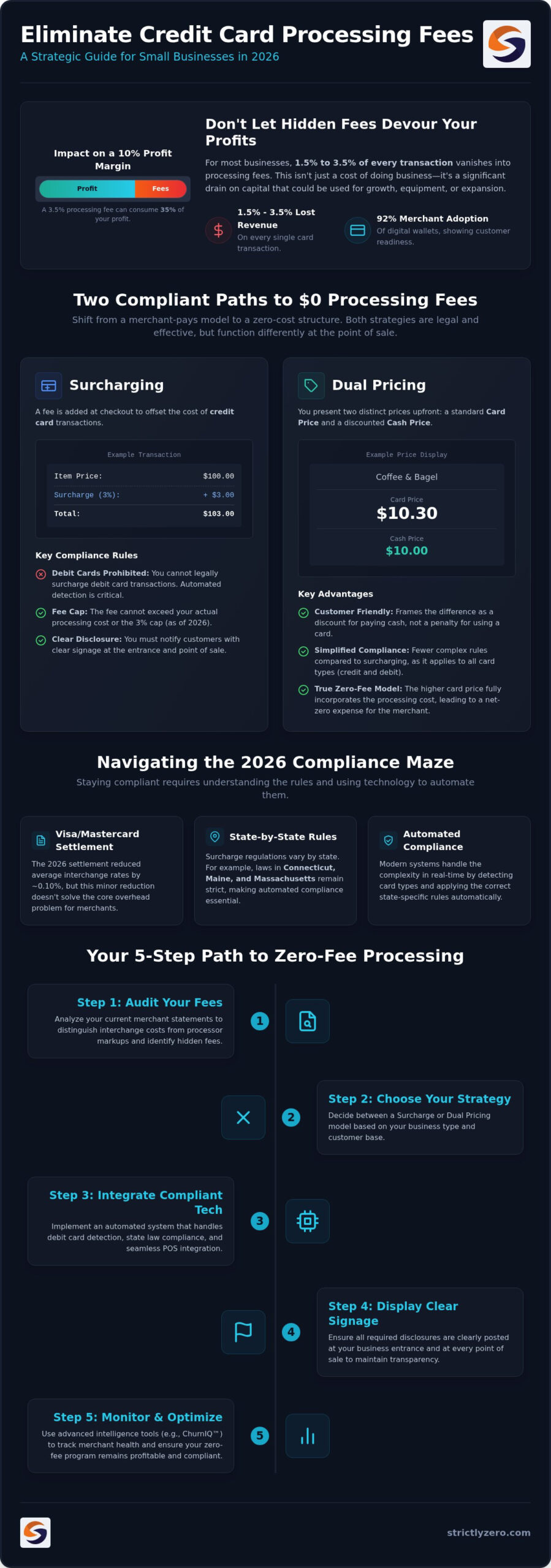
A 3.5% fee sounds like a minor cost of doing business until you calculate its impact on your bottom line. If your business operates on a 10% profit margin, that single processing fee is actually consuming 35% of your take-home pay. Over a decade, these fees can amount to hundreds of thousands of dollars in lost capital that could have funded expansion or new equipment. Most traditional “fee reduction” plans fail because they only address the processor’s markup while leaving the bulk of the costs intact. To truly scale, you need to understand how to eliminate credit card processing fees for small business by shifting the cost structure entirely.
Consumer behavior has shifted dramatically in this post-cash economy. With 92% of U.S. merchants now accepting digital wallets, customers prioritize convenience over specific payment methods. This shift has made the acceptance of payment system surcharges more common. People understand that processing payments costs money; they’ve seen service fees at gas stations and utility offices for years. The goal is to transition your processing bill from a fluctuating, profit-eating variable into a fixed $0 monthly expense.
The Evolution of Merchant Services in 2026
The industry reached a turning point in June 2026 following the revised Visa and Mastercard interchange settlement. While this settlement reduced average rates by about 0.10%, it didn’t solve the fundamental problem of high overhead for the merchant. Modern technology now allows for automated compliance, moving businesses away from legacy flat-rate pricing toward zero-fee models. Traditional processors are often slow to offer these programs because they rely on the “spread” between interchange and what they charge you. Automated engines now handle the complexity of state laws and card types in real time, making fee elimination accessible to every storefront.
Identifying Your Current Processing Gaps
To fix your costs, you must first find the leaks. Merchant statements are notoriously difficult to read, often hiding “non-qualified” fees that trigger when a customer uses a high-rewards card or a corporate account. You need to distinguish between interchange costs, which go to the card-issuing banks, and the processor’s markup. If you are just starting to look into your options, our guide on credit card processing for small business provides the foundational basics you need to spot these discrepancies. Identifying these gaps is the first step toward reclaiming your margins and reaching a true zero-cost processing environment.
Surcharging vs. Dual Pricing: Strategies to Eliminate Your Fees
Most business owners spend years trying to shave a few basis points off their merchant statements. That’s a losing game because processors can raise rates or add hidden markups at any time. To truly master how to eliminate credit card processing fees for small business, you have to stop negotiating and start restructuring. Surcharging and dual pricing are the two primary vehicles that allow you to move from a merchant-pays model to a zero-cost model. Both strategies are legal and effective, but they function differently at the point of sale.
Surcharging specifically targets credit card transactions. You add a fee, typically capped at 3% in 2026, to the customer’s total at checkout. It is vital to remember that you cannot surcharge debit cards. This is a strict requirement under the Durenberger Amendment and various card network rules. If your system doesn’t automatically detect the difference between a credit and debit card, you’re at risk of non-compliance. Checking state-by-state laws is essential because regulations in places like Connecticut, Maine, and Massachusetts remain strict.
How Surcharging Works in Practice
A surcharge program is a compliant way to offset processing costs by applying a fee only to credit card transactions. Visa and Mastercard rules require you to disclose this fee at the entrance of your business and at the point of sale. The fee cannot exceed your actual cost of acceptance or the 3% cap. Modern systems automate this process. They detect the card type and apply the fee instantly, ensuring you never accidentally surcharge a debit user.
Dual Pricing: The Ultimate “Zero Fee” Model
Dual pricing is often viewed as the more customer-friendly option. Instead of adding a fee at the end of the transaction, you present two distinct prices: a “Card Price” and a “Cash Price.” The Card Price includes the processing cost, while the Cash Price reflects a discount. This model is effective because it feels like a reward for using cash or debit rather than a penalty for using credit. You can implement this across all channels, including your virtual terminal and e-commerce website. For a deeper dive into these $0 models, see our guide on zero fee credit card processing.
The real advantage for modern merchants is “Smart Pricing” automation. You don’t want your staff guessing which rules apply or which cards can be surcharged. A compliant surcharge engine handles these decisions at the point of sale. It ensures you stay within legal limits while effectively reaching that predictable $0 monthly processing bill.
Navigating the Legal Landscape: Compliance and State Rules in 2026
Legal compliance is the biggest hurdle for merchants looking into how to eliminate credit card processing fees for small business. While federal laws allow for cost-shifting, the state-level environment in 2026 remains a patchwork of specific rules. As of September 2026, credit card surcharges are prohibited in Connecticut, Massachusetts, Maine, and Puerto Rico. If you operate in Colorado, your surcharge is capped at 2% of the transaction amount. In all other states where it’s legal, card network rules limit you to a maximum of 3% or your actual cost of acceptance, whichever is lower.
You also have to meet strict disclosure requirements to remain compliant. Customers must see clear signage at your entrance and at the point of sale before they reach the checkout. Your receipts must also display the surcharge as a separate line item rather than hiding it in the total. Beyond state laws, you must maintain PCI DSS compliance to protect customer data throughout the transaction. Failing to follow these rules doesn’t just lead to card brand fines; it can result in the loss of your merchant account entirely.
Automating Compliance with Smart Engines
Relying on staff to remember which states allow surcharges or which cards are debit is a recipe for disaster. Strictly’s Smart Pricing Engine automates these decisions by detecting the card type and the merchant’s location in real-time. This prevents illegal surcharging on debit cards, which is a common point of failure for manual systems. If a customer swipes a debit card, the engine ensures no surcharge is applied, keeping you compliant with the Durenberger Amendment. Manual surcharging often leads to heavy fines because it’s prone to human error and lacks the necessary data-level card detection required for modern auditing.
Card Brand Notifications and Registration
Before you can start a surcharge program, you must provide a 30-day written notice to Visa and Mastercard. This isn’t just a courtesy; it’s a mandatory registration step. A modern payment processor handles this paperwork for you, ensuring your account is properly flagged in the card brand databases. This registration is vital during annual PCI audits, as it proves your fee structure is transparent and authorized. By letting technology handle the notification and compliance monitoring, you can focus on growth while maintaining a compliant bridge to zero-cost processing. It’s the safest way to reach a predictable $0 monthly processing bill without risking your reputation.
5 Steps to Implement a Zero-Fee Processing Program
Moving from a high-overhead model to a zero-cost structure requires more than just flipping a switch. It’s a deliberate process that ensures both financial accuracy and customer satisfaction. If you are researching how to eliminate credit card processing fees for small business, following a structured roadmap prevents the common pitfalls of non-compliance or customer pushback. Most businesses find that the transition takes less than 30 days when using the right technology.
- Step 1: Audit your statements. Review your last three merchant statements to find your true effective rate. If your fees are between 1.5% and 3.5%, you have a clear baseline for your potential savings.
- Step 2: Choose your model. Decide between a surcharge program for credit cards or a dual pricing model that covers all payment types.
- Step 3: Select an omni-channel platform. You need a system that supports “smart pricing” across your website, mobile payments, and in-person sales.
- Step 4: Deploy compliant signage. Transparency is a legal requirement in 2026. You must disclose fees at the point of entry and the register.
- Step 5: Train your staff. Prepare your team to explain the change clearly and confidently to your customers.
Communicating the Change to Customers
Transparency is your best defense against confusion. When customers understand that processing fees are an external cost, they are more likely to accept the shift. Instead of framing the change as a new penalty, your staff should focus on the concept of choice. Scripts should emphasize that the “Cash Price” is the standard rate, while the “Card Price” covers the convenience of credit. Using “Cash Discount” language frames the change as a benefit for those paying with cash or debit. This approach maintains customer loyalty while you work to reach a predictable $0 monthly processing bill.
Integrating with Your Existing Workflow
Your transition shouldn’t break your backend operations. Modern merchants use a virtual gateway to manage zero-fee invoicing and recurring billing. This ensures that even for remote payments, the surcharge is applied automatically and accurately based on the card type. Your accounting software must also be configured to recognize the offset correctly so your books stay balanced at the end of the month. If you’re ready to stop paying for your customers’ rewards points, you can start your zero-fee transition today by implementing a compliant smart pricing engine.
Strictly: The Compliant Path to Eliminating Merchant Fees
Understanding how to eliminate credit card processing fees for small business isn’t just about finding a cheaper rate; it’s about changing the technology you use to accept payments. Strictly operates as a compliant bridge, providing the Smart Pricing Engine needed to automate the complex rules of 2026. Our unified platform ensures that whether you’re selling online, via a mobile app, or in-person, your costs stay at zero. This API-first approach allows businesses with custom integrations to plug in our surcharge engine without rebuilding their entire digital infrastructure.
At the heart of our service is the “Trust as a Payment Processor” philosophy. We handle the security, the card brand notifications, and the real-time compliance checks so you don’t have to. You get a seamless experience that prioritizes security and cost-elimination simultaneously, ensuring your business stays protected while you reclaim your profit margins.
Advanced Tools for Scaling Businesses
Scaling requires more than just zero fees; it requires intelligence. We use ChurnIQ™ to monitor merchant health, giving you retention intelligence as you transition to a zero-fee model. For businesses that work with partners, ClearSplit™ automates compensation, removing the manual headache of profit sharing. These tools work alongside our AI-driven fraud prevention, which detects high-risk transactions in real-time to reduce chargebacks. It’s a comprehensive suite designed to protect your margins while you scale your operations across every sales channel.
The Bottom Line: Your First Month at $0
When you receive your first merchant statement after switching, the difference is immediate. Instead of seeing thousands of dollars deducted for interchange and markups, you’ll see a predictable $0 monthly processing bill. This isn’t a temporary discount or a complex rebate scheme; it is the result of a compliant surcharge or dual pricing strategy that works in real-time.
Reinvesting the 3% to 4% you save back into your business can be transformative. That capital could fund a new marketing campaign, hire an additional staff member, or upgrade your inventory. When you master how to eliminate credit card processing fees for small business, you’re no longer at the mercy of card brand rate hikes. By choosing a partner that automates the legal landscape, you’re free to focus on what you do best: running your business. Eliminate your fees today with Strictly’s Smart Surcharge Program.
Take Control of Your Profit Margins Today
The days of letting merchant fees eat 3.5% of your gross revenue are over. By shifting from a variable expense model to a structured zero-fee program, you can reclaim thousands of dollars every month. You’ve seen that the secret to how to eliminate credit card processing fees for small business lies in automating the complex dance of state laws and card network rules. Whether you choose a surcharge model or dual pricing, the goal is the same: a predictable $0 monthly processing bill that allows you to reinvest in your own growth.
Strictly provides the proprietary Smart Pricing Engine you need to stay compliant in all 50 states via our Dual Pricing model. We believe in total transparency, which is why we offer no hidden markups or surprise fees on your statement. It’s time to stop paying for your customers’ rewards points and start scaling your business with the capital you’ve already earned. Start Eliminating Your Processing Fees with Strictly and watch your bottom line transform. Your future growth depends on the margins you protect today.
Frequently Asked Questions
Is it legal to pass credit card fees to customers in 2026?
Yes, it is legal in most of the United States, provided you follow specific card brand rules and state laws. As of 2026, you can use a surcharge or dual pricing model to offset costs. However, you must avoid surcharging in Connecticut, Massachusetts, and Maine. Using a compliant engine ensures you stay within the 3% cap set by Visa and Mastercard while meeting all disclosure requirements at the point of sale.
What is the difference between a surcharge and a cash discount?
A surcharge adds a fee to the advertised price when a customer uses a credit card. A cash discount offers a lower price to those paying with cash or debit compared to the listed card price. While both strategies help you understand how to eliminate credit card processing fees for small business, dual pricing is often more customer-friendly. It frames the difference as a reward for cash users rather than a penalty for credit users.
Can I surcharge debit card transactions?
No, surcharging debit cards is strictly prohibited under federal law and card network rules. Even if a customer runs their debit card as credit at the terminal, it remains a debit transaction and cannot be surcharged. Strictly’s Smart Pricing Engine uses real-time BIN detection to identify debit cards instantly. This automation prevents illegal fees and protects your business from the heavy fines associated with non-compliant surcharging practices.
Will I lose customers if I eliminate my processing fees?
Most merchants find that customers accept small service fees when they are disclosed transparently. In a post-cash economy, shoppers prioritize convenience and digital wallet acceptance over a 3% difference. If you use a dual pricing model, customers feel they have a choice rather than being forced into a fee. Providing clear signage and training your staff to explain the cash price vs. card price helps maintain loyalty while protecting your profit margins.
How much can a small business save by switching to a zero-fee model?
You can typically save between 1.5% and 3.5% of your total credit card sales volume. For a business processing $50,000 monthly, this equates to roughly $750 to $1,750 in monthly savings. Over a year, these reclaimed funds can exceed $20,000. These savings represent pure profit that was previously lost to interchange and markups. Reinvesting this capital into marketing or inventory is a primary reason to learn how to eliminate credit card processing fees for small business.
Do I need special hardware to implement dual pricing?
You don’t need to purchase proprietary physical POS hardware to run a dual pricing program. Strictly provides an omni-channel platform that works through a virtual terminal, payment links, or mobile apps. The smart part of the pricing happens in the software engine, not the card reader. This allows you to integrate zero-fee processing into your existing sales channels without the capital expense of buying new registers or credit card machines.
How do I notify the card brands that I am starting a surcharge program?
You are required to provide a 30-day written notice to Visa and Mastercard before implementing a surcharge. This registration process ensures your merchant account is properly flagged for compliance. When you partner with a professional processor like Strictly, we handle this paperwork and registration on your behalf. This automated approach ensures you meet all network requirements without having to manage complex filings or risk being shut down for unauthorized fee collection.
What happens if my state bans surcharging but I have an online store?
Compliance is generally based on the location of the merchant’s place of business. If your business is registered in a restricted state like Connecticut, you cannot surcharge credit card transactions, even for out-of-state online customers. In these scenarios, a dual pricing model is the best alternative. Dual pricing is legal in all 50 states because it offers a discount for cash or debit rather than adding a credit-specific fee at checkout.