

What if your expansion into new sales channels actually increased your profit margins instead of drowning them in a sea of fragmented fees? Most merchants feel the sting of growth when they realize that syncing online sales with in-person retail means managing multiple gateways and watching a significant portion of every dollar vanish into processing costs. It’s exhausting to see your data scattered across disconnected dashboards while trying to implement omnichannel payment processing that satisfies the strict PCI DSS v4.0 standards and the new 2026 Nacha fraud rules. You want to grow, but the technical debt and fee structures often make it feel like you’re running in place.
We understand that the current state of unified commerce often feels like a trade-off between customer convenience and your bottom line. This guide is designed to help you master these complexities and learn how to eliminate processing fees across every sales channel you operate. We’ll show you how to centralize your transaction data into a single dashboard, leverage smart pricing engines to reach a zero-fee model, and maintain seamless compliance across state lines. By the end of this article, you’ll have a clear roadmap to a more profitable and integrated payment strategy for 2026.
Key Takeaways
- Modern unified commerce requires a single data stream to eliminate the security risks and data silos associated with fragmented legacy systems.
- Transitioning to omnichannel payment processing through an API-first platform allows you to manage web, mobile, and virtual terminal transactions from one central dashboard.
- Protect your margins by adopting a zero-fee credit card processing model that uses smart pricing engines to handle surcharge and dual pricing automatically.
- Stay compliant in 2026 by using automated tools to manage complex state-level regulations and the latest PCI DSS v4.0 security requirements.
- Scale your infrastructure effectively by leveraging partner management tools like ClearSplit™ to automate residuals and maintain a transparent trust layer for every transaction.
What is Omni-Channel Payment Processing in 2026?
In 2026, the definition of success for a merchant isn’t just selling in more places; it’s how those sales talk to each other. True omnichannel payment processing represents a unified ecosystem where every transaction, whether it happens through a mobile app, a virtual terminal, or an online storefront, shares a single, real-time data stream. For years, businesses operated with fragmented systems, but that’s now a significant liability. With new Nacha ACH rules requiring risk-based fraud identification by June 19, 2026, and the strict validation requirements of PCI DSS v4.0, having disconnected payment silos isn’t just inefficient; it’s a security risk.
Modern consumers expect a seamless transition between platforms. They might start a purchase on their phone and finish it via a payment link or a virtual terminal. If your backend can’t recognize that customer across these touchpoints, you lose valuable insights and create friction. Shifting to a unified commerce model allows for centralized reporting and instant inventory synchronization, turning your payment stack into a growth engine rather than a technical hurdle.
To better understand how this unified approach transforms your operations, watch this helpful video:
Multi-Channel vs. Omni-Channel: The Critical Difference
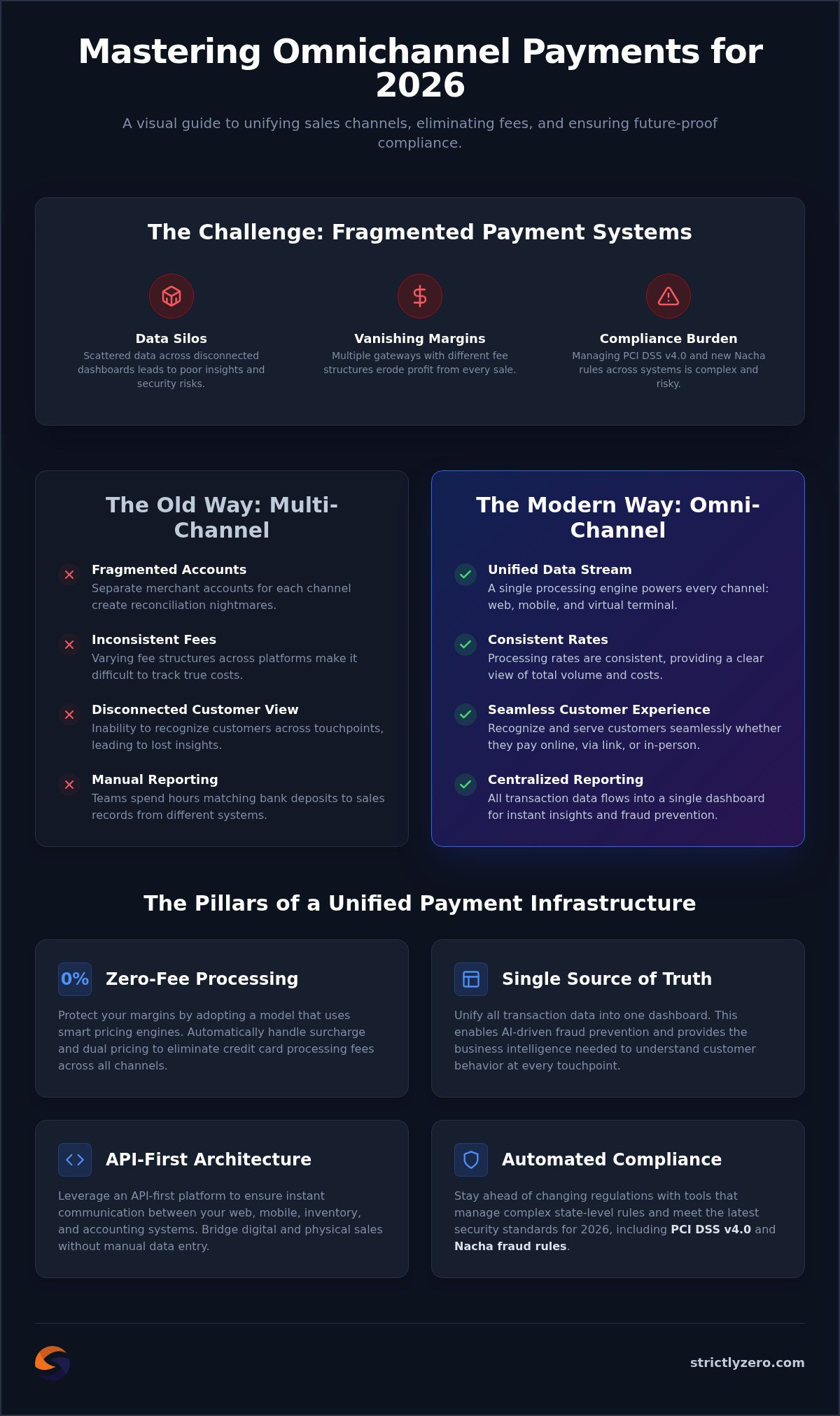
Many merchants confuse multi-channel with omnichannel. Multi-channel usually means you have several different merchant accounts, each with its own fee structure and reporting login. This setup creates reconciliation nightmares where your accounting team spends hours matching bank deposits to sales records. In contrast, omnichannel uses a single ecommerce payment processing engine to power every touchpoint. This integration eliminates data silos and ensures that your processing rates remain consistent across the board, providing a clear view of your total volume without the manual cleanup.
The Role of Unified Data in Merchant Trust
Trust is the most valuable currency in 2026. When your payment data lives in a single source of truth, it becomes much easier to spot anomalies and prevent fraud before it impacts your bottom line. AI-driven fraud prevention tools work best when they have access to your entire transaction history across all channels. This unified view doesn’t just reduce chargebacks; it also provides the business intelligence needed to understand customer behavior. By offering a consistent, secure payment experience whether the customer is at home or on the go, you build the kind of long-term loyalty that drives sustainable growth.
The Mechanics of a Unified Payment Infrastructure
Building a robust system for omnichannel payment processing requires more than just adding new buttons to your checkout page. It demands a technical foundation that treats every transaction as part of a single, continuous conversation with your customer. In 2026, this is achieved through an API-first architecture. This design allows different software environments to communicate instantly, ensuring that a payment made via a mobile app is immediately visible to your accounting and inventory systems. By leveraging modern credit card processing services, you can bridge the gap between digital and physical sales without the need for manual data entry or complex middleware.
Modern infrastructure also embraces the rise of social commerce and “text-to-pay” through secure payment links. These links allow you to meet customers exactly where they are, whether that’s in a direct message or a follow-up email. When combined with automated recurring billing, your payment system becomes a passive revenue engine. Customers can sign up for a subscription online, and your system handles the subsequent billing cycles across every touchpoint, maintaining a consistent experience that keeps churn low and lifetime value high. It’s about creating a frictionless path to purchase that works regardless of the device or location.
The Virtual Terminal: Your Digital Command Center
A virtual terminal is essential for businesses that handle phone, mail, or remote orders. It turns any web browser into a secure payment portal, allowing your team to process transactions without needing a physical website or a customer-facing checkout page. This tool is particularly powerful for 2026 compliance. By entering sensitive data directly into a cloud-based virtual environment, you significantly reduce your PCI scope. You don’t store the card data on your local devices; instead, it’s transmitted securely to the processor, keeping your business safe from common security vulnerabilities while keeping all your transaction data in one place.
API Integration for Custom Checkout Experiences
Developers and enterprise leaders prioritize API-first platforms because they offer the flexibility to build custom checkout flows that match a brand’s specific needs. At the heart of this flexibility is tokenization. This process replaces sensitive cardholder data with a unique, non-sensitive identifier called a token. This token can be used for future transactions or recurring billing across the entire omnichannel lifecycle without exposing the original data. If you’re looking for a way to streamline these complex integrations, you might want to explore how a unified API simplifies your payment stack. Maintaining broad gateway compatibility ensures you have the flexible routing needed to optimize transaction costs and improve authorization rates as you scale.
Eliminating Costs: The Zero-Fee Omnichannel Model
While most discussions around omnichannel payment processing focus on technical integration, the elephant in the room is the cost. Expanding to new channels often means aggregating fees from multiple gateways, which can quickly eat into your margins. Domestic online processing fees typically range from 1.5% to 3.49% per transaction. When you add international surcharges or the higher rates associated with card-not-present transactions, the convenience of unified commerce starts to feel like a financial burden. Most competitors assume the merchant must simply accept these fees as a cost of doing business, but that’s no longer the case.
The solution lies in the zero fee credit card processing revolution. By shifting the cost of processing to the consumer through compliant surcharging or dual pricing, merchants can reclaim 100% of their sale price. A key component of this is a Smart Pricing Engine. This technology automatically detects whether a customer is using a debit or credit card at the moment of entry. Since it’s illegal to surcharge debit cards, the engine ensures you only apply fees to credit transactions, keeping your business compliant without manual intervention across every sales channel.
Surcharging vs. Dual Pricing in 2026
Choosing the right model depends on your business structure. Surcharging adds a clear, compliant fee to credit transactions at the point of sale. This is often the preferred choice for B2B services where transaction values are high and clients expect professional fee disclosures. Dual pricing, on the other hand, displays two different prices: one for cash or low-cost methods and one for credit cards. This model is gaining massive traction in retail environments because it provides total transparency and incentivizes customers to choose the most cost-effective payment method for the merchant, effectively eliminating the merchant’s processing overhead.
Automated Compliance and State Regulations
Compliance isn’t a “set it and forget it” task. State laws in New York, Massachusetts, and Connecticut have historically had strict rules regarding how fees are disclosed and applied. By 2026, these regulations have become even more granular, requiring precise language and placement. An AI-driven compliance engine removes the guesswork by automatically adjusting checkout fees based on the customer’s geographic location. This ensures that your omnichannel payment processing remains legal across all state lines, protecting you from heavy fines while maintaining a transparent, trust-based relationship with your customers.
Implementing Omnichannel Strategy for Growth
Implementing a successful strategy for omnichannel payment processing starts with a thorough audit of your current touchpoints. You need to map out exactly how customers interact with your brand across the web, mobile apps, and in-person environments. For many merchants, this reveals a mess of disconnected systems that don’t talk to each other. When selecting a partner, look for a processor that supports credit card processing for small business with the ability to scale as your volume increases. You’ll need a virtual gateway that supports multi-user access with granular permissions, ensuring your team can process orders securely from any location without compromising sensitive data.
Training your staff is equally vital. If you’re moving to a zero-fee model, your team must be able to communicate dual pricing or surcharge structures clearly to customers. This transparency builds trust and prevents confusion at the point of sale.
Step 1: Unifying Your Payment Gateway
The first move is migrating away from legacy, siloed systems to a single API-driven platform. This consolidation allows you to manage every transaction through one login. You can set up payment links for instant invoicing, which is perfect for service-based sales or social media orders. Once the gateway is live, test the entire customer journey. A customer should be able to click an ad on their phone, receive a payment link via text, and then pick up their item in person with the transaction already reconciled in your central dashboard. This level of integration is what separates modern leaders from those struggling with manual reconciliation.
Step 2: Security and PCI Compliance
Security in 2026 isn’t optional; it’s a core operational requirement. Implementing end-to-end encryption across all channels ensures that cardholder data is protected from the moment it’s entered until it reaches the processor. With PCI DSS v4.0 requirements now fully mandatory as of 2025, your system should use AI-driven fraud prevention to monitor cross-channel patterns. These tools can flag a suspicious transaction on your website based on data gathered from your virtual terminal. Finally, ensure your surcharge program runs on an automated engine. This removes the risk of manual error and keeps you compliant with shifting state regulations without needing constant oversight.
If you’re ready to modernize your infrastructure and protect your margins, get started with a unified omnichannel platform today.
Why Strictly is the Ultimate Omnichannel Partner
Strictly isn’t just another service provider; it’s the underlying infrastructure that powers high-growth businesses. By bridging the gap between complex omnichannel payment processing and daily operational ease, the platform serves as a “Trust” layer for the entire payment lifecycle. Whether you’re an individual merchant or looking for one of the premier payment processing platforms for ISOs, the technology is built to handle the heavy lifting of 2026 compliance. This includes the “Smart Surcharge” guarantee, which ensures your business remains aligned with shifting state-level regulations and the June 2026 Nacha fraud rules without requiring constant manual updates.
The platform’s API-first design means you’re never locked into a rigid system. You can deploy virtual terminals, generate secure payment links, and manage recurring billing from a single, unified backend. This level of integration doesn’t just save time; it provides the data clarity needed to make informed scaling decisions. By removing the friction between different sales channels, you create a more resilient business model that’s prepared for whatever the future of commerce holds.
Tools for Merchants: Scaling to $0 Fees
The Strictly dashboard serves as your digital command center, simplifying multi-channel reporting into a single view. Merchants can access advanced features like AI-driven fraud prevention and POS lending directly through the platform, eliminating the need for fragmented third-party integrations. This partner-centric approach is designed to help you keep more of your hard-earned revenue. By leveraging the proprietary Smart Pricing Engine, you can automatically detect debit versus credit cards and apply the correct surcharge or dual pricing model. This allows you to scale toward a $0 processing fee model, turning a traditional overhead expense into a significant competitive advantage for your bottom line.
Tools for Partners: ISOs and Developers
For those building their own brands, Strictly offers robust white-labeling capabilities that allow you to provide a complete omnichannel experience under your own banner. ClearSplit™ revolutionizes how partners manage their business by automating complex residual compensation structures; this ensures everyone is paid accurately and on time without the need for manual spreadsheets. To help maintain a healthy portfolio, ChurnIQ™ provides advanced retention intelligence. This tool uses data patterns to identify at-risk accounts before they leave, allowing you to intervene proactively. It’s a comprehensive suite designed to help ISOs and developers scale their operations with confidence and transparency.
Building a Future-Proof Payment Infrastructure
Transitioning to a unified commerce model isn’t just about technical convenience; it’s about reclaiming your profit margins. By integrating your sales channels into a single data stream, you eliminate the reconciliation headaches and fragmented fees that stifle growth. Mastering omnichannel payment processing ensures your business stays resilient against shifting regulations and rising costs while providing the seamless experience your customers expect.
The right infrastructure does more than just move money. It protects your brand with AI-driven fraud protection and simplifies your operations with automated residual reporting. Whether you’re a merchant looking to scale or a partner managing a portfolio, you need a system that’s compliant in all 50 states and built for the demands of 2026. Don’t let processing fees eat into your success when a zero-fee model is within reach. It’s time to take control of your payment stack and focus on what really matters: growing your business.
Start Processing with $0 Fees Today and leverage tools like ClearSplit™ residual automation and AI-driven fraud protection. Your journey toward a more profitable, integrated future starts now.
Frequently Asked Questions
What is the difference between omnichannel and multichannel payments?
Multichannel payments treat each sales platform as a separate silo, often requiring different merchant accounts and separate logins for reporting. In contrast, omnichannel payment processing unifies these channels into a single, continuous data stream. This integration means your online transactions, mobile sales, and virtual terminal entries all live in one dashboard. This unified approach simplifies reconciliation and provides a holistic view of customer behavior across every touchpoint your business operates.
Is it legal to pass credit card processing fees to customers in all states?
It is legal to pass credit card fees to customers in most states, provided you follow specific disclosure rules and card brand requirements. However, federal law prohibits surcharging on debit cards. Strictly’s platform uses a proprietary Smart Pricing Engine to automatically detect debit cards and manage state-by-state compliance. Since regulations in states like New York or Connecticut can be complex, using an automated engine ensures you stay compliant without manual oversight.
How does a virtual terminal work for omnichannel businesses?
A virtual terminal is a web-based portal that allows you to process transactions manually without a physical card reader or a website checkout. For omnichannel businesses, it serves as a critical bridge for phone, mail, or remote orders. Because it’s integrated into your unified platform, these manual entries sync instantly with your online and mobile sales data. This keeps your financial reporting accurate and centralized in one secure location for easier management.
Can I use a surcharge program with an online store?
Yes, you can implement a surcharge program within an e-commerce environment using a compliant checkout engine. The system calculates the fee in real-time and displays it clearly to the customer before they finalize the purchase. This allows you to achieve a zero-fee model for online sales just as you would for in-person transactions. The key is using a gateway that can distinguish between credit and debit cards to ensure you remain legally compliant.
What security measures are required for omnichannel processing?
Omnichannel processing requires adherence to PCI DSS v4.0 standards, which became mandatory in 2025. Essential measures include end-to-end encryption and tokenization to protect sensitive data across every platform. Additionally, AI-driven fraud prevention monitors transaction patterns across your entire ecosystem. This helps identify suspicious activity on one channel based on data gathered from another, creating a much stronger security posture than siloed systems can provide for your business.
How do I sync my in-person sales with my online inventory?
Syncing happens through a unified API that connects your payment gateway with your inventory management software. When a transaction occurs via a virtual terminal or a payment link, the system updates your stock levels in real-time across all platforms. While Strictly doesn’t sell physical POS hardware, its API-first infrastructure allows your existing software to communicate seamlessly. This prevents overselling and ensures your reporting remains consistent across every sales channel you use.
What are the benefits of an API-first payment platform?
An API-first platform provides the flexibility to build custom payment experiences tailored to your specific business needs. It allows developers to integrate omnichannel payment processing directly into existing software stacks, mobile apps, or websites. This architecture supports rapid scaling and makes it easier to add new features, such as POS lending or automated partner residuals via ClearSplit™, without needing to overhaul your entire technical foundation or manage multiple vendors.
How does dual pricing differ from surcharging?
Surcharging involves adding a compliant fee to the total cost when a customer chooses to pay with a credit card. Dual pricing presents two separate prices for every item: a card price and a discounted price for cash or low-cost methods. While both models aim to eliminate merchant processing fees, dual pricing is often preferred in retail settings for its transparency. It clearly shows the benefit of choosing non-credit payment methods while keeping you compliant with state laws.