

What if the biggest threat to your business in 2026 isn’t a sophisticated cyberattack, but a compliance deadline you thought you already handled? While the transition to version 4.0 began years ago, the final set of future-dated PCI DSS 4.0 requirements becomes mandatory on March 31, 2026. It’s completely understandable if you feel overwhelmed by the shift toward a risk-based model or the new “Customized Approach.” Managing security across online, in-store, and mobile channels is a complex puzzle that often leads to valid fears of non-compliance fines and increased liability.
You don’t have to solve these technical hurdles alone or guess at your security status. This guide provides a clear, actionable checklist designed to help you master the complexities of the latest standards while protecting your bottom line. We’ll break down the essential 2026 updates, from 12-character password mandates to mandatory multi-factor authentication for all cardholder data access. You’ll also discover how choosing the right omni-channel payment processor can automate your security and significantly reduce your merchant burden. Let’s simplify your path to a secure and compliant future.
Key Takeaways
- Understand the shift from prescriptive rules to objective-based security controls to better defend against modern cyber threats.
- Master the mandatory PCI DSS 4.0 requirements for 2026, including 12-character password minimums and multi-factor authentication for all data access points.
- Learn how to maintain strict compliance while using a Smart Pricing Engine to manage surcharge and dual pricing programs across all sales channels.
- Follow a step-by-step process to identify your merchant level and map your cardholder data environment to minimize audit scope and risk.
- Discover how an API-first payment platform can reduce your technical burden by providing built-in security features that meet 4.0 standards out of the box.
What is PCI DSS 4.0 and Why is it Mandatory in 2026?
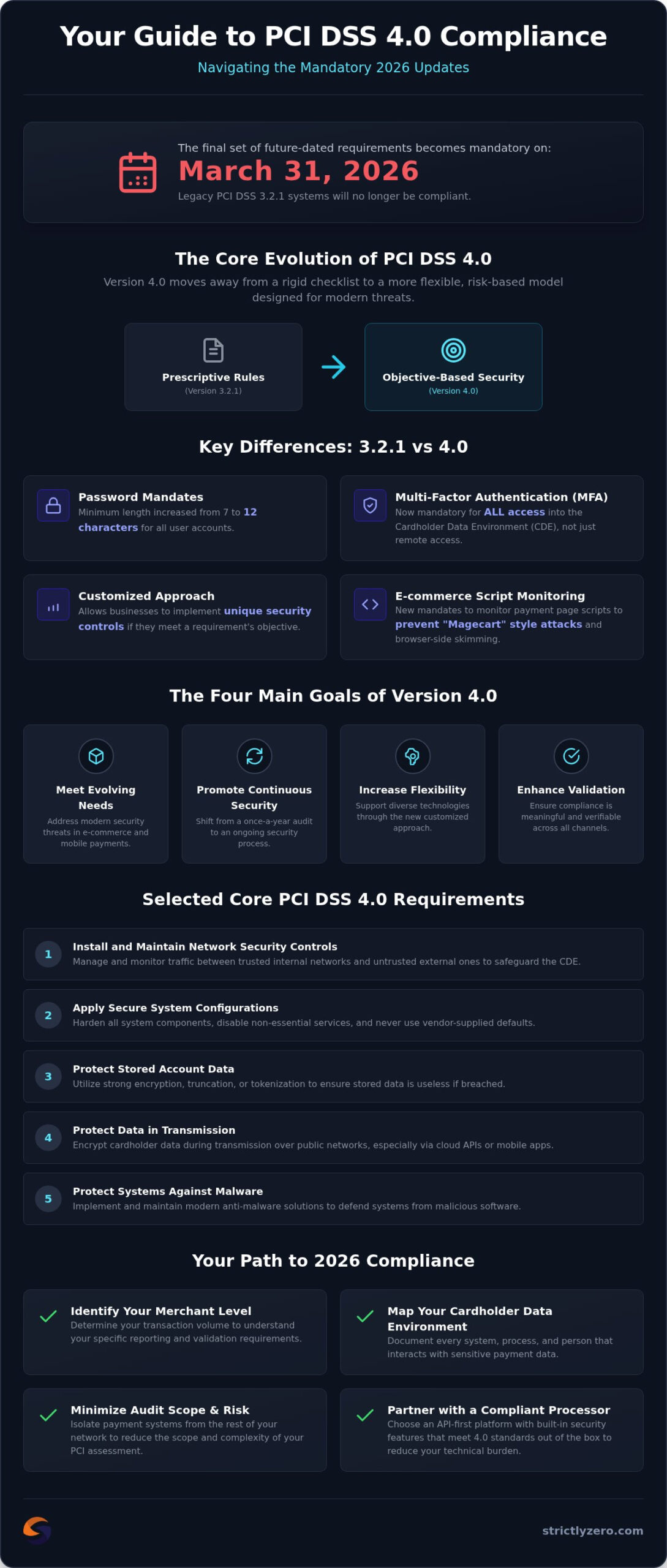
The Payment Card Industry Data Security Standard (PCI DSS) has entered its most significant evolution yet. Version 4.0 isn’t just a minor patch; it’s a complete overhaul of how businesses handle sensitive data. The PCI Security Standards Council designed these updates to address sophisticated threats that didn’t exist a decade ago. While the core framework went live in 2024, the clock is ticking. By March 31, 2026, the most rigorous future-dated PCI DSS 4.0 requirements become mandatory for every merchant. Relying on legacy 3.2.1 systems in 2026 is a high-risk gamble. These older systems often lack the automated defenses needed to stop modern, AI-driven fraud attempts that exploit gaps in older encryption methods.
This shift moves the industry from prescriptive rules to objective-based security. Instead of just checking a box, you must now prove that your security controls actually meet the intended goal. This flexibility is essential for omni-channel businesses using diverse tech stacks. Strictly’s platform is built to meet these 4.0 standards out of the box. Security isn’t static. By integrating AI-driven fraud prevention directly into the payment flow, merchants can stay ahead of the 2026 threat landscape without constant manual intervention.
The Four Main Goals of Version 4.0
Council leaders focused on four pillars to modernize the standard for a digital-first economy. First, it ensures the industry can meet evolving security needs as e-commerce and mobile payments grow. Second, it promotes security as a continuous, year-round process rather than a once-a-year audit headache. Third, it increases flexibility for organizations using different technologies through the new customized approach. Finally, it enhances validation methods to ensure compliance is meaningful and verifiable across all payment channels.
Key Differences Between PCI DSS 3.2.1 and 4.0
Version 4.0 introduces the “Customized Approach,” which allows innovative businesses to implement unique security controls as long as they meet the requirement’s objective. You’ll also face much stronger Multi-Factor Authentication (MFA) rules and a new 12-character minimum for passwords. MFA is now mandatory for all access into the cardholder data environment, not just for remote access. Additionally, new mandates for e-commerce script monitoring have been added to stop “Magecart” style attacks. Meeting these new PCI DSS 4.0 requirements helps you stay ahead of the compliance curve while protecting your customers from browser-side skimming.
The 12 Core PCI DSS 4.0 Requirements for Merchants
The 12 core requirements remain the structural backbone of compliance, but version 4.0 adds layers of technical scrutiny that didn’t exist previously. For a deep dive into the official language, consult the document library for The 12 Core PCI DSS 4.0 Requirements. These standards aren’t optional; they apply to every transaction method, from high-volume ecommerce payment processing to simple in-person sales. A primary goal for any merchant is to strictly define the Cardholder Data Environment (CDE). If a system doesn’t touch card data, it shouldn’t be in scope. Properly mapping this flow can significantly reduce the complexity of your annual assessment.
Building and Maintaining a Secure Network
Requirement 1 mandates the installation and maintenance of network security controls to safeguard the CDE. Network Security Controls serve as the primary digital barrier that manages and monitors traffic between trusted internal networks and untrusted external ones. Requirement 2 focuses on secure system configurations. It’s no longer enough to just change a password; you must ensure that all non-essential services are disabled and that every system component is hardened according to industry standards. Using vendor-supplied defaults is one of the most common ways businesses fail their initial audits.
Protecting Account Data and Vulnerability Management
Requirement 3 requires protecting stored account data through encryption, truncation, or tokenization. For 2026, the focus has shifted toward ensuring that even if a database is breached, the data remains useless to the attacker. Requirement 4 ensures this protection continues during transmission over public networks. This is a critical area for merchants who use cloud-based APIs or mobile payment apps to process transactions.
Requirement 5 involves protecting systems against malware. Modern anti-malware solutions must now be capable of detecting sophisticated threats that hide in memory or use legitimate system tools against the network. Requirement 6 focuses on maintaining secure systems and software. This includes a rigorous patching schedule where critical security updates are applied immediately. For businesses with custom-built checkout pages, this requirement also covers secure coding practices to prevent common web attacks. Navigating these PCI DSS 4.0 requirements becomes much simpler when your omni-channel payment processing partner handles the underlying infrastructure security for you.
Compliance for Omni-Channel and Surcharge Programs
Implementing a zero fee credit card processing model adds a layer of complexity to your security audit. To stay compliant with card brand rules and PCI DSS 4.0 requirements, merchants must use specific compliant hardware that accurately distinguishes between debit and credit cards in real time. Strictly’s Smart Pricing Engine handles this logic automatically, ensuring that surcharges are only applied to eligible credit transactions. This automation prevents manual errors that could lead to non-compliance or customer disputes. By using secure payment gateway integrations, our platform maintains data integrity across every sales channel, whether you’re processing a transaction in-store or taking a payment over the phone.
The PCI Security Standards Council emphasizes that security should be a continuous process, not a periodic event. This is especially true for omni-channel merchants who manage data across multiple touchpoints. Strictly’s infrastructure is designed to keep sensitive card data out of your local environment, effectively reducing the scope of your compliance burden. When your pricing engine and payment gateway work in tandem, you can offer flexible pricing models without creating new vulnerabilities in your network.
Multi-Factor Authentication (MFA) Mandates
One of the biggest shifts in the 2026 landscape is the expansion of MFA. Under version 4.0, MFA is required for all administrative access into the cardholder data environment, even if the user is on a local network. Strictly’s virtual terminal and merchant portal are built with these standards in mind, providing secure login protocols that protect your business from unauthorized access. For those looking for credit card processing for small business, these built-in security features are vital. They ensure that even smaller operations have enterprise-level protection without needing a massive IT department.
E-commerce Security: Monitoring Scripts and Skimming
Digital skimming has become a primary threat for online retailers. New PCI DSS 4.0 requirements mandate that merchants maintain an inventory of scripts running on their payment pages. You must also verify that these scripts are authorized and have not been tampered with. Strictly helps solve this through AI-driven fraud prevention that monitors for suspicious activity and unauthorized changes to payment forms. Whether you use hosted checkout pages or direct payment links, our system provides the visibility needed to prevent browser-side attacks. This proactive approach ensures your customers’ data stays safe from the moment they enter their card details.
Your 2026 PCI DSS 4.0 Compliance Checklist
Moving from the theory of PCI DSS 4.0 requirements to actual implementation requires a structured workflow. The first step is identifying your Merchant Level. These levels, ranging from 1 to 4, are based on your annual transaction volume. While Level 1 merchants processing over 6 million transactions annually require an on-site assessment by a QSA, most small to mid-sized businesses fall into Levels 2 through 4, which typically allow for a Self-Assessment Questionnaire (SAQ). Once you know your level, you must map your data flow to define your Cardholder Data Environment (CDE). If you don’t know exactly where card data enters, travels, and sits within your network, you can’t accurately secure it.
After mapping your data, choose the correct SAQ for your business model. For example, SAQ A is common for merchants who fully outsource their e-commerce payments, while SAQ D is the “catch-all” for those who don’t fit other categories. Conduct a thorough gap analysis to see where your current systems fall short of the 4.0 standards. Finally, implement the necessary technical controls. This includes enforcing 12-character minimum passwords, enabling multi-factor authentication for all system access, and ensuring all stored data is encrypted using industry-standard protocols.
Operational and Administrative Tasks
Compliance isn’t just a technical fix; it’s an administrative commitment. You must assign a dedicated security lead to oversee these policies and ensure they’re documented properly. Version 4.0 introduces a stronger focus on the human element, requiring merchants to train employees on phishing and social engineering risks. Additionally, you’re required to perform quarterly vulnerability scans using an Approved Scanning Vendor (ASV). These scans identify external weaknesses in your network that attackers could exploit before they become a breach.
Validation and Reporting
The final phase involves completing your Attestation of Compliance (AOC). This document is your formal declaration that you’ve met all necessary security standards. You’ll need to submit this documentation to your acquiring bank or your provider of credit card processing services to maintain your standing. Remember that compliance isn’t a one-time event. Establish a recurring schedule for annual re-validation to ensure your security posture remains strong as new threats emerge in the 2026 landscape. If you’re ready to simplify this process, partner with a processor that builds compliance into the platform.
How Strictly Simplifies PCI 4.0 for Merchants and ISOs
Strictly functions as an API-first platform designed to absorb the technical burdens of modern compliance. By offloading sensitive data handling to our secure infrastructure, you can drastically reduce the scope of your Cardholder Data Environment (CDE). This is a critical advantage because a smaller CDE means fewer systems to audit, lower costs, and a faster path to validation. When you choose the best credit card processing for small business, you shouldn’t have to worry about the underlying encryption or network segmentation. Our omni-channel systems ensure that whether a customer pays online or via a virtual terminal, the data remains protected by enterprise-grade security that meets all PCI DSS 4.0 requirements out of the box.
For Independent Sales Organizations (ISOs), the platform offers more than just security. Tools like ChurnIQ™ and ClearSplit™ allow partners to manage portfolios and automate compensation within a fully compliant ecosystem. This allows ISOs to focus on growth rather than technical debt. By leveraging our pre-built compliance framework, partners can provide their merchants with a seamless experience that balances zero-fee processing with top-tier data protection. This unified approach eliminates the friction often found in fragmented payment stacks.
AI-Driven Security and Fraud Prevention
Requirement 10 of the standard focuses on logging and monitoring all access to network resources and cardholder data. Strictly’s AI-driven fraud prevention automates this process by monitoring for anomalous behavior in real time, far exceeding the capabilities of manual log reviews. AI-native security stops breaches before they require a forensic audit. This proactive approach identifies suspicious patterns, such as unusual login locations or rapid-fire transaction attempts, and flags them instantly. By automating these PCI DSS 4.0 requirements, we provide a continuous security posture that protects your brand’s reputation without constant manual oversight.
Partnering for Success
ISOs face the unique challenge of maintaining security across a diverse merchant base. Strictly provides a unified platform that maintains consistent security standards across mobile, in-person, and online sales channels. This consistency is vital for preventing weak links in the payment chain. When ISOs use our infrastructure, they’re offering their clients a robust, future-proof solution that adapts to regulatory shifts automatically. If you’re ready to grow your portfolio without the compliance headaches, it’s time to Partner with Strictly to scale your payments business securely and lead the zero-fee revolution.
Future-Proof Your Payments Strategy for 2026
The shift toward version 4.0 represents more than just a set of technical checkboxes; it’s a fundamental move toward a more resilient foundation for your business. By mastering the 12 core pillars and following a structured checklist, you can transform a complex regulatory hurdle into a genuine competitive advantage. The March 31, 2026, deadline for the remaining future-dated PCI DSS 4.0 requirements is approaching quickly. You don’t have to manage this technical transition alone or risk the financial penalties that come with non-compliance.
Our omni-channel unified platform integrates AI-Driven Fraud Prevention and a Smart Pricing Engine to handle these compliance hurdles automatically. This allows you to focus on scaling your operations while we manage the security heavy lifting. It’s time to eliminate fees and automate compliance with Strictly. With the right partner by your side, you can navigate the 2026 landscape with total confidence and keep your customer data safe. Your path to a secure, zero-fee future starts today.
Frequently Asked Questions
What is the deadline for PCI DSS 4.0 compliance?
The final deadline for all future-dated PCI DSS 4.0 requirements is March 31, 2026. While the core version 4.0 standard became mandatory in early 2025, specific advanced controls were granted an extended timeline for implementation. Businesses must have these final security measures, such as 12-character passwords and automated script monitoring, fully implemented and validated before this date to avoid non-compliance penalties and increased transaction fees.
Does PCI DSS 4.0 apply to small businesses with low transaction volumes?
Yes, the standard applies to every business that accepts credit or debit cards, regardless of size or transaction volume. Small businesses typically fall into Merchant Level 4, which allows for a simplified Self-Assessment Questionnaire. Even if you only process a few transactions each month, you’re still responsible for protecting cardholder data. You must validate your compliance status annually to protect your business from legal liability and potential data breach costs.
What happens if my business is not PCI 4.0 compliant in 2026?
Non-compliant businesses face significant financial and operational risks, including monthly fines from card brands and increased transaction fees. In the event of a data breach, a non-compliant merchant is often held liable for all forensic audit costs, card replacement fees, and legal settlements. Beyond the immediate costs, your acquiring bank may eventually terminate your merchant account. This effectively ends your ability to accept card payments and can damage your reputation permanently.
How does the “Customized Approach” in PCI 4.0 work?
The Customized Approach allows businesses to implement innovative security controls that meet the specific objective of a requirement without following the standard’s prescriptive methods. This is ideal for companies using modern technology that doesn’t fit traditional security models. To use this path, you must document your specific control and prove to a Qualified Security Assessor that it provides a level of protection equivalent to the original requirement. It offers flexibility for complex omni-channel environments.
Is MFA mandatory for all employees under PCI 4.0?
Multi-factor authentication (MFA) is mandatory for any individual accessing the cardholder data environment, not just IT administrators or remote workers. This includes any employee who logs into a system that handles, stores, or transmits payment data. Implementing MFA across your entire network is one of the key PCI DSS 4.0 requirements that becomes strictly enforced in 2026. This layer of security is designed to prevent unauthorized access resulting from stolen or weak credentials.
Can my payment processor handle all PCI 4.0 requirements for me?
No processor can handle every single requirement, but a partner like Strictly can significantly reduce your compliance scope. While we manage the technical security of the transaction flow and data encryption, you remain responsible for internal policies, staff training, and physical security. Using our API-first platform ensures that the most complex technical PCI DSS 4.0 requirements are met out of the box. This simplifies your annual validation process and keeps your data environment secure.
How often do I need to perform vulnerability scans under the new standard?
Merchants must perform external vulnerability scans at least once every 90 days using a PCI-Approved Scanning Vendor. You must also conduct these scans whenever a significant change occurs in your network, such as installing new hardware or upgrading payment software. Maintaining a passing scan record is a critical component of your annual attestation. It helps identify potential entry points for attackers before they can be exploited, ensuring your network remains hardened against modern threats.
What is the difference between an SAQ and an AOC?
A Self-Assessment Questionnaire is the actual tool used to evaluate your compliance with the standard, containing a series of security questions tailored to your merchant level. The Attestation of Compliance is the formal document where you declare the results of that assessment. You submit the completed attestation to your payment processor or acquiring bank as formal proof that you’ve successfully met the necessary security standards. Both documents are required for a complete compliance filing.