

Most payment integrations are built on a house of cards that could collapse the moment a transaction crosses state lines into Connecticut or Maine. Implementing a surcharge compliance API isn’t just about adding a fee. It’s about building a real-time regulatory engine that understands the difference between a 3% Visa credit cap and a 2% Colorado state limit. You’ve likely felt the headache of trying to distinguish debit from credit cards programmatically or worrying about the heavy fines that come with non-compliant surcharging.
We’ve reached a point where manual logic can’t keep up with 50 different state laws and shifting card brand rules. You need a reliable way to automate compliance without ruining the customer’s checkout experience. This guide shows you how to integrate a surcharge compliance API to eliminate merchant processing fees while staying 100% compliant with current regulations. We’ll explore the technical logic required to automate these decisions, from using a Smart Pricing Engine for debit detection to managing disclosure requirements at the point of sale.
Key Takeaways
- Identify the latest state-level restrictions and card brand rules to ensure your payment flow meets 2026 regulatory standards.
- Automate the critical distinction between debit and credit cards using a robust surcharge compliance API to prevent illegal fees.
- Implement dynamic fee calculations and automated disclosure messaging to keep your checkout process transparent and compliant.
- Minimize development overhead and PCI scope by utilizing hosted fields and secure tokenization during the integration process.
- Leverage the Smart Pricing Engine and ClearSplit™ to scale zero-fee models across ISO and SaaS platforms efficiently.
The Regulatory Landscape of Surcharge Compliance in 2026
Understanding The Regulatory Landscape of Surcharge Compliance requires looking at a patchwork of rules that change the moment a transaction crosses state lines. In 2026, surcharging isn’t just a binary choice for a business. It’s a complex intersection of the Durbin Amendment, which protects debit transactions from added fees, and evolving state statutes. For developers, this means the logic inside your surcharge compliance API must be dynamic enough to block fees on every debit card, regardless of how the customer tries to route the payment.
Manual compliance is no longer a viable strategy for multi-state merchants. Laws change, court rulings flip-flop, and card brands update their merchant monitoring programs without much fanfare. Trying to hardcode these rules into a checkout flow creates a massive technical debt and a high risk of regulatory fines. An API bridges the gap between static code and shifting laws by acting as a real-time compliance filter that evaluates every transaction before it’s authorized.
The 2026 State Map: Where Surcharging Stands
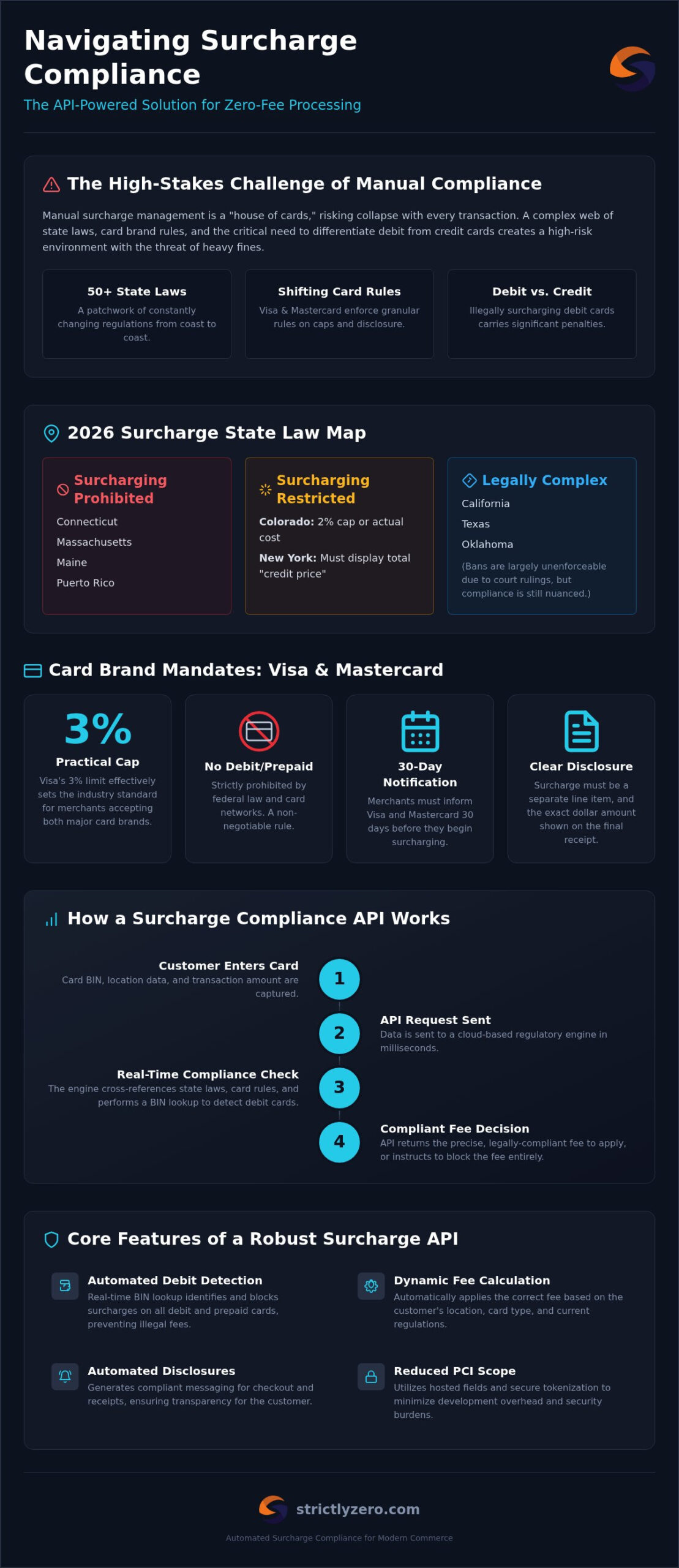
While most of the U.S. allows surcharging, a few key holdouts remain. Connecticut, Massachusetts, and Maine maintain active, enforced bans on credit card surcharges. Puerto Rico also prohibits these fees. Other states like California, Texas, and Oklahoma have bans on their books that federal court rulings have made largely unenforceable, but the compliance burden hasn’t vanished. In states like Colorado, the law caps surcharges at 2% or the merchant’s actual cost of card acceptance, whichever is lower. New York requires merchants to display the total “credit price” upfront rather than simply adding a percentage at the end. The regulatory ceiling represents the maximum allowable percentage a merchant can legally charge a customer to cover credit card processing costs without exceeding state or network limits.
Card Brand Requirements: Visa and Mastercard Rules
Card networks enforce their own set of hurdles that developers must account for in the UI. You can’t just flip a switch; merchants must provide a 30-day notification to Visa and Mastercard before they start surcharging. Once active, the rules for digital checkouts are strict. Your interface must mirror physical signage requirements by showing the surcharge as a clear, separate line item before the customer clicks the final pay button.
- 3% Practical Cap: While Mastercard technically allows a 4% cap, Visa’s 3% limit effectively sets the standard for any merchant that accepts both brands.
- Debit and Prepaid Prohibition: It’s illegal to surcharge any debit or prepaid card transaction. This is a non-negotiable rule enforced by the card networks and federal law.
- Disclosure Logic: The exact dollar amount of the fee must appear on the final receipt provided to the customer, not just a general notification of the percentage.
Because these rules are so granular, a surcharge compliance API is the only way to ensure every transaction remains within legal bounds. It moves the regulatory burden from your local source code to a dedicated engine that updates in real-time as state and network policies evolve.
How a Surcharge Compliance API Works Under the Hood
A surcharge compliance API operates in the narrow window between a customer entering their card details and the final transaction authorization. Speed is king here. If the logic takes more than a few hundred milliseconds to execute, checkout friction spikes and conversion rates drop. The engine acts as a real-time gatekeeper, receiving a request that typically includes the card’s Bank Identification Number (BIN), the transaction amount, and the customer’s location data. It then queries a cloud-based regulatory database to determine if a fee is legally permitted and what the specific cap should be for that exact scenario.
For developers, the goal is to move the regulatory burden away from the local application logic. By using a cloud-based database, the API ensures that any sudden changes in state laws or card brand rules are applied instantly across all checkouts. You don’t have to push a code update every time a state legislature adjusts its pricing transparency requirements; the API handles the heavy lifting in the background.
Automated BIN Lookup and Debit Detection
The most critical step in the logic flow is distinguishing credit cards from debit cards. Under federal law, surcharging debit or prepaid cards is strictly prohibited, regardless of whether the customer chooses to process the transaction as “credit” at the terminal. A surcharge compliance API performs an automated BIN lookup on the first 6 to 8 digits of the card number to identify the funding source. This real-time identification is a significant technical hurdle because card networks frequently update their BIN ranges. By offloading this check to a Surcharge & Dual Pricing Engine, you ensure that illegal fees are blocked before they can trigger a network violation or a heavy fine.
Geo-IP Logic and State-Level Enforcement
Location-based compliance adds another layer of complexity to the request. The API uses Geo-IP data or the customer’s billing address to determine which state’s laws apply. This solves the “Nexus” problem, where a merchant based in a surcharge-friendly state like Florida might be selling to a customer in a restricted state like Connecticut or Maine. If the API detects a transaction originating in a restricted jurisdiction, it automatically suppresses the surcharge to maintain compliance.
In regions where surcharging is restricted or capped, a robust API will offer an automated fallback to Dual Pricing. This allows the merchant to present two distinct prices to the customer, one for cash and one for card. Since Dual Pricing is legally distinct from surcharging, it remains a viable way to offset costs in all 50 states. The API manages this transition seamlessly, ensuring the checkout UI updates with the correct pricing labels without manual intervention from the developer.
Core Features of a Robust Surcharge API
A high-performance surcharge compliance API doesn’t just calculate a flat percentage. It serves as an intelligent layer that pulls real-time interchange data to ensure the merchant never charges more than the actual cost of acceptance. This is crucial because overcharging isn’t just a bad customer experience; it’s a violation of card brand rules that can lead to account termination. The API should also return pre-formatted disclosure text that developers can drop directly into their checkout UI. This ensures the legal language is always current and matches the specific requirements of the customer’s state without requiring manual updates.
Beyond the transaction itself, robust reporting is essential for fee reconciliation. Merchants need to see a clear breakdown of the base price, the surcharge amount, and the final total. This data must be accessible across all platforms, including web checkouts, mobile apps, and back-office tools. By integrating a surcharge compliance API, developers can ensure that every platform follows the same regulatory logic, creating a unified experience for both the business and its customers.
Surcharging vs. Dual Pricing Logic
Technical implementation differs significantly between these two models. Surcharging adds a fee at the final stage of checkout after the card type is identified. Dual Pricing, however, requires the API to return two distinct prices (cash and card) for every item in the cart from the beginning of the session. A Smart Pricing Engine will programmatically recommend Dual Pricing when it detects a transaction in a restricted state or when the merchant wants to eliminate fees on all card types, including debit. To understand which model fits your business goals, check out Surcharging vs. Dual Pricing: Which is Right for You?
Virtual Terminal Integration for Service Businesses
Compliance isn’t just for e-commerce carts. Service-based businesses often use a Virtual Terminal to key in card details for over-the-phone payments or professional services. The API must apply the same BIN lookup and state-level logic to these keyed-in transactions to prevent illegal surcharges on debit cards. This ensures that even back-office staff stay within the lines of the law without needing to be regulatory experts. For more on how to secure these workflows, see Virtual Terminal: Process Payments Without a Website.
Integration Best Practices for Developers
Integrating a surcharge compliance API should simplify your workflow, not increase your security burden. To minimize PCI scope, developers should prioritize using hosted fields and tokenization. By ensuring the raw card data never touches your servers, you reduce the complexity of annual compliance audits. Your integration should focus on capturing the card’s Bank Identification Number (BIN) early in the checkout process to trigger the necessary compliance checks before the customer reaches the final payment button.
Success in production requires rigorous testing in a sandbox environment. You must simulate a wide variety of scenarios, including transactions from restricted states like Connecticut and the use of various card types. Testing should verify that the API correctly identifies a debit card and suppresses the surcharge, while also confirming that credit card transactions from states like Colorado are capped at the legal 2% limit. Version control is equally vital; as card brands and state legislatures update their rules, your API should handle these shifts via the cloud, though you must ensure your local UI can handle updated disclosure strings without breaking the layout.
Designing a Compliant Checkout UI
Card brand rules are specific about where and how fees are disclosed. The surcharge must be presented as a separate line item, and the disclosure text must be visible before the user completes the transaction. A common mistake is showing the fee only on the final confirmation page. Instead, your UI should update in real-time. If a user starts with a credit card and switches to a debit card, the surcharge line item must vanish instantly. This dynamic feedback prevents “sticker shock” and ensures you aren’t violating network rules by presenting a fee that no longer applies to the selected payment method.
Error Handling and Compliance Guardrails
A robust surcharge compliance API acts as a fail-safe for your business. If a transaction request attempts to apply a fee that exceeds the 3% Visa cap or a specific state’s regulatory ceiling, the API should return a compliance block. Your code must handle these responses gracefully by explaining to the user (or the back-office staff) why the fee was adjusted or blocked.
Graceful degradation is a critical consideration for high-volume environments. If the BIN lookup service or the regulatory database becomes unreachable, the safest default is to process the transaction without a surcharge. It’s better to absorb a single processing fee than to risk a non-compliant transaction that could lead to heavy fines. For long-term protection, ensure your system logs every compliance decision, providing an audit trail that proves you performed the necessary checks for every transaction. To start building these guardrails into your platform, explore the developer documentation for our Smart Pricing Engine.
Scaling with Strictly’s Smart Pricing Engine
Strictly’s Smart Pricing Engine is more than just a calculation tool. It’s a scalable infrastructure designed for platforms that need to bake compliance directly into their product. While many providers push a standard fee model that eats into merchant margins, an API-first approach allows SaaS platforms and ISOs to offer a zero-fee model that actually sticks. By integrating a surcharge compliance API, you move from being a simple payment gateway to a regulatory partner. This shift reduces churn significantly. Merchants rarely leave a platform that has successfully eliminated their processing overhead while keeping them on the right side of state laws.
Scaling a payments business also requires managing the money behind the scenes. Strictly provides ClearSplit™ for automated partner residuals, ensuring that compensation flows correctly without manual spreadsheet work. This is vital as we move through 2026, where the complexity of local rules in states like Maine or New York makes automated oversight a necessity rather than a luxury. You can also leverage ChurnIQ™ for retention intelligence, using data to identify which merchants are most likely to stay or leave based on their fee structures. You’ll future-proof your stack by offloading the legal monitoring to the engine, allowing your team to focus on core product features instead of tracking legislative sessions.
The ISO and Partner Advantage
For ISOs, the ability to white-label a compliance engine is a massive competitive differentiator. You can offer “Zero Fee” processing as a core part of your value proposition, positioning your brand as the expert in high-margin merchant services. This isn’t just about saving money. It’s about providing a professional, compliant experience that builds long-term trust. When you white-label the engine, the customer sees your brand as the source of their savings. To see how this fits into a broader growth strategy, read about The Ultimate Payment Processing Platform for ISOs.
Getting Started with the Strictly API
Moving from a concept to a live integration is streamlined through a developer-first portal. You’ll start by accessing comprehensive documentation and generating your sandbox keys to test the logic flow we’ve covered in previous sections. Before flipping the switch to production, you’ll go through a compliance checklist that verifies your UI disclosures and BIN lookup logic. This ensures that every transaction, whether it’s via a web checkout or a virtual terminal, meets the 2026 standards for transparency and network rules. Once you’re ready, you can Scale your payments business with Strictly’s API and start deploying zero-fee models across your entire merchant portfolio.
Future-Proof Your Payments Strategy
Building a zero-fee payment model requires more than just adding a fee to a checkout page. It demands a technical foundation that can navigate the shifting sands of state laws and network regulations in real-time. By implementing a robust surcharge compliance API, you protect your business from heavy fines while providing the transparency customers expect. You’ve seen how automated BIN detection and Geo-IP logic can turn a regulatory nightmare into a seamless, hands-off workflow that scales without manual intervention.
Scaling your platform shouldn’t mean increasing your legal liability or technical debt. With Strictly, you gain access to a PCI Level 1 Compliant Infrastructure and the Smart Pricing Engine™ to automate every compliance decision. Whether you’re managing partner residuals through ClearSplit™ or optimizing your own checkout, the right tools make all the difference in a competitive market. It’s time to stop worrying about the fine print and start focusing on your next big feature. Eliminate fees with Strictly’s Surcharge Compliance API and build a more profitable, compliant future today.
Frequently Asked Questions
Is a surcharge compliance API legally required?
No law mandates the use of an API, but it’s the only practical way to ensure 100% compliance across different jurisdictions. With states like Connecticut and Maine enforcing strict bans and Colorado capping fees at 2%, manual tracking is a liability. Using a surcharge compliance API automates these checks in real-time. It prevents you from accidentally violating network rules or state statutes that could lead to heavy fines.
How does an API distinguish between a debit and credit card?
The API uses a real-time Bank Identification Number (BIN) lookup to identify the card’s funding source. It analyzes the first six to eight digits of the card number before the transaction is authorized. Since surcharging debit cards is illegal under federal law and card network rules, this check is critical. If the BIN identifies the card as debit or prepaid, the engine automatically blocks the fee to maintain strict regulatory compliance.
Can I surcharge more than 3% if the API allows it?
You shouldn’t exceed the 3% cap enforced by major card networks like Visa. While some platforms might technically permit higher settings, doing so violates merchant agreements and can lead to account termination. Most robust APIs include guardrails that automatically cap the fee at 3% or the merchant’s actual cost of acceptance, whichever is lower. This ensures you stay within the regulatory ceiling and avoid penalties from the card brands.
What happens if I process a surcharge in a prohibited state?
Processing a surcharge in prohibited states like Connecticut, Massachusetts, or Maine can result in significant legal penalties and merchant account suspension. State attorneys general actively monitor for these violations. The system prevents this by using Geo-IP or billing address data to detect the transaction’s origin. If it identifies a restricted jurisdiction, it suppresses the fee or suggests a compliant alternative like dual pricing to keep the merchant safe.
Does the API handle the registration with Visa and Mastercard?
While the API manages the technical logic, the merchant is still responsible for notifying the card networks 30 days before they begin surcharging. Some integrated platforms facilitate this notification process through their onboarding workflows. It’s a critical step that ensures you’re officially registered to pass on fees. Once registered, the API takes over the daily burden of enforcing the specific signage and disclosure rules required by the networks.
How do I integrate surcharging into a mobile app via API?
You can integrate surcharging into a mobile app by using an API-first architecture that supports hosted fields or secure tokenization. This approach keeps sensitive card data off your mobile environment while still allowing for real-time BIN lookups. The app sends the transaction metadata to the engine, which returns the compliant fee amount and disclosure text. This ensures the mobile checkout experience remains as compliant as a standard web based or virtual terminal transaction.
Can I use a surcharge API for international transactions?
Most surcharge compliance APIs focus on U.S. regulations because international laws vary wildly. For instance, the UK and EU have broad bans on surcharging for most consumer credit cards. If you’re processing global payments, the API must be configured to recognize the customer’s country and apply the appropriate local restrictions. In many cases, the engine will simply disable surcharging for international cards to avoid violating cross-border payment regulations or network rules.
What is the difference between a surcharge API and a standard payment gateway?
A standard payment gateway simply moves transaction data from the merchant to the processor. In contrast, a surcharge compliance API adds a layer of intelligent logic to the transaction flow. It performs real-time checks for card type, state laws, and network caps before the payment is finalized. While a gateway might just process whatever amount it’s given, the surcharge engine ensures that the amount itself is legally calculated and properly disclosed.