

Why are you still paying a premium just because your customer is on the other end of a phone line? For years, MOTO payment processing has been treated as a high-cost “necessary evil” by merchants who dread the interchange rates and the PCI compliance headaches that come with manual data entry. You likely feel that phone and mail orders are a clunky, expensive outlier compared to your slick online checkout. It’s frustrating to watch your margins shrink just because a transaction isn’t happening face-to-face.
This guide will show you how to flip that script. You’ll learn how to master the complexities of Mail Order/Telephone Order payments and use a secure virtual terminal to eliminate processing fees entirely. We’ll explore the 2026 standards for state-by-state surcharge compliance, how to automate your security to stop fraud before it happens, and the steps to unify your phone sales with your digital reporting for a truly omni-channel experience. By the end of this article, you’ll have a clear roadmap to turn your phone orders into a streamlined, zero-cost revenue stream that fits perfectly into your existing business model.
Key Takeaways
- Identify how modern phone and mail orders integrate into a unified omni-channel sales strategy to reach more customers.
- Secure your transaction flow and protect sensitive data by utilizing a PCI-compliant Virtual Terminal for all manual entries.
- Discover how to combat rising interchange rates and high Card-Not-Present fees inherent in MOTO payment processing.
- Streamline your back-office operations by syncing phone sales with your CRM and accounting tools for accurate, unified reporting.
- Leverage a Smart Pricing Engine to automate state-by-state surcharge compliance and effectively reduce your processing costs to zero.
What is MOTO Payment Processing in 2026?
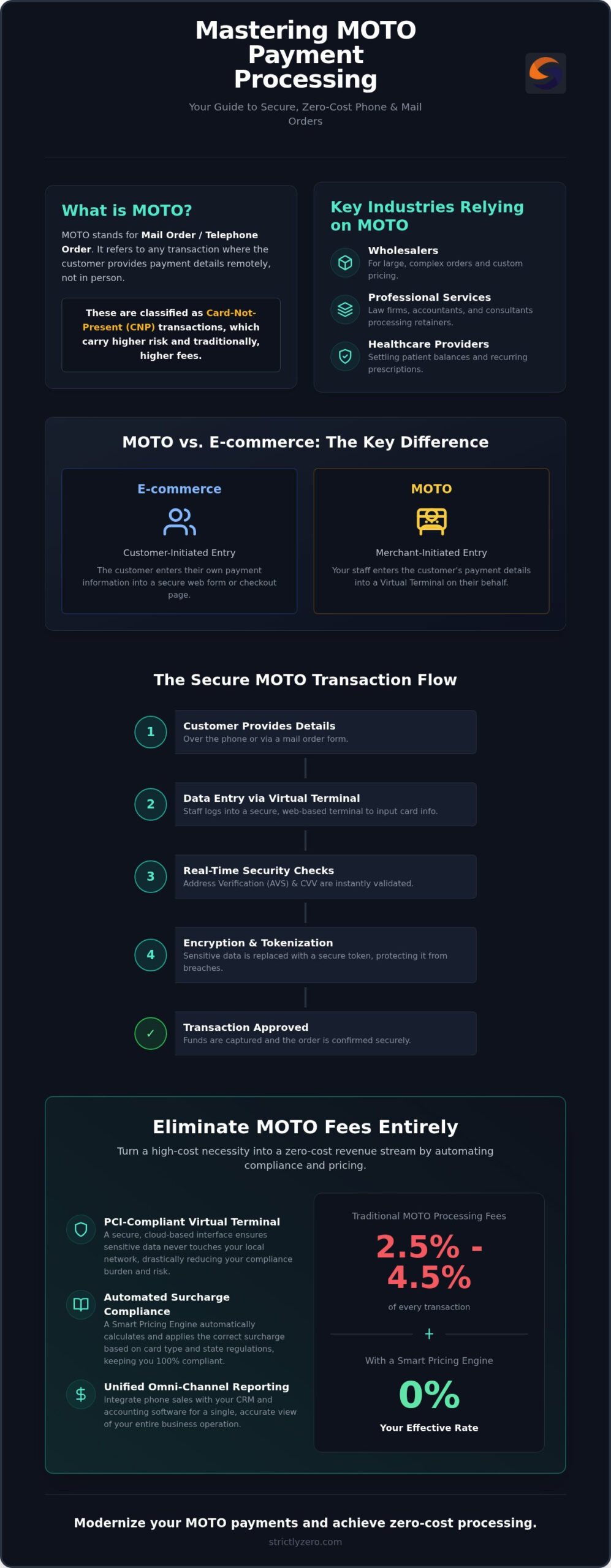
MOTO payment processing is a term that refers to Mail Order and Telephone Order transactions. While it might sound like a relic from the catalog era, it’s actually a cornerstone of modern omni-channel commerce. In 2026, successful businesses don’t just sell through a website or a physical storefront; they meet customers wherever they are. For many buyers, that’s still over a phone call or through a mailed-in order form. Because the physical credit card isn’t present at the point of sale, these are classified as Card-Not-Present (CNP) transactions. This classification matters because it dictates the specific security protocols and interchange fees you’ll encounter.
Specific industries rely heavily on this model to maintain their daily operations. These include:
- Wholesalers: Often take large, complex orders over the phone to ensure inventory accuracy and custom pricing.
- Healthcare Providers: Use phone payments to settle balances with patients who aren’t in the office or to process recurring prescriptions.
- Professional Services: Law firms, accountants, and consultants find it’s the most efficient way to process retainers or invoice payments without requiring a client to navigate a complex web portal.
The Evolution of Mail and Phone Orders
The way we handle these orders has shifted dramatically over the last few years. We’ve moved away from physical paper trails and carbon copies that were once industry standards. Today, digital invoicing and secure payment links augment traditional MOTO workflows. Instead of writing down card numbers on sticky notes, staff use secure digital vaults that tokenize information instantly. This shift protects the business from data breaches while maintaining the “human touch” that many high-value clients still prefer. A phone call allows for real-time upsells and personalized service that a standard e-commerce checkout simply can’t replicate. It bridges the gap between digital efficiency and personal connection.
MOTO vs. E-commerce: Key Differences
The primary distinction between MOTO and standard e-commerce is who initiates the data entry. In e-commerce, the customer types their own information into a web form. In MOTO, the merchant enters the data. This merchant-initiated entry changes the risk profile significantly. Banks and processors often view MOTO as higher risk because your employees are handling sensitive payment data directly. To manage this risk and maintain PCI compliance, a dedicated Virtual Terminal is essential. It provides a secure, encrypted interface for your team to input details without the data ever touching your local network. Modern systems also integrate AI-driven fraud prevention to verify these manual entries in real-time, providing a layer of trust that manual spreadsheets lack.
How MOTO Transactions Work: A Step-by-Step Security Guide
MOTO payment processing follows a specific flow that prioritizes security at every touchpoint. It starts when your customer provides their card details over the phone or through a mail-in form. Instead of using a physical card reader, your team logs into a secure Virtual Terminal. This web-based interface acts as a gateway, encrypting the data the moment it’s entered. Once submitted, the system performs real-time checks, including Address Verification Service (AVS) and Card Verification Value (CVV) validation. These steps are vital for MOTO because they confirm the person on the phone actually possesses the card and resides at the billing address provided.
To keep your business safe, modern systems use tokenization. This process replaces sensitive card numbers with a unique digital identifier, or “token.” If a breach ever occurred, the stolen tokens would be useless to hackers. By using a PCI-compliant Virtual Terminal, you ensure that sensitive data never touches your local servers, significantly reducing your security liability. This approach transforms a potentially risky manual process into a hardened, digital workflow that protects both your reputation and your revenue.
PCI DSS Compliance for Phone Orders
Securing phone orders requires a shift in office culture. One of the biggest risks is the temptation to write credit card numbers on paper scraps or sticky notes. To stay compliant, you must implement a “Clean Desk” policy. This means employees shouldn’t have pens, paper, or even personal smartphones at their workstations while handling payments. Using a cloud-based Virtual Terminal helps by keeping the entire transaction within a secure, encrypted environment. This setup simplifies your annual PCI self-assessment because you aren’t storing or transmitting data through your own internal network.
Managing Staff Access and Permissions
Accountability is key when multiple employees handle customer data. You should set up a multi-user hierarchy that gives each sales representative their own unique login credentials. This creates a clear audit trail, allowing you to track exactly who processed which MOTO transaction and when. If an issue arises, you won’t be left guessing which staff member was involved. This visibility is also essential for reconciling daily sales reports and managing commissions across your team.
Least Privilege access ensures that staff members only have the specific permissions required to perform their job functions, minimizing the risk of unauthorized data exposure.
The High Cost of MOTO: Why Interchange Rates Are Rising
MOTO payment processing is often the most expensive channel for a business. Because these are Card-Not-Present (CNP) transactions, they carry inherently higher interchange rates than a physical swipe or dip. Banks view the absence of a physical card as a security gap, so they charge a premium to offset potential fraud risks. Your Merchant Category Code (MCC) also plays a role. If your industry is flagged as high-risk, those base rates can climb even higher before you even account for processor markups. These costs represent the bank’s way of pricing in the likelihood that a transaction might be disputed or fraudulent.
Beyond the base rates, “downgrades” are a silent profit killer. If your team fails to enter complete data, like the CVV or Address Verification Service (AVS) details, the card brands move the transaction to a more expensive tier. You’re essentially being penalized for incomplete security. Many major card brands also apply specific CNP surcharges that are often buried in the fine print of complex merchant statements. These hidden fees make it difficult to calculate your true margin on every phone order.
Interchange-Plus Pricing vs. Flat Rate for MOTO
Many business owners choose flat-rate pricing because it’s predictable. However, this simplicity usually works in the processor’s favor. When you process a low-cost debit card via MOTO, the interchange cost is minimal, but the flat-rate provider keeps the entire difference. Switching to an interchange-plus model provides the transparency needed to see the raw costs from Visa and Mastercard. It ensures you aren’t overpaying for MOTO payment processing volume that should be cheaper. Understanding these nuances is a key part of choosing Credit Card Processing for Small Business that actually scales with your volume without draining your profits through hidden markups.
The Cost of Chargebacks in Phone Sales
Phone orders are uniquely vulnerable to “friendly fraud,” where a customer claims a transaction was unauthorized after the fact. Since there’s no physical signature to prove they were present, the burden of proof falls entirely on you. You need a system that logs every interaction. Documenting phone authorizations through digital receipts or follow-up emails is a start. Using AI-driven fraud prevention adds a critical layer of defense. It analyzes behavioral data to identify red flags that human eyes might miss, stopping disputes before they start. This proactive approach is much cheaper than fighting a chargeback after the funds have already been pulled from your account.
Setting Up a Secure Virtual Terminal for MOTO Success
Setting up a virtual terminal isn’t just about finding a digital box to type in card numbers. It’s about building a professional workflow that supports your staff and protects your bottom line. For effective MOTO payment processing, you need a gateway that balances security with operational speed. This means looking beyond basic data entry fields to find a solution that integrates with your existing tech stack. When your payment gateway “talks” to your CRM and accounting software, you eliminate the manual errors that often plague phone and mail orders. It turns a fragmented process into a cohesive part of your daily business operations.
If your business manages service contracts or monthly retainers, recurring billing is a massive advantage. Instead of calling the client every month to re-enter their details, you can securely store their information and automate the entire process. This requires specific training for your sales team. They need to understand the importance of verifying Address Verification Service (AVS) and CVV data in real-time. Fast, accurate data entry ensures that authorizations happen while the customer is still on the line, preventing the awkward situation of a declined card after the call has ended.
Virtual Terminal Features Every Merchant Needs
To maximize efficiency, your virtual terminal should offer more than just a “submit” button. Look for these essential features to streamline your office:
- Real-time authorization: Receive instant feedback on transaction approvals to confirm orders immediately.
- Instant receipt delivery: Automatically send professional receipts via email or SMS as soon as the payment clears.
- Customer vaulting: Securely save cardholder details for “one-click” future MOTO orders without needing to re-ask for sensitive data.
- Customizable tracking: Use custom fields to attach invoice numbers, PO numbers, or project codes to every transaction for easier reconciliation.
Omni-Channel Integration
A fragmented system leads to inventory and reporting nightmares. If a phone order is processed but doesn’t sync with your online store, you risk overselling your stock. By using a unified platform, you ensure that every sale is reflected in your central dashboard. This creates a single source of truth for your business, regardless of how the customer chooses to pay. For more on building a cohesive system, check out our Ecommerce Payment Processing Guide. A unified platform prevents data silos by centralizing transaction history and inventory levels across every sales channel.
Ready to streamline your office and secure your phone orders? Get started with a professional virtual terminal today.
Eliminating MOTO Fees with Strictly’s Surcharge Engine
While we’ve established that MOTO payment processing is traditionally expensive, it doesn’t have to stay that way. Strictly’s Smart Pricing Engine changes the math by automating the surcharging process in real-time. Instead of your business absorbing the cost of a phone order, the engine calculates the fee and adds it to the transaction. This shifts the cost of convenience to the cardholder, allowing you to maintain your full margins on every sale. It transforms your phone order desk into a zero-cost revenue stream.
Compliance is the biggest hurdle for manual surcharging, but the software handles the heavy lifting. In 2026, state laws regarding surcharges continue to evolve. For instance, states like Connecticut and Massachusetts maintain strict bans on these fees. The Smart Pricing Engine uses bin-level data to detect exactly what card the customer is using. It automatically blocks surcharges on debit cards, which is a legal requirement across the country. This protects you from expensive fines and ensures you never accidentally charge an illegal fee on a debit transaction.
Transparent Surcharging for Phone Orders
Success with a zero-fee model depends on clear communication. When your team takes a phone order, they should follow a simple script that notifies the customer of the credit card surcharge before the payment is processed. To remain compliant and maintain high customer satisfaction, always offer an alternative like a debit card to avoid the fee. This transparency builds trust and gives the customer the power to choose their preferred payment method. You can find more strategies for this approach in our guide to Zero Fee Credit Card Processing.
Why Strictly is the Preferred Choice for MOTO
Strictly stands out because of its API-first architecture. This allows for seamless integration into enterprise-level workflows, making it easy to connect the surcharge engine to your existing CRM or accounting tools. We focus on providing trust as a processor, offering the reliable uptime and security needed to handle high-volume MOTO payment processing environments. When you stop losing a percentage of every phone call to processing fees, the impact on your annual bottom line is immediate. It turns your order desk from a cost center into a high-margin engine for growth.
Future-Proofing Your Phone and Mail Order Operations
Transforming your manual order desk into a high-margin profit center starts with shifting your perspective on MOTO payment processing. By moving away from outdated paper trails and embracing a PCI-compliant virtual terminal, you secure your data and your reputation. You’ve seen how rising interchange rates can be mitigated through smart automation and how a unified omni-channel infrastructure prevents the data silos that slow down growth. The goal is to make every phone call as efficient and cost-effective as a digital checkout.
Strictly provides the tools you need to achieve this balance. With a smart surcharge engine that ensures 100% compliance and AI-powered fraud prevention that watches every transaction, you can finally eliminate the high costs of manual entry. It’s time to stop letting processing fees eat your margins and start scaling your business with confidence. Scale your MOTO business with Strictly’s Zero-Fee Platform today and experience the difference of a truly optimized payment strategy. Your bottom line will thank you.
Frequently Asked Questions
Is MOTO payment processing safe for my customers?
Yes, it’s highly secure when you use the right tools. By processing orders through a PCI-compliant Virtual Terminal, your team never actually stores sensitive card data on local computers or paper notes. Modern systems use tokenization to replace card numbers with digital identifiers. This ensures that even if your network were compromised, the customer’s actual data remains hidden. AI-driven fraud prevention also monitors these transactions in real-time to stop unauthorized use.
What is the difference between a virtual terminal and a payment gateway?
A virtual terminal is the digital interface your staff uses to manually enter card details. In contrast, a payment gateway is the invisible technology that transmits that data to the banks for approval. For MOTO payment processing, you need both. The terminal provides the user-friendly dashboard for your office team, while the gateway handles the complex task of securing and routing the payment information behind the scenes to ensure a successful transaction.
Can I surcharge on MOTO transactions in all 50 states?
No, you cannot surcharge in every state. While most states allow it, some jurisdictions like Connecticut and Massachusetts have long-standing bans on credit card surcharging. It’s also illegal to surcharge debit cards anywhere in the country. To stay safe, you should use a Smart Pricing Engine. This technology automatically detects the customer’s location and card type, ensuring you only apply fees where it’s legally permitted and avoiding costly compliance penalties.
Do I need special hardware to take phone orders?
You don’t need any physical POS hardware to process phone or mail orders. Since MOTO transactions are merchant-initiated, all you need is a standard computer, tablet, or smartphone with an internet connection. You simply log into your cloud-based Virtual Terminal through a secure web browser. This setup is much more flexible than traditional hardware because it allows your sales team to process payments securely from any location without maintaining expensive equipment.
How do I lower my MOTO processing rates?
The fastest way to lower your costs is by implementing a compliant surcharge program that passes the processing fee to the customer. This can effectively bring your costs down to zero. Additionally, you should always provide full data for every transaction, including the CVV and billing zip code. Providing this extra information through your MOTO payment processing software helps you avoid “downgrades,” which are higher interchange rates triggered by incomplete security data.
What happens if a MOTO transaction is flagged as high risk?
If a transaction is flagged, it’s typically reviewed by AI-driven fraud prevention tools. The system analyzes data points like the IP address of the entry, the card’s history, and Address Verification Service results. If the risk is too high, the system may decline the payment automatically to protect you from a future chargeback. You can then ask the customer for an alternative payment method or additional verification to ensure the order is legitimate.
Can I set up recurring payments via a MOTO virtual terminal?
Yes, you can easily set up recurring billing for service contracts or subscriptions. Modern virtual terminals include a “customer vault” feature that securely saves payment details for future use. Once the initial order is taken over the phone, you can schedule automated payments on a weekly, monthly, or annual basis. This improves your cash flow and saves your team from having to call the customer every time a new invoice is due.
Is PCI compliance required if I only take a few phone orders a month?
PCI compliance is mandatory for every business that handles credit card data, regardless of your transaction volume. Even if you only take one phone order a year, you’re responsible for protecting that data. Fortunately, using a third-party Virtual Terminal makes compliance much easier. Since the payment data is processed on the provider’s secure servers rather than your own, your “compliance scope” is greatly reduced, making your annual self-assessment much simpler to complete.