

What if the very system you use to collect patient payments is actually the biggest liability in your medical practice? It’s a stressful reality for many providers who worry that a single oversight in HIPAA compliant payment processing could lead to devastating fines or a compromised reputation. You’ve likely spent hours trying to decipher complex BAA requirements while watching high merchant fees steadily erode your practice’s hard-earned margins.
We understand the pressure of balancing ironclad security with the need for a profitable, efficient business. This 2026 guide is designed to help you secure patient data and eliminate processing fees entirely with a strategy built for the modern healthcare landscape. You’ll learn how to leverage AI-driven fraud prevention and a Smart Pricing Engine to protect your revenue. We will walk through the essentials of virtual terminals, automated partner management; and the specific steps needed to ensure every transaction remains fully compliant without slowing down your daily workflow.
Key Takeaways
- Understand why HIPAA compliant payment processing requires protecting more than just credit card numbers; specifically focusing on the sensitive metadata linked to patient records.
- Discover why a signed Business Associate Agreement is the non-negotiable legal foundation for shifting liability and ensuring your processor handles data correctly.
- Compare the pros and cons of integrated EHR payments against the flexibility of standalone HIPAA-ready virtual terminals for remote billing and invoicing.
- Learn the essential 2026 checklist for auditing a provider’s PCI status and their willingness to commit to healthcare security standards.
- Explore how a Smart Pricing Engine can help your practice eliminate merchant fees while maintaining full compliance and protecting your bottom line.
What Is HIPAA Compliant Payment Processing?
In the context of merchant services, HIPAA compliance isn’t just about protecting a 16-digit credit card number. While standard financial security focuses on preventing fraud, HIPAA compliant payment processing ensures that any information identifying a patient remains confidential and secure throughout the entire transaction lifecycle. This requirement stems from the Health Insurance Portability and Accountability Act (HIPAA), which mandates strict safeguards for Protected Health Information (PHI).
Many providers confuse PCI DSS (Payment Card Industry Data Security Standard) with HIPAA. PCI DSS is a technical requirement for all businesses that handle credit cards. It focuses on encryption and network security. HIPAA, however, is a federal law that adds a layer of privacy protection. A processor can be PCI compliant but still fail HIPAA standards if they don’t sign a Business Associate Agreement (BAA) or if they allow patient names to be linked to specific medical services in unencrypted logs. This is why standard processors like Square or PayPal often fall short; they are designed for retail, not the high-stakes regulatory environment of healthcare.
The Role of PHI in Your Transactions
When a patient swipes a card, the data transmitted often includes more than just currency. PHI can hide in the metadata of a transaction. If a payment receipt includes a patient’s name alongside a provider’s name that reveals a specialty, such as “City Oncology Clinic,” that transaction has potentially exposed sensitive health data. Even a simple treatment code or diagnostic note entered into a “memo” field can trigger a violation if it isn’t handled by a compliant gateway.
In 2026, PHI in medical billing is any individually identifiable health information, including names, dates, or payment descriptions, that is transmitted or maintained in electronic media during a financial transaction.
Why Encryption Isn’t Enough
Security and compliance are not synonymous. You can have the strongest encryption in the world, but if your payment processor doesn’t provide a detailed audit trail, you aren’t compliant. Regulatory standards require you to know exactly who accessed patient data and when. Standard “secure” gateways often lack these healthcare-specific logs. A HIPAA-ready platform, like the one offered by Strictly, utilizes a Virtual Terminal and AI-driven fraud prevention to maintain these trails while keeping data siloed. This ensures that even if the technical encryption is sound, the administrative and legal requirements of the law are also met through proper documentation and restricted access.
The Business Associate Agreement (BAA): The Key to Compliance
A Business Associate Agreement (BAA) is the bridge between your practice and your payment provider. It’s a legally binding contract that outlines how a vendor will safeguard PHI and establishes their liability in the event of a data breach. Without a signed BAA, a merchant service provider cannot technically offer HIPAA compliant payment processing. The law is clear: if a third party handles, stores, or transmits patient data on your behalf, they must agree to follow HIPAA Security Rule requirements in writing.
This agreement does more than just check a box for auditors. It shifts the burden of responsibility. When a processor signs a BAA, they acknowledge their role as a “Business Associate” and agree to implement administrative, physical, and technical safeguards. If a breach occurs on their end, the BAA defines who is responsible for notifying affected patients and the Department of Health and Human Services. Without this document, the legal and financial fallout rests entirely on the medical practice, even if the error happened within the processor’s system.
Debunking the Conduit Rule for Payments
Some processors claim they don’t need to sign a BAA because they fall under the “conduit exception.” This rule was originally intended for entities like the U.S. Postal Service or internet service providers that merely transport data without ever accessing or storing it. However, modern payment gateways rarely qualify. If a processor stores credit cards on file, provides recurring billing, or maintains transaction history linked to patient IDs, they aren’t just a conduit. They are storing data. Legal precedents have repeatedly shown that any persistent storage of PHI requires a BAA. Relying on this exception is a high-risk gamble that most modern practices can’t afford to take.
Essential Clauses in a Payment BAA
Not all agreements are created equal. When reviewing a contract, look for specific language regarding breach notification timelines. While federal law allows up to 60 days, a proactive partner should notify you much sooner. You should also look for clauses that mandate regular employee training and the right to audit the processor’s security protocols. A transparent provider will have no issue documenting these commitments. When you’re ready to upgrade your billing, look for a HIPAA-ready payment platform that prioritizes these legal protections from day one.
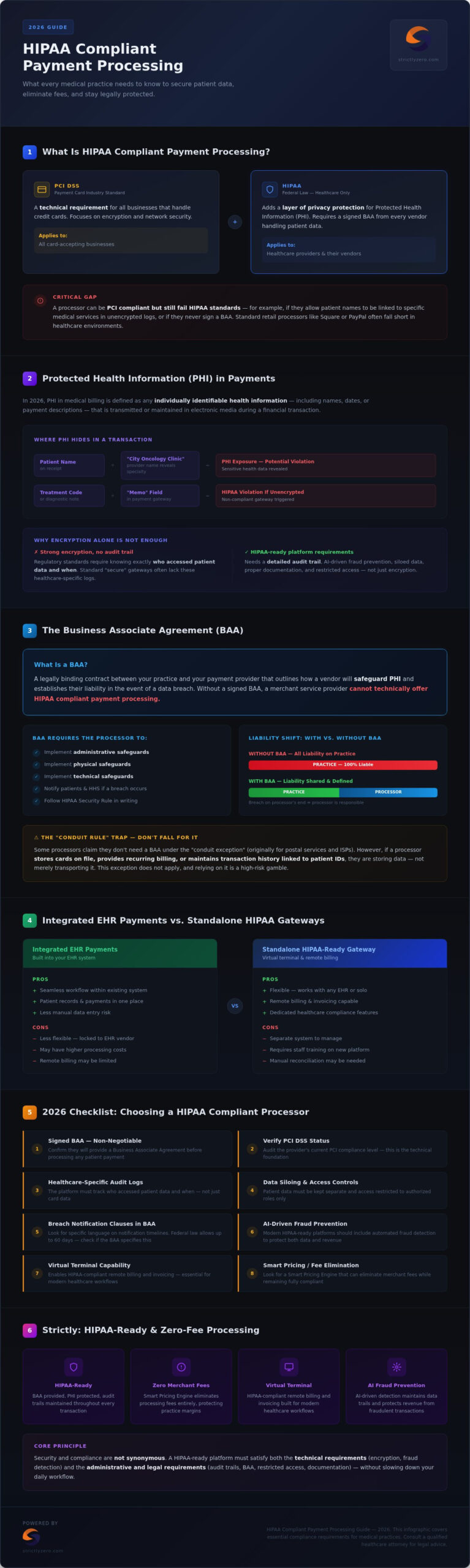
Integrated EHR Payments vs. Standalone HIPAA Gateways
Many medical providers start with the payment tool built directly into their Electronic Health Record (EHR) software. It’s the path of least resistance. While these integrated systems offer immediate convenience, they aren’t always the most cost-effective or flexible solution for HIPAA compliant payment processing. As a practice grows, the limitations of these all-in-one platforms become obvious, especially regarding merchant fees and data portability.
The choice between an integrated system and a standalone gateway involves balancing administrative speed against financial control. Integrated systems prioritize reconciliation, while standalone gateways prioritize processing efficiency. Both can be secure, provided they adhere to the Business Associate Agreement (BAA) provisions mandated by federal law. Understanding the nuances of each will help you decide which model fits your practice’s 2026 growth strategy.
When to Choose Integrated EHR Payments
Integrated payments are often the best fit for solo practitioners or small clinics. The primary benefit is the automated reconciliation of patient accounts. When a patient pays through the EHR portal, the balance updates in real time without manual data entry. This reduces the risk of human error in patient charts. However, this convenience comes with a “convenience tax.” EHR vendors often bundle processing at a higher flat rate. This can be significantly more expensive than wholesale merchant services once your transaction volume increases.
The Case for a Standalone Virtual Terminal
A standalone HIPAA-compliant virtual terminal provides control that integrated systems rarely match. Portability is a major advantage. If you decide to switch EHR providers, you don’t lose your payment history or your ability to bill patients. You own the merchant account. Standalone gateways also allow you to utilize a Surcharge & Dual Pricing Engine. This tool helps medical practices offset rising operational costs by passing processing fees to the cardholder where permitted. Most basic EHR payment modules miss this feature.
Specialized standalone systems frequently offer more robust security features. For example, Strictly provides AI-driven fraud prevention specifically tuned for high-ticket medical transactions. This specialized focus ensures that while your payments remain separate from your clinical notes, they are protected by top-tier financial technology. You can still link these systems via API-first architecture. This gives you the best of both worlds: specialized HIPAA compliant payment processing and a streamlined workflow.
Checklist: Choosing a HIPAA Compliant Processor in 2026
Selecting a partner for HIPAA compliant payment processing requires a rigorous vetting process that goes beyond scanning a marketing website. In 2026, the legal landscape for medical billing has evolved, making a superficial check of security features insufficient. You need a processor that understands the intersection of financial technology and medical privacy. Use this checklist to evaluate potential candidates and ensure your practice remains protected.
- Willingness to sign a BAA: This is your first filter. If a provider refuses to sign a Business Associate Agreement, they aren’t a viable option for healthcare.
- PCI Level 1 Status: Confirm the provider maintains the highest level of Payment Card Industry certification to ensure data is handled with maximum security.
- Omni-channel capabilities: Your practice needs flexibility. Ensure the system supports a Virtual Terminal for remote billing, online payment links, and secure mobile options.
- Automated surcharge tools: Look for a Smart Pricing Engine that handles dual pricing and surcharging automatically, ensuring you stay compliant with both card brand rules and state laws.
- AI-driven fraud prevention: Modern medical practices are targets for identity theft. AI tools can spot suspicious patterns that traditional filters might miss.
Technical Security Requirements
Data must be protected at every touchpoint. Point-to-Point Encryption (P2PE) ensures that information is encrypted from the moment a card is entered until it reaches the secure processing environment. This prevents sensitive data from ever existing in a readable format on your office computers. Tokenization is equally vital; it replaces card data with a unique digital “token.” This allows you to keep a card on file for future treatments without storing the actual account number. Additionally, require multi-factor authentication (MFA) for every staff member who accesses the billing system to prevent unauthorized data entry or exports.
Operational Compliance Features
Compliance is as much about documentation as it is about technology. Your processor must generate detailed reporting and audit logs that track exactly who accessed the system and what changes they made. These logs are a mandatory requirement during a HIPAA audit. Your receipting process also needs careful attention. A compliant system allows you to customize receipts to minimize PHI exposure, ensuring that sensitive treatment codes don’t appear on a document that a patient might leave in a public space. For practices managing chronic conditions, the platform should support secure recurring billing that maintains these protections over the long term. Switch to a processor that prioritizes your compliance and your bottom line.
Strictly: Secure, HIPAA-Ready, and Zero-Fee Processing
Medical practices often feel they must choose between high security and low operational costs. Strictly removes that compromise by offering a purpose-built platform for HIPAA compliant payment processing. By signing a BAA with every healthcare partner, we ensure the legal foundation is solid from the very first transaction. Our system combines AI-driven fraud prevention with a suite of tools designed to handle the specific metadata requirements of medical billing. This approach provides the peace of mind that practice owners need to focus on patient care rather than regulatory paperwork.
The Strictly BAA is more than just a document; it’s a commitment to shared responsibility. It defines exactly how we protect patient data and establishes the protocols we follow to maintain compliance. When you partner with us, you aren’t just getting a merchant account. You’re gaining a partner that understands the high-stakes environment of healthcare and the technical requirements of the Health Infrastructure Security and Accountability Act updates in 2026.
Zero-Fee Processing for Medical Practices
The Smart Pricing Engine is a game-changer for medical margins. It automates surcharging and dual pricing, allowing practices to pass processing costs to the cardholder where appropriate. In 2026, state-by-state rules for surcharging can be complex to track manually. Our engine manages these rules in real time, ensuring your billing remains compliant with local regulations and card brand requirements. By eliminating these merchant fees, practices can redirect significant capital to offset the rising costs of medical supplies or facility upgrades. This isn’t just about saving money; it’s about making your practice more resilient in a tightening economy.
The Strictly Virtual Terminal Advantage
Modern care happens everywhere, not just at the front desk. The Strictly Virtual Terminal allows providers to send secure payment links to patients immediately following a telehealth session. These links are fully encrypted and designed to minimize the exposure of PHI while ensuring a smooth patient experience. For practices with complex structures, ClearSplit™ residuals automate the distribution of funds among multiple providers or partners. This ensures that every stakeholder is paid accurately and on time without the need for manual accounting spreadsheets.
Strictly provides a unified, omni-channel payment experience that secures patient data across in-person visits, remote consultations, and digital invoicing. Our API-first architecture also means you can link these tools directly to your existing medical software, creating a seamless flow from the moment a patient checks in until the final balance is settled. By centralizing your payments in one HIPAA-ready ecosystem, you eliminate the security gaps that often occur when using multiple, disconnected billing tools.
Modernizing Your Medical Billing Strategy
The transition to HIPAA compliant payment processing is more than a regulatory hurdle; it’s an opportunity to rebuild your practice’s financial foundation. By securing a signed Business Associate Agreement and moving away from the “convenience tax” of basic EHR bundles, you protect both your patients and your profitability. We’ve explored how the right technology, like a standalone virtual terminal, provides the flexibility and audit trails necessary for modern healthcare environments.
Strictly simplifies this transition with a PCI Level 1 Secure Infrastructure and dedicated BAA support tailored for medical providers. Our Smart Pricing Engine works automatically to ensure compliance while eliminating the merchant fees that drain your margins. You don’t have to choose between legal safety and business growth. Switch to Strictly’s HIPAA-ready, zero-fee platform today and reclaim your focus for what matters most: delivering exceptional patient care. Your practice deserves a payment partner that works as hard as you do.
Frequently Asked Questions
Are major retail-focused payment platforms HIPAA compliant?
Most popular retail platforms don’t sign a Business Associate Agreement for their standard merchant accounts. While they offer high levels of encryption, they aren’t legally authorized to handle patient data under federal law. Using these services for your medical practice can lead to massive fines. You should always verify that your partner specifically supports HIPAA compliant payment processing before processing your first patient transaction.
Can I use PayPal for medical patient payments?
PayPal generally doesn’t provide a Business Associate Agreement (BAA) for its standard merchant services. This means any transaction involving patient info could trigger a violation. Healthcare providers should look for a merchant service that understands medical privacy requirements. Relying on a general retail tool for sensitive healthcare billing is a risk that doesn’t pay off in the long run.
What happens if my payment processor doesn’t sign a BAA?
Operating without a signed BAA means your practice assumes all legal and financial risks for a data breach. Federal law is very clear that any vendor handling patient info must be a Business Associate. If you don’t have this contract in place, you’re non-compliant from day one. It’s one of the first things auditors look for during an investigation into medical billing practices.
Are credit card surcharge programs legal for medical practices?
Surcharge programs are legal in the vast majority of the US. You just need to follow the specific rules set by card brands and state governments. A smart pricing engine handles this for you by identifying debit cards and applying the correct fees automatically. It’s a great way to protect your practice margins while staying within legal boundaries and maintaining professional standards.
How much does HIPAA compliant payment processing cost?
The cost of processing depends on the platform you choose. Many EHR systems have high flat rates that eat into your profits. However, you can eliminate these costs by using a compliant surcharge program. This shifts the processing fee to the cardholder, allowing you to maintain a zero-fee merchant account while still keeping your patient data perfectly secure and within federal guidelines.
What is the difference between PCI compliance and HIPAA compliance?
PCI compliance focuses on the security of the credit card data itself. HIPAA compliance focuses on the privacy of the patient’s health information. You need both. A processor might be PCI compliant but still fail HIPAA standards if they don’t provide the necessary audit trails and legal agreements for healthcare. Security is about the technology; compliance is about the legal framework surrounding that technology.
Can I store patient credit card info for recurring billing?
You can definitely store card info for recurring billing as long as you use secure tokenization. This process replaces the card number with a random string of characters so the actual data isn’t on your servers. It’s a vital feature for practices that manage long-term care plans. This ensures your billing is both convenient for patients and safe for your practice’s regulatory standing.
Do I need a BAA if I only take payments in person?
You absolutely need a BAA for in-person payments. Even a simple credit card swipe creates a digital record that includes patient names and payment history. This metadata is considered protected information under federal law. Every part of your HIPAA compliant payment processing chain must be covered by a legal agreement to ensure you aren’t leaving your practice exposed to unexpected audits.