

What if the most effective way to protect your business in 2026 isn’t to build a thicker wall, but to ensure there’s nothing left for a hacker to steal? The traditional approach to secure payment data storage often feels like a losing battle against rising PCI audit costs and the terrifying possibility of a data breach. You’re likely feeling the pressure of managing complex recurring billing cycles while trying to keep sensitive information out of your own systems. It’s a heavy burden. It keeps many merchants up at night.
In this guide, you’ll discover how to shift from “locking the vault” to “devaluing the data” using modern tokenization and AI-driven security. We’ll show you how to achieve a zero-liability environment using an omni-channel infrastructure. This simplifies your path to PCI compliance and makes recurring billing seamless. We’ll explore the latest 2026 standards, the role of AI in fraud prevention, and how an integrated security strategy can turn data protection into your greatest competitive advantage.
Key Takeaways
- Learn why devaluing data through tokenization is more effective than standard encryption for modern security.
- Discover how offloading secure payment data storage to a gateway vault reduces your business liability and simplifies PCI audits.
- Identify the latest 2026 security threats, such as AI-powered brute-force attacks, and how to defend against them.
- Implement the principle of least privilege to ensure only essential staff can access sensitive customer information.
- Find out how secure vaulting provides the foundation for seamless recurring billing and successful surcharge programs.
Why Secure Payment Data Storage is Non-Negotiable in 2026
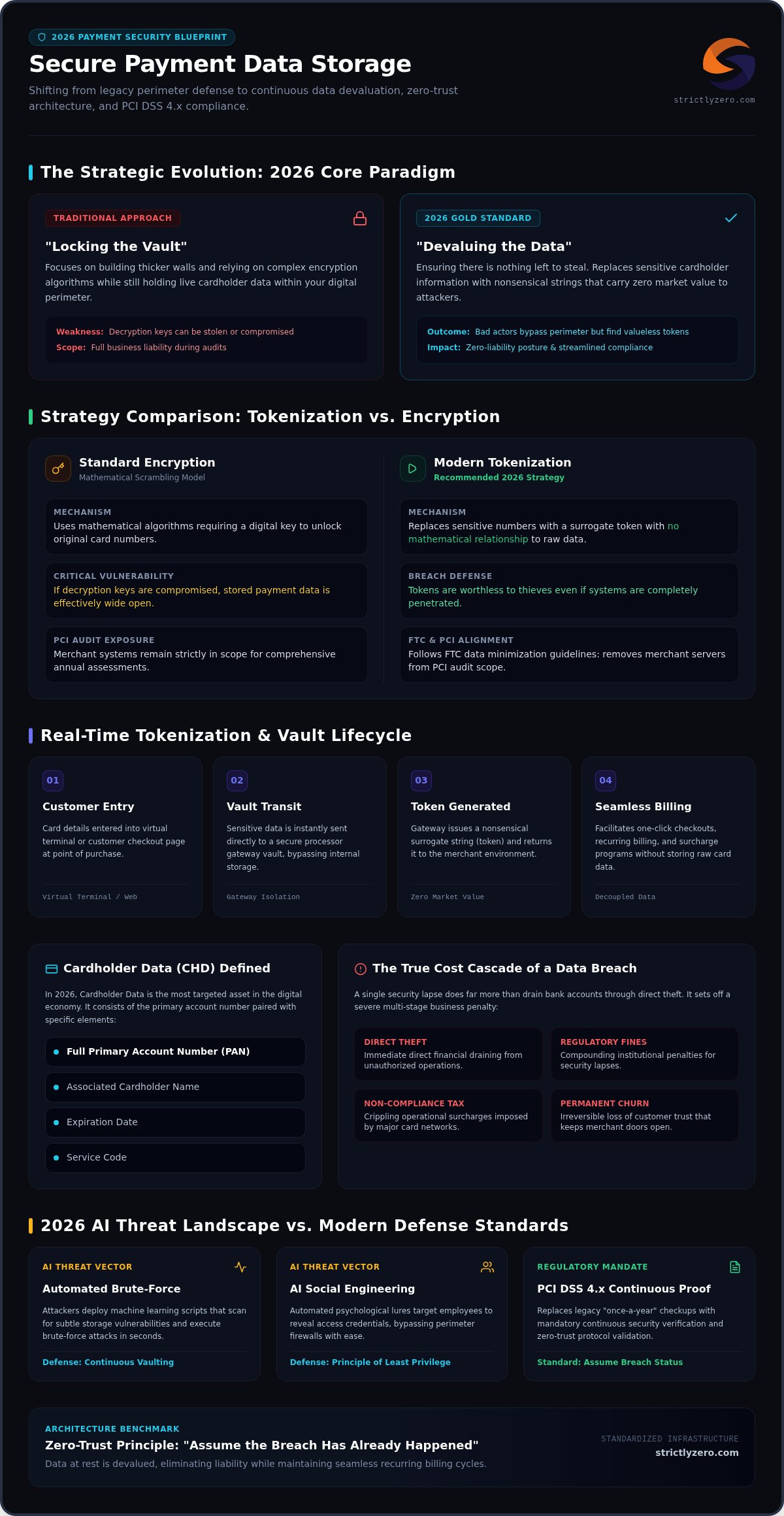
Think of secure payment data storage as the technical discipline of safeguarding cardholder data (CHD) while it sits in your digital environment. In 2026, the strategy has evolved significantly. Merchants are moving away from traditional encryption because keys can be stolen or compromised. The current gold standard is “data devaluation,” a strategy where sensitive information is replaced by nonsensical strings that are useless to hackers. By prioritizing tokenization for data security, you ensure that even if a bad actor bypasses your perimeter, the data they find has zero market value. This shift is essential as PCI DSS 4.x requirements become more demanding for small and medium businesses, requiring proof of continuous security rather than once-a-year checks.
To better understand the fundamentals of protecting customer information, watch this helpful video:
The True Cost of a Data Breach
A single security lapse does more than drain your bank account through direct theft. It triggers a cascade of regulatory fines and a “non-compliance tax” from major card networks that can cripple a small business. Beyond the immediate dollars, the long-term brand damage leads to permanent customer churn. In 2026, Cardholder Data (CHD) is defined as the full primary account number plus any associated cardholder name, expiration date, or service code; it’s the most targeted asset in the digital economy. If you lose it, you don’t just lose money. You lose the trust that keeps your doors open.
AI and the Evolution of Payment Threats
The threat landscape has shifted because hackers now use machine learning to automate their attacks. These AI-driven scripts can identify subtle storage vulnerabilities or execute sophisticated brute-force attempts in seconds. Beyond technical attacks, AI-powered social engineering has become a primary way for criminals to trick employees into revealing access credentials. Relying on legacy storage methods in ecommerce payment processing is a recipe for disaster. Modern merchants must adopt a zero-trust architecture, where no user or system is trusted by default. This approach forces a more rigorous standard for authentication. It’s no longer enough to have a firewall. You need a system that assumes the breach has already happened and protects the data at rest accordingly.
Tokenization vs. Encryption: Which Strategy Wins?
Choosing between tokenization and encryption isn’t just a technical decision; it’s a strategic move to reduce your business liability. Encryption uses complex algorithms to scramble cardholder data, requiring a digital key to unlock the original information. While robust, the primary weakness of encryption is the key itself. If a hacker gains access to your decryption keys, your secure payment data storage is effectively wide open. This creates a high-stakes environment where you must guard the keys with the same intensity as the data they protect.
Tokenization offers a more resilient alternative. Instead of scrambling data, it replaces sensitive card numbers with a non-sensitive “token.” This token has no mathematical relationship to the original card number, making it worthless to thieves even if they breach your system. This approach aligns with FTC guidelines on protecting personal information, which advocate for data minimization. If you don’t have the real data, you can’t lose it. For most merchants, tokenization is the preferred method for credit card processing for small business because it removes the merchant’s server from the scope of most PCI audits.
How Tokenization Works in Real-Time
The process begins the moment a customer enters their details into a virtual terminal or checkout page. The data is instantly sent to a secure vault managed by your processor, which returns a token to your system. This allows you to facilitate one-click checkouts and recurring billing without ever actually seeing or storing the card number. For 2026 auditors, tokenization functions by permanently decoupling sensitive card data from the business environment, replacing it with a mathematically unrelated reference string. This simple exchange keeps your operations fast and your risk profile low.
Encryption Standards for 2026
While tokenization handles data at rest, encryption still plays a vital role for data in transit. Moving beyond standard AES-256, modern cryptographic security now focuses on post-quantum readiness and end-to-end encryption (P2PE). P2PE is especially critical for mobile and in-person payments, ensuring data is encrypted from the moment a card is swiped until it reaches the processor. Success here depends on strict key management and rotation policies. You shouldn’t use the same digital keys indefinitely; regular rotation prevents a single compromised key from exposing years of transaction history. If you’re looking to simplify this complexity, choosing a processor that manages vaulting for you can significantly reduce your internal security overhead.
On-Premises vs. Gateway Vaulting: Comparing Storage Models
Storing cardholder data on your own local servers creates a massive target for cybercriminals. It also complicates your compliance journey, often pushing you into the most rigorous PCI Self-Assessment Questionnaire (SAQ) levels. When you manage secure payment data storage internally, you’re responsible for every firewall, every patch, and every potential entry point. Most small to mid-sized businesses don’t have the resources to maintain this level of technical oversight without significant risk.
Gateway-based vaulting offers a safer path by offloading the actual data to professional credit card processing services. In this model, the sensitive data never touches your environment. Instead, it goes directly to the processor’s secure vault, and you receive a token in return. This shift drastically reduces your liability and your audit scope, moving the heavy lifting of security to the experts.
The ‘Liability Shift’ Advantage
Using a third-party vault does more than just simplify paperwork. It places your customers’ information behind enterprise-grade defenses, including AI-driven fraud prevention that monitors for suspicious patterns at the point of storage. This is why many developers and partners look for an API-first payment processing platform for ISOs. By following NIST key management recommendations, gateway providers ensure that the cryptographic keys protecting your data are rotated and managed according to the highest industry standards. This is a task that’s often too complex for individual merchants to handle alone.
Unified Customer Profiles and Recurring Billing
The real power of gateway vaulting shines in omni-channel environments. When you use a unified storage model, a customer profile created during an online purchase is instantly available for a recurring subscription or an in-person visit. This API-first omni-channel infrastructure ensures data integrity across mobile apps, web checkouts, and virtual terminals. You won’t have to ask customers for their card details every time they switch channels. This reduces friction at checkout and significantly improves the customer experience. By leveraging secure payment data storage at the gateway level, you build a foundation for seamless recurring invoicing and automated partner compensation without the headache of managing raw card data.
Best Practices for PCI-Compliant Data Management
PCI compliance in 2026 has moved beyond a “check-the-box” annual event. With the full implementation of PCI DSS 4.x standards, merchants are now expected to demonstrate continuous security monitoring rather than static snapshots. This starts with quarterly vulnerability scans and annual penetration testing to find the cracks before a hacker does. However, technology is only half the battle. You must also enforce the principle of least privilege. This means strictly limiting access to your secure payment data storage environment to only those employees who absolutely need it to perform their daily tasks. If your marketing team only needs to see transaction trends, they shouldn’t have the permissions to view full cardholder profiles or vault details.
Data retention is another critical pillar of a modern security strategy. The safest data is the data you’ve already deleted. You should establish a strict disposal policy to purge customer information once it’s no longer legally or operationally required. Don’t hoard data “just in case.” By minimizing your data footprint, you naturally shrink your risk profile and simplify your next compliance audit. This proactive approach ensures that your secure payment data storage remains lean and easier to defend against evolving threats.
The 2026 Compliance Checklist
- Confirm your payment processor maintains Level 1 Service Provider status, which is the highest level of security certification available.
- Implement multi-factor authentication (MFA) across every entry point of your payment system to stop credential-based attacks.
- Automate security patches for all integrated software to close vulnerabilities as soon as they’re discovered by researchers.
Employee Training and the Human Element
Even the most advanced encryption can’t stop a staff member from falling for a sophisticated social engineering attack. In 2026, hackers use AI-generated voices and deepfake emails to target billing departments with frightening accuracy. Your team needs specific standard operating procedures (SOPs) for handling virtual terminals and payment links to prevent accidental disclosure. They should know exactly how to verify a request before processing a refund or changing sensitive billing details. This isn’t just about a one-time training session. You need to create a culture of security awareness where every employee understands their role in protecting customer trust.
Building a secure business starts with a partner you can rely on. If you’re ready to upgrade your infrastructure, partner with a processor that prioritizes trust and high-integrity data storage.
Strictly: Trust-First Infrastructure for Modern Merchants
Strictly approaches the payments industry with a clear philosophy: trust is the most valuable currency. While other processors focus solely on transaction volume, Strictly builds the infrastructure that makes those transactions possible and safe. The platform provides a unified omni-channel experience that simplifies complex security requirements into a single, manageable stream. By centralizing your secure payment data storage within Strictly’s high-integrity vault, you gain the freedom to operate across web, mobile, and virtual terminals without the constant fear of a data breach. This unified approach doesn’t just protect you; it empowers your business to scale without technical friction.
Security is also the essential prerequisite for modern cost-saving strategies. You can’t effectively implement zero fee credit card processing without a storage system that card networks and regulators trust. Strictly’s surcharge and dual pricing engine relies on this secure foundation to function compliantly across all channels. It’s why ISOs and high-growth developers prioritize Strictly’s API-first infrastructure. They need a partner that handles the heavy lifting of AI-driven fraud prevention and multi-channel data integrity so they can focus on their own core products.
Security as a Revenue Driver
Trust is a powerful motivator at the point of sale. When customers feel their information is handled with care, they’re more likely to complete their purchase and return for future ones. Strictly’s secure vaulting enables seamless recurring billing through tools like ChurnIQ™, which reduces churn by managing stored tokens intelligently. This means less failed payments and a more reliable revenue stream for subscription-based models. By positioning your brand as a leader in data security, you aren’t just avoiding fines. You’re building a reputation that justifies customer loyalty and drives long-term growth.
Getting Started with Secure Vaulting
Moving your business to a more secure model shouldn’t be a technical nightmare. Strictly’s API makes it simple to integrate secure payment data storage into your existing workflow, whether you’re using a virtual terminal or a custom-built ecommerce site. If you’re currently managing card data on legacy systems, the Strictly team can help you migrate that information into a modern, tokenized vault. This transition immediately reduces your PCI scope and protects your business from the AI-driven threats of 2026. Reach out to Strictly today for a comprehensive security and savings audit to see how a trust-first infrastructure can transform your bottom line.
Future-Proofing Your Business with Data Devaluation
Protecting your customers in 2026 requires shifting from static security to a dynamic strategy that devalues data. By choosing tokenization over traditional encryption, you ensure that stolen information is worthless to hackers. Moving your sensitive information into a gateway-based vault is the most effective way to simplify your operations and reduce your liability. These modern methods turn security from a technical burden into a strategic asset that fuels your growth.
Implementing secure payment data storage is about more than just checking a box; it’s about building a foundation of trust. When you leverage a PCI Level 1 Compliant Infrastructure and AI-Driven Fraud Prevention, you can focus on scaling your brand while knowing your data is defended by enterprise-grade technology. This approach effectively reduces your PCI scope by 90%, allowing you to spend less time on audits and more time on your customers.
Don’t let the complexity of modern threats hold your business back. You can take control of your security and your bottom line today. Secure your business and eliminate fees with Strictly and start building a more resilient future for your brand.
Frequently Asked Questions
What is the most secure way to store customer payment data in 2026?
Gateway-based tokenization is the gold standard for secure payment data storage in 2026. This method ensures that sensitive cardholder details never touch your local servers. Instead, they’re stored in a PCI Level 1 compliant vault managed by your processor. You receive a non-sensitive token for transaction processing. This approach effectively devalues the data, making it useless to hackers even if they manage to breach your digital perimeter.
Can I store credit card numbers in my own database if they are encrypted?
You can technically store encrypted credit card numbers, but it’s not recommended for most merchants. Doing so keeps your business in the highest scope for PCI audits, which increases your operational costs and legal liability. Encryption keys are also vulnerable to theft. It’s much safer to use a tokenization service where the actual data resides in a professional vault, completely removing the raw card numbers from your local database.
How does tokenization reduce my PCI compliance burden?
Tokenization reduces your compliance burden by removing sensitive cardholder data from your network entirely. When you don’t store, process, or transmit raw card numbers, you qualify for a much shorter PCI Self-Assessment Questionnaire. This can reduce your compliance workload by up to 90%. It shifts the technical responsibility to your processor, allowing you to focus on growth while maintaining a high-integrity secure payment data storage environment.
What is the difference between PCI DSS 3.2 and PCI DSS 4.0 for data storage?
PCI DSS 4.0 shifts the focus from a point-in-time audit to a continuous security model. While version 3.2 allowed for annual snapshots, the 2026 standard requires ongoing monitoring and stronger authentication. Specifically, multi-factor authentication (MFA) is now mandatory for all access to the cardholder data environment. This version also emphasizes customized implementations, allowing businesses to prove their security through unique, effective controls rather than just following a rigid checklist.
Does secure storage slow down the checkout process for customers?
No, modern security protocols are designed to be invisible to the end user. Tokenization and vaulting occur in milliseconds during the authorization process. In fact, these systems often speed up future checkouts by enabling one-click payments. Because the customer’s data is already safely vaulted and represented by a token, they don’t have to re-enter their card details for subsequent purchases, which significantly reduces friction at the checkout.
What happens to stored payment data if I switch payment processors?
Most modern processors allow for a secure data migration if you decide to switch providers. This process involves a secure transfer between two PCI Level 1 compliant vaults to maintain the chain of custody. You should check your contract for data portability clauses before signing. Strictly, for example, prioritizes merchant trust and works with partners to ensure customer profiles remain accessible and secure during infrastructure transitions or platform upgrades.
How often should I conduct security audits on my payment storage systems?
You should conduct vulnerability scans at least every 90 days to comply with current standards. Additionally, an annual penetration test is essential to identify deep-seated vulnerabilities that automated scans might miss. In the fast-moving threat landscape of 2026, many high-growth businesses choose to implement continuous security monitoring. Regular audits ensure that your internal policies, such as the principle of least privilege, are actually being followed by your staff.
Is stored data protected against AI-driven hacking attempts?
Yes, provided your storage strategy includes AI-driven fraud prevention. Legacy systems rely on static rules that hackers can eventually bypass. Modern storage environments use machine learning to analyze access patterns and identify suspicious behavior in real time. By combining tokenization with a zero-trust architecture, you create a layered defense. This ensures that even the most sophisticated AI-powered brute-force attacks struggle to find a way into your sensitive customer data vaults.