
What if the payment trend that matters most to your business isn’t a new way to pay, but how checkout connects with fraud controls and back-office operations? The trends in digital payments shaping 2026 bring new opportunities for convenience, along with practical questions about security, integration, and customer experience.
It’s hard to act on trend coverage that blurs proven changes with predictions or treats every new payment option as a must-have. To make a sound decision, identify what is changing, where it could affect customers or operations, and what your business would need to support it.
This guide examines seven developments influencing checkout, money movement, security, and merchant operations, from digital wallets and real-time payments to AI-driven fraud prevention and agentic commerce. For each, you’ll find what’s established, what’s still emerging, and practical questions to consider before adapting your payment setup. The goal isn’t to chase every trend, but to match customer convenience with trust and operational readiness.
Key Takeaways
- Separate established payment capabilities from emerging developments to distinguish practical changes from forecasts.
- Understand how wallets, account-to-account payments, tokenization, and contactless payments differ.
- Consider how AI-assisted fraud detection may help manage risk without treating it as a guarantee.
- Use a clear decision framework to assess which trends in digital payments fit your customers, channels, and operational needs.
- See how connected online, in-person, and mobile payment operations can support a consistent customer experience and reduce fragmentation.
How Digital Payment Trends Change Customer Experience 2026
Customers expect payment to feel convenient, connected, and trustworthy, whether they’re buying online, paying in person, or switching between the two. But preferences differ. One shopper may prefer a mobile wallet; another may choose a card or cash. A good checkout offers clear, reliable choices without adding unnecessary steps.
Digital payments are electronically initiated ways for customers to transfer funds to a merchant, including card payments and account-based transfers. The Federal Reserve’s overview of payment systems provides context on the systems that move payments.
Why customers expect more flexible digital payment experiences
Mobile-first habits have made customers familiar with tapping a phone, saving payment details, and completing purchases across digital channels. They may expect a smooth website checkout and a similarly straightforward in-person experience. For merchants, flexibility means offering options that suit the purchase and channel, rather than assuming one method works for everyone.
Consistency matters, too. When customers move from an online interaction to an in-person purchase, disconnected payment experiences can create friction for customers and staff. Connected payment operations can help merchants manage those interactions more coherently while keeping the payment experience clear and secure.
Which payment trends are established and which are still emerging?
The trends in digital payments include capabilities already used in commerce and developments whose adoption is still evolving. Start by distinguishing what a technology does from how mature its use is:
- Digital wallets and contactless payments: Established ways to present payment credentials online or in person. Wallets can also bring payment and other digital features together. See this overview of digital wallets for background on their functions and applications.
- Tokenization: An active security approach that substitutes a token for sensitive payment details in supported transactions. It helps protect payment data, but isn’t itself a payment method.
- Real-time payments: Account-to-account payment rails that support rapid movement of funds where available. They differ from wallets, which store or present credentials. Availability and use depend on the payment system and merchant setup.
- AI-assisted fraud detection: A tool already used to help assess transaction risk. Its effectiveness depends on implementation and controls. It can support fraud management, not guarantee fraud prevention.
- Agentic and connected commerce: Emerging developments. AI-led purchasing and more integrated shopping-to-payment journeys may affect checkout, but forecasts about future adoption aren’t evidence of universal use today.
Cards and cash remain part of the payment mix. Rather than treating any single trend as a replacement, assess how each could serve your customers and fit your payment operations.
How are digital wallets, real-time payments, and tokenization evolving?
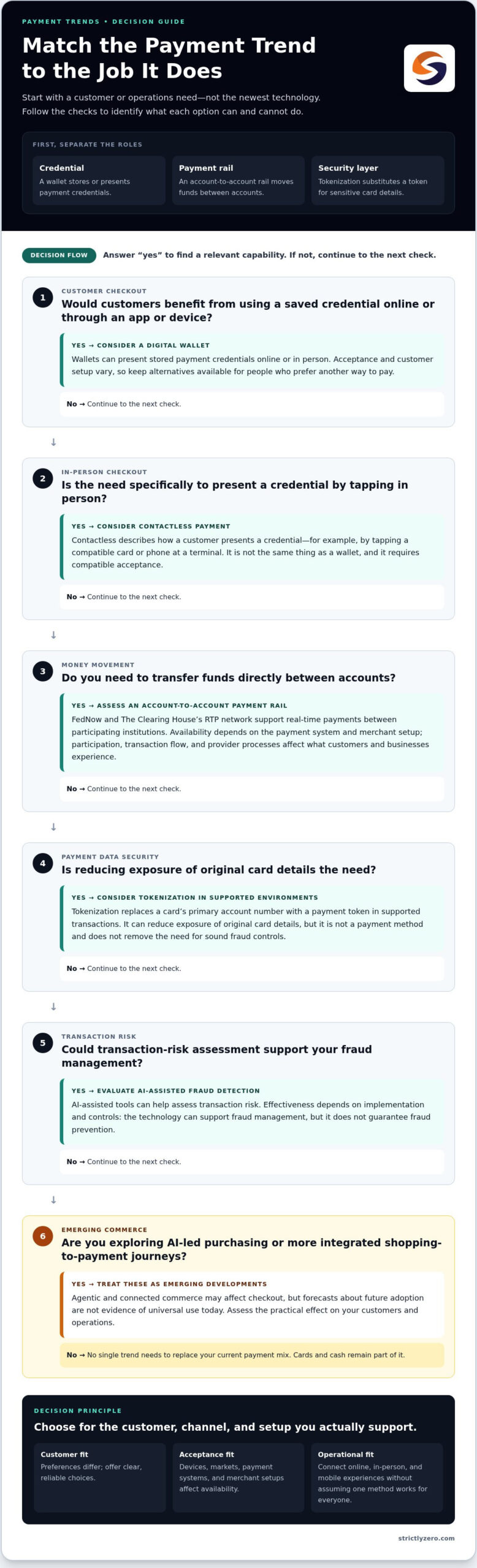
These technologies often appear together at checkout, but they do different jobs. A wallet presents a payment credential, a payment rail moves funds between parties, and tokenization helps protect sensitive card details. Knowing the distinction helps you compare customer convenience with acceptance, processing, and risk considerations. The Digital Payment Trends in the Debit Industry also discusses wallet use and tokenization in the context of debit payments.
Digital wallets and contactless payments: convenience at checkout
A digital wallet lets customers use stored payment credentials, often through an app or device. Apple Pay and Google Pay are third-party examples. Contactless describes how a customer presents a credential, such as tapping a compatible card or phone at a payment terminal. A wallet can support contactless payment, but the terms aren’t interchangeable.
These options can reduce checkout steps, but the experience depends on the customer’s device, the market, and whether the merchant’s checkout or acceptance setup supports the method. Keep alternatives visible so customers who prefer another way to pay aren’t left without a convenient option.
Real-time payments and tokenization: speed versus security
FedNow, a Federal Reserve payment service, and The Clearing House’s RTP network support real-time payments between participating institutions. They move funds through account-to-account payment rails rather than presenting a card credential. That doesn’t mean every transfer or merchant settlement is instant: participation, transaction flow, and provider processes affect what the customer and business experience.
Tokenization serves a different purpose. EMVCo’s payment tokenization specifications support replacing a card’s primary account number with a payment token in supported environments. This can reduce exposure of the original card details, but tokenization isn’t a payment method and doesn’t remove the need for sound fraud controls.
| Option | Use case | Customer benefit | Merchant consideration |
|---|---|---|---|
| Digital wallet | Online or in-person checkout | Uses saved credentials or a device | Acceptance and customer setup vary |
| Contactless | Tap-to-pay in person | Quick credential presentation | Requires compatible acceptance |
| Account-to-account rail | Transfers between accounts | Can move funds in real time on supported networks | Availability, settlement, and protections vary |
| Tokenization | Protecting card data in supported transactions | Limits use of the underlying card number | Needs compatible processing and risk controls |
Compare the full transaction experience, not just the checkout button: acceptance, timing, customer protections, and operational fit all matter. For businesses coordinating online, in-person, and mobile payments, omnichannel payment processing can help connect payment operations across those channels.
What do AI, fraud prevention, and emerging checkout trends mean for merchants?
New checkout experiences can make paying easier, but every reduction in friction needs to be balanced against the risk of unauthorized transactions. AI-assisted fraud detection and agentic commerce are among the trends in digital payments worth watching, but they’re at different stages of maturity. Treat AI as a tool that supports risk decisions and agentic commerce as an emerging way customers may shop and pay, not as complete solutions.
AI in payment security: useful signals, not a silver bullet
Fraud detection systems can analyze signals such as transaction patterns and flag activity that appears unusual. AI can help teams review those signals, but a flag isn’t proof of fraud, and an apparently ordinary transaction isn’t automatically safe. Results depend on data quality and relevance, system configuration, and how people respond to alerts.
False positives matter: blocking a legitimate customer can damage trust and interrupt a sale. Consider how a system handles borderline transactions, protects personal information, and allows human review or adjustment. BioCatch’s AI, Fraud Prevention, and Digital Trust report explores the connection between AI and evolving digital threats. No single signal or tool should carry the entire burden of fraud prevention. Layered controls can address different risks, while review processes help teams handle uncertain cases.
In practice, aim for proportionate checks. Apply stronger scrutiny when risk signals warrant it, while avoiding unnecessary hurdles for routine purchases. Monitor both suspected fraud and legitimate transactions that get declined. Either outcome can show where controls need refinement.
Agentic commerce and new checkout journeys
Agentic commerce describes software agents helping people discover, select, or complete purchases. Some uses are being explored through pilots and limited implementations; forecasts about broader adoption are projections, not proof that consumers widely delegate purchases to agents today. Merchants can follow developments without treating them as an immediate replacement for familiar checkout flows.
Delegated purchasing raises practical questions. Did the customer authorize the agent to make this specific purchase? How are the customer and agent identified? What limits apply to the order, and how can the customer dispute or reverse an unintended transaction? Clear consent, traceable authorization, and workable dispute processes will matter as these journeys develop.
For merchants evaluating AI-assisted risk tools, AI-driven fraud prevention is one part of a broader payment setup, not a substitute for operational oversight and sound controls.
How can a business decide which digital payment trends to act on?
A new payment option is worth considering when it solves a real customer or operational problem, not simply because it’s attracting attention. Use this five-step framework to assess the trends in digital payments against your customers, transaction channels, and ability to support a change.
A five-step framework for prioritizing payment innovations
- Map customer needs. Identify where checkout creates friction or customers request more flexibility. Compare needs across online, in-person, and mobile transactions rather than assuming one channel tells the whole story.
- Assess operational fit. Document how the option would work with your existing checkout, payment processing, accounting, and reconciliation workflows. Include integration effort and any effect on staff tasks.
- Review risk and responsibilities. Consider what data is collected, who can access it, how transactions are authenticated, and how disputes or suspicious activity will be handled. Identify any new processes your team would own.
- Test on a manageable scale. Where practical, pilot the change in a defined channel or customer journey. Prepare staff with clear instructions for common issues before expanding its use.
- Measure the results. Track checkout completion, payment failures, customer support issues, staff workload, and relevant fraud signals. Compare results with the problem you set out to solve, then adjust, expand, or stop based on what the test shows.
Channel planning keeps the decision grounded. A payment method that suits online checkout may not address an in-person need, and a change that works in one channel can create extra reconciliation steps elsewhere. For a broader view of how channels fit together, see this guide to ecommerce payment processing.
How to evaluate trust, security, and compliance
Before rollout, map the full flow of payment data: what is collected, where it moves, who can access it, and how it’s protected. Review authentication, permissions, dispute handling, and the division of security responsibilities across the systems involved. Staff should know how to recognize and escalate unusual transactions without creating unnecessary obstacles for legitimate customers.
For card-data guidance, consult current materials from the PCI Security Standards Council and determine which requirements apply to your environment. Requirements can depend on how payments are accepted and processed. Also review relevant federal and state requirements through current authoritative sources before changing payment or data practices. Don’t assume a rule applies identically across locations or transaction types.
For businesses assessing connected payment operations across channels, explore omnichannel payment processing as one way to align payment experiences with operational needs.
How can connected payment processing support the trends that matter?
Payment trends are most useful when they improve a real customer journey without creating avoidable work or weakening trust. A wallet, faster payment rail, or new fraud tool can address one need, but merchants also have to manage how it fits with checkout, staff processes, reporting, and customer support. Connected payment operations bring these considerations together across online, in-person, and mobile transactions.
For foundational context on how payment acceptance works, explore this guide to credit card processing services.
What connected payment operations can help businesses manage
A unified platform can make it easier to coordinate payment activity across channels and reduce fragmentation from disconnected workflows. For example, a merchant might accept a payment online, send a payment link for a remote purchase, use a virtual terminal to enter a transaction, and manage recurring billing through its payment setup. A connected view can help teams manage these activities more consistently.
Integration still matters. An API-first platform can support connections with other systems, but the outcome depends on the specific integration, data flows, and business processes involved. Before adopting a new capability, map how transaction information moves into accounting, reporting, and customer support workflows. This can reveal gaps that a unified payment platform alone may not address.
Where Strictly fits into the 2026 payment landscape
Strictly provides an omnichannel payment processing platform for businesses accepting payments online, in person, or via mobile. Its capabilities include API integrations, payment links, a virtual terminal, recurring billing, and AI-driven fraud prevention. These tools can support evolving customer experiences, while merchants should assess how each feature fits their systems and operating needs.
Strictly also offers surcharge and dual-pricing programs with a Smart Pricing Engine that automates state-by-state surcharge rules and debit card detection. Rules vary by state, and not every transaction can be surcharged, so businesses need to account for applicable requirements in their payment practices. Treat convenience, security, and operational readiness as connected priorities when deciding which trends in digital payments to pursue.
Rather than adopting every new option at once, start with the customer or workflow problem you want to solve. Then assess whether your payment infrastructure can support the change across relevant channels. Explore Strictly payment solutions to see how connected processing capabilities can fit into that evaluation.
Make Your Next Payment Move Count
The trends in digital payments worth acting on are the ones that solve a real customer or operational need. Wallets, faster payment options, and AI-assisted fraud tools can create opportunities, but each brings different considerations for security, integration, and day-to-day operations. Start with a clear business goal, test changes thoughtfully, and measure whether they improve the experience without adding unnecessary risk or complexity.
Connected payment operations can help businesses manage transactions across online, in-person, and mobile channels. Strictly combines omnichannel payment processing with an API-first platform that includes payment links, a virtual terminal, and recurring billing, giving merchants tools to support different payment journeys.
Ready to explore infrastructure that can support your payment operations? Explore Strictly payment solutions and see how connected processing could fit your business. Take a practical first step toward payment experiences that earn customer trust.
Frequently Asked Questions
What are the biggest trends in digital payments in 2026?
Key trends include digital wallets, real-time payment networks, tokenization, AI-assisted fraud detection, and more connected checkout experiences. Agentic commerce, where software helps people discover or complete purchases, is also emerging, but forecasts about its future aren’t proof of widespread adoption today. These developments serve different purposes: some change how customers pay, some move funds, and others support security or connect payment activity across channels.
How are digital payments changing the customer experience?
Digital payments give customers more ways to complete purchases across online, in-person, and mobile channels. Wallets and contactless options can simplify checkout, while connected payment journeys can make it easier to move between channels. Preferences still vary, so flexibility matters more than assuming every customer wants the same method. Merchants can improve the experience by making available options clear and balancing convenience with dependable security and support.
Are real-time payments the same as instant settlement?
No. Real-time payments refer to payment networks designed to move funds quickly between participating financial institutions. Instant settlement describes when funds are settled for a particular transaction, which may depend on the payment method, institutions, and processing arrangements. A payment sent over a real-time network doesn’t necessarily mean every merchant sees funds immediately. Understand how the specific payment flow handles timing, availability, and reconciliation before relying on it operationally.
How does tokenization make digital payments safer?
Tokenization replaces sensitive card details, such as a card number, with a payment token in supported transactions. If tokenized data is exposed, it may be less useful than the original card details outside the context it was created for. Tokenization can reduce exposure of payment information, but it doesn’t prevent every type of fraud or replace other safeguards. Merchants still need appropriate security controls and processes for managing payment data.
Will AI change how businesses prevent payment fraud?
AI can help identify unusual transaction patterns and prioritize activity for review, making it a useful part of fraud management. It isn’t a guarantee against fraud, and its effectiveness depends on data quality, configuration, and oversight. False positives can block legitimate customers, while missed alerts carry their own risks. Businesses should review both outcomes, maintain layered controls, and ensure staff know how to handle suspicious or uncertain transactions.
What is agentic commerce in digital payments?
Agentic commerce describes software agents helping people find, select, or complete purchases. It’s an emerging area, so pilots and forecasts shouldn’t be confused with broad everyday use. As these checkout journeys develop, merchants will need clear ways to establish customer identity and consent, confirm what an agent is authorized to buy, and handle mistakes or disputes. These details are central to maintaining customer trust when purchases involve delegated actions.
How should a small business choose which payment trend to adopt?
Start with a documented customer or operational problem, then assess whether a payment change fits your channels, systems, and staff workflows. Review data access, security responsibilities, customer support needs, and relevant compliance requirements. If practical, test the change in a limited setting and measure checkout completion, payment issues, support requests, and risk signals. Expand only if the results show that it addresses the original need without adding undue complexity.