

Why should your firm sacrifice up to 3.75% of every retainer just to give clients the digital convenience they expect? It’s a frustrating trade-off. You know that firms accepting online payments collect 33% more revenue, yet the high overhead of transaction fees eats into your take-home pay. When you add the constant anxiety of manual reconciliation and the threat of a state bar audit, it’s no wonder many partners hesitate. Modern credit card processing for law firms shouldn’t force you to choose between your bottom line and ethical compliance.
We understand that protecting your IOLTA account is your top priority. You need a system that handles the heavy lifting of separating earned and unearned funds without the risk of commingling. In this 2026 guide, you’ll learn how to eliminate processing costs through compliant surcharge engines that are ethically bulletproof. We’ll explore the latest state-specific regulations in places like New York and Colorado, explain how to get paid four times faster with digital links, and show you how to automate your workflows to ensure 100% compliance. It’s time to stop losing thousands to bank fees and start billing with total confidence.
Key Takeaways
- Discover how modern credit card processing for law firms can eliminate overhead costs while meeting the 2026 demand for instant, digital payment options.
- Learn how to maintain absolute IOLTA compliance by ensuring transaction fees are only deducted from operating accounts, never touching client trust funds.
- Understand the legal framework for surcharging and how automated dual pricing engines remove the ethical guesswork across different state jurisdictions.
- Explore how virtual terminals and secure payment links allow your firm to collect retainers faster and reduce manual reconciliation time.
- Find out how shifting to a “Trust as a Payment Processor” model protects your practice from fraud and audit risks.
The State of Credit Card Processing for Law Firms in 2026
Legal credit card processing is a specialized subset of merchant services designed to navigate the strict ethical boundaries of the legal profession. It isn’t just about moving money; it’s about the architecture of where that money lands. In 2026, digital payments aren’t a luxury. They’re a mandate from clients who have abandoned paper checks for the speed of their smartphones. Firms that fail to adapt are finding themselves at a significant competitive disadvantage as the industry moves toward a digital-first billing model.
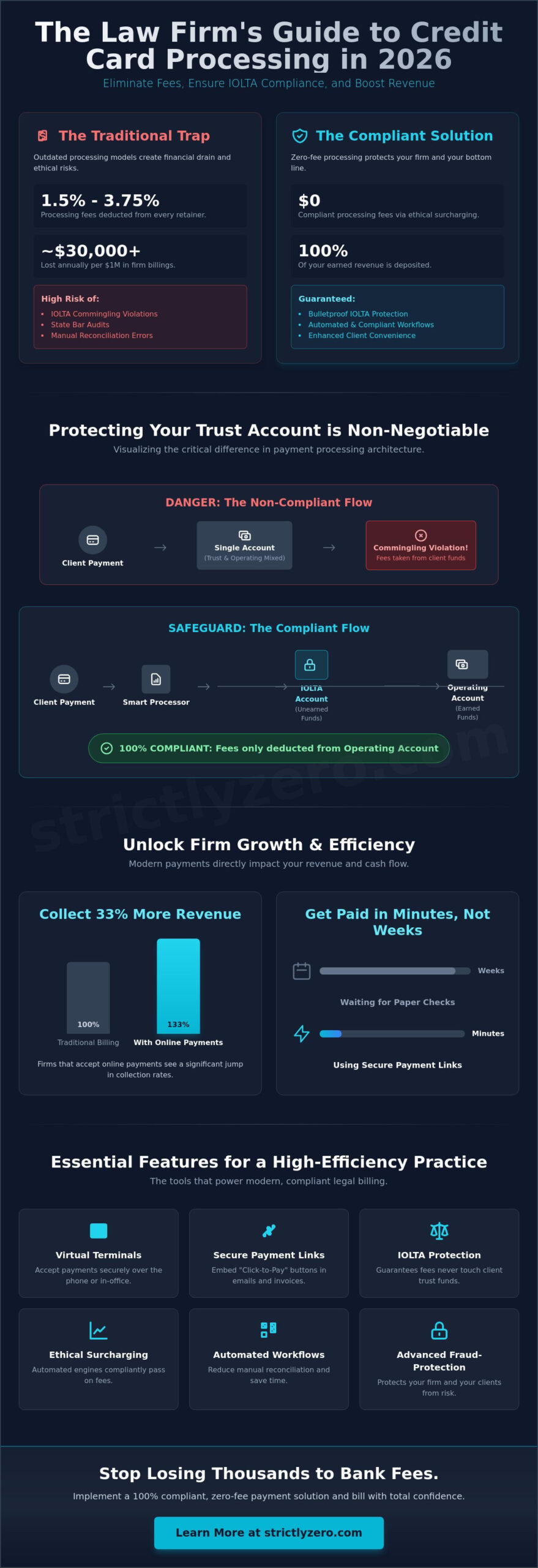
The financial drain on firms using outdated models is staggering. With average transaction fees ranging from 1.5% to 3.75% in 2026, a typical mid-sized firm processing $1 million in annual billings through standard channels often loses over $30,000 every year to merchant service providers. This is why “Zero-Fee” processing has emerged as the new industry standard for law. By shifting these costs through compliant surcharge programs, firms are reclaiming their margins without sacrificing client convenience or violating state bar rules.
To better understand how modern firms integrate these tools to streamline their operations, watch this helpful video:
Why Traditional Merchant Accounts Fail Law Firms
Traditional processors treat every deposit the same, which creates a massive risk for attorneys. If a processor pulls a monthly service fee or a chargeback directly from a trust account, it creates a commingling violation that could trigger a state bar audit. This “fee clawback” problem is a leading cause of accidental ethics violations. Maintaining IOLTA Compliance requires a system that strictly separates these streams. IOLTA-compliant credit card processing for law firms is the only viable path because it ensures transaction costs are only ever deducted from the firm’s operating account.
The 2026 Digital Transformation in Legal Billing
The shift toward mobile and “click-to-pay” links has revolutionized how firms collect retainers. Instead of waiting for a check to arrive in the mail, attorneys now embed secure payment buttons directly into digital invoices. This approach mirrors the efficiency of ecommerce payment processing, giving clients a frictionless way to pay. Data shows that firms using these digital tools see collection rates jump by over 30%, often getting paid in minutes rather than weeks. By implementing a modern system, your firm can provide the high-end experience that 2026 clients expect while securing your revenue faster than ever before.
IOLTA Compliance and Trust Accounting: The Non-Negotiables
Trust accounting is the third rail of legal practice. Touching client funds without authorization, even by a few dollars to cover a merchant fee, can lead to immediate disciplinary action. This is why standard credit card processing for law firms must be handled with a specialized architecture. You can’t simply use a retail processor that lumps all deposits into one bucket. You need a system that respects the wall between your Operating Account and your Interest on Lawyers’ Trust Accounts (IOLTA).
A compliant processor ensures that every penny of a client’s payment reaches the trust account. If a client pays a $5,000 retainer, exactly $5,000 must land in that account. Any associated transaction fees must be debited from your firm’s operating account separately. Beyond the flow of funds, 2026 regulations place a heavy emphasis on data security. PCI DSS compliance is no longer a checkbox; it’s a shield for sensitive client financial data. Automated reporting serves as your final line of defense, providing the paper trail necessary to survive a state bar audit without manual reconciliation headaches.
Protecting the IOLTA Account from Third-Party Debits
The biggest threat to your trust account isn’t just the initial fee. It’s the “fee clawback.” Many generic processors are programmed to pull monthly service charges or chargebacks from the same account where deposits land. If this happens to your IOLTA, you’ve technically commingled funds. A legal-specific engine provides chargeback protection by ensuring all disputes and fees are routed to your operating account. This setup is vital when handling unearned retainers. It keeps the client’s money “whole” until the work is actually performed and the funds are earned.
Ethics Rules: Can Law Firms Pass on Processing Fees?
The question of whether you can pass fees to clients has shifted significantly. While the ABA Model Rules allow for the recovery of “reasonable costs,” state-specific opinions vary. For instance, the New York State Bar Association Opinion on Credit Card Fees clarifies that firms can pass these costs along if they are transparent and the client agrees in writing. By 2026, the consensus has moved toward using technology to automate this transparency. Using a zero fee credit card processing model allows you to offer digital convenience without eroding your margins. If you want to ensure your firm stays on the right side of these evolving rules, you can review your current billing workflow with a specialist to close any compliance gaps.
The Zero-Fee Revolution: Surcharging Ethics for Modern Attorneys
For years, the standard for credit card processing for law firms was the flat-rate model. You simply accepted that 3% of your gross revenue would vanish into the pockets of banks. By 2026, this “fee fatigue” has reached a breaking point. Firms are now adopting the Strictly Surcharge & Dual Pricing Engine to reclaim those lost margins. This shift moves the processing cost from the firm’s balance sheet to the transaction itself, effectively creating a zero-fee environment. While some partners worry that clients might push back, the reality is that 82% of law firms now accept digital payments because clients demand it. They value the ability to pay instantly or use credit lines more than they mind a transparently disclosed fee.
The difference between the old flat-rate model and the new zero-fee model is stark. In a traditional setup, a $10,000 retainer costs the firm roughly $300 in fees. With an automated surcharge engine, that $300 stays in the firm’s operating account. This isn’t just about saving money. It’s about fairness and transparency. You provide the legal service, and the client pays for the convenience of their preferred payment method. This model has become the industry standard because it aligns the cost of the payment with the person choosing the payment method.
Automated Compliance: The Smart Pricing Engine
Navigating the legalities of surcharging used to be a nightmare for office managers. Regulations vary wildly across the country. As of April 2026, surcharging is prohibited in Connecticut, Maine, and Massachusetts. In Colorado and Oklahoma, fees are capped at 2%. Our smart pricing engine removes this guesswork by detecting the card type in real-time. It’s a critical distinction because federal law and card network rules strictly prohibit surcharging debit cards. Automated engines prevent over-charging violations by applying the correct percentage based on the client’s specific card and location. The system also handles mandatory signage and digital disclosures, ensuring your firm meets all state bar and card brand requirements without manual effort.
Surcharging vs. Dual Pricing in a Legal Context
Understanding the nuance between these two models is essential for maintaining client trust. Surcharging adds a compliant fee to credit card transactions only. Dual pricing, however, presents two distinct prices: a lower price for payments via check or wire and a standard price for cards. Criminal defense and family law practices often prefer surcharging because it allows for immediate, full-value retainers via card. Corporate law firms often lean toward dual pricing, as their clients frequently use ACH or wire transfers. Choosing the right model depends on your specific practice area and how your clients typically prefer to settle their accounts. By using an intelligent engine, you can offer these choices without the risk of manual calculation errors.
Essential Payment Features for a High-Efficiency Law Practice
Efficiency in a modern firm is about more than just legal research. It’s about how quickly those billable hours translate into liquid capital. Digital payments are the engine of this transformation. To maximize collections, your firm needs an omni-channel approach. This means accepting payments in person, through your website, over the phone, and via mobile devices. When you provide multiple ways to pay, you remove the friction that often delays a client’s decision to settle their bill. Modern credit card processing for law firms has evolved to include automated recurring billing, which is perfect for long term litigation or monthly retainer agreements. Instead of chasing a check every thirty days, you can set up a compliant payment plan that runs automatically, ensuring your firm stays cash-flow positive without the administrative headache.
Virtual Gateways and Remote Invoicing
The virtual terminal is perhaps the most versatile tool in your billing arsenal. It allows your staff to process payments securely over the phone during an initial consultation or while a client is on the line for a case update. You don’t need a physical card reader or a complex website setup to get started. By integrating secure payment links into your existing practice management software like Clio or MyCase, you can embed “Pay Now” buttons directly into your digital invoices. This “click-to-pay” convenience is why digital billing is now the industry standard. For firms just starting to build their digital infrastructure, our credit card processing for small business guide offers specific setup tips to get your gateway running in hours.
Security and Fraud Prevention
Protecting your firm from financial loss requires more than just a secure password. In 2026, AI-driven fraud detection is a necessity. These systems analyze transaction patterns in real-time to flag suspicious activity before a charge is even authorized. This is your first line of defense against costly chargebacks that can disrupt your trust accounting. Another critical security layer is tokenization. You should never store raw credit card numbers on your local servers or in paper files. Tokenization replaces sensitive data with a unique identifier, ensuring that even if your firm’s systems are compromised, the client’s actual financial information remains safe. Staying current with 2026 PCI DSS requirements isn’t just about avoiding fines; it’s about maintaining the professional reputation you’ve worked hard to build. If you’re ready to upgrade your firm’s security and efficiency, you can explore our virtual terminal solutions to start taking secure payments today.
Strictly: The Compliant Path to $0 Processing Fees for Lawyers
Strictly represents the next evolution of credit card processing for law firms. While legacy processors are content to let you lose 2.9% to 3.75% of every retainer to bank fees, we’ve built a system that prioritizes your firm’s profitability. Our “Trust as a Payment Processor” philosophy means we don’t just provide a gateway; we provide a compliance-first architecture. We handle the technical heavy lifting of separating operating and trust funds, allowing you to focus on your caseload rather than your ledger. Switching from a legacy provider shouldn’t be a hurdle. We manage the migration of your data and workflows, ensuring your billing cycle isn’t interrupted while you reclaim that lost 3% margin.
The transition to zero-fee billing is about more than just software. It’s about a partnership that understands the unique risks of the legal profession. By choosing a processor that integrates AI-driven fraud prevention and automated compliance, you protect your firm from the financial and reputational risks associated with chargebacks and bar audits. You’ve spent years building your practice; you shouldn’t have to spend thousands of dollars just to get paid for your expertise.
Why Strictly Beats Legal-Specific Aggregators
Many “legal-only” aggregators act as expensive middlemen, adding their own markups on top of standard bank fees. Strictly offers a direct processing model that provides more transparency and lower baseline costs. For firms handling high-ticket legal retainers, our Dual Pricing engine is a game-changer. It allows you to offer a clear choice: a lower price for payments via check or wire, and a standard price for credit cards that includes the processing cost. This flexibility makes us a top contender for the best credit card processing for small business in the legal sector. You get the specialized tools of a legal processor with the pricing efficiency of a direct merchant service provider.
Getting Started: Your 24-Hour Firm Upgrade
Upgrading your billing department doesn’t have to be a months-long project. Our onboarding process is designed to get law firms and legal ISOs up and running within 24 hours. Once you’re live, you gain immediate access to our Smart Pricing Engine. This tool automatically manages the complex web of state-level regulations and card brand rules, ensuring every transaction is 100% compliant without any manual input from your staff. You can stop worrying about whether you’re following the latest rules in Colorado or New York and start focusing on your clients. There’s no longer a reason to let thousands of dollars in fees leak out of your practice every month. Partner with Strictly to eliminate your firm’s processing fees today.
Secure Your Firm’s Financial Future with Compliant Billing
The legal industry has reached a turning point where digital payments are no longer optional. You’ve seen how the right technology can bridge the gap between client convenience and strict ethical requirements. By prioritizing IOLTA-safe fee deductions and leveraging automated state-by-state compliance, you protect your license while protecting your profits. It’s time to stop letting legacy bank fees erode the revenue you’ve worked hard to earn.
Modernizing your credit card processing for law firms doesn’t have to be a complex overhaul. With API-first integration for your existing legal software, your practice can start collecting the full value of its billable hours almost immediately. You’ve built your reputation on precision and trust; your payment system should reflect those same values. Take control of your overhead and provide the frictionless experience your clients expect in 2026.
Eliminate your law firm’s processing fees with Strictly’s compliant surcharge program.
Take the first step toward a more efficient, profitable practice today.
Frequently Asked Questions
Is it ethical for law firms to charge a credit card surcharge?
Yes, it’s generally ethical as long as you follow your state’s specific bar associations and card network rules. Most jurisdictions allow surcharging if the fee is clearly disclosed and doesn’t exceed the actual cost of processing. For example, New York permits it but requires specific price display transparency. You must ensure the fee only applies to credit cards, as surcharging debit cards remains illegal nationwide.
How does Strictly ensure IOLTA compliance?
We use a specialized architecture that maintains a strict wall between your operating and trust accounts. When a client pays a retainer, 100% of those funds land in your IOLTA. Any transaction fees or monthly service costs are debited exclusively from your operating account. This setup prevents the commingling of funds, which is a leading cause of trust account audits and disciplinary actions.
What is the difference between a surcharge and a convenience fee for lawyers?
A surcharge is a percentage added specifically to credit card transactions to offset processing costs. A convenience fee is typically a flat charge for using a specific payment channel, like an online portal, rather than a standard method like a check. While surcharges are restricted to credit cards, convenience fees must apply to all payment types within that specific channel to remain compliant with network rules.
Can I accept credit card payments for my trust account?
You can absolutely accept credit card payments for your trust account if you use a legal-specific processor. The key is ensuring that the gross amount of the payment is deposited into the IOLTA. Any associated fees must be pulled from your operating account. This ensures that client money stays whole and you don’t inadvertently spend client funds on your own business expenses.
What happens if a client disputes a charge (chargeback) in a law firm?
When a dispute occurs, a compliant system ensures the funds are withdrawn from your operating account, not your trust account. This protection is a vital part of credit card processing for law firms because it prevents accidental trust account overdrafts. Strictly also uses AI-driven fraud prevention to analyze transaction patterns, helping you flag and avoid high-risk payments before a dispute can even happen.
Do I need special hardware to accept credit cards at my law firm?
No, you don’t need any physical POS hardware to manage your billing. Strictly provides a virtual terminal and secure invoicing tools that let you process payments through any web browser. You can take card details over the phone or send secure “click-to-pay” links via email. This digital-first approach gives you the flexibility to handle payments from the office, the courtroom, or your home.
How does the Smart Pricing Engine handle different state laws on surcharging?
The engine uses real-time card identification and geolocation to apply state-specific rules automatically. If a client uses a card from a state where surcharging is prohibited, such as Connecticut or Maine, the system won’t apply the fee. It also caps fees in states like Colorado and Oklahoma where limits are set at 2%. This automation removes the risk of manual error and keeps your firm compliant.
Can I use Strictly if I already use legal practice management software like Clio?
Yes, our system is built with an API-first approach that works alongside major practice management platforms. You don’t have to abandon your current case management workflows to benefit from our engine. By using Strictly for credit card processing for law firms, you can keep your existing software for daily tasks while utilizing our surcharge engine to eliminate the high overhead of transaction fees.