
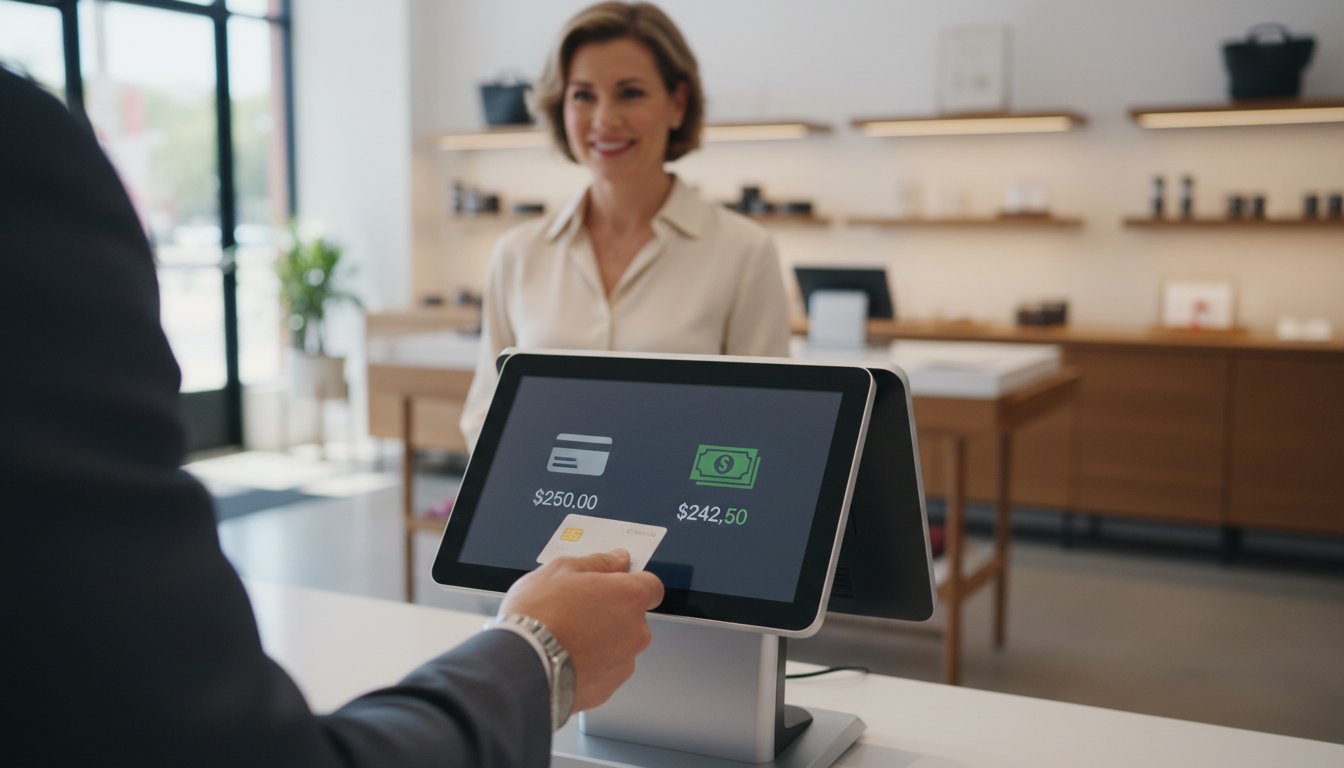
Did you know that U.S. merchants paid a staggering $172 billion in credit card processing fees in 2023? It’s a massive drain on your bottom line that feels unavoidable if you want to stay competitive. You’ve likely considered passing these costs along but hesitated because you don’t want to deal with a negative customer reaction to credit card surcharge at the point of sale. It’s a common fear. Nobody wants to risk a decade of brand loyalty for a 3% margin improvement, especially when state by state compliance feels like a moving target.
The good news is that you don’t have to choose between your profits and your reputation. This article reveals how to eliminate those processing fees safely while actually maintaining high customer satisfaction scores. We’ll show you how to master the psychology of modern surcharging so your clients feel informed rather than insulted. We’re going to dive into the specific communication strategies for 2026 and the legal frameworks you need to follow to keep your business protected and profitable.
Key Takeaways
- Understand the 2026 shift toward shared transaction responsibility and why transparency is now the cornerstone of modern merchant-customer relationships.
- Learn how to manage the customer reaction to credit card surcharge by addressing the “surprise factor” and leveraging social proof to normalize fee structures.
- Evaluate why dual pricing often outperforms traditional surcharging by framing the transaction as a cash discount rather than a credit penalty.
- Identify actionable steps for training your staff to handle fee-related objections with empathy and professional clarity to preserve brand loyalty.
- Explore how automated pricing engines ensure legal compliance and eliminate technical errors that trigger unnecessary customer complaints and legal risks.
The State of Credit Card Surcharges in 2026
By the second quarter of 2026, the number of American merchants implementing checkout fees reached an all-time high. This surge marks a fundamental shift in how small and medium-sized businesses (SMBs) manage their overhead. For decades, entrepreneurs accepted processing fees as an unavoidable cost of doing business. That mindset has changed. Business owners now view these costs as a shared transaction responsibility between the merchant and the consumer who chooses the convenience of credit.
This transition didn’t happen in a vacuum. Rising interchange fees, which climbed by an average of 15% between 2023 and 2025, forced the hands of many retailers. When combined with persistent inflation that squeezed net margins down to 3% or 5% in the service sector, the old model became unsustainable. To maintain operations, many have turned to payment surcharges to offset the heavy toll of digital transactions.
Understanding the terminology is critical for compliance. A surcharge is a percentage added specifically to credit card transactions to cover processing costs. It doesn’t apply to debit cards. A convenience fee is a flat charge for using a non-standard payment channel, like an online portal for a business that usually takes payments in person. A service fee is typically reserved for government or educational institutions. Confusing these terms can lead to legal complications and a negative customer reaction to credit card surcharge programs.
Why Merchants are Making the Switch
Small businesses face Merchant Discount Rates (MDR) that often exceed 3.5% for premium rewards cards. These high rates directly threaten the survival of mom-and-pop shops. Adopting zero fee credit card processing has become a strategic necessity to keep doors open. By passing these specific costs to the cardholder, merchants can protect their margins without raising base prices for everyone. This ensures that cash or debit users aren’t subsidizing the travel points and cashback rewards of credit card users.
The 2026 Regulatory Landscape
Transparency is the primary driver of a positive customer reaction to credit card surcharge policies. In 2026, the Consumer Financial Protection Bureau (CFPB) enforces strict disclosure rules at both the entrance of a business and the point of sale. While Visa and Mastercard updated their rules in 2023 to allow more flexibility, they still require merchants to register their surcharge programs 30 days in advance. Hidden fees remain the biggest risk for brand loyalty. Recent data suggests that 68% of shoppers don’t mind a small fee if it’s disclosed upfront, but they’ll abandon a purchase if the charge appears unexpectedly at the final stage of checkout.
Decoding the Psychology of Customer Reaction to Surcharges
The immediate customer reaction to credit card surcharge programs often boils down to timing. Psychology experts point to the “Surprise Factor” as the primary driver of checkout abandonment. When a shopper reaches the end of a transaction only to see an unexpected 3% fee, it triggers a cognitive sting. Recent 2025 consumer sentiment reports indicate that 64% of shoppers feel “betrayed” when fees aren’t disclosed until the final payment screen. This isn’t just about the money; it’s about transparency. If a business isn’t clear about state laws on credit card surcharges and their own store policies, they risk losing trust instantly.
Normalization is slowly shifting this landscape. As surcharging becomes standard at gas stations, government offices, and local restaurants, the “shock” wears off. By 2026, industry analysts project that 45% of small to mid-sized businesses will use some form of surcharge or cash discount program. This widespread adoption creates social proof, making the fee feel like a standard cost of doing business rather than an targeted penalty.
The type of product also dictates the emotional response. Buyers are far more likely to accept a surcharge on luxury goods or specialized services where the total ticket price is high. Conversely, adding a $0.50 fee to a daily coffee or a loaf of bread often results in higher churn. For these daily essentials, customers view the fee as a barrier to a routine necessity.
Why Customers Push Back
Loss aversion plays a massive role in how people spend. Behavioral economists found that a $3 surcharge feels twice as painful as a $3 price increase. Customers hate the feeling of “paying for the privilege to pay.” According to 2025 PCMI data, demographic splits are becoming clear. Gen Z and Millennials show a 15% higher acceptance rate of credit card fees compared to Baby Boomers, who often view the fee as a violation of traditional retail “rules.” Many businesses find that switching to a zero-cost model works best when the transition is paired with clear, upfront signage to mitigate this demographic friction.
The Loyalty Test: When do they actually leave?
The decision to switch stores over a fee depends on “Switching Cost” versus “Fee Friction.” If a customer has a deep brand affinity, they’ll likely grumble but stay. However, 2026 projections suggest that 21% of customers will actively seek a competitor if a surcharge is implemented without a corresponding increase in service quality. Some merchants have successfully flipped this narrative. One mid-sized retailer reported a 12% increase in perceived value by using the savings from credit card fees to fund a new 24/7 customer support line, proving that how you reinvest the savings matters as much as the fee itself.
Surcharging vs. Dual Pricing: Which Wins the Customer?
The checkout experience differs significantly between these methods. Surcharging is a “plus-up” model where the final total grows after the customer decides to buy. Dual pricing is a “choice-based” model where the customer picks their price path before the transaction starts. This distinction determines whether a customer leaves feeling satisfied or frustrated.
The Dual Pricing Advantage
Dual pricing is the gold standard for retention because it empowers the consumer. By showing a “Cash Price” and a “Card Price” on every menu item or shelf tag, you remove the element of surprise. Psychological studies on consumer behavior show that people value choice. When a customer chooses to use a card despite knowing the cash price is lower, they take ownership of that cost. This reduces the friction often felt at the point of sale.
- Clarity: In a 2023 survey by payments industry analysts, over 70% of small businesses reported that clear price communication reduced checkout complaints.
- Reduced Friction: Choice shifts the perspective from “I’m being charged more” to “I’m choosing convenience.”
- Compliance: You must display both prices clearly on every tag to stay compliant with state laws and card brand regulations.
When Surcharging Makes More Sense
Surcharging remains effective in specific high-ticket or “must-have” industries. Car dealerships, professional services, and government utilities often use this model because their customers are already accustomed to service fees. However, the technical requirements are strict. As of April 2023, Visa lowered the maximum surcharge cap to 3% to protect consumers. You cannot surcharge debit cards under the 2010 Durbin Amendment.
Using a smart pricing engine is essential for compliance. These systems automatically detect the card type in real-time. If a customer swipes a debit card, the system suppresses the fee immediately. This prevents illegal surcharging and protects the business from heavy fines. A negative customer reaction to credit card surcharge usually happens when the fee feels hidden or applied incorrectly to a debit transaction. When implemented with the right technology, surcharging provides a clear way to protect margins without manual calculations.
How to Introduce Fees Without Losing Your Customers
Implementing a surcharge requires a delicate touch. A 2022 study by the Strawhecker Group found that while consumers dislike fees, they value transparency above all else. If you surprise a shopper at the register, the customer reaction to credit card surcharge programs will likely be negative. You can mitigate this risk by following a structured rollout that prioritizes clarity and choice.
- Step 1: Visual Transparency. Place clear signage at your entrance and every point of sale. Digital stores must display this information on the checkout page before the final payment button is clicked.
- Step 2: Empathetic Training. Staff shouldn’t apologize for the fee. They should explain it as a tool for price stability.
- Step 3: Diversify Options. Always provide a way out. Offering cash, debit, or ACH options ensures that price-sensitive customers aren’t trapped into a fee they didn’t anticipate.
- Step 4: Audit and Adjust. Track your transaction volume for at least 90 days. If your total sales volume dips by more than 3 percent, reconsider your communication strategy or the fee percentage.
Communication Best Practices
Your messaging determines the customer reaction to credit card surcharge updates. Instead of blaming the bank, use the “Inflation Narrative.” Explain that credit card processing costs have risen, and this fee allows you to keep your shelf prices from increasing for everyone. A compliant sign might read: “To maintain the quality you expect without raising our shelf prices, a 3.5% credit card service fee applies to all credit transactions. Pay with cash or debit to skip this fee.”
Staff Training: The Front Line of Retention
An uneducated cashier is your biggest liability. If they can’t explain the fee, customers feel exploited. Train them to use simple terms. Instead of saying “interchange reimbursement fees,” they should say “the cost the bank charges us to swipe the card.” Cashiers should pivot the conversation toward the “Cash Discount” model. By framing it as a reward for paying with cash rather than a penalty for using credit, you change the psychology of the transaction. This small shift in wording preserves your brand’s reputation and keeps customers coming back.
Strictly: Smart Technology for Seamless Pricing Transitions
Strictly’s Smart Pricing Engine automates the complex variables of modern payment processing to protect your bottom line. Managing the customer reaction to credit card surcharge programs depends entirely on how the technology handles the checkout experience. By automating compliance, the platform ensures that every transaction follows local and federal regulations without manual input from staff. This removes the risk of human error and ensures that the price a customer sees is accurate, fair, and legally defensible.
One critical feature involves eliminating the “Debit Card Error” that plagues many manual surcharge setups. Under the Durbin Amendment, merchants cannot legally apply a surcharge to debit cards, even if they are processed as “credit” at the terminal. Strictly’s engine identifies the card type in real-time, instantly bypassing the surcharge for debit users. This prevents legal violations and avoids the friction that occurs when a customer feels unfairly charged.
Omni-channel consistency is another pillar of the platform. Whether a customer shops on your website or at a physical counter, they receive the same transparent fee experience. Partnering with a payment processing platform for ISOs ensures your business stays ahead of shifting consumer sentiment while scaling through 2026. The technology adapts to your growth, ensuring that your pricing model remains professional and reliable across all sales channels.
Automated Compliance as a Trust Builder
Rules regarding surcharges aren’t uniform. While 48 states allow the practice, specific disclosure requirements in regions like New York or Maine require precise signage and itemization. Strictly’s system includes state-by-state automated rule sets that adjust based on your business location. It never overcharges a customer, keeping fees strictly within the 3% or 4% network caps established following the 2023 card network settlements.
Clear receipting is your best defense against “hidden fee” accusations. Strictly itemizes the surcharge as a distinct line item, showing the customer exactly where their money is going. This transparency reduces the likelihood of chargebacks and disputes because the customer isn’t surprised by their final total. Strictly protects the merchant-customer relationship through technology by providing a frictionless, legally compliant checkout process that prioritizes honesty over hidden costs.
The Path to $0 Processing Fees
Transitioning to a surcharge or dual pricing model doesn’t need to be a disruptive event. You can start your transition today by integrating software that understands the nuances of the customer reaction to credit card surcharge implementations. Our “Smart Surcharge” is designed for 2026 consumer habits, where digital payments are the norm and price transparency is a baseline expectation for 85% of shoppers.
- Identify card types instantly to remain compliant with the Dodd-Frank Act.
- Update fee structures automatically as card network rules change.
- Provide digital and physical receipts that clearly explain the discount for cash or the cost of credit.
By moving to this model, businesses often eliminate 100% of their processing fees, redirecting thousands of dollars back into their operations. If you’re ready to modernize your checkout and protect your margins, Schedule a consultation to see how our platform manages customer friction.
Future-Proof Your Bottom Line for 2026
Navigating the shift in payment processing doesn’t have to mean sacrificing your hard-earned reputation. As we move through 2026, transparency remains the most effective tool for mitigating a negative customer reaction to credit card surcharge. By choosing between dual pricing and surcharging based on your specific business model, you can protect your margins while maintaining high loyalty levels. Success depends on using technology that handles the heavy lifting for you across all 50 states.
Strictly provides the infrastructure needed to stay ahead of evolving mandates. Our platform offers automated state-by-state compliance and a Smart Pricing Engine that ensures 100% accuracy in debit detection, which is vital for staying within legal boundaries. Whether you operate on the web, mobile, or in-person, our omni-channel support keeps your pricing consistent across every single transaction. It’s time to stop losing revenue to swipe fees and start focusing on your 2026 growth goals.
Calculate your savings and protect your loyalty with our Smart Surcharge program.
You’ve built a brand your customers trust; now use the right tools to protect it.
Frequently Asked Questions
Do customers really stop shopping at stores with credit card surcharges?
Yes, many shoppers will switch to a competitor to avoid these fees. A 2022 survey by CardFellow found that 64% of consumers said they’d stop shopping at a business that added a surcharge. The customer reaction to credit card surcharge policies is often negative because people feel penalized for using their preferred payment method. You’ll likely see higher churn among price-sensitive demographics who value cost transparency.
What is the most common complaint customers have about surcharges?
The most frequent complaint is the lack of transparency or feeling “nickeled and dimed” at the register. Research from the Baymard Institute shows 48% of online shoppers abandon carts because extra fees were too high or unexpected. Customers prefer knowing the total price before they reach the checkout. They feel frustrated when a $20 item suddenly costs more at the final step without clear prior warning.
Is it better to raise prices or add a credit card surcharge?
Raising base prices is usually the safer strategy for customer retention. A study in the Journal of Economic Psychology found that consumers react more negatively to explicit surcharges than to slightly higher base prices. By increasing all prices by 3%, you cover your costs without triggering a negative customer reaction to credit card surcharge labels. It feels like a standard inflation adjustment rather than a specific penalty for card users.
Can I legally charge a fee on debit card transactions?
No, you can’t legally charge a surcharge on debit card transactions. Federal law under the Durbin Amendment and merchant rules from Visa and Mastercard strictly prohibit surcharging debit cards, even if they’re processed as “credit” without a PIN. If you apply a fee to a debit card, you risk fines from card networks or legal action. Always check the card type before you apply any extra fees.
How much can I legally surcharge a customer in 2026?
You can legally surcharge a maximum of 3% as of 2026. This limit follows the policy change implemented by Visa and Mastercard in April 2023, which lowered the previous 4% cap. Additionally, you can’t charge more than your actual cost of acceptance. If your processing fee is only 2.5%, you must limit the surcharge to that specific amount to stay within legal bounds and avoid compliance issues.
What is the difference between a surcharge and a cash discount?
A surcharge adds a fee to the advertised price for credit users, while a cash discount offers a lower price for those paying with cash. Legally, a cash discount requires you to display the higher price as the standard and then deduct the savings. Surcharges are the opposite; you show a lower price and add the fee at the end. This distinction is vital for compliance in states like New York or California.
How should I display the surcharge to stay compliant?
You must place clear signage at your store entrance and at the point of sale to remain compliant. Visa merchant rules require these disclosures to be visible before the customer decides to shop. Your receipts must also show the surcharge as a separate line item. Failure to provide these specific notifications can lead to the termination of your merchant account or heavy fines from the card brands.