

What if the best way to lower fees for large ticket transactions is to get each payment onto the right pricing path? High-value sales can make processing costs more noticeable, but a large transaction doesn’t automatically qualify for a lower interchange category. Eligibility can depend on the card type, transaction details, and data submitted with the payment.
It’s reasonable to look for savings, but overlooking transaction requirements or customer experience can create new problems. This guide explains how to review large-ticket payment costs, identify expenses that may be optimized, and compare interchange optimization with surcharging and dual pricing. You’ll also learn why the right approach can differ across online, in-person, and mobile sales, and which compliance considerations to keep in view.
From transaction data to pricing controls, the practical goal is to match each payment with a suitable approach. Strictly supports omnichannel payment processing and a Smart Pricing Engine for surcharge compliance workflows and debit-card detection, helping businesses manage payment acceptance and pricing across channels.
Key Takeaways
- Define large-ticket payments in the context of your business, then review how percentage-based fees affect high-value sales.
- To lower fees for large ticket transactions, assess card type, transaction details, required data, and settlement results rather than assuming size alone determines eligibility.
- Compare interchange optimization with surcharging and dual pricing. They address payment costs in different ways and can affect customers differently.
- Use transaction samples segmented by channel, card type, sale size, and customer group to identify practical opportunities for improvement.
- Explore how consistent omnichannel processing and Strictly’s Smart Pricing Engine can support pricing controls and compliance workflows.
Why large-ticket transaction fees deserve a closer look
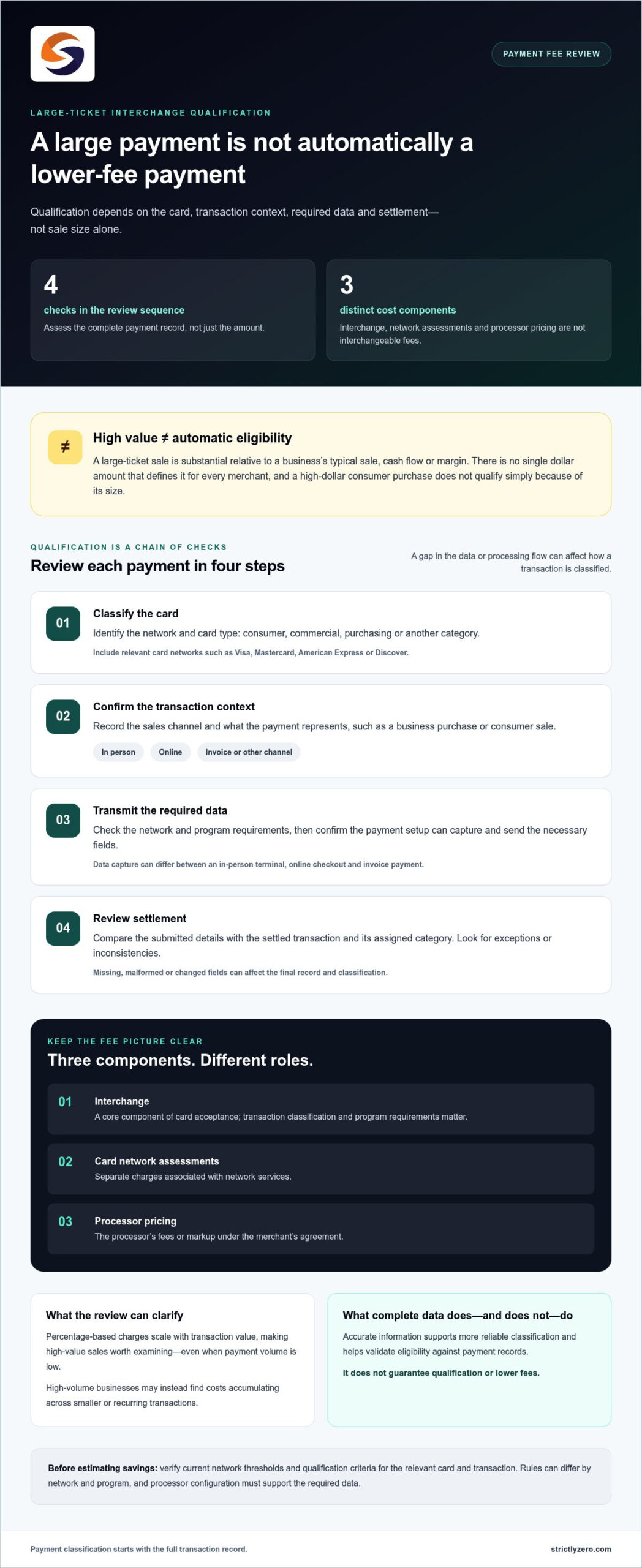
A large-ticket transaction is substantial in the context of a business’s typical sale, cash flow, or margin. It might be an unusually high invoice for one company and a routine order for another. There’s no single dollar amount that defines every merchant’s large-ticket sale, and transaction size alone doesn’t determine interchange eligibility. A payment can be high value without meeting a card network’s program rules.
That distinction matters when you’re looking to lower fees for large ticket transactions. A higher sale amount can make percentage-based charges more noticeable in absolute terms, but the final processing cost also depends on how the transaction is classified, the pricing arrangement, and other applicable charges. Reviewing each component helps you identify costs that may be addressed through better data or a different pricing approach.
For a quick overview of why payment pricing matters to high-ticket businesses, watch this video:
Why high-value payments can magnify processing costs
When a processing charge is calculated as a percentage of the payment, the charge scales with the transaction value. That makes a high-value sale worth examining closely, even if the business processes relatively few payments. A high-volume business may instead see costs accumulate across many smaller or recurring transactions. Both patterns deserve attention, but the reviews differ: one focuses on individual payment details, while the other looks for recurring trends across batches or channels.
Actual costs depend on the transaction and the merchant’s pricing details. Interchange is a core component of card acceptance; this interchange fee overview explains its role between financial institutions. Card network assessments are separate charges associated with network services. Processor pricing is another component, reflecting the processor’s fees or markup under the merchant’s agreement. These components shouldn’t be treated as one interchangeable fee.
Which large-ticket transactions may qualify for special treatment?
Some commercial, purchasing-card, or government payment contexts may qualify for specific interchange programs, depending on card network requirements. The business purpose and transaction data can matter alongside the card type. A high-dollar consumer purchase doesn’t automatically become eligible simply because its amount is large.
Before estimating potential savings, verify the current network thresholds and qualification criteria for the relevant card and transaction. Rules can differ by network and program, and processor configuration must support the required data. Validate eligibility against payment records rather than assuming it from the sale amount.
How large-ticket interchange qualification works in practice
Qualification is a chain of checks, not a label assigned because a payment is large. Card network rules define categories and required data; processor and gateway configuration determine whether relevant information is captured and passed through correctly. A gap at any point can affect classification, so assess the complete payment record rather than relying on the sale amount or a single statement line.
Use this sequence to review a transaction:
- Classify the card. Identify the network and whether it’s a consumer, commercial, purchasing, or other card type.
- Confirm the context. Record the sales channel and what the payment represents, such as a business purchase or consumer sale.
- Transmit required data. Check the network and program requirements, and confirm whether your payment setup can send the necessary fields.
- Review settlement. Compare the submitted details with the settled transaction and its assigned category to identify exceptions or inconsistencies.
Complete, accurate transaction data gives networks and processors information to assess card type, purchase context, channel, and program criteria. It supports more reliable classification, but doesn’t guarantee qualification or lower fees.
Card type and transaction details that affect eligibility
Commercial and purchasing cards can follow different interchange programs from consumer cards, but eligibility depends on the applicable network rules and transaction requirements. Include Visa, Mastercard, American Express, or Discover in your review where relevant to your card mix. Also record whether the payment was in person, online, or handled through another channel, and document its purchase purpose. These details help explain why transactions of similar value may be treated differently.
Card-present and card-not-present payments can involve different data capture and processing flows. An in-person terminal may collect information differently from an online checkout or invoice payment. That doesn’t mean one channel always qualifies or requires a universal set of fields. Compare the data each channel collects with the criteria for the specific card and program. For debit transactions, the Federal Reserve’s overview of Regulation II (Durbin Amendment) provides background on debit interchange regulation.
Data capture, settlement, and ongoing review
Accurate data matters at authorization and through settlement. If a field is missing, malformed, or changed between steps, the final record may not contain the information needed for the intended classification. Review representative transactions across channels, then flag records with blank, inconsistent, or unexpected values. Trace each issue to the checkout, invoice, gateway, or processor configuration that handled it.
Keep a record of the card category, channel, purchase context, submitted data, and settled result. Revisit the sample after configuration changes or when network program requirements are updated. This gives you a practical basis for deciding where to focus further analysis, without assuming that one data fix will secure eligibility or savings. Businesses looking to connect payment acceptance across channels can explore omnichannel payment processing as part of a broader review.
Compare interchange optimization, surcharging, and dual pricing
These approaches address payment costs in different ways. Interchange optimization focuses on how eligible transactions are classified under card network programs. Surcharging and dual pricing change how prices are presented to customers. One doesn’t replace the other, and none guarantees savings. Start with your transaction mix, then weigh eligibility, operational changes, customer expectations, and applicable network and state requirements.
Use this comparison to identify which path merits closer analysis:
| Approach | How it works | Suitable context | Customer impact | Compliance considerations |
|---|---|---|---|---|
| Interchange optimization | Submits accurate transaction details to support correct classification under applicable programs. | Potentially eligible commercial or purchasing-card transactions. | Usually no new checkout fee or price display is introduced. | Network criteria, transaction data, and processor configuration determine eligibility. |
| Surcharging | Adds a disclosed charge to eligible credit-card transactions. | Businesses assessing whether to offset some card acceptance costs. | Customers see an additional charge associated with using a credit card. | State and network rules may govern eligibility, disclosure, and limits; debit-card restrictions also apply. |
| Dual pricing | Displays different prices upfront for different payment methods, commonly card and cash. | Businesses able to present clear payment-specific prices before purchase. | Customers can see the applicable price before choosing how to pay. | Price presentation and implementation must follow applicable laws and network requirements. |
Because requirements vary, don’t assume a surcharge or dual-pricing setup is permitted in every situation. Review current rules for the places you operate and the card networks you accept before changing prices. This zero-fee credit card processing guide provides additional context on how customer-facing pricing models are described, but the right model depends on your transaction and compliance review.
When interchange optimization is the relevant path
Consider optimization when your transaction records show commercial or purchasing cards and a plausible fit with a network program. The goal is accurate classification, not changing eligibility rules: a large payment alone doesn’t qualify. Compare a representative sample by card type, channel, and purchase context before estimating whether better data capture could matter. If most payments are consumer-card transactions, this may not be the main path to pursue.
When customer-facing pricing models merit evaluation
Evaluate surcharging and dual pricing separately. A surcharge appears as an added charge for eligible credit-card use, while dual pricing presents payment-specific prices upfront. Consider how customers will encounter the price online, in person, or through an invoice, and whether the method suits your sales process. A credit card processing services guide can help frame broader processing choices alongside these pricing decisions.
To lower fees for large ticket transactions, first determine whether the opportunity lies in transaction qualification or in how payment costs are presented. Then compare operational and customer implications before selecting a strategy. Reviewing all payment channels can make that decision clearer.
Build a practical workflow to review large-ticket payment fees
A useful fee review starts with comparable records, not one unusually large payment or a processor statement viewed in isolation. The aim is to see how costs and transaction outcomes vary across your business, then test changes against a clear baseline. A repeatable process helps you decide whether to focus on data quality, pricing presentation, or a particular sales channel.
Audit transaction mix and processing records
Begin with a representative sample that includes online, in-person, and mobile payments, plus the payment types and customer groups that matter to your business. Record transaction size, card category, sales channel, and customer segment. Check that transaction details are complete and consistent, then note patterns or questions before choosing a fee strategy.
- Set a consistent review period. Use the same statement and transaction dates when comparing costs. Account for refunds, adjustments, and other items that could make periods difficult to compare.
- Group like with like. Separate consumer and commercial cards where records allow, and compare transactions within similar channels, size bands, and customer groups.
- Reconcile records. Compare transaction data with settlement details and processing statements. Flag unexplained differences, missing fields, or categories that appear inconsistent.
- Document the baseline. Track current fee components, transaction counts, classification outcomes, and customer-facing pricing practices. Keep definitions consistent for future comparisons.
This segmentation helps prevent a change in one area from obscuring what’s happening elsewhere. For example, an overall cost shift may reflect a different card mix or sales channel, rather than the effect of a pricing or data change. Record observations first; don’t treat a single statement line as proof of a broader pattern.
Evaluate a change without overlooking trade-offs
Model eligible commercial transactions separately from consumer payments, and don’t assume all high-value sales meet program criteria. Compare possible interchange improvements with customer-facing options such as surcharging or dual pricing. Consider operational work and customer messaging alongside fee effects. Set a regular review cadence and assess results against the original baseline, including classification accuracy, customer response, and fee changes.
Before implementing a change, define what you’ll monitor and who will review it. If the payment experience changes, give staff and customers clear, consistent information through the relevant channel. After implementation, compare equivalent periods and transaction groups, noting both expected and unexpected outcomes. If records or customer feedback point to a problem, investigate the affected segment before drawing conclusions or expanding the change.
A disciplined workflow makes it easier to identify realistic ways to lower fees for large ticket transactions without confusing a change in transaction mix with a meaningful improvement. Strictly’s omnichannel payment processing connects online, in-person, and mobile acceptance. Its Smart Pricing Engine supports state-by-state compliance automation and debit-card detection for surcharge and dual-pricing workflows. Explore payment-fee management with Strictly as you evaluate a setup that fits your channels and customers.
How Strictly supports a more manageable payment-fee strategy
Your audit may reveal fee-management challenges beyond one large sale. Payment data may come from different channels, pricing rules may need review, or records for assessing transaction patterns may be spread across separate workflows. Strictly’s omnichannel payment processing supports online, in-person, and mobile transactions, bringing payment acceptance across these channels into a more consistent setup.
A unified approach doesn’t change card network eligibility rules or guarantee lower processing costs. It can help connect your findings to operational decisions: which channels need closer review, where pricing controls may apply, and how customer payment options are presented. The right next step depends on what your audit shows.
Bring payment channels and pricing controls together
Businesses can use online checkout for e-commerce, in-person acceptance for face-to-face sales, and mobile payments for transactions completed away from a fixed counter. Strictly supports these channels through its payment processing platform. Virtual terminal and invoicing tools can also support payments by invoice or payment link, while recurring billing is relevant for repeat charges.
Consistent payment workflows across channels can make ongoing review more practical. Compare transaction records by channel, card type, and customer group, then use those findings to revisit classification and pricing decisions. This gives your team a clearer basis for follow-up without assuming every channel or transaction should use the same fee strategy.
Explore a compliant pricing approach with Strictly
If your analysis points toward surcharge or dual pricing, treat either as an option to evaluate, not an automatic route to savings. Requirements can vary by state and card network, and customer experience matters too. Strictly’s Smart Pricing Engine supports state-by-state compliance automation and debit-card detection for surcharge and dual-pricing workflows. These features support pricing controls, but they don’t make every transaction eligible or replace careful review of applicable requirements.
Before changing how prices are presented, consider where customers encounter the price, how they choose a payment method, and whether the same approach can be communicated clearly across your sales channels. Review the impact after implementation, including customer response and transaction outcomes. A pricing setup should fit the way your business sells, not simply react to a large payment on a statement.
To lower fees for large ticket transactions, pair transaction analysis with a payment setup that helps you manage channels and pricing decisions coherently. Strictly brings omnichannel processing together with surcharge and dual-pricing tools, so businesses can assess these options in the context of their payment mix. Explore payment processing with Strictly and consider how its approach fits your business.
Make your next payment review count
Turn your fee review into an ongoing business practice. Set a baseline, decide which transaction patterns to monitor, and revisit the results when your sales mix or payment process changes. This keeps decisions about how to lower fees for large ticket transactions grounded in current records rather than assumptions about what should qualify or save money.
As your review points to practical changes, consider how payment tools fit your sales workflow and customer expectations. Strictly’s API-first platform includes a virtual terminal, payment links, and recurring billing, alongside omnichannel processing and pricing controls. These capabilities can support a payment setup shaped around the ways your business accepts payments, without promising a particular fee outcome.
Explore Strictly’s payment processing platform and take the next step toward a clearer, more manageable payment strategy.
Frequently Asked Questions
Do large-ticket transactions automatically qualify for lower interchange fees?
No. A high transaction amount alone doesn’t establish eligibility. Qualification depends on the card network’s program criteria, the card category, transaction context, and required data. For example, a payment might exceed a program’s value threshold but still fail other requirements. Review the transaction’s settled classification alongside its original details before assuming it received a particular interchange category or estimating potential savings.
What qualifies as a large-ticket credit card transaction?
There isn’t one universal definition across card networks or programs. For current U.S. thresholds cited in this 2026 guide, Visa’s large-ticket program starts at $6,980, while Mastercard’s starts at $7,255. Meeting a threshold doesn’t guarantee qualification: the card type, transaction criteria, and required data also matter. Check the current network rules for the specific card program before applying a threshold to your transactions.
Can a large consumer purchase qualify for large-ticket interchange?
Not necessarily. A consumer purchase can be expensive and still fall outside a program intended for particular commercial or purchasing-card transactions. For instance, a customer’s personal card purchase shouldn’t be treated like a company’s purchasing-card transaction just because the sale amount is similar. Review the card product and transaction purpose, then compare them with the applicable network criteria. Don’t classify a sale from its amount alone.
How can a business check whether a transaction received the correct interchange classification?
Match a settled payment to its processor transaction details and statement entry. Compare the card network and type, transaction date, channel, submitted data, and assigned interchange category. Then review the applicable program criteria to see whether the recorded information appears consistent with that classification. If a result looks unexpected, document the transaction identifier and discrepancy. An unexplained entry may point to a data or configuration issue worth investigating.
Can surcharging reduce processing fees on large-ticket payments?
Surcharging may offset some acceptance costs for eligible credit-card payments, but it doesn’t change the underlying interchange or processor charges. Whether it’s appropriate depends on applicable state and card network requirements, the payment method, and how customers will see the charge. Debit-card transactions have separate restrictions. Assess the potential financial effect alongside customer response and implementation needs rather than treating surcharging as guaranteed savings.
Is dual pricing the same as adding a credit card surcharge?
No. A surcharge adds a disclosed charge for eligible credit-card use, while dual pricing presents separate payment-method prices upfront so customers can see the applicable amount before paying. The distinction affects checkout design, messaging, and how prices appear in sales materials. Neither approach suits every business by default: review current legal and network requirements, and make sure pricing is clear in each channel where customers shop.
What transaction data should a business review when trying to lower processing fees?
To lower fees for large ticket transactions, examine records that connect payment details to the settled result: card network and type, transaction amount, channel, purchase context, submitted data, and assigned classification. Also compare authorization and settlement records, refunds or reversals, and statement categories over consistent periods. Segment results by customer group where useful. This can reveal whether a cost pattern relates to card mix, missing information, or processing workflow.