

What if your most valuable customer data was also your biggest liability, unless it didn’t actually exist in your system at all? With the global tokenization market expected to hit $6.29 billion in 2026, it’s clear that the old ways of handling sensitive information are over. You’re likely feeling the pressure of PCI DSS v4.0.1 requirements, where every stored digit feels like a ticking time bomb for a potential breach. Implementing credit card tokenization for merchants is no longer just a security feature; it’s a fundamental requirement for any business that wants to grow without the constant fear of a data leak or an expensive, complex audit.
You want to provide a seamless shopping experience, but the friction of repeated data entry often kills the sale. We understand that balancing tight security with a “one-click” checkout feels like a moving target. This guide will show you how to use tokenization to lock down your data while simultaneously unlocking new growth. You’ll learn how to reduce your PCI compliance scope, leverage AI-driven fraud prevention, and even eliminate processing fees using a smart surcharge engine. We’ll explore the path to a more secure, profitable, and customer-friendly payment ecosystem.
Key Takeaways
- Learn how replacing raw card numbers with unique identifiers ensures your data isn’t useful to hackers even if a breach occurs.
- Discover how credit card tokenization for merchants simplifies your compliance journey by moving you from complex SAQ-D audits to a streamlined SAQ-A.
- See how tokens enable seamless one-click checkouts and help you recognize returning customers across every sales channel.
- Understand how a Smart Pricing Engine uses tokenized logic to identify card types instantly and keep your surcharge program compliant in every state.
- Find out how to audit your current data storage and integrate an API-first platform that supports your developers and scales your business.
What is Credit Card Tokenization? A 2026 Definition for Merchants
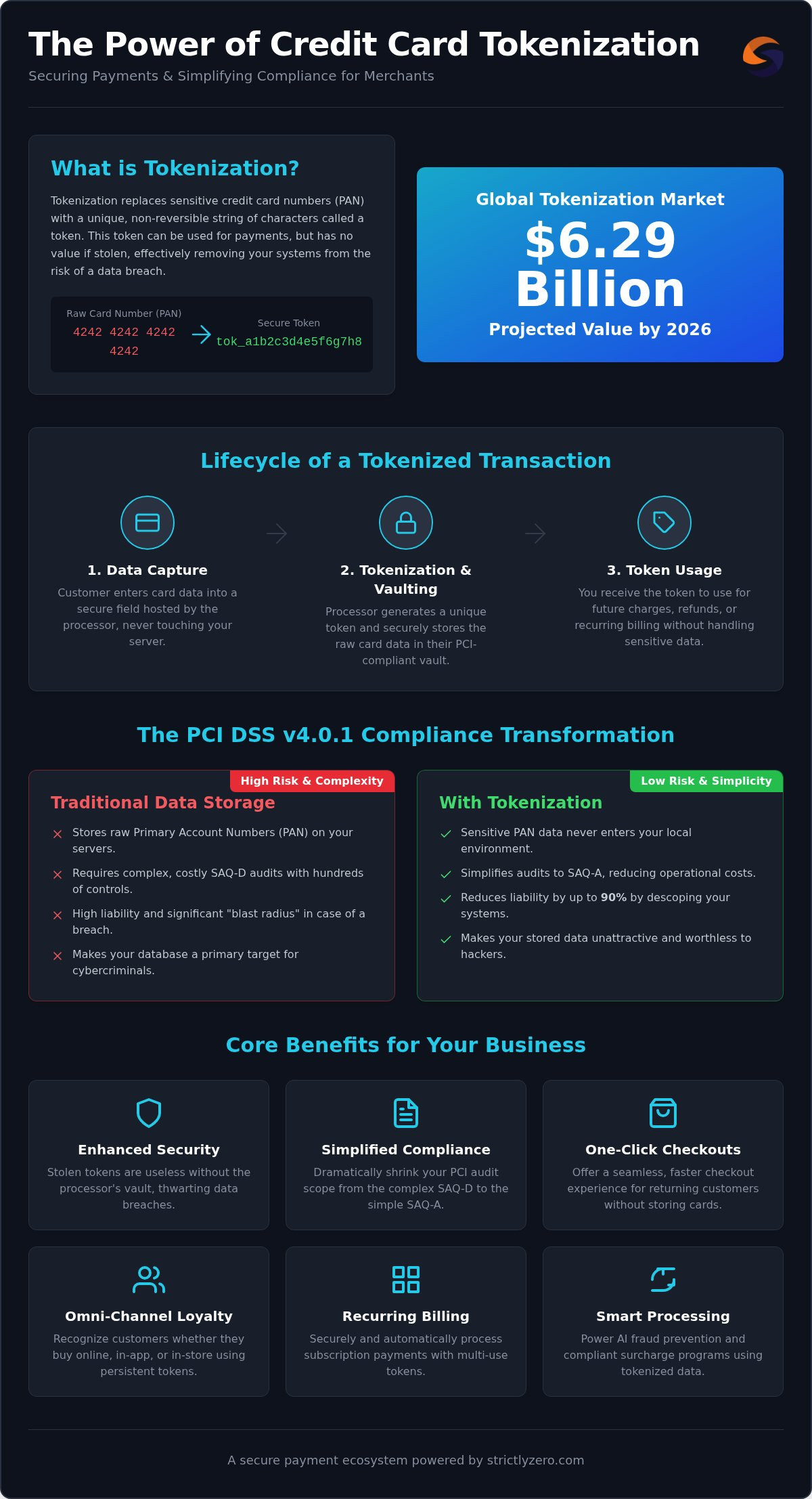
Credit card tokenization for merchants is the process of replacing a customer’s 16-digit Primary Account Number (PAN) with a unique, randomly generated alphanumeric string known as a token. This process happens instantly at the point of capture. While encryption scrambles data using a mathematical algorithm that can be reversed with a decryption key, tokenization is non-reversible. There’s no mathematical formula to turn a token back into a card number. This makes Payment tokenization a superior security layer because even if a hacker intercepts the data, they possess nothing of value.
The way tokens behave depends on the environment. In-store transactions using EMV chips typically rely on dynamic tokens that change with every tap or dip. This prevents replay attacks where a thief tries to reuse captured data. For e-commerce, merchants often use persistent tokens. These allow you to recognize a returning buyer and offer a one-click experience without actually holding their financial details on your own servers. By keeping the sensitive data at the processor level, you effectively remove your business from the line of fire.
The Lifecycle of a Tokenized Transaction
Understanding how a transaction moves through your system helps clarify why your risk drops so significantly. It’s a three-step cycle that keeps sensitive data away from your internal network:
- Step 1: The customer enters card data into a secure payment field on your site or app. This field is usually hosted by the processor, so the data never touches your server.
- Step 2: The processor generates a unique token and stores the raw card data in their secure, PCI-compliant vault.
- Step 3: You receive the token for future use. You can process refunds, recurring bills, or one-click checkouts without ever touching the actual card data.
Vaulting vs. Tokenization: What Merchants Need to Know
Vaulting refers to where the data lives; tokenization is how you interact with it. In 2026, the Token Vault is the heart of the payment ecosystem, sitting entirely outside the merchant’s network. Multi-use tokens are especially valuable for recurring billing models. They let you trigger monthly payments or recognize customers across different platforms while the actual PAN remains locked away. Because the sensitive data doesn’t live on your servers, your liability is slashed, and your compliance path becomes much simpler.
The Role of Tokenization in PCI DSS Compliance and Data Security
Credit card tokenization for merchants provides a powerful shortcut to meeting the rigorous demands of PCI DSS v4.0.1. By replacing raw card data with tokens, you ensure that sensitive information never enters your local environment. This simple shift can reduce your liability by up to 90% because you aren’t storing the data that cybercriminals actually want. When your systems don’t see or touch the Primary Account Number (PAN), the scope of your annual security audit shrinks dramatically.
Moving from a complex SAQ-D, which involves hundreds of security controls, to a simplified SAQ-A is a game changer for operational costs. Instead of spending weeks on documentation and network testing, you rely on your processor’s PCI Level 1 certified environment to handle the heavy lifting. This allows you to focus on growth while maintaining a risk-based security model. Modern systems combine this with AI-driven fraud prevention to analyze tokenized data streams, stopping unauthorized transactions before they can impact your bottom line.
Reducing the ‘Blast Radius’ of a Potential Breach
Storing tokens instead of card numbers makes your database an unattractive target for hackers. If a breach occurs, the stolen tokens are worthless without access to the secure vault held by your processor. This is especially vital in credit card processing for small business, where resources for high-level cybersecurity are often limited. In 2026, end-to-end tokenization has become the standard for omni-channel merchants, ensuring that a customer’s data remains protected whether they buy online, via a mobile app, or at a physical terminal.
Tokenization and the 2026 PCI DSS Version Requirements
The current PCI DSS v4.0.1 standard emphasizes continuous compliance rather than a once-a-year checklist. Cloud-based tokenization solutions are now the preferred method for meeting these updated requirements because they remove sensitive data from the merchant’s network entirely. By choosing a partner that manages the entire data lifecycle, you effectively outsource the technical complexities of encryption and key management. This ensures your business stays ahead of regulatory changes without needing a dedicated team of security experts. To see how this fits into a broader strategy, you can explore how we provide trust as a payment processor through our secure infrastructure.
Omni-Channel Benefits: Using Tokens to Power Customer Loyalty
Beyond the shield of security, credit card tokenization for merchants acts as a catalyst for superior customer experiences. In 2026, the friction of manual data entry is a major conversion killer. By utilizing tokens, you can implement a “one-click” checkout process that rivals major global marketplaces. When a customer returns to your site, their token is retrieved from a secure vault, allowing them to finalize a purchase in seconds without ever re-entering their card details. This level of convenience is essential for modern ecommerce payment processing, whether the customer is browsing on a mobile device or a desktop.
The true power of this technology lies in its ability to bridge the gap between digital and physical storefronts. If a customer buys a product online and later visits your brick-and-mortar location, a unified tokenization system allows you to recognize them instantly. This cross-channel recognition means you can provide personalized service and apply loyalty rewards based on their entire purchase history. It creates a frictionless journey that builds long-term trust without requiring you to store sensitive data on local devices.
Enabling Seamless Recurring Billing
Managing subscriptions used to be a headache involving manual outreach every time a card expired. Today, credit card tokenization for merchants integrates with Account Updater services. These services automatically refresh the tokenized data when a bank issues a new physical card to the customer. This prevents payment failures and reduces involuntary churn, ensuring your revenue remains stable. Whether you’re processing these payments through a website or a virtual terminal, the transition is invisible to the customer and effortless for your team. You don’t have to worry about the “expired card” emails that often lead to cancelled subscriptions.
The Unified Customer Profile
Tokens serve as a unique identifier that links a customer’s online and offline behavior without storing their actual financial data. This unified profile lets you track purchase history across all credit card processing services you utilize. You can see what a customer likes and tailor your marketing efforts accordingly, all while maintaining strict privacy standards. By focusing on the customer rather than just the transaction, you transform a simple security measure into a strategic asset for growth. It’s about recognizing the person behind the payment and delivering a consistent experience every time they interact with your brand.
Implementation Strategies: Integrating Tokenization into Your Workflow
Implementing credit card tokenization for merchants involves more than just flipping a switch. It requires a deliberate shift in how your business handles data at every touchpoint. Start with a thorough audit of your current storage practices. You might find raw card numbers hidden in legacy databases, old spreadsheets, or even customer support logs. Once you’ve identified these vulnerabilities, the next step is selecting a processor that offers universal tokenization through an API-first infrastructure. This ensures that the data is replaced by a token before it ever touches your internal network.
Your implementation should follow these five core steps:
- Step 1: Audit storage locations to identify where PAN data currently resides.
- Step 2: Select an API-first processor that supports cross-channel tokens.
- Step 3: Use secure migration tools to swap legacy data for tokens.
- Step 4: Implement hosted fields or secure iFrames in your checkout UI to keep data off your servers.
- Step 5: Train your team on managing tokenized records within your virtual terminal.
API-First Integration for Developers
Developers favor RESTful APIs because they allow for clean, scalable deployment across mobile and web platforms. By using an API-first approach, your technical team can build custom payment flows that integrate directly with your existing ERP or CRM systems. It’s vital to test these flows in a sandbox environment before going live. This ensures that the tokenization handshake between your front end and the processor’s vault is seamless and doesn’t introduce latency into the checkout process. A successful rollout of credit card tokenization for merchants ensures that your developers spend less time on compliance and more time on feature growth.
Migrating Legacy Card Data
If you’re moving from an older system, you’ll need a bulk migration strategy. This involves a secure transfer of sensitive data from your previous provider to a new, more robust payment processing platform for ISOs. A well-executed migration avoids downtime and ensures that your recurring billing cycles aren’t interrupted. Once the transfer is complete, verify data integrity by running test transactions against the new tokens. If you’re ready to modernize your stack, you can partner with a processor that prioritizes developer-friendly security to guide you through the transition.
Strictly’s Tokenization: The Key to Zero-Fee Processing
Strictly’s platform turns credit card tokenization for merchants into a strategic advantage that goes far beyond simple data protection. While we’ve discussed how tokens mitigate the risk of a breach, their role in financial optimization is equally vital. Our Smart Pricing Engine uses the metadata attached to a token to distinguish between card types in milliseconds. This precision is what makes zero fee credit card processing a reality. By identifying a credit card versus a debit card at the moment of the transaction, our system applies the correct surcharge logic automatically. You don’t have to guess or manually calculate fees; the technology does it for you while keeping your business safely within the lines of state and federal regulations.
Staying compliant with surcharge programs is often a moving target. State laws are in a constant state of flux, but our tokenized backbone allows for automated software updates that reflect the latest legal requirements. This means your checkout process remains frictionless and transparent for the consumer. You protect your profit margins without the administrative burden of tracking legislative changes. It’s about building a sustainable business model where you aren’t penalized for every sale you make. By leveraging credit card tokenization for merchants, we provide a level of automation that legacy processors simply can’t match.
Smart Surcharge Compliance
Automating the surcharge process requires deep insight into the card being used. Our tokenized logic detects the card’s attributes instantly to ensure you only apply surcharges where they are legally permitted. This prevents the risk of overcharging or non-compliance, which can lead to heavy fines or loss of processing privileges. As state laws evolve in 2026, our system updates in real time, ensuring your business never misses a beat. This automation reduces friction for your customers because the price they see is accurate and compliant, protecting your reputation while you eliminate processing costs.
Unified Reporting and ChurnIQ™
The value of tokenization extends into your long-term strategy through unified reporting. Strictly’s dashboard provides a clear window into your business health by feeding tokenized data into ChurnIQ™, our merchant retention intelligence tool. This helps you understand customer behavior patterns and predict potential churn before it happens. You gain access to real-time statistics and cost tracking that prove the value of your zero-fee setup every day. Instead of raw card numbers that offer no insight, you have a secure stream of data that informs your marketing and operational decisions. When you’re ready to stop losing revenue to processing fees, it’s time to scale your business with Strictly’s zero-fee payment platform and experience the intersection of total security and total savings.
Future-Proof Your Payments Strategy
The transition to credit card tokenization for merchants represents a fundamental evolution in how we protect and grow businesses in 2026. By removing sensitive data from your local environment, you’ve learned how to slash your PCI compliance burden while simultaneously creating a smoother, one-click experience for your customers across every channel. This isn’t just about defensive security; it’s about building a foundation for scalable growth and customer loyalty through a unified, secure platform.
Strictly provides the tools you need to turn these security benefits into real-world savings. Our API-first omni-channel platform combines AI-driven fraud prevention with a compliant surcharge and dual pricing program to help you reclaim your margins. It’s time to stop letting processing fees and data liabilities hold your business back. Secure Your Business and Eliminate Fees with Strictly and start focusing on what you do best. Your journey to a more secure and profitable future begins today.
Frequently Asked Questions
Is credit card tokenization the same as encryption?
No, they’re different technologies. Encryption uses an algorithm to scramble card data into a format that can be reversed with a key. Tokenization replaces the card number with a random string that has no mathematical value. This makes it non-reversible. Because there’s no key to steal, tokenization is often considered safer for long-term storage and reducing the scope of your security audits.
Does tokenization make my business 100% PCI compliant?
No single tool makes you 100% compliant, but tokenization handles the most difficult requirements. By using credit card tokenization for merchants, you ensure your systems never touch raw card data. This allows you to fill out a much shorter Self-Assessment Questionnaire, such as SAQ-A. You’re still responsible for physical security and employee access; however, you’ve eliminated the risk of storing sensitive financial digits on your own network.
Can I use the same token across different payment channels?
Yes, if you’re using an omni-channel platform. A unified system generates a single token that follows the customer across your website, mobile app, and physical terminal. This lets you recognize a returning buyer regardless of where they shop. It’s a powerful way to link purchase history and loyalty points without ever storing a card number. You get a complete view of customer behavior while keeping their data locked in a secure vault.
What happens to the tokens if I decide to switch payment processors?
Tokens are usually specific to the processor that created them. If you move to a new platform, you don’t lose your data, but you will need a bulk migration. Your old processor securely transfers the raw card data to the new processor’s vault. Once the transfer is complete, your new provider generates fresh tokens for your records. This ensures your recurring billing and subscription services continue to run without any downtime or customer friction.
Does tokenization affect the speed of the checkout process for my customers?
It actually makes the process faster for returning buyers. Since the token is already stored in a secure vault, customers don’t have to re-enter their card details for future purchases. This enables a seamless one-click checkout. For new customers, the tokenization happens in the background in a fraction of a second. There’s no noticeable delay, and the added security gives your buyers more confidence to complete their transaction on your site.
How much does it cost to implement tokenization for a small business?
Pricing depends on your processing partner, but many modern providers bundle tokenization into their standard security offerings. Instead of looking at it as an extra cost, think of it as a way to save money. By reducing your PCI compliance scope and protecting you from breach-related fines, it pays for itself. It’s a strategic investment that helps small businesses compete with larger retailers by offering a high-end, secure checkout experience.
Can tokenization help reduce my chargeback rates?
While it won’t stop every dispute, it helps you fight fraud more effectively. Tokenization links transactions to a specific customer profile, which makes it easier for AI-driven fraud prevention tools to spot anomalies. If a fraudster tries to use stolen data, the system can flag it instantly. Having a secure, tokenized history also provides better evidence if you need to challenge a dishonest chargeback, as it proves a consistent relationship with the buyer.
Is tokenization required for mobile wallet payments like Apple Pay?
Yes, tokenization is the core technology behind mobile wallets. When a customer uses Apple Pay, your system never sees their actual card number. Instead, it receives a unique device-account number or token. Supporting credit card tokenization for merchants means your business is fully equipped to handle these secure, modern payments. It ensures that you’re meeting 2026 standards for contactless security while providing the fast, tap-to-pay convenience that your customers expect.