

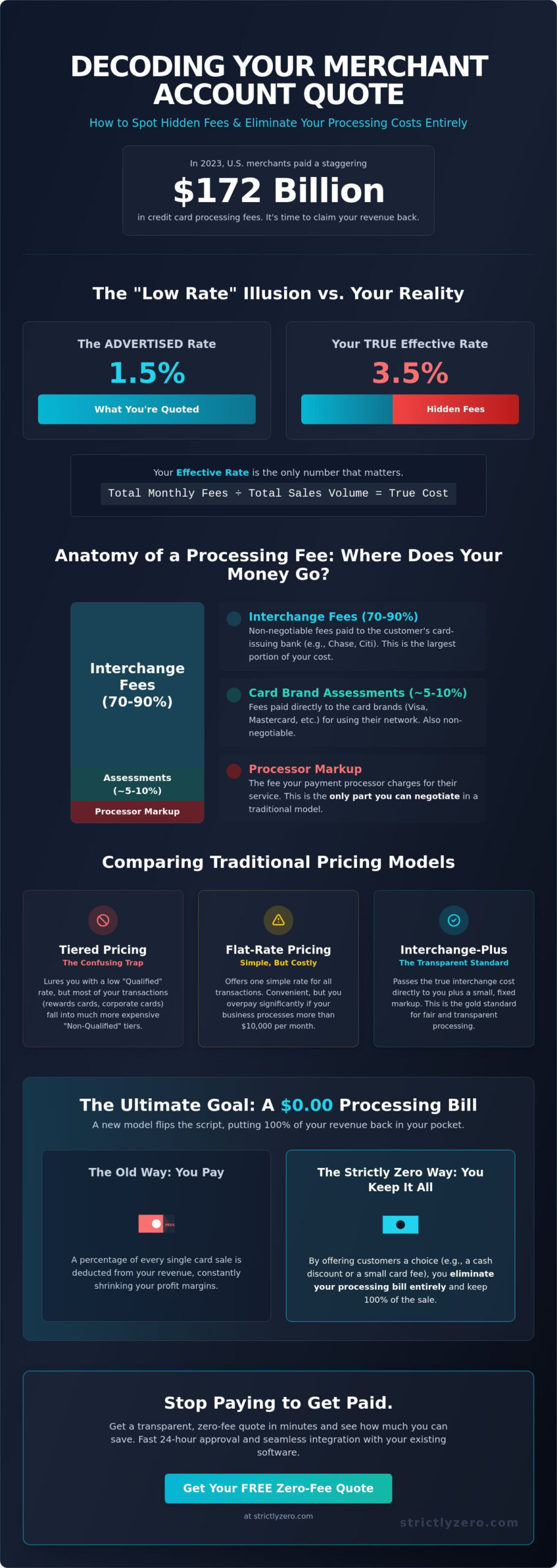
What if the monthly statement from your payment processor showed a balance of exactly $0.00? It sounds like a fantasy, but it’s a reality for businesses that know how to get a merchant account quote that cuts through industry jargon. You likely already know that the “low rates” promised in sales calls often morph into a mess of hidden fees within 90 days of signing. It’s frustrating to watch a significant portion of your revenue vanish into a black hole of complex tiered pricing. In 2023, U.S. merchants paid a staggering $172 billion in processing fees, proving that the traditional model is designed to favor the processor, not the store owner.
For businesses in the UK, PurePay Hub provides specialized card machines and POS systems that help demystify the quoting process with clear, local pricing.
We agree that your processing bill should be predictable and transparent, not a monthly riddle. This guide promises to show you exactly how to decipher confusing quotes and leverage a zero-fee model to eliminate your processing costs entirely. We’ll walk through the specific steps to integrate these savings with your existing software and explain how to manage surcharge compliance across all 50 states. You are about to learn how to secure a merchant account that protects your margins instead of draining them.
Key Takeaways
- Identify the “hidden fee” trap by learning how to distinguish between low advertised rates and your true effective processing cost.
- Decode the complex components of a processing proposal, from non-negotiable interchange fees to card brand assessment charges.
- Learn the exact steps to get a merchant account quote that utilizes zero-fee models to eliminate your credit card processing expenses entirely.
- Master the transition from traditional pricing to dual pricing strategies that maintain transparency while protecting your profit margins.
- Prepare the critical documentation required to fast-track your approval and activate a modern, omni-channel processing solution in as little as 24 hours.
What Is a Merchant Account Quote and Why Is It So Confusing?
A merchant account quote is a formal proposal that breaks down the specific costs your business will pay to process credit and debit card transactions. It acts as a financial blueprint for your payment infrastructure, detailing everything from percentage-based fees to fixed per-transaction charges. To understand the foundational mechanics of these systems, it helps to review What Is a Merchant Account and how it connects your business to the banking networks.
The process to get a merchant account quote has become increasingly complex as we move through 2026. This is largely due to the rise of omni-channel commerce. When you mix e-commerce, in-person POS systems, and mobile payments, the risk profiles change for every transaction. This complexity often leads to the “hidden fee” trap. A provider might advertise a low rate to get you in the door, but the final cost rarely reflects that initial number once you factor in the specific ways your customers pay.
To better understand the steps involved in this process, watch this helpful video:
The Difference Between a Quote and an Effective Rate
The most important number for any business owner is the effective rate. You calculate this by taking your total monthly fees and dividing them by your total sales volume. It’s the only way to see the true cost of processing. Many merchants are lured by a 1.5% teaser rate, only to find their actual effective rate is 3.5% after monthly maintenance, PCI compliance fees, and gateway costs are added. When comparing quotes, you will often hear the term basis points. A single basis point (BPS) is equal to 1/100th of a percentage point.
Common Quote Structures: Tiered, Flat, and Interchange-Plus
Providers generally use one of three pricing models. Tiered pricing is often a bait-and-switch tactic. It groups transactions into “qualified,” “mid-qualified,” and “non-qualified” buckets. While the qualified rate looks low, high-end rewards cards or corporate cards often fall into the non-qualified category, which carries much higher fees.
Flat-rate pricing offers a single percentage for every transaction. It’s simple to understand, but it’s frequently the most expensive option for businesses with high sales volumes. For a business processing more than $10,000 monthly, flat rates usually result in overpayment.
Interchange-plus is the gold standard for transparency. This model passes the raw cost from the card networks directly to you, plus a small, fixed markup. By 2026, many savvy businesses are also looking at dual-pricing and surcharge models. These newer structures allow merchants to offset processing costs by offering a cash discount or adding a small fee to credit card transactions, which can significantly lower the overall expense of your merchant account quote.
The Anatomy of a Processing Quote: Breaking Down the Fees
To get a merchant account quote that actually reflects your true costs, you must look past the “teaser” rate often highlighted on sales pages. A processing quote is a stack of different costs from different entities. First, interchange fees represent the largest portion of your bill. These are non-negotiable costs paid to the banks that issue the credit cards. According to industry data from 2024, interchange typically accounts for 70 percent to 90 percent of total processing expenses.
Second, you will see assessment fees. These are small percentages, often around 0.13 percent to 0.15 percent, paid directly to card brands like Visa and Mastercard for the use of their networks. Understanding Processing Fees and how these regulations impact your bottom line is vital for any business owner looking to minimize overhead.
The third layer is the processor markup. This is the only part of the quote where the processing company makes their profit. It’s also the only area where you have significant room to negotiate. Finally, watch for ancillary costs. These include PCI compliance fees to ensure data security, gateway fees for online connectivity, and monthly statement charges. If a quote doesn’t explicitly list these, they’re likely hidden in a higher markup elsewhere.
Transactional vs. Monthly Fixed Costs
Quotes generally split costs into per-transaction fees and recurring fixed fees. High-ticket businesses, such as a custom jeweler with a $5,000 average sale, should prioritize the lowest possible per-transaction percentage. A small 0.20 percent difference on a large sale saves significant capital. Conversely, low-ticket businesses like coffee shops are often hurt by high per-transaction minimums. If you sell a $4.00 latte, a $0.30 transaction fee eats 7.5 percent of your revenue before the percentage fee even applies. For these models, a quote with a higher monthly “membership” fee but a lower per-transaction cent-amount is usually more profitable.
Technology and Integration Fees
Your hardware and software choices directly impact the final numbers when you get a merchant account quote. If you process orders over the phone, your quote will include virtual terminal costs. If you run a custom web store, expect API and gateway integration fees. Because ecommerce payment processing requires more robust security layers like tokenization and 3D Secure, those quotes often carry higher technology overhead than a standard retail tap-to-pay setup. If you want to see how these tech costs apply to your specific business model, you can review a transparent fee schedule to compare options side-by-side.
Traditional Quotes vs. Zero-Fee Surcharge Quotes
When you get a merchant account quote in 2026, you’ll see two distinct paths. The traditional path involves the merchant paying 2.5% to 4% of every sale to banks and processors. To understand the complexity of the old way, look at The Anatomy of a Processing Quote, which details the interchange and markup layers that eat into your margins. The modern path shifts these costs from the business owner to the cardholder, fundamentally changing your bottom line.
The math is simple but impactful. A business processing $75,000 monthly under a traditional quote pays roughly $2,100 in fees. With a zero-fee surcharge model, that monthly bill drops to $0. Dual pricing makes this transparent by showing a card price and a discounted cash price. This ensures customers feel they have a choice rather than a penalty, which is vital for maintaining high-volume retail operations.
How the Strictly Surcharge Engine Works
Strictly’s Smart Pricing Engine automates the heavy lifting of legal compliance. It’s illegal to surcharge debit cards under federal law; our system uses automated debit card detection to identify the card type instantly. If a customer swipes a debit card, the surcharge is blocked. This technology is a core part of zero fee credit card processing. The engine also tracks state-by-state laws in real-time. Since states have different rules regarding disclosure and caps, the engine adjusts automatically based on your physical location and the customer’s billing state.
Customer Perception and Retention
Business owners often worry that surcharges drive people away. Data from 2025 shows that 84% of consumers now expect a small fee for credit card convenience or a discount for cash. It’s often better than the alternative. If a merchant raises all prices by 5% to cover fees, cash customers are penalized. This “hidden tax” is becoming less popular than transparent surcharging.
Clear signage and transparent invoicing are the keys to building trust. Most customers prefer a 3% fee on their specific transaction over a store-wide price hike that affects everyone. When you get a merchant account quote that includes these transparency tools, you’re protecting your brand reputation while eliminating overhead. Using professional signage at the point of sale ensures you stay compliant while educating your customer base on why you offer a cash discount.
5 Things You Need to Get an Accurate Merchant Quote
Getting a precise estimate requires more than just your business name and a rough guess of your sales. If you want to get a merchant account quote that holds up during the underwriting process, you must provide hard data from the start. Processors use this information to calculate risk and determine which pricing tier fits your business model. Providing vague numbers usually leads to “teaser rates” that vanish once you sign the contract.
- Processing history: Gather at least 90 days of recent processing statements. These documents reveal your actual effective rate and highlight exactly where you’re overpaying.
- Average transaction size: Your “average ticket” influences whether a flat-rate or interchange-plus model is more cost-effective. A $10 quick-service restaurant has vastly different needs than a $2,500 luxury furniture store.
- Monthly volume: Total sales volume is your primary bargaining chip. Businesses processing over $50,000 monthly often secure lower basis point markups because they offer more stability to the processor.
- Business Type (MCC Code): Your Merchant Category Code determines your risk profile. High-risk industries face different fee structures than standard retail businesses.
- Technical requirements: Identify if you need physical POS hardware, a virtual terminal for remote billing, or a specific API integration for your website.
Preparation prevents the “bait and switch” tactics common in the industry. When you get a merchant account quote with these five pieces of data, you force the salesperson to provide a binding offer rather than a generic estimate.
Reviewing Your Current Statements for Leverage
Statement analysis is the first step to negotiation. Look closely at your current bill for “mid-qualified” or “non-qualified” surcharges. These labels often hide a 1.5% markup that wasn’t mentioned in your initial sales pitch. You should also identify junk fees like “PCI Non-Compliance” charges, which often cost between $19.00 and $45.00 per month. These fees are entirely avoidable if your provider helps you complete your annual self-assessment questionnaire properly.
2026 Compliance Checklist for Quotes
The regulatory environment shifted with the full implementation of PCI DSS 4.0 on March 31, 2025. Your 2026 quote must include technical support for these updated security standards. Verify that the processor handles 1099-K reporting accurately to ensure your gross sales figures match IRS records. Modern quotes should also include AI-driven fraud prevention. This technology can reduce chargeback rates by 22% or more by identifying suspicious patterns before the transaction is even authorized.
Get a Strictly Quote: The Path to $0 Processing Fees
Strictly represents a fundamental shift in how businesses handle transaction costs. We built an omni-channel platform specifically for the zero-fee revolution. By 2026, industry reports suggest that over 70% of retail businesses will utilize surcharging or cash discounting to protect their margins from rising interchange rates. Our technology automates this entire process, ensuring compliance across all 50 states while removing the burden of processing costs. When you get a merchant account quote from our team, you aren’t just getting a price list. You’re gaining access to a system designed to return thousands of dollars in annual revenue back to your bottom line.
Speed is our priority. We’ve streamlined our internal underwriting to facilitate fast-track approvals. Our goal is to have your quote finalized and your account active in as little as 24 hours. We don’t believe in the weeks-long waiting periods common with legacy banks. Whether you’re a single-location boutique or a national franchise, the path to zero fees starts with a transparent, data-driven assessment of your current volume and processing history.
Partner Quotes: Scaling with ClearSplit™
We provide robust infrastructure for ISOs, MSPs, and developers who need more than a standard merchant setup. ClearSplit™ technology automates residual payments, removing the manual spreadsheet errors that often plague the industry. Partners can also leverage ChurnIQ™ to monitor merchant health. This tool identifies specific patterns that lead to attrition, allowing you to intervene before a client switches providers. For a deeper look at these tools, explore our payment processing platform for ISOs and see how white-labeling can transform your brand’s value proposition.
The Onboarding Experience
Accepting your quote is just the first step. Once you’ve signed, our team initiates a structured integration process. This includes hardware configuration, software syncing, and comprehensive staff training. We’ve found that proper training reduces customer friction by 45% during the first month of zero-fee processing. You’ll have 24/7 access to our US-based support team. We don’t outsource our help desk, so you’ll always speak with a specialist who understands your specific setup and industry requirements.
Stop letting processing fees erode your profits. It’s time to get a merchant account quote that prioritizes your growth and sustainability. Get your custom merchant account quote from Strictly and join the zero-fee movement today.
Future-Proof Your Business with Transparent Processing
Navigating the complexities of payment processing doesn’t have to be a guessing game. You’ve learned how to decode hidden fees and why gathering your last 3 months of processing statements is vital for accuracy. The payment landscape is shifting toward total transparency. By 2026, business owners who prioritize surcharge models can significantly improve their bottom lines. It’s time to stop letting legacy fee structures eat your profit margins. When you’re ready to get a merchant account quote, look for solutions that prioritize modern technology over outdated manual adjustments.
Our API-first platform integrates seamlessly with your existing stack. Meanwhile, the Smart Pricing Engine ensures 100% compliance with evolving state and federal regulations. This specialized approach helps businesses reduce their processing fees by up to 100%. Don’t settle for opaque pricing when you can leverage a system built for the future of global commerce. You now have the knowledge and tools to make an informed decision and reclaim your hard-earned revenue. Success starts with clarity.
Get Your Zero-Fee Merchant Account Quote Now
Frequently Asked Questions
Is a merchant account quote free?
Yes, getting a merchant account quote is free with 95% of reputable payment processors in 2026. You shouldn’t pay an application or consultation fee just to see potential rates. If a provider asks for an upfront payment before disclosing their fee structure, it’s a red flag. Most firms use these quotes as a sales tool to earn your business and build trust during the initial discovery phase.
How long does it take to get a merchant account quote?
You can typically expect to receive a detailed quote within 24 to 48 hours after submitting your processing statements. While some automated systems provide instant estimates, these often lack accuracy because they don’t account for your specific risk profile. A manual review by an underwriter ensures the numbers remain valid once you actually apply for the account. This timeline allows for a thorough analysis of your historical data.
Can I get a quote if I’m a high-risk business?
Yes, high-risk businesses can get a merchant account quote, though the terms will differ from standard retail accounts. Industries like CBD, gaming, or nutraceuticals often face higher reserve requirements or elevated transaction fees. You’ll need to provide at least 3 months of previous processing history so the provider can accurately assess the chargeback ratios and volume patterns. Specialized high-risk processors handle these requests daily to ensure coverage for sensitive industries.
What is the ‘effective rate’ in a merchant quote?
The effective rate is the total amount of fees paid divided by your total processing volume. It represents the actual percentage you pay after accounting for interchange, markups, and monthly fees. For example, if you process $10,000 and pay $300 in total costs, your effective rate is 3%. This metric is the most reliable way to compare different providers because it exposes hidden costs that a simple flat rate might hide.
Do I need to provide my SSN just to get a quote?
No, you don’t need to provide your Social Security Number just to get a merchant account quote. A processor only requires your SSN during the formal application stage to perform a credit check as mandated by the Patriot Act of 2001. For a preliminary quote, providing your business type, estimated monthly volume, and average ticket size is usually sufficient for a provider to generate a transparent proposal for your review.
Can I negotiate the rates in my merchant account quote?
Yes, you can negotiate the markup over interchange if your business processes more than $20,000 per month. Processors often have a 0.10% to 0.50% margin they can adjust to win your business. Presenting a competing offer or showing a history of low chargeback rates gives you leverage. Don’t hesitate to ask for a reduction in monthly statement fees or annual PCI compliance charges, as these are often flexible for established merchants.
What is the difference between a quote for surcharging vs. traditional processing?
A surcharging quote focuses on technology that passes credit card fees to the consumer, while traditional processing quotes list fees the merchant pays. Under Visa and Mastercard rules updated in 2023, surcharges are capped at 3% in the United States. Traditional quotes usually follow an interchange-plus or flat-rate model where the business absorbs 100% of the transaction costs. Surcharging quotes should clearly outline the required signage and terminal software settings.
Will my quote include the cost of POS hardware?
Your quote will list hardware costs separately if you request specific terminals or POS systems. Some providers offer “free” equipment, but this often involves higher monthly fees or long-term contracts. Ensure the quote specifies whether you’re buying the hardware for a one-time fee or leasing it. According to 2025 industry trends, 60% of small businesses now prefer purchasing equipment upfront to avoid recurring rental costs that inflate the long-term price.