

What if you could stop paying for your customers’ travel rewards and reclaim the 3.5% of gross revenue you currently lose to swipe fees? You’ve likely spent years watching merchant service providers take a massive cut of every sale, feeling like there’s no way to fight back without risking heavy fines. It’s exhausting to track the patchwork of laws across different states, especially when a single mistake could lead to a costly non-compliance notice from Visa or Mastercard.
We’re here to tell you that you don’t have to choose between profitability and legal safety. This guide will show you how to implement a compliant surcharge program that legally eliminates your credit card processing fees while protecting your brand’s reputation. By following the updated 2026 standards, you can protect your margins and offer your customers the transparency they deserve. We’ll walk you through the latest April 2023 Visa rule changes and show you how to automate your compliance so your business stays protected around the clock.
Key Takeaways
- Understand the legal distinction between surcharges and convenience fees to ensure your business remains on the right side of evolving card network regulations.
- Master the four pillars of a compliant surcharge program, including the critical 3% cap that prevents legal pitfalls and protects your profit margins.
- Discover whether surcharging or dual pricing is the optimal fit for your specific business model, from retail storefronts to B2B service providers.
- Follow a streamlined implementation process to audit your current fees and select a platform that automates complex state-level compliance.
- Leverage advanced automation tools like the Smart Pricing Engine to eliminate manual errors and maintain compliance across all sales channels.
What is a Compliant Surcharge Program?
A compliant surcharge program is a legally structured framework that allows merchants to add a small fee to credit card transactions to cover processing costs. This practice shifts the financial burden of credit card rewards and bank fees from the business owner to the consumer who chooses the convenience of credit. To understand the foundational mechanics, you can read more about What is a Surcharge? and how it functions globally. In 2026, compliance isn’t just a suggestion; it’s a strict requirement involving specific signage, terminal programming, and registration with card brands like Visa and Mastercard.
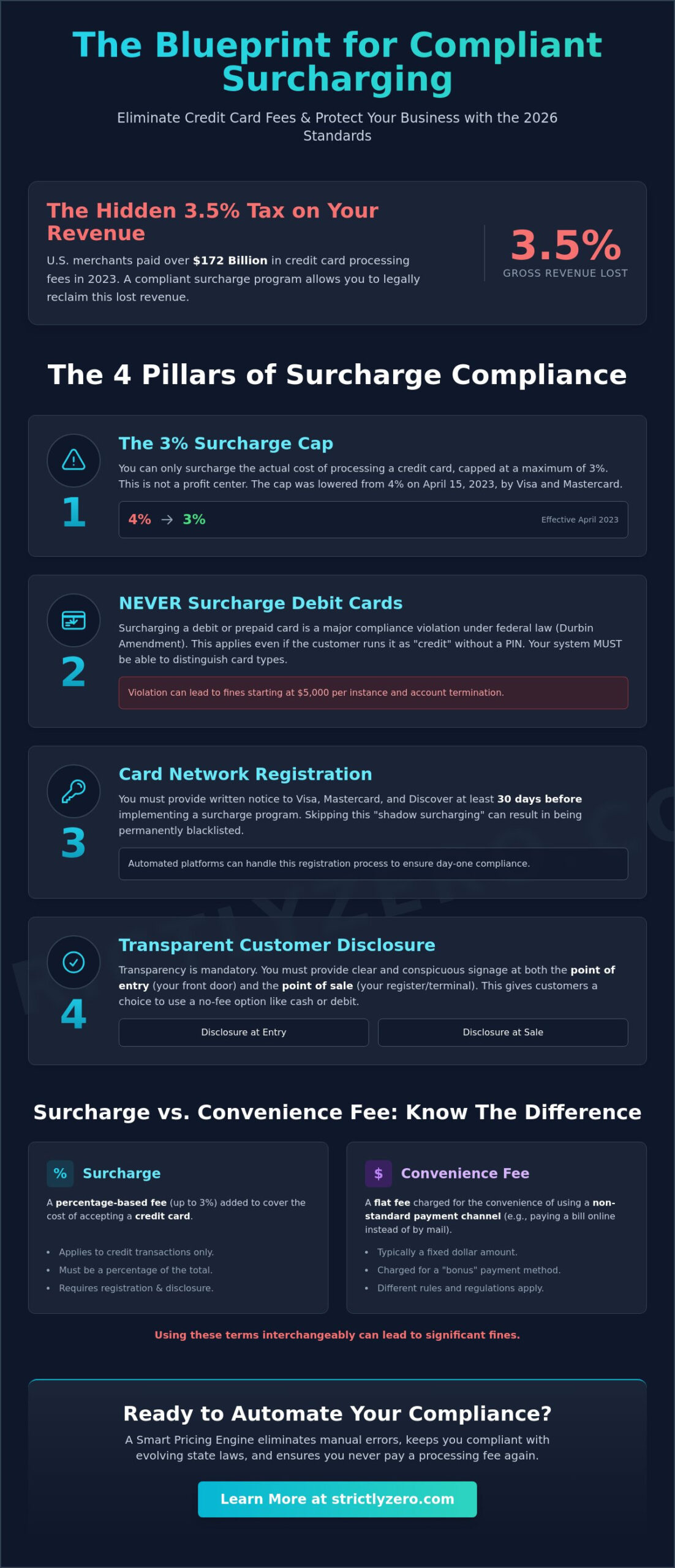
The distinction between a surcharge and a convenience fee has sharpened in 2026. A surcharge applies to all credit card transactions as a percentage of the total. A convenience fee is typically a flat charge for a “bonus” payment channel, such as paying via a web portal instead of in person. Using these terms interchangeably can lead to significant fines. A truly compliant program ensures that debit cards are never surcharged, as this remains a violation of federal law under the Durbin Amendment.
To better understand this concept, watch this helpful video:
Transparency is the core of any compliant surcharge program. Merchants must provide clear disclosure at the point of entry and the point of sale. This gives the consumer a choice. They can pay the extra fee for the convenience of credit, or they can opt for a “no-fee” alternative like cash or a debit card. This choice is what keeps the program within the bounds of consumer protection laws.
The Legal Evolution of Surcharging
The ability to surcharge stems from a 2013 class action settlement between merchants and major card networks. Since then, the legal map has shifted. As of 2026, states like New York and Florida have implemented strict “Total Price” display laws, requiring merchants to show the highest possible credit price alongside the cash price. The Durbin Amendment continues to play a massive role, strictly prohibiting surcharges on debit card transactions, even when they are processed as “credit” without a PIN. Failure to distinguish between these card types is the most common cause of non-compliance today.
Why Businesses Are Switching in 2026
The financial pressure on small businesses has reached a breaking point. In 2023, U.S. merchants paid more than $172 billion in processing fees. With inflation driving up the cost of goods and labor, many can no longer absorb these 3% to 4% hits to their margins. This has made zero fee credit card processing a competitive necessity rather than an experimental option. Consumer behavior has also shifted; over 65% of shoppers now report that they expect a small fee for credit card usage at local boutiques, restaurants, and service providers, making it a standard industry practice.
The 4 Pillars of Surcharge Compliance
Operating a compliant surcharge program requires balancing federal regulations, card network mandates, and state-by-state surcharge laws. On April 15, 2023, Visa and Mastercard lowered the maximum allowable surcharge from 4% to 3%. This change ensures merchants recover only the actual cost of processing without turning the program into a profit center. Violations of these caps lead to hefty fines, often starting at $5,000 per instance.
Card Network Notification and Registration
Merchants can’t start charging fees the moment they decide to. You must provide written notice to Visa, Mastercard, and Discover at least 30 days before you begin. This 30-day rule is a non-negotiable requirement for any compliant surcharge program. Merchants who engage in “shadow surcharging” by skipping this step risk immediate account termination and permanent blacklisting. An automated platform like Strictly handles network registration for you, ensuring your business is registered correctly from day one.
The Debit Card Dilemma
Surcharging a debit card is a major compliance violation. It doesn’t matter if the customer chooses to run the transaction as “credit” at the terminal; the underlying card is still a debit instrument. Under the Durbin Amendment and network rules, these transactions are strictly off-limits for surcharging. To prevent accidental violations, professional systems use real-time BIN (Bank Identification Number) lookups. This technology identifies the card type in milliseconds. Strictly’s Smart Pricing Engine automatically detects and excludes debit or prepaid cards. This ensures you never accidentally charge a fee on a prohibited card type, keeping your business safe from audits.
Transparency is the final pillar of a legal program. You must include proper signage and digital disclosures to keep customers informed. This includes:
- Entry Signage: A notice at the store entrance stating that a surcharge applies.
- Point of Sale: A clear sign at the register explaining the fee percentage.
- Digital Disclosure: Online checkout pages must show the surcharge as a separate line item before the customer clicks “pay.”
- Receipt Clarity: The exact dollar amount of the surcharge must appear on every transaction receipt.
These disclosures must state that the surcharge is not greater than the merchant’s cost of acceptance. They also need to clarify that the fee does not apply to debit cards. Following these rules protects your merchant account and maintains customer trust during the checkout process.
Surcharging vs. Dual Pricing: Which Fits Your Business?
Choosing between these models depends on your industry and customer base. Surcharging applies a fee only to credit card transactions. Dual pricing displays both a cash and card price for every item. In 2024, the legal landscape for a compliant surcharge program varies significantly by geography. Dual pricing offers a more uniform legal standing across the country because it treats the price difference as a discount rather than a penalty.
The operational divide between these two models centers on how you communicate value to your customers. Surcharging is a reactive process. The fee only appears once a credit card is presented, which can lead to sticker shock at the finish line. Dual pricing is proactive. By displaying two prices on every shelf tag or digital listing, you provide total transparency. This distinction is vital for maintaining trust. Industry data from 2023 suggests that 60% of consumers are likely to abandon a purchase if they encounter unexpected fees at checkout. Dual pricing avoids this by making the card-related cost part of the initial price discovery.
When to Choose a Surcharge Program
Service-based businesses, wholesalers, and professional services often find this model ideal. It’s simpler to explain to existing clients and doesn’t require re-tagging physical inventory. However, you can’t ignore the map. States like Connecticut and Massachusetts strictly prohibit the practice. If you operate there, see our guide on best credit card processing for small business for legal alternatives. You must also register your intent with card brands 30 days in advance and ensure your receipt clearly labels the fee as a surcharge.
The Advantages of Dual Pricing
Dual pricing is the most resilient model for 2026. It presents a Cash Price and a Card Price side-by-side. This transparency satisfies consumer protection and disclosure requirements by showing the total cost upfront. It’s legal in all 50 states because it’s technically a cash discount. Retailers prefer this for omni-channel consistency, as it eliminates the need for complex, state-specific signage at every entrance. While a compliant surcharge program works for some, dual pricing offers maximum legal safety and integrates better with modern point-of-sale systems.
How to Implement Your Program Without Losing Customers
Transitioning to a compliant surcharge program requires a strategy that prioritizes customer trust over immediate savings. If you rush the rollout without clear communication, you risk a 15% to 20% increase in customer friction at the point of sale. Success lies in following a structured deployment that balances legal requirements with professional transparency.
- Step 1: Conduct a fee audit. Divide your total monthly processing fees by your gross sales volume to calculate your current effective rate. Most businesses find they’re paying between 2.5% and 4% in aggregate costs.
- Step 2: Choose an automated platform. Use software that automatically detects card types. Since April 15, 2023, Visa capped surcharge rates at 3%, so your system must instantly adjust to stay within this limit.
- Step 3: Update your signage. Place clear notices at your entrance and every point of sale. These signs must be present at least 30 days before you begin surcharging in certain jurisdictions.
- Step 4: Train your staff. Employees should explain the fee as a way to keep product prices stable. If a customer objects, staff must be ready to offer a no-fee alternative immediately.
- Step 5: Monitor receipts. Check that the surcharge appears as a separate line item. Combined totals that hide the fee are a primary cause of merchant account terminations.
Effective Customer Communication
Shift the narrative from “adding a fee” to “providing a choice.” Your staff scripts should be direct. Instead of saying, “There is a 3% fee for credit,” try: “Our prices reflect a cash discount, but we accept credit cards with a standard processing fee.” Offering a no-fee alternative like ACH, check, or cash is vital. Data from 2024 shows that 74% of customers accept a surcharge when they understand it’s an optional convenience rather than a hidden cost. Transparency reinforces your brand value by showing you aren’t hiding overhead in inflated menu or shelf prices.
The Role of Technology in Implementation
Manual surcharging is a recipe for a PCI DSS audit failure. If your staff manually enters fee amounts, your risk of overcharging or applying fees to debit cards increases by 40%. Automated systems eliminate this human error. For digital storefronts, integrated ecommerce payment processing tools ensure you remain compliant across state lines by geolocating the customer. Real-time reporting allows you to track your exact savings and compliance status through a single dashboard, giving you the data needed to defend against potential chargebacks.
Ready to stop losing revenue to processing fees? Contact our experts to build your compliant program today.
Why Strictly is the Leader in Compliant Surcharging
Strictly isn’t just another payment processor; it’s a technology powerhouse built to solve the complex legal and technical hurdles of modern merchant billing. At the core of our platform is the Smart Pricing Engine. This proprietary technology acts as the automated brain of your compliant surcharge program. It instantly identifies card types at the point of sale, ensuring that only eligible credit cards are surcharged while debit transactions remain fee-free, keeping you on the right side of card brand rules.
Our platform provides true omni-channel flexibility. You can manage your billing across several environments:
- In-Person: Smart terminals that handle disclosures automatically.
- Online: E-commerce integrations that update in real-time.
- Virtual Terminals: Secure phone and mail-order billing for back-office teams.
For ISOs and Developers, Strictly offers an API-first infrastructure that allows for rapid scaling. Most partners can integrate our compliant logic into their existing software stacks in under 48 hours, providing a seamless experience for their own merchant portfolios.
The “Zero Fee” promise is simple: we help you keep 100% of your revenue. By shifting the cost of credit card processing to the transaction level, businesses typically save between 3% and 4% on every sale. We handle the complex math and settlement behind the scenes so your daily deposits remain whole.
Automation That Protects Your Merchant Account
Compliance isn’t a “set it and forget it” task. Laws change constantly. For example, in 2023, states like New York and New Jersey introduced specific requirements for how surcharges must be displayed to consumers. Strictly’s platform handles these state-by-state rule updates automatically. You don’t need to track legislative calendars or hire expensive consultants; our software adjusts your disclosures the moment new regulations take effect.
We also offer advanced management tools like ChurnIQ™ and ClearSplit™. ChurnIQ™ uses data analytics to monitor customer sentiment and retention, ensuring your compliant surcharge program is helping your bottom line without driving away patrons. ClearSplit™ simplifies partner management by automating the division of funds between different stakeholders, which is a critical tool for high-volume ISOs. Our API-first platform ensures these tools plug directly into your current workflows without friction.
Ready to Eliminate Your Processing Fees?
Getting started with Strictly is designed to be fast and transparent. We begin with a free processing audit that takes about five minutes of your time. Our team analyzes your current merchant statements to identify hidden fees and show you exactly how much capital you’ll reclaim each month.
The Strictly onboarding experience is built for speed. Once you register, we move you from the application phase to “Go Live” status in as little as 24 hours. We provide the signage, the hardware, and the digital disclosures required by Visa and Mastercard, so you’re protected from day one. Join the Zero-Fee Revolution with Strictly today.
Future-Proof Your Bottom Line for 2026
Navigating the evolving landscape of credit card processing requires more than just a sign at the register. Success in 2026 depends on mastering the four pillars of compliance and choosing the right model between surcharging and dual pricing. Implementing a transparent strategy ensures you offset rising interchange costs while maintaining trust with your patrons. It’s about protecting your margins without compromising the customer experience you’ve worked hard to build.
Strictly provides the specialized tools needed to manage this transition effortlessly. Their Smart Pricing Engine features automated state-law updates that adjust to shifting regulations in real-time. This proprietary technology is already trusted by thousands of merchants and ISOs across the United States. Additionally, their ClearSplit™ partner compensation technology streamlines financial distributions for complex business structures, ensuring every stakeholder is accounted for accurately.
Eliminate your processing fees today with Strictly’s Compliant Surcharge Program.
Taking control of your overhead is the smartest move you can make for your business’s future. You’ve built a great company; now it’s time to keep more of the revenue you deserve.
Frequently Asked Questions
Is a surcharge program legal in all 50 states in 2026?
No, surcharging isn’t legal in all 50 states as of 2026. Connecticut and Massachusetts maintain strict bans on credit card surcharges for merchants. New York and Maine have specific laws requiring you to display the full credit price alongside the cash price rather than just a percentage. You’ll need to check your local state statutes to ensure you don’t violate regional consumer protection acts or face state-level lawsuits.
What is the maximum percentage I can charge as a surcharge?
The maximum percentage you can charge is 3% of the total transaction. Visa and Mastercard lowered this cap from 4% on April 15, 2023, to better align with average processing costs. You can’t charge a fee that’s higher than what you actually pay to your processor for that specific card. If your merchant fee is 2.5%, your surcharge shouldn’t exceed that 2.5% mark to remain within network rules.
Can I add a surcharge to debit card transactions if the customer signs for it?
You can’t add a surcharge to debit cards even if the customer chooses a signature-based path. Federal law and card brand rules prohibit fees on all debit and prepaid products across the board. Your point of sale system needs to identify the Bank Identification Number automatically to prevent accidental charges. Violating this rule often results in immediate fines from the card networks and potential legal action from consumers.
Do I need to notify my customers before implementing a surcharge program?
You must notify your credit card processor and the card brands 30 days before you begin surcharging. This mandatory notification period allows the networks to update your merchant profile for monitoring. You’re also required to place signage at your store’s entrance and the register. These signs must clearly state the fee percentage so customers aren’t surprised. Failure to provide this 30 day notice can lead to the immediate suspension of your merchant account.
How does a surcharge program differ from a cash discount?
A surcharge adds a fee to the advertised price, while a cash discount lowers the price for customers paying with physical currency. A compliant surcharge program only applies to credit cards and requires specific 30 day notifications to the major brands. Cash discounts don’t have the same registration requirements. However, you must post the highest price and offer the discount clearly at the register to stay within Truth in Lending Act guidelines.
What signage is required for a compliant surcharge program?
You’re required to display signage at the point of entry and the point of sale. This signage must be visible to customers before they reach the register or start the checkout process. It has to state the surcharge percentage and confirm the fee doesn’t exceed your cost of acceptance. Your receipts must also show the surcharge as a distinct line item separate from the subtotal and tax to ensure full transparency.
What happens if I am found non-compliant by Visa or Mastercard?
Non-compliance leads to heavy fines ranging from $1,000 to over $25,000 per month depending on the severity of the violation. Card brands like Visa monitor merchant behavior through mystery shoppers and will issue a warning first. If you don’t fix the violation within 30 days, they’ll likely terminate your merchant account permanently. A compliant surcharge program is the only way to avoid these costly network penalties and maintain your processing status.
Can I use a surcharge program for online e-commerce transactions?
You can implement surcharging for e-commerce if your checkout page meets specific disclosure requirements. The customer must see the surcharge amount clearly before they finalize the payment or click the purchase button. Your online system must also be smart enough to detect debit cards using BIN lookup and skip the fee instantly. This ensures your digital storefront follows the same federal and network rules as physical retail locations to avoid expensive chargebacks.