

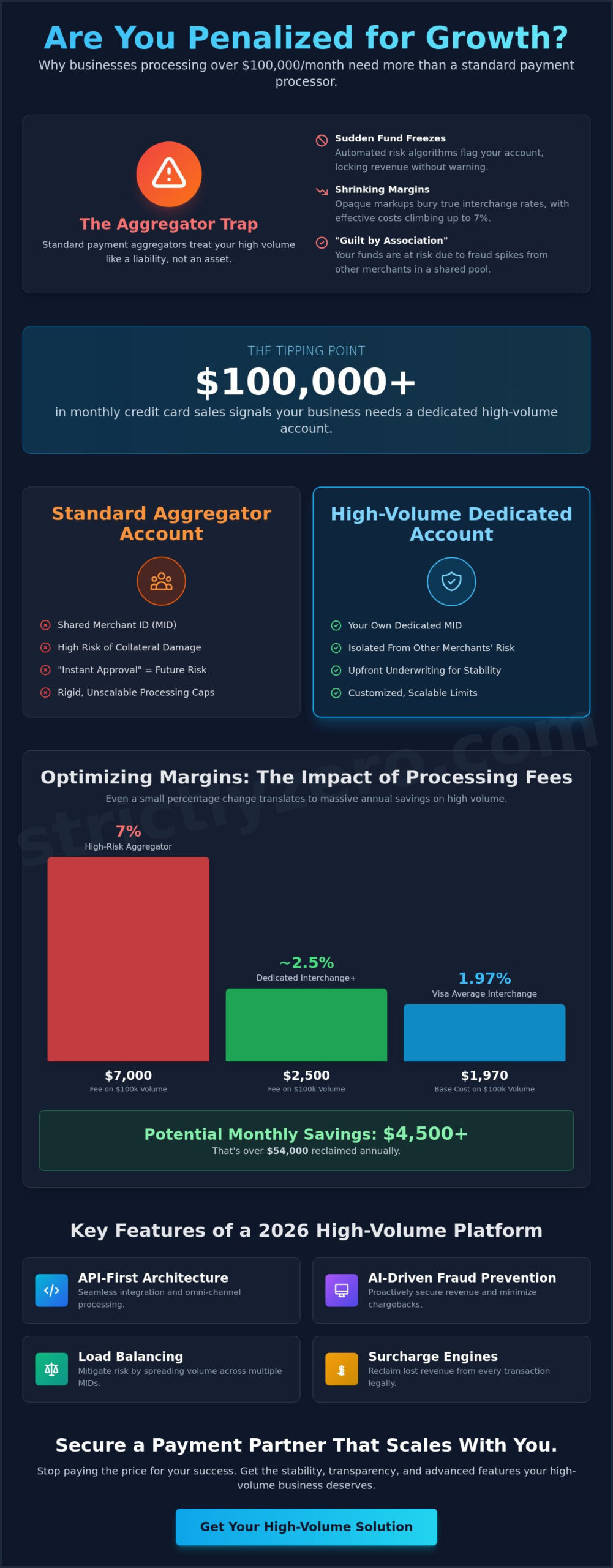
If you’re processing over $100,000 in monthly credit card sales, your business isn’t just a merchant anymore; it’s a target for automated risk algorithms. You’ve likely felt the anxiety of a sudden fund freeze or watched your margins shrink as Visa’s 1.97% average US interchange rate gets buried under layers of opaque aggregator markups. It’s frustrating to feel like you’re being penalized for your growth, especially when high-risk effective processing costs can climb as high as 7% in 2026. You don’t have to settle for a processor that treats your volume like a liability.
You deserve a payment partner that scales as fast as your sales do. This guide teaches you how to secure a dedicated high volume merchant account that uses upfront underwriting and AI-driven fraud prevention to keep your revenue flowing without interruption. We’ll explore the latest 2026 interchange schedules, the shift toward API-first infrastructure, and how surcharge engines can help you reclaim lost revenue from every transaction.
Key Takeaways
- Learn why standard payment aggregators often freeze funds at scale and how a specialized high volume merchant account provides the stability needed for $100,000+ monthly processing.
- Discover why upfront underwriting is superior to “instant approval” models for protecting your business from sudden account terminations.
- Explore how to leverage API-first architecture and omni-channel processing to create a seamless checkout experience across all your sales platforms.
- Understand the impact of interchange-plus pricing on your bottom line and how a 0.5% fee reduction translates into massive annual savings.
- Find out how AI-driven fraud prevention and ClearSplit™ technology can automate your partner management and secure your revenue.
What Is a High Volume Merchant Account?
As of May 2026, a high volume merchant account is a specialized financial arrangement designed for businesses that have outgrown basic payment tools. While entry-level facilitators are perfect for startups, they often lack the infrastructure to support companies processing over $100,000 every month. This classification isn’t just about the total dollar amount; it also encompasses businesses with high average ticket sizes, such as luxury wholesalers or enterprise software providers. For instance, a firm processing five $25,000 transactions monthly faces different logistical hurdles than a high-frequency retailer processing 10,000 smaller orders. Both, however, require a robust framework that can handle significant transaction velocity or high-ticket risk without triggering the automated security holds common in shared processing environments.
Stepping into this category means moving away from a one-size-fits-all approach. High-volume merchants deal with a complex set of variables, including varying interchange rates and stricter data security standards like PCI DSS. Because your business processes a larger volume of sensitive data, the scrutiny from card networks increases. A dedicated setup allows you to manage these demands through a direct relationship with the processor, ensuring your cash flow remains consistent even as your sales continue to climb. This direct connection also provides the transparency needed to audit processing costs, which is vital when even a 0.1% fluctuation in fees can impact your annual bottom line by thousands of dollars.
To better understand the nuances of these specialized accounts, watch this detailed breakdown:
The $100,000 Monthly Milestone
Crossing the $100,000 monthly threshold is the industry-recognized signal that your business needs a dedicated high volume merchant account. At this level, your risk profile changes in the eyes of financial institutions. You’re no longer seen as a small-scale seller; you’re an enterprise entity with significant liability. This shift often triggers a transition from automated, “hands-off” approvals to a more detailed manual underwriting process. Underwriters look at your fulfillment cycles and chargeback history to ensure your business can handle the increased volume. While this involves more paperwork upfront, it provides a level of account security that simpler platforms simply can’t match.
Aggregators vs. Dedicated Merchant Accounts
The primary difference between a standard aggregator and a dedicated account lies in the Merchant ID (MID). Aggregators lump your business into a shared pool with thousands of other merchants. If someone else in that pool experiences a fraud spike, your funds could be caught in a “guilt by association” freeze. A dedicated account provides you with your own MID, isolating your processing from the risks of other businesses. This setup gives you total control over your reserves and allows for customized processing limits that grow alongside your revenue. Instead of being capped by a platform’s rigid policies, you gain a scalable infrastructure that adapts to your specific billing cycles and seasonal peaks.
Why Account Stability is the #1 Priority for High Volume
Many processors promise “instant approval” to attract new sign-ups, but for a scaling business, this is a ticking clock. These platforms approve accounts first and ask questions later. When your transaction volume hits that $100,000 mark, their risk algorithms flag your account for a manual review. This often results in a “Monday morning freeze” where your revenue is locked while the provider verifies your legitimacy. Choosing Your High Volume Partner involves looking past the speed of setup to the depth of the initial review process.
Stability also comes from diversification. Smart merchants use “load balancing” to mitigate risk by spreading their transaction volume across multiple Merchant IDs (MIDs). If one MID faces a temporary technical issue or a localized spike in disputes, your business continues to operate through the others. It prevents a single point of failure from paralyzing your entire cash flow. Maintaining a high volume merchant account requires this level of structural redundancy to ensure you never miss a sale.
Understanding Underwriting and Risk
Underwriting is the foundation of high-volume stability because it verifies your business legitimacy before you process a single dollar. Processors analyze your two-year financial history, current processing statements, and fulfillment timelines. They want to ensure you can survive a spike in returns or disputes without going under. By completing this rigorous process upfront, you avoid the sudden fund holds that plague merchants using aggregate platforms. It’s a proactive step that protects your 2026 revenue from the whims of automated risk bots.
Managing Chargebacks at Scale
High volume naturally leads to more disputes. In 2026, Visa and Mastercard maintain a strict 1% chargeback-to-transaction threshold. Crossing this limit can land you in a monitoring program with even higher fees and more scrutiny. Using AI-driven fraud prevention helps you identify suspicious patterns before they turn into costly chargebacks. Since each dispute in 2026 costs between $15 and $35, a proactive defense isn’t just a safety measure; it’s a financial necessity for your bottom line.
New 2026 credentialing rules require clearer communication about recurring billing and one-click checkouts. You must store cardholder credentials securely and provide transparent billing notifications to avoid “friendly fraud” disputes. Regulators are also cracking down on hidden “junk fees,” making transparency a legal requirement for large-scale operations. If you’re tired of navigating these complexities alone, you can find a partner who prioritizes trust as a payment processor to keep your operations compliant and your accounts stable.
Key Features of a 2026 High Volume Processing Platform
Technology in the payments space moves fast. By May 2026, a high volume merchant account is no longer just a portal for accepting cards; it’s a sophisticated data engine. High-volume success now relies on AI-driven fraud prevention that moves beyond simple blocklists. Modern systems analyze behavioral biometrics and transaction velocity in real-time to differentiate between a high-spending loyal customer and a sophisticated bot. This shift is critical because reducing false declines is just as important as stopping fraud when you’re processing thousands of transactions daily. When you evaluate merchant payment processors, you must look for platforms that prioritize this intelligent filtering to protect your conversion rates.
Reliability at scale requires an API-first architecture. This allows your payment stack to integrate seamlessly with existing ERPs and accounting software without bulky middleware. To maintain 99.9% uptime, top-tier platforms utilize smart routing and failover systems. If one processing endpoint experiences a delay, the system automatically reroutes the transaction through an alternative path. This ensures that your checkout remains functional even during peak traffic events or regional network outages. Advanced reporting tools now provide multi-entity views, allowing you to see consolidated data across different business units or physical locations in a single interface.
Unified Omni-Channel Management
Modern consumers expect a frictionless experience whether they’re buying from a mobile app or a physical storefront. High-volume merchants need a unified omni-channel guide to help them bridge the gap between online and offline data. A single dashboard provides a holistic view of your customer’s journey, making it easier to manage returns, loyalty programs, and inventory. Real-time data syncing ensures that your accounting records are always accurate, which is essential when you’re managing the complex cash flows associated with high-volume revenue.
Virtual Terminals and Payment Links
Not every high-volume transaction happens at a traditional checkout. For B2B companies or service-based enterprises, secure virtual terminals allow for the safe processing of high-ticket orders over the phone or via mail. You can also use secure payment links to accelerate collections. These links allow customers to pay via their preferred method, including instant bank payments which are gaining significant traction in 2026. For those with subscription models, modern recurring billing engines are designed to handle thousands of simultaneous transactions while adhering to the latest credentialing rules to minimize disputes and maximize retention.
Optimizing Margins: The Impact of Processing Fees
Many businesses struggle to balance margins when selling online and in-person simultaneously. This omni-channel complexity often leads to “fee creep,” where different rates for card-present and card-not-present transactions become impossible to track. A dedicated high volume merchant account should provide a unified pricing structure across all channels. While you’re evaluating the best credit card processing for small business, remember that enterprise-level scaling requires a deeper look at the math behind every swipe. Entry-level processors often hide their high markups behind the promise of “no monthly fees,” which ends up costing you more as your volume grows.
The Zero-Fee Revolution for High Volume
Integrating zero fee credit card processing strategies allows you to pass the cost of acceptance to the customer. In 2026, dual pricing has emerged as the preferred method for high-volume retailers because it offers a clear “cash price” and “card price.” If you choose surcharging, you must adhere to strict April 2026 regulations. These include notifying Visa and Mastercard 30 days in advance and ensuring the surcharge is listed as a separate line item on every receipt. Automated compliance tools are now essential to ensure these rules are met across every state where you do business.
Smart Pricing Engines
The key to protecting your margins is distinguishing between card types in real-time. Surcharges aren’t permitted on debit or prepaid card transactions under 2026 rules. Strictly’s Surcharge & Dual Pricing Engine automates this detection at the point of sale. It ensures that credit transactions are optimized to reduce your effective rate to near zero, while debit transactions are processed at the lowest possible interchange rates. This level of automation is why many merchants choose to partner with Strictly as their payment processor to maintain a competitive edge in a crowded market.
Choosing Your High Volume Partner: The Strictly Advantage
Selecting the right partner for your high volume merchant account is the most critical decision you’ll make for your business’s long-term health. Many providers ignore the massive cost-saving potential of surcharge models at scale, focusing instead on entry-level features that don’t serve enterprise needs. Strictly is the preferred payment processing platform for ISOs and large-scale merchants because we provide the tools to reclaim margins while maintaining perfect compliance. Our technology is built to handle the complexities of 2026 regulations, ensuring that your surcharge or dual pricing programs are fully automated and transparent for every customer transaction.
Managing a massive operation requires more than just a gateway. It requires intelligence. Our ClearSplit™ technology manages complex partner compensations at scale, automating the distribution of funds to various stakeholders without manual intervention. This is paired with ChurnIQ™, an advanced intelligence engine that monitors the health of your merchant accounts in real-time. By identifying subtle shifts in processing patterns or dispute frequencies, ChurnIQ™ allows you to address potential issues before they trigger a risk flag or account freeze. When you move to our platform, you can expect an onboarding process that prioritizes upfront underwriting, giving you the peace of mind that your account is built on a stable, long-term foundation.
Scalable Infrastructure for Partners and Developers
Success in 2026 requires a payment stack that speaks the language of your developers. Our API-first design allows your team to build custom high-volume workflows that integrate directly with your existing software. For ISOs and MSPs, we offer extensive white-labeling opportunities, allowing you to provide a premium processing experience under your own brand. We’ve also automated residual tracking for large-scale partner networks, ensuring that every referral and commission is calculated and reported with 100% accuracy every single month.
Expert Support for Enterprise Clients
High-volume merchants can’t afford to wait in a chat queue when a technical hurdle arises. We’ve moved beyond the “chat-only” support model to provide dedicated account management for our enterprise clients. Your account manager understands your specific industry risks and helps customize your fraud monitoring to prevent false-positive flags that could disrupt your sales. This personalized approach ensures that your processing remains uninterrupted even during your highest traffic periods. If you’re ready to move beyond the limitations of standard aggregators, it’s time to scale your high-volume business with Strictly and experience a platform built for your growth.
Future-Proof Your Processing Strategy for 2026
Reaching the $100,000 monthly threshold is a milestone that requires a total shift in how you view your payment stack. You’ve seen how upfront underwriting prevents the sudden freezes that plague entry-level aggregators. You also understand that navigating Visa’s 1.97% average interchange rate requires more than just a standard gateway. It requires a high volume merchant account that prioritizes stability and fee transparency. By 2026, the most successful merchants won’t just accept payments; they’ll use smart routing and dual pricing to turn processing costs into profit centers. To stay updated on the digital trends shaping the future of business, you can discover +Puls for expert news and magazine insights.
Strictly provides the infrastructure you need to lead this change. Our AI-driven Smart Pricing Engine ensures you remain compliant in all 50 states while protecting your margins on every swipe. With ClearSplit™, you can automate complex partner residuals without the manual errors that slow down your growth. Don’t let outdated pricing models or rigid risk algorithms hold your business back. It’s time to take control of your revenue and build a resilient payment foundation. Your growth is limitless when your payments are secure.
Eliminate your processing fees today with Strictly
Frequently Asked Questions
What qualifies as a high volume merchant account?
A high volume merchant account is typically required once a business processes $100,000 or more in monthly credit card sales. This threshold is an industry standard for 2026, marking the point where standard retail accounts are no longer cost-effective or stable. You may also be classified this way if you handle high-ticket transactions over $500, regardless of your total monthly count.
Why was my account frozen by a standard payment facilitator?
Popular payment facilitators use an “approve now, audit later” model that fails at scale. When your monthly volume hits the $100,000 mark or experiences a 25% spike, automated risk bots flag the activity as suspicious. Since these platforms don’t perform upfront underwriting, they often freeze funds for 90 to 180 days to mitigate their own liability against potential chargebacks.
How long does it take to get approved for a high-volume merchant account?
Getting approved for a dedicated high volume merchant account typically takes between 3 and 7 business days. This timeframe allows underwriters to manually review your financials and processing history to ensure your business is stable. While this is slower than “instant” setup, it prevents the sudden fund holds that occur when a business outgrows a basic facilitator’s risk appetite.
Can I use a surcharge program with a high-volume account?
Yes, you can implement surcharging, but you must adhere to the latest 2026 card network rules. You’re required to notify Visa and Mastercard 30 days before implementation and ensure the surcharge is a separate line item on receipts. It’s important to remember that as of April 2026, surcharges are strictly prohibited on debit and prepaid card transactions.
What are the typical fees for high-volume credit card processing?
Large-scale merchants usually utilize interchange-plus pricing for maximum transparency. In 2026, the average Visa interchange rate in the US is 1.97%, while Mastercard sits at 1.79%. High-risk merchants may see an effective total processing cost between 3.5% and 7%. Moving to a dedicated account allows you to negotiate a lower fixed markup over these base rates.
Is a high-volume merchant account the same as a high-risk account?
No, these are separate designations that often overlap. High volume refers specifically to your processing amount or transaction frequency. High risk is determined by your industry’s likelihood of fraud or disputes. However, in 2026, most high-risk businesses are automatically placed into high-volume structures because they require the same robust underwriting and stability features to handle their revenue.
How does load balancing work for high-volume processing?
Load balancing distributes your transaction traffic across multiple Merchant IDs (MIDs) to protect your cash flow. If one MID reaches a monthly cap or experiences a technical delay, the system automatically reroutes the transaction to a secondary MID. This redundancy is essential for staying below the 1% chargeback threshold and ensuring your checkout remains active 24/7.
What documents do I need to apply for a dedicated merchant account?
Underwriters require specific documentation to verify your business legitimacy and financial health. You’ll need three to six months of processing statements, two years of tax returns, and a government ID for any owner with 25% or more equity. Providing a voided check and ensuring your website clearly displays your refund and fulfillment policies is also mandatory for a successful 2026 application.