

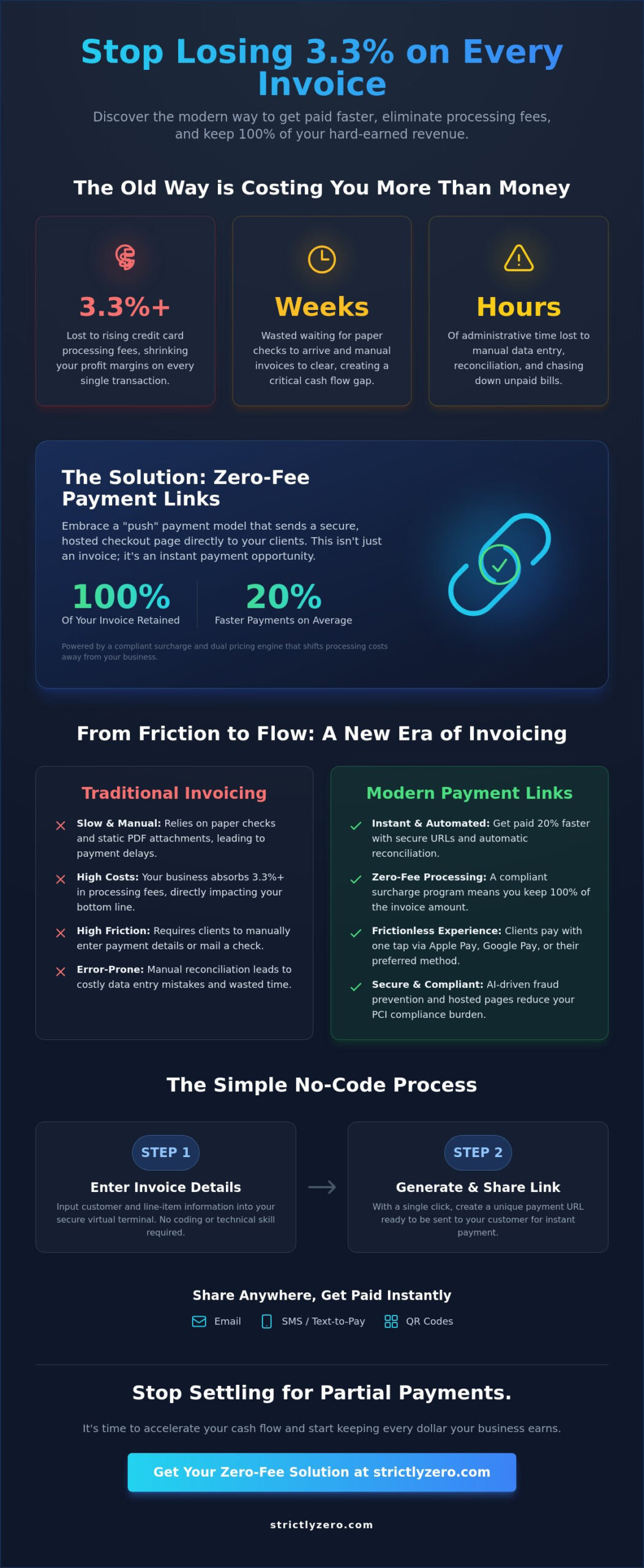
Why are you still handing over 3.3% of your hard-earned revenue to payment processors just for the privilege of getting paid? With major platforms hiking rates in early 2026, many business owners feel trapped between losing money on merchant fees or chasing slow paper checks. You’ve likely accepted these high costs as an unavoidable part of doing business, but it’s frustrating to watch your margins shrink while you wait weeks for a manual invoice to clear. Using payment links for invoices can change this dynamic instantly, especially since businesses adopting automated billing now collect payments 20% faster on average.
This guide will show you how to accelerate your cash flow and eliminate credit card processing fees for good. You’ll learn how to implement a professional payment experience that shifts the cost away from your bottom line. We’ll explore how to use a surcharge and dual pricing engine to retain 100% of your invoice amount, leverage AI-driven fraud prevention, and finally stop the cycle of chasing unpaid bills. It’s time to stop settling for partial payments and start keeping every dollar your business earns.
Key Takeaways
- Discover why secure, hosted URLs are replacing traditional PDF invoices and paper checks to accelerate your cash flow.
- Learn the simple two-step process to generate payment links for invoices without needing any technical or coding skills.
- Identify how a surcharge and dual pricing engine can compliantly shift processing fees away from your business.
- Master best practices for link delivery and recurring billing to ensure consistent, professional payment experiences.
- Protect your revenue with AI-driven fraud prevention while maintaining 100% of your invoice totals through modern processing tools.
What are Payment Links for Invoices and How Do They Work?
A payment link is a unique, secure URL that acts as a direct bridge between your bill and your bank account. Instead of sending a static document and hoping your client remembers to log into their banking portal, you send a digital path to a pre-filled checkout page. This technology represents a fundamental shift in how businesses collect revenue. To understand the broader context of this shift, it’s helpful to look at the history of What are Payment Links for Invoices and How Do They Work? and how digital data exchange has replaced paper-heavy processes.
In 2026, the industry is moving away from “pull” payments, where you passively wait for a client to initiate a transfer or mail a check. By using payment links for invoices, you utilize a “push” model. You’re pushing the payment opportunity directly to the customer’s inbox or phone. This method bridges the gap between a standard virtual terminal and a full e-commerce website. You get the professional, streamlined checkout experience of an online store without the complexity of managing a web catalog or shopping cart.
The Anatomy of a High-Converting Payment Link
A link that actually gets clicked must do more than just show a total. High-converting payment links for invoices feature clear branding and your business name to build immediate trust. When a client clicks, they should see detailed line items that mirror their original agreement, leaving no room for confusion. Most importantly, these pages are mobile-responsive. In a world where business happens on the go, allowing a client to pay with one tap via Apple Pay or Google Pay can be the difference between getting paid today or waiting another week.
Why Traditional Invoicing is Costing You Time and Money
Traditional methods are riddled with friction. Paper checks still account for about 30-35% of B2B payments in North America, leading to the infamous “check is in the mail” syndrome. This delay isn’t just annoying; it’s a drain on your cash flow. Manual invoicing also invites data entry errors during reconciliation, which can take hours of administrative time to fix. Beyond the time lost, standard gateways often eat into your margins with fees that have risen to 3.3% or more in early 2026. Businesses that pivot to automated AR tools see payments collected 20% faster on average, largely because they remove these manual hurdles and offer customers a friction-free way to settle their debts instantly.
The Mechanics of No-Code Invoicing in 2026
You don’t need a developer or a complex API to start using payment links for invoices. The process is designed for speed and simplicity, moving away from the technical hurdles that once required a dedicated IT team. To start, you simply enter the invoice details into your virtual terminal or payment platform. With a single click, the system generates a secure, hosted payment URL that’s ready for immediate use. This “no-code” approach allows any business owner to modernize their billing in minutes rather than weeks.
Once you’ve generated the link, the distribution is entirely up to you. You can send it via email, deliver it through an SMS text message, or embed the link directly into a digital PDF. When the customer receives the link and completes the transaction using their preferred payment method, the system handles the rest. You’ll receive an instant notification, and the transaction is automatically reconciled in your ledger. This eliminates the need for manual data entry, which is a major source of error in traditional accounting. Government agencies have long recognized the efficiency of these digital shifts. For instance, The Cost Dilemma: Standard Links vs. Zero-Fee Processing highlights how electronic invoicing can save billions in administrative costs across the economy.
Sharing Your Link: Beyond Just Email
Email is the standard, but it isn’t always the fastest way to get a response. Field service workers and contractors often find that SMS or “Text-to-Pay” gets them paid before they even leave the job site. You can also print QR codes on physical work orders, allowing clients to “scan and pay” in seconds using their mobile wallets. If a bill goes unpaid, integrating these links into automated dunning sequences ensures the customer always has a friction-free way to settle their debt. This omni-channel approach ensures you’re meeting your customers exactly where they are.
Security and PCI Compliance for Payment Links
Security is a top priority when handling remote transactions. Because these links lead to hosted payment pages, you aren’t responsible for storing sensitive card data on your own servers. This significantly reduces your PCI DSS compliance burden. Tokenization is the process of replacing sensitive data with unique identifiers. To stay ahead of modern threats, our systems utilize AI-driven fraud prevention to monitor transactions for suspicious activity in real time. This ensures your revenue is protected without adding friction to the customer experience. You can focus on growing your business while the technology handles the heavy lifting of security and compliance.
The Cost Dilemma: Standard Links vs. Zero-Fee Processing
Most business owners view processing fees as a “cost of doing business.” When you send payment links for invoices through standard gateways, you’re often losing between 2.9% and 3.5% of the total amount. As of January 2026, Square’s base rate for online transactions rose to 3.3% plus $0.30. If your business processes $500,000 in annual invoices, those percentages translate to roughly $16,500 vanishing from your bottom line every year. That’s money that could be reinvested into equipment, payroll, or marketing.
Strictly’s surcharge program changes the math entirely by shifting these processing costs to the customer. Instead of you absorbing the fee, the system applies it at the point of sale. This allows you to retain 100% of the invoice amount. It’s not just about saving money; it’s about protecting your margins in an environment where operational costs continue to climb. By utilizing a surcharge and dual pricing engine, you ensure that the price you quoted is the exact amount that hits your bank account. It’s a simple change that has a massive impact on your annual profitability.
Automated Surcharge Compliance
Navigating the legal landscape of surcharging can be complex because regulations vary by state and card type. You can’t just add a flat fee and hope for the best. Our Smart Pricing Engine automatically detects whether a customer is using a debit card or a credit card in real time. This is vital because surcharging debit cards is generally prohibited. The system also ensures transparent disclosure by clearly showing any fees on the checkout page before the transaction is finalized. This keeps your business compliant with card brand rules and state laws without requiring manual oversight on every invoice.
Dual Pricing: The Best of Both Worlds
Some customers prefer to avoid fees by paying with cash or ACH. Dual pricing provides the ultimate transparency by offering a “Cash Discount” price alongside a “Credit Card” price. This gives your clients the power of choice. They can choose the convenience of a credit card and cover the associated cost, or they can opt for a lower price by using a different payment method. Most clients appreciate this honesty and the ability to control their own costs. To learn more about how this works, check out our guide on Zero Fee Credit Card Processing: The 2026 Merchant Guide to $0 Fees. This approach turns a potential point of friction into a professional, flexible experience for everyone involved.
Best Practices for Integrating Payment Links into Your Workflow
Speed is the most critical factor in your accounts receivable cycle. Businesses that adopt AR automation, like sending payment links for invoices, see payments collected 20% faster on average. The best time to send a link is the moment the service is completed or the product is shipped. When you wait days to send a bill, you’re essentially giving your client an interest-free loan while your own cash flow suffers. By automating the delivery of these links, you ensure that the payment request arrives while the value of your work is still fresh in the customer’s mind.
For clients on retainers or subscription models, recurring payment links are a game changer. You set the schedule once, and the system handles the rest. If you’re transitioning long-term clients from paper checks to digital links, be transparent about the benefits. Explain that digital links provide a more professional payment experience and provide them with instant, digital receipts for their own records. If a project requires an upfront deposit, you can configure your links to accept partial payments. This ensures you have the capital needed to start work immediately without the typical wait for a physical check to arrive and clear the bank.
Industry-Specific Strategies
- Professional Services: Use links for upfront consultation fees or monthly retainers to keep your billable hours protected. This prevents the awkwardness of chasing a client for a small fee after the advice has already been delivered.
- Home Services: Contractors should use SMS links to get paid on-site. Getting a payment before leaving the driveway eliminates the “forgotten” invoice that often sits in a customer’s inbox for weeks.
- B2B Wholesalers: High-ticket bulk orders can be simplified by sending a single URL that supports both ACH and credit card payments. This caters to the 45-50% of B2B payments that are now initiated digitally in 2026.
- Community-Based Enterprises: For organizations and halal businesses listed on Minar360, utilizing digital links for event bookings or service fees provides a professional and efficient experience for their global user base.
Reducing Friction at Checkout
Every extra form field on a checkout page is a chance for a customer to abandon the payment. Keep your payment pages lean by only asking for essential information. For returning clients, enabling one-click payment options can significantly boost completion rates. This level of efficiency is a core part of modern Credit Card Processing for Small Business: The 2026 Essential Guide. If you want to see how these tools fit into your specific business model, you can explore our omni-channel payment processing options to find the right fit.
Why Strictly is the Smart Choice for Modern Invoicing
Strictly stands out because it’s built specifically to protect your margins. While other platforms prioritize their own transaction volume, we focus on helping you eliminate merchant fees through a compliant surcharge and dual pricing engine. This isn’t just a workaround; it’s a professional, robust solution that allows you to send payment links for invoices while ensuring you keep 100% of the revenue you’ve earned. By shifting the processing cost to the customer, you turn a major operational expense into a neutral line item.
Our platform offers true omni-channel flexibility. You aren’t limited to just one way of getting paid. You can generate links, use our virtual terminal for over-the-phone orders, or utilize our mobile app for in-person interactions. All of these tools feed into a single dashboard equipped with ChurnIQ™ intelligence. This gives you real-time reporting on payment health and helps you monitor for potential churn before it impacts your bottom line. Our system also integrates seamlessly with major accounting software and standard processing environments, ensuring your workflow remains uninterrupted as you scale.
Beyond the Link: A Unified Payment Ecosystem
Strictly is designed to grow alongside your business. You might start with a single link, but our partner management tools and POS lending options mean we can support you as you evolve into a full-scale operation. In 2026, the value of “Trust as a Payment Processor” cannot be overstated. With regulatory shifts like the U.S. GENIUS Act and the EU’s PSD3 creating a more complex landscape, having a partner that prioritizes security and compliance is essential. For those expanding into digital storefronts, our Ecommerce Payment Processing: The Ultimate Omni-Channel Guide provides a deeper look at how to manage sales across every platform.
Getting Started with Strictly Today
Onboarding with Strictly is straightforward and efficient. We’ve removed the typical red tape to ensure you can get your first payment links for invoices live in under 10 minutes. Once your account is set up, you can test the system immediately and see exactly how the dual pricing engine presents options to your customers. There is no reason to continue losing 3% or more of your income to outdated fee models. Take control of your revenue today and switch to a platform that puts your profitability first.
Take Control of Your Revenue in 2026
The shift toward digital payments isn’t just about convenience; it’s about reclaiming the margins that high merchant fees have historically eroded. By implementing payment links for invoices, you’ve seen how to streamline your collection process while offering clients the professional experience they expect in 2026. You now understand how a surcharge and dual pricing engine keeps your business compliant across all 50 states while shifting processing costs away from your bottom line.
Protecting your cash flow requires more than just a faster billing method. It demands a secure ecosystem where AI-driven fraud prevention and automated reconciliation work in the background to safeguard every transaction. You don’t have to settle for losing a percentage of every sale to outdated fee models. It’s time to stop chasing paper checks and start retaining 100% of your hard-earned revenue.
Eliminate your processing fees today with Strictly’s Smart Invoicing and experience a zero-fee processing model designed for modern growth. Your business deserves to keep every dollar it earns, and the tools to make that happen are ready for you to use.
Frequently Asked Questions
Are payment links for invoices secure for my customers?
Yes, they are highly secure because they utilize hosted payment pages. This means sensitive card data never touches your own servers, which drastically reduces your security liability. In 2026, these links are protected by AI-driven fraud prevention that monitors transactions for suspicious patterns in real time. This setup ensures your business remains compliant with PCI DSS standards while providing a safe, encrypted environment for your clients.
Can I add a surcharge to my payment links legally in 2026?
Surcharging is legal in most jurisdictions when handled through a compliant surcharge and dual pricing engine. These systems automatically apply the fee at checkout and provide the necessary legal disclosures to the customer. You should check specific state regulations, as some regions have unique notice requirements. Using an automated engine ensures you stay within card brand rules without needing to perform manual calculations on every bill.
How do I send a payment link via text message?
You can send a link by generating a unique URL in your virtual terminal and copying it into an SMS platform. Many omni-channel systems allow you to trigger a “Text-to-Pay” message directly from your invoicing dashboard. The customer receives a short link on their mobile device. They can then tap the link to open a secure, mobile-responsive checkout page and complete the payment in seconds.
What happens if a customer pays with a debit card on a surcharge link?
A compliant smart pricing engine automatically detects the card type and waives the surcharge for debit transactions. Federal and card brand rules generally prohibit surcharging debit cards, even when the customer chooses to process the transaction as “credit.” By using payment links for invoices integrated with an automated engine, you avoid accidental non-compliance while still capturing the full amount from credit card users.
Do payment links work for international customers?
Payment links are an effective tool for international billing, though you should verify your processor’s specific cross-border capabilities. With the full implementation of the EU’s PSD3 and MiCA regulations in 2026, digital cross-border payments have become more standardized. Your customers can often pay in their local currency while the system handles the conversion, which is much faster than waiting for international wire transfers or paper checks.
How quickly do funds from a payment link reach my bank account?
Funding speed depends on your specific merchant agreement, but many processors now offer next-day or same-day funding. The continued rollout of FedNow and Real Time Payments in the US has significantly reduced settlement times in 2026. While traditional ACH transfers may still take one to three business days, link-based credit card transactions typically settle quickly, providing more predictable cash flow for your daily operations.
Can I customize the branding on my payment link checkout page?
Yes, professional invoicing platforms allow you to upload your logo and choose colors that match your brand identity. Consistent branding is vital because it builds trust and reassures the customer that the transaction is legitimate. If you are interested in extending your professional brand to custom apparel or office supplies, read more about available membership options. When a client clicks payment links for invoices, seeing a familiar business name and professional design reduces friction and increases the likelihood that they’ll complete the payment immediately.
Is there a limit to the invoice amount I can send via a link?
Transaction limits are typically determined by your merchant account profile rather than the link technology itself. If you regularly handle high-ticket B2B invoices, your processor may need to adjust your volume caps to accommodate those larger payments. For very large amounts, many businesses prefer links that support both ACH transfers and credit cards to provide customers with a lower-cost alternative for significant settlements.