

The April 2026 network fee updates are estimated to cost U.S. merchants up to $3 billion in additional expenses. If you feel like your processing costs are spiraling out of control, you aren’t alone. Truly understanding your merchant statement is the only way to stop the bleed. Between new Visa interchange rates effective April 18 and complex assessment fees, it’s easy to get lost in a sea of “Non-Qualified” labels and opaque markups.
It’s frustrating to watch your hard-earned revenue disappear into a black hole of confusing terminology and unexpected price hikes. You deserve total clarity on every line item and a clear path to calculating your actual ROI. This guide will show you how to decode every fee on your bill, from the non-negotiable interchange rates to the processor markups you can actually influence. Understanding your statement isn’t about learning to live with these costs; it’s about identifying the inefficiencies that a surcharge program can eliminate. We’ll explore how modern dual pricing engines and AI-driven tools can help you remove the markup portion of your bill entirely, shifting your focus from managing fees to growing your business.
Key Takeaways
- Learn to distinguish between non-negotiable wholesale costs and the processor markups that directly impact your profit margins.
- Master the process of understanding your merchant statement by calculating your “Effective Rate” to see the true cost of every transaction.
- Pinpoint hidden “junk” fees and PCI non-compliance penalties that could be adding unnecessary monthly costs to your ledger.
- Explore how transitioning to a surcharge or dual pricing model can help you offset processing fees and reclaim your business revenue.
- Gain total clarity on the 2026 fee structures to ensure your reporting is simple, transparent, and built for maximum ROI.
The Anatomy of a Merchant Statement in 2026
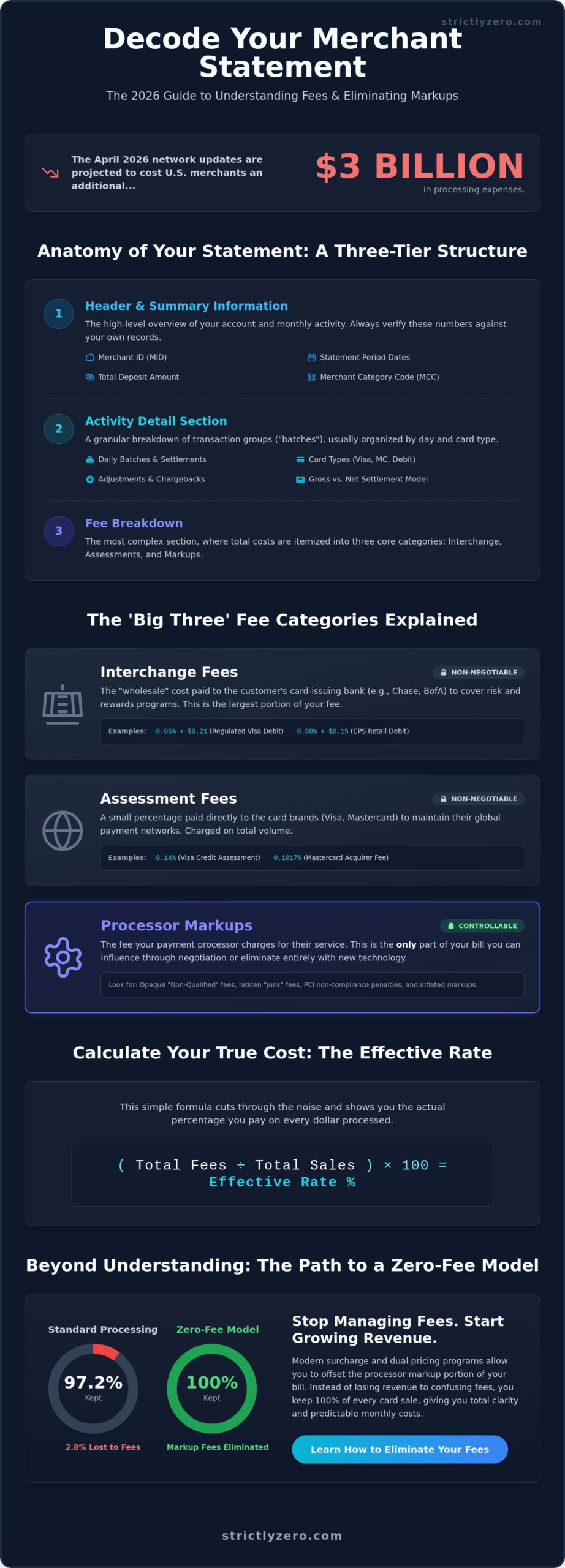
Your merchant statement is more than just a monthly bill; it’s a comprehensive ledger of every card transaction your business handled over the last thirty days. To begin understanding your merchant statement, you have to view it as a diagnostic tool for your financial health. Most statements follow a standard three-tier structure: a high-level summary, a granular processing detail section, and a final fee breakdown. This layout helps you see the big picture before diving into the weeds of individual transaction costs.
To better understand how these sections fit together, watch this helpful video breakdown:
One detail that many business owners overlook is their Merchant Category Code (MCC). This four-digit number is assigned to your Merchant account based on your industry. It’s the most important “hidden” detail because it dictates your baseline interchange rates. If your business is misclassified, you could be paying “High Risk” premiums on every single swipe. You also need to identify if you’re on a Gross or Net settlement model. Gross settlement deposits your total sales volume and bills fees separately, while Net settlement deducts fees before the money hits your bank. Net settlement often makes understanding your merchant statement difficult because your bank deposits won’t match your daily sales reports.
Header and Summary Information
The top of your statement contains your Merchant ID (MID), which is your unique 15-digit identifier. You’ll need this number for everything from fraud prevention support to PCI compliance updates. Always verify the statement period dates to ensure there’s no overlap with previous months. If the dates don’t align, you might be paying twice for the same batch of transactions. Cross-reference the “Total Deposit” amount with your actual bank ledger. If these numbers don’t match, it usually indicates a processing delay or a held reserve.
The Activity Detail Section
This section breaks down your activity into “batches.” Each batch represents a group of transactions sent for settlement, usually at the end of your business day. Look closely at the card types listed. In 2026, the cost difference between card types is massive. For instance, a regulated Visa Check Card costs 0.05% + $0.21, while a small business credit card can be significantly higher following the April 2026 rate updates. Watch for “adjustments” in this list. These are often manual corrections for errors or chargebacks that can silently drain your revenue if left unmonitored.
Decoding the Language: Interchange, Assessments, and Markups
Once you’ve identified the physical structure of your bill, the next hurdle in understanding your merchant statement is deciphering the jargon. Every transaction fee you pay is split between three distinct entities: the bank that issued the customer’s card, the card network itself, and your payment processor. These costs aren’t created equal, and knowing who gets what is the first step toward lowering your overhead.
The ‘Big Three’ Fee Categories
Interchange fees represent the “wholesale” cost of credit card processing. These are paid to the card-issuing bank and are non-negotiable. As of April 18, 2026, Visa’s interchange rates vary based on the card’s risk and reward profile. For example, a CPS Retail Debit transaction currently costs 0.80% + $0.15, while premium rewards or business cards command much higher rates. This guide to credit card processing fees explains that these rates compensate the bank for the risk of fraud and the cost of funding rewards programs. This is why a customer’s high-limit travel card costs you significantly more than a basic debit swipe.
Assessment fees are paid directly to card brands like Visa and Mastercard to maintain their global networks. These are also non-negotiable. For instance, Visa currently charges a 0.14% network assessment for credit transactions, while Mastercard’s acquirer assessment fee sits at 0.1017%. These percentages look small, but they apply to every dollar processed. They add up quickly across high volumes and are usually listed as separate line items on your statement.
Processor markups are the only negotiable part of your bill. This is the fee your provider charges for their services, such as omni-channel payment processing and reporting tools. While interchange and assessments are fixed by the networks, processors can add whatever margin they choose. If you want to stop paying these margins altogether, exploring a surcharge and dual pricing engine is the most effective way to shift these costs away from your bottom line.
Pricing Models: Interchange-Plus vs. Tiered
The way these fees are packaged determines how much you actually pay. Interchange-Plus is the industry gold standard for transparency. It lists the exact interchange cost followed by a clear, separate markup from the processor. This model makes understanding your merchant statement straightforward because you see exactly where every penny goes.
In contrast, tiered pricing is often a “Non-Qualified” trap. Processors group transactions into “Qualified,” “Mid-Qualified,” and “Non-Qualified” buckets. They often advertise a low “Qualified” rate but push the majority of your transactions into higher tiers. When you see a “Non-Qualified” fee, it’s usually an expensive markup hidden behind a confusing label. Flat-rate pricing offers simplicity, but for high-volume businesses, that simplicity often comes with a massive hidden cost because the flat rate must be high enough to cover the most expensive rewards cards.
Calculating Your Effective Rate: The Only Metric That Matters
Processors often lead with their lowest possible rate to get you in the door. They might quote a “Qualified” rate of 1.5%, but your actual monthly bill rarely reflects that number. Focusing on individual transaction rates is a common mistake that prevents true clarity. The only number that accurately reflects your business’s health is the effective rate. This single metric cuts through the noise of interchange, assessments, and markups to show exactly what you pay for every dollar you earn.
To find this number, use the following formula: (Total Fees / Total Sales Volume) x 100 = Effective Rate. For example, if you processed $10,000 and paid $300 in total fees, your effective rate is 3%. In 2026, a realistic effective rate for most e-commerce merchants falls between 2.5% and 3.1%. If you’re a retail business, you might see an average closer to 2.35%. Understanding your merchant statement through this lens allows you to compare different processing offers objectively. If a competitor quotes a lower “rate” but their effective rate math doesn’t hold up, you aren’t actually saving money.
Step-by-Step Effective Rate Calculation
The math is simple. First, locate your total monthly volume in the summary section of your statement. This should be the gross amount before any deductions. Next, find the “Total Fees” line item. You must include everything: interchange, assessments, markups, and even monthly service or PCI charges. Divide the total fees by the total volume and multiply by 100. This provides your “Real World” percentage cost. If this number is significantly higher than your quoted rate, it’s time to investigate where the extra costs are hiding.
The Statement Audit Checklist
Once you have your effective rate, use this checklist to spot red flags that might be inflating your costs. These “junk” fees often hide in plain sight:
- Check 1: PCI Non-Compliance. Look for a monthly penalty between $20 and $50. If you see this, you’re paying for a status that you can easily fix.
- Check 2: Miscellaneous or Admin Fees. Any line item labeled “Admin,” “Service,” or “Statement Fee” that exceeds $10 is usually a pure profit center for the processor.
- Check 3: The Quoted vs. Effective Gap. Is your effective rate more than 0.5% higher than the rate you were originally quoted? If so, your provider is likely using a tiered model that pushes your transactions into expensive “Non-Qualified” categories.
Mastering this calculation is the foundation of understanding your merchant statement. It gives you the leverage to negotiate with your current provider or seek out a more transparent partner. If your effective rate remains stubbornly high, it might be time to look beyond traditional models. A surcharge and dual pricing engine can often lower this rate significantly by passing the cost of acceptance to customers who choose the convenience of credit cards.
Identifying Hidden Fees and 2026 Compliance Red Flags
By May 2026, the payment landscape has shifted under the weight of new regulations and updated network standards. If your bill looks identical to your 2024 records, you’re likely missing critical red flags. A major part of understanding your merchant statement involves distinguishing between legitimate network costs and the “Junk Fee Hall of Fame.” These unnecessary charges, such as statement fees, portal fees, and “annual” account maintenance fees, serve no purpose other than padding a processor’s profit margin. While a $15 monthly portal fee might seem small, it’s a pure markup that adds no value to your transaction security or speed.
PCI non-compliance remains one of the most common drains on small business revenue. Most processors charge a monthly penalty between $20 and $50 if you haven’t updated your compliance profile. As of March 31, 2025, several PCI DSS 4.0 requirements that were previously considered “best practices” became mandatory. If you haven’t performed your 2026 assessment, you’re likely paying these penalties. You should also watch your chargeback activity closely. There’s a big difference between the reversal, which is the loss of the original sale amount, and the chargeback penalty. The penalty is an additional fee, often ranging from $15 to $50 per instance, that stays with the processor regardless of whether you win the dispute.
Spotting the ‘Junk’ in Your Statement
Monthly minimum fees are a common trap for seasonal businesses. If your total processing fees don’t reach a specific threshold, the processor charges you the difference. You should also look for “Batch Header” fees. These are small charges applied every time you close out your terminal for the day. If you batch out daily, these 30 small fees can quietly erode your margins. Perhaps most dangerous is “Rate Creep.” This is a practice where a processor slowly increases your markup by 0.05% or 0.10% annually, hoping you won’t notice the slight change in your effective rate over time.
Compliance and Security Costs
Security is a legitimate cost, but you must ensure you’re getting what you pay for. Check if your statement includes a “Data Security” fee. This is often different from actual PCI compliance support. In 2026, a trustworthy processor should provide AI-driven fraud prevention to mitigate the rising risks of digital commerce. Surcharge compliance is another area where errors lead to legal “creep.” As of May 2026, merchants must notify their processor 30 days before implementing surcharges, and they must strictly adhere to the 3% cap for Visa transactions.
Managing these rules manually is a recipe for non-compliance fines. To ensure your business stays within the law while recouping costs, you can automate your compliance with a surcharge and dual pricing engine. This technology handles the disclosure requirements and rate caps automatically, so you don’t have to worry about state-specific statement audit red flags.
Beyond Understanding: Transitioning to a Zero-Fee Model
Most industry guides suggest negotiating with your processor to shave off a few basis points. While that might save you a small amount, it’s like trying to bail water out of a leaky boat. The real power of understanding your merchant statement lies in realizing you don’t have to pay those markups at all. Instead of just managing your costs, you can move toward a zero-fee model that eliminates the processor’s margin from your bottom line. This shift transforms your monthly ledger from a list of expenses into a report of reclaimed revenue.
Zero-fee processing works through smart surcharging and dual pricing programs. These models allow you to pass the cost of credit card acceptance directly to the customers who choose that convenience. By May 2026, these programs have become a standard way for high-volume merchants to protect their margins. Rather than squinting at “Non-Qualified” fees, you’ll see those costs offset in real-time. This isn’t about hiding fees; it’s about transparency and giving your customers a choice between a standard credit price and a discounted cash or debit price.
How the Strictly Surcharge Engine Works
Compliance is the biggest hurdle for any business looking to eliminate fees. Strictly’s surcharge and dual pricing engine automates the complex legal requirements that vary by state. For instance, current 2026 regulations prohibit surcharging on debit card transactions. Our technology uses real-time detection to identify debit cards instantly, ensuring no surcharge is applied and keeping your business on the right side of card network rules. Furthermore, the engine strictly enforces the 3% cap for Visa transactions and handles the 30-day processor notification requirement automatically. When the month ends, the “Greek” on your statement is replaced by a simple line item showing your processing fees as $0.00.
Next Steps for Your Business
Switching to a more efficient model doesn’t require a total overhaul of your daily operations. You can maintain your workflow while integrating these savings into your ecommerce payment processing and omni-channel systems. This ensures your margins stay protected whether you’re selling in-person or through a virtual terminal. If you’re tired of the monthly guessing game, it’s time for a professional review. Get a free statement audit from Strictly and see your potential savings. We’ll help you decode your current bill and show you exactly how much revenue you’re currently leaving on the table. Understanding your merchant statement is the first step toward never having to pay for a markup again.
Reclaiming Your Revenue in 2026
Mastering the art of understanding your merchant statement is the only way to ensure your business thrives in an era of rising network costs. You’ve learned how to strip away the jargon, calculate your true effective rate, and identify the junk fees that serve no purpose. By shifting your focus from simply paying bills to actively managing your margins, you put yourself in a position of power. You don’t have to accept opaque fee structures or unexpected price hikes as a cost of doing business.
Modern tools make it possible to move beyond traditional processing. With an automated 50-state compliance engine and ClearSplit™ partner transparency, you can eliminate the markup portion of your bill entirely. When you add real-time AI fraud prevention to the mix, you aren’t just saving money; you’re securing your future growth. It’s time to stop letting confusing line items dictate your profitability. Stop guessing and start saving with a Zero-Fee Merchant Account from Strictly. You have the knowledge to decode the past. Now, take the steps to build a more transparent and profitable tomorrow.
Frequently Asked Questions
What is a ‘good’ effective rate for credit card processing in 2026?
A competitive effective rate generally ranges between 2.35% for retail businesses and up to 3.1% for e-commerce merchants. This percentage represents your total processing costs divided by your total sales volume. If your math shows a number higher than these benchmarks, you’re likely paying for excessive processor markups or hidden junk fees that aren’t tied to the actual cost of the transaction.
Why is my merchant statement so much higher than my ‘per-swipe’ rate?
Your “per-swipe” rate often only reflects the lowest possible “Qualified” tier and ignores the non-negotiable assessment fees paid to card networks. Understanding your merchant statement requires looking at the total cost, which includes batch fees, monthly service charges, and higher rates for rewards cards. These additional layers can easily double the base rate you were originally quoted during the sales process.
Can I really eliminate all my processing fees with a surcharge program?
You can eliminate the markup and interchange costs for credit card transactions, but you cannot legally surcharge debit cards. A surcharge program passes the cost of credit acceptance to the customer, which can bring your credit-related processing fees to zero. While you still pay for debit transactions, the overall reduction in your monthly bill is usually enough to significantly protect your profit margins.
What is the difference between a discount and a surcharge on my statement?
A surcharge is an extra fee added to a credit card transaction, while a discount is a lower price offered to customers who pay with cash or debit. On a merchant statement, a surcharge program typically appears as a credit that offsets your processing costs. Dual pricing models are often easier to manage because they present two clear price points, ensuring you stay compliant with network rules without manual calculations.
How do I find hidden fees on a tiered pricing statement?
Search your statement for labels like “Non-Qualified” or “Mid-Qualified” to find hidden markups. These categories allow processors to group transactions into more expensive tiers whenever a customer uses a premium rewards or business card. Because these labels don’t show the actual interchange cost, they are frequently used to hide profit margins that are much higher than the industry standard for transparent pricing.
Is it legal to pass credit card fees to customers in all 50 states?
Surcharging is legal in the vast majority of states, but merchants must follow strict disclosure and notification requirements. You’re required to notify your processor at least 30 days before starting and must cap surcharges at 3% for Visa transactions. Because state laws and network rules can change, using an automated compliance engine is the most reliable way to ensure you don’t face legal penalties or fines.
What happens if my merchant statement shows I am PCI non-compliant?
Your processor will likely charge a monthly non-compliance fee, which typically ranges from $20 to $50. Beyond the fee, being non-compliant means your business hasn’t met the mandatory PCI DSS 4.0 security requirements, leaving you vulnerable to fraud and data breaches. Understanding your merchant statement helps you spot these penalties so you can complete your security assessment and stop the unnecessary monthly drain on your revenue.
How often should I review my merchant processing statement?
You should review your statement every month to catch “rate creep” or the sudden appearance of miscellaneous administrative fees. Processors sometimes increase markups by small increments like 0.05% annually, hoping you won’t notice the gradual change in your effective rate. A monthly check ensures your costs stay aligned with your original agreement and helps you identify when it’s time to switch to a more transparent model.