

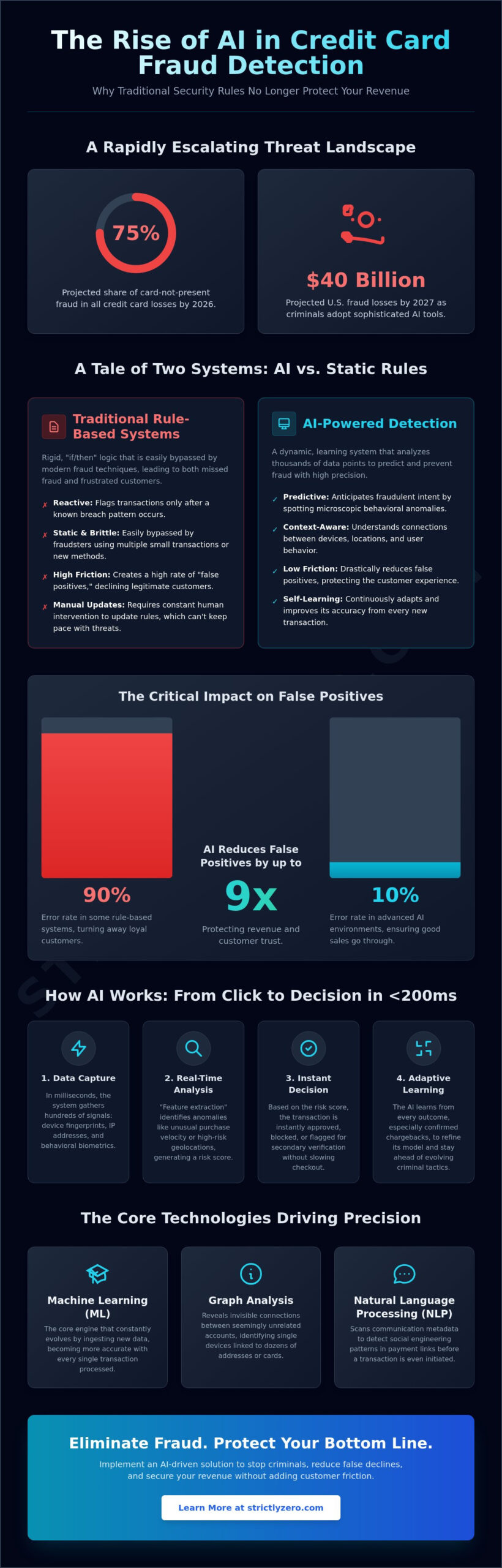
Did you know that card-not-present fraud is projected to account for nearly 75% of all credit card losses by the end of 2026? As criminals use increasingly sophisticated tools to mimic legitimate buyers, relying on outdated static rules is a recipe for lost revenue. Implementing advanced AI for credit card fraud detection isn’t just a technical upgrade anymore; it’s a vital survival strategy for any business processing payments in an omni-channel environment.
You’ve likely felt the sting of a “false positive” where a loyal customer’s card is declined, leading to instant churn and a damaged reputation. It’s a balancing act that often feels impossible to win, especially when rising chargeback fees eat away at your bottom line. You deserve to protect your margins without creating a digital fortress that scares away real shoppers. This article shows you how AI-driven fraud detection identifies threats in real-time, reduces false declines, and secures your revenue without adding customer friction. We’ll explore how combining aggressive security with cost-saving processing models can eliminate fraudulent transactions before they ever happen.
Key Takeaways
- Discover how shifting from reactive security to predictive intelligence allows your business to analyze thousands of data points in milliseconds.
- Understand why context-aware AI for credit card fraud detection outperforms rigid “hard rules,” allowing you to stop criminals without frustrating honest customers.
- Learn the essential steps for an effective data audit to identify vulnerabilities across your entire payment workflow.
- See how integrating AI-driven fraud prevention with smart processing models can eliminate chargeback costs and protect your profit margins.
What is AI for Credit Card Fraud Detection?
AI for credit card fraud detection represents the intersection of machine learning and real-time transaction telemetry. Unlike traditional software that follows a rigid, manual checklist, this technology acts as a dynamic brain capable of analyzing thousands of data points in milliseconds. It sits at the heart of modern payment systems, working tirelessly to distinguish legitimate spenders from increasingly sophisticated bad actors. The primary goal isn’t just to stop theft, but to do so with such precision that honest customers never experience a delay.
To better understand how these systems operate at scale, watch this helpful video:
In 2026, the industry has shifted away from “reactive” security, which only flags transactions after a breach has occurred. Today, the focus is on “predictive” intelligence. This means the system doesn’t just wait for a stolen card number to appear; it anticipates fraudulent intent by spotting microscopic anomalies in how a transaction is structured. By learning from every successful and failed attempt, the AI becomes more accurate every single day.
The 2026 Fraud Landscape: Why Old Methods Fail
Static “if/then” rules are easily bypassed by modern bots. For example, a rule that declines any order over $500 is useless if a fraudster makes twenty $50 purchases. Criminals now use generative AI to create deepfake identities and highly convincing phishing messages, contributing to a projected $40 billion in U.S. fraud losses by 2027. We’re also seeing a rise in “Adversarial Machine Learning,” where hackers train their own models to probe merchant defenses for weaknesses. Traditional rules can’t keep up with the “all green” problem, where scams manipulate real account holders into making transactions that look perfectly normal on the surface. Only an adaptive AI can spot the behavioral pressure points behind these coerced payments.
Core Technologies: ML, NLP, and Graph Analysis
Machine Learning (ML) serves as the engine, constantly evolving as it ingests new data from across the payment ecosystem. While ML handles the heavy lifting, Graph Analysis allows the system to see invisible connections between seemingly unrelated accounts. It can identify if a single device fingerprint is linked to dozens of different shipping addresses across the country. Additionally, Natural Language Processing (NLP) is now essential for scanning communication metadata to detect social engineering patterns in payment links before a transaction is even initiated. By combining these tools, businesses can lower false positive rates from the 90% seen in rule-based systems to as low as 10% in advanced AI environments.
How AI Fraud Detection Works in Real-Time
When a customer clicks “buy,” the engine captures hundreds of signals in a heartbeat. It doesn’t just look at the card number; it builds a digital silhouette of the user by analyzing device fingerprints, IP addresses, and behavioral biometrics. This high-speed data capture happens in the background, ensuring that the security layer remains invisible to the person making the purchase. By the time the transaction reaches the gateway, the system has already gathered enough data to make an informed decision.
Modern software utilizing AI for credit card fraud detection then performs “feature extraction.” This is where the machine identifies specific clues, such as unusual purchase velocity or high-risk geolocations that don’t match the cardholder’s history. Every swipe, dip, or click receives a risk score in real-time. If the score is low, the sale goes through instantly. If it’s high, the system can block the attempt or trigger a verification step. This scoring happens in under 200 milliseconds, ensuring that security never slows down the checkout experience for legitimate users.
The system doesn’t stay static; it uses adaptive learning to get smarter after every transaction. When a merchant confirms a chargeback, the AI analyzes that specific data point to find patterns it previously missed. This feedback loop ensures the model evolves alongside shifting criminal tactics. Relying on AI-driven fraud detection systems allows businesses to lower false positive rates significantly, often moving from a 90% error rate in rule-based systems to as low as 10% in advanced AI environments.
Supervised vs. Unsupervised Learning
Most credit card processing services now rely on a hybrid model of AI for credit card fraud detection that combines supervised and unsupervised learning. Supervised learning trains on historical data to recognize known fraud patterns, such as typical “card-not-present” theft. Unsupervised learning is the innovative edge; it detects “new” anomalies that haven’t been seen before. This hybrid approach is essential for stopping zero-day attacks where criminals use brand-new methods to probe your defenses.
Behavioral Biometrics: The New Frontier
Behavioral biometrics represent the new frontier of security. Instead of asking for a password or a PIN, the AI analyzes how a user interacts with the device. This includes typing speed, mouse movements, and even screen pressure. It’s a powerful way to distinguish a human customer from a high-speed script or bot. By using these background signals, you can reduce friction and keep the checkout process smooth for real buyers. If you want to see how these layers work together to protect your revenue, exploring omni-channel payment processing with integrated AI is a smart next step.
AI-Powered Detection vs. Traditional Rule-Based Systems
Traditional security relies on “Hard Rules.” These are static instructions like “decline any transaction over $500” or “block all IPs from a specific region.” While these rules are easy to understand, they’re incredibly blunt instruments. They can’t distinguish between a high-value fraud attempt and a loyal customer making a legitimate splurge. In contrast, AI for credit card fraud detection uses context to make nuanced decisions. It might see that same $500 transaction and allow it because the user’s behavioral biometrics match their history and the device is a recognized “trusted” source.
For businesses focused on ecommerce payment processing, scalability is the deciding factor. During peak seasons like Black Friday, transaction volumes skyrocket. Rule-based systems often buckle under this pressure, leading to a surge in manual reviews that slow down your fulfillment. AI handles these spikes effortlessly, allowing you to pass verified orders to fulfillment specialists like EZ3PL Ltd without delay or manual intervention.
The following table illustrates the fundamental differences in how these two approaches manage your security:
| Feature | Rule-Based Systems | AI Fraud Detection |
|---|---|---|
| Response Time | Fast, but lacks situational awareness. | Real-time analysis of thousands of data points. |
| Accuracy | Low; relies on broad, rigid categories. | High; uses predictive modeling for precision. |
| Maintenance | Heavy manual updates required for new threats. | Automated learning through feedback loops. |
Reducing False Declines: The Revenue Multiplier
A “false positive” occurs when a legitimate sale is declined because the system flagged it as suspicious. This is a massive revenue killer. Industry data shows that traditional rule-based systems suffer from false positive rates as high as 90% to 95%. When a good card is declined, the damage isn’t just the lost sale; it’s the psychological impact on the customer. They feel embarrassed and frustrated, and they’ll likely take their business to a competitor. Advanced AI for credit card fraud detection lowers these rates to between 10% and 30% by identifying “good” customers even when they act unusually, such as making a purchase while traveling abroad.
Ensuring that legitimate transactions are never blocked is a priority for high-quality online retailers like Standard Cold Pressed Oil, as it directly impacts both customer satisfaction and the bottom line.
Maintenance and Adaptability
Rule-based systems are a maintenance nightmare. Every time fraudsters change their tactics, your team has to manually write, test, and deploy new rules. This creates a bottleneck that prevents your business from growing. AI removes this administrative overhead by updating itself. As it processes more transactions, it identifies emerging fraud patterns without human intervention. This reduces the need for large internal fraud departments, allowing you to protect your profit margins while keeping your operations lean and efficient.
Implementing AI Fraud Prevention in Your Workflow
Before flipping a switch on new technology, you need to know where your current security leaks are occurring. A thorough data audit reveals if your losses stem from card-not-present transactions, account takeovers, or friendly fraud. Understanding these specific patterns allows you to choose an omni-channel platform that integrates AI across every touchpoint, from your online store to your virtual terminal. This holistic view is critical because fraudsters rarely stick to one lane; they probe for the weakest link in your chain.
Tuning the sensitivity of your AI model is a delicate task that directly impacts your bottom line. Setting it too high might block legitimate sales, while setting it too low leaves you exposed to chargeback fees and administrative overhead. Most modern platforms allow you to adjust these thresholds based on your risk tolerance. For high-volume periods, you might lean toward a more frictionless approach, relying on the system’s ability to spot microscopic anomalies without interrupting the user’s journey.
Security isn’t just about stopping thieves; it’s about staying compliant with evolving industry standards. Ensuring credit card processing for small business remains PCI compliant is a non-negotiable requirement in 2026. Since many new requirements in PCI DSS 4.0 became mandatory after March 31, 2025, your AI for credit card fraud detection solution should automatically handle data encryption and tokenization. This keeps sensitive information out of your environment while still providing the real-time telemetry necessary to block threats.
Omni-Channel Security: From Web to Terminal
Fraudsters often probe different sales channels to find a vulnerability. A criminal might fail a security check on your website but try their luck through a phone order via your virtual terminal. An integrated omni-channel system tracks a single fraudster’s behavior across all these channels simultaneously. By syncing this data with your CRM, you get a 360-degree view of customer behavior. This helps you identify if a new customer on your web store is actually a repeat offender who previously targeted your invoicing system. If you want to secure every transaction, exploring AI-driven fraud prevention is the most effective way to protect your revenue across all channels.
The Role of Human Oversight
Even the best AI for credit card fraud detection needs a human touch for high-value edge cases. Instead of having staff review every suspicious flag, the AI prioritizes transactions that actually need a manual look. This “human-in-the-loop” model ensures that your team focuses their energy where it matters most, such as verifying a massive wholesale order that looks slightly unusual. Training your staff to interpret AI risk scores is vital. When the system flags a transaction with a high risk score, your team should know exactly which behavioral signals, like unusual typing speed or high-risk geolocations, triggered that alert. This partnership between machine speed and human intuition creates a formidable defense against modern cybercrime.
Protecting the Bottom Line: Strictly’s AI-Driven Solution
Protecting your revenue in 2026 requires more than just stopping thieves; it requires a strategy that addresses the entire cost of doing business. By integrating zero fee credit card processing with advanced AI for credit card fraud detection, Strictly allows you to reclaim your margins from both criminals and high processing costs. This dual approach ensures that your business isn’t just secure, but also optimized for maximum profitability.
Strictly’s platform uses real-time intelligence to stop chargebacks before they start. Instead of just reacting to a dispute weeks after it happens, the system analyzes the transaction telemetry discussed earlier to prevent high-risk orders from ever reaching your fulfillment stage. This proactive stance is a core part of our “Smart Pricing Engine.” This technology combines high-level AI security with a compliant surcharge and dual pricing engine, ensuring you stay on the right side of state-by-state regulations while passing the cost of processing to the transaction itself. We position Strictly as the unified “Trust Layer” for your business, removing the need for a disjointed security stack.
Trust as a Payment Processor
Our API-first approach makes AI integration seamless for developers and ISOs. You won’t have to deal with a “Frankenstein” security stack made of disjointed tools that don’t talk to each other. This unified platform handles everything from virtual terminals to invoicing, ensuring that your data remains consistent across every channel. Since state-by-state compliance for surcharging is baked into the engine, you can expand into new markets without worrying about varying legal hurdles. This level of integration is essential for maintaining the high-risk AI standards set by recent regulations like the EU AI Act.
Zero Fees, Zero Fraud, Zero Friction
The ultimate merchant goal is simple: eliminate processing costs while securing every dollar. AI for credit card fraud detection plays a massive role here by reducing the “indirect costs” of fraud. This includes the administrative time spent on manual reviews and the lost inventory that never gets recovered after a successful theft. By lowering false positive rates from the industry average of 90% down to as low as 10%, Strictly ensures your real customers never face unnecessary friction. You don’t have to choose between a secure checkout and a profitable one. Our AI-driven fraud prevention works in the background to protect your profit margins, while our dual pricing engine handles the fees. Scale your business with Strictly’s secure, zero-fee platform today.
Future-Proof Your Revenue with Intelligent Security
The shift toward AI for credit card fraud detection is no longer optional for businesses that want to thrive in 2026. By moving away from blunt, rule-based systems that alienate good customers, you can finally eliminate the high cost of false declines. We’ve explored how real-time behavioral biometrics and adaptive learning allow you to stay ahead of sophisticated bots while maintaining a frictionless checkout experience for your shoppers.
Success in today’s market requires a unified approach. You need a platform that doesn’t just block thieves but also protects your bottom line from rising processing costs. Strictly provides this exact foundation through an API-first omni-channel platform that handles automated state-level compliance. With our Smart Pricing Engine, you can achieve $0 processing fees without sacrificing the robust security your business deserves. You don’t have to settle for a “Frankenstein” security stack that eats into your profit margins.
Secure Your Revenue with Strictly’s AI-Driven Processing and start building a more profitable future today. You have the tools to stop fraud before it starts; it’s time to put them to work. Your business is ready for the next level of growth.
Frequently Asked Questions
How does AI fraud detection differ from traditional fraud filters?
AI uses machine learning to evaluate context, whereas traditional filters rely on rigid, binary rules. While a filter might block all transactions over a certain dollar amount, AI looks at the user’s history and current behavior to make a nuanced decision. This allows the system to adapt to new threats automatically, ensuring your security evolves without the need for constant manual updates to your software.
Can AI fraud detection help reduce my business chargeback rate?
Yes, it identifies and blocks high-risk transactions before they are processed, which directly prevents fraudulent chargebacks from occurring. By analyzing micro-patterns like unusual purchase velocity or mismatched behavioral biometrics, the system stops stolen card usage at the source. This proactive approach saves merchants from the administrative overhead and fees associated with disputing unauthorized charges that shouldn’t have been approved.
Is AI-based fraud prevention compliant with PCI DSS standards?
Advanced AI for credit card fraud detection is built to exceed PCI DSS 4.0 requirements by prioritizing data tokenization. These systems focus on analyzing behavioral metadata and encrypted signals rather than storing sensitive cardholder information in a vulnerable state. It’s a smart way to enhance your security posture while ensuring your business remains compliant with the latest industry standards for data protection.
Will AI fraud detection slow down my customer checkout process?
No, the analysis happens in the background in less than a quarter of a second, which is faster than most manual rule engines. Because the system captures signals like device fingerprints and IP locations silently, legitimate customers experience a frictionless checkout. This speed is a significant advantage over traditional methods that might trigger invasive, time-consuming verification steps for low-risk buyers.
How does AI handle “False Positives” compared to manual rules?
AI reduces false positives by looking at the intent behind a transaction instead of just the transaction details. Traditional rules often have high error rates because they can’t tell the difference between a thief and a loyal customer shopping from a new location. In contrast, AI recognizes these subtle differences, preventing unnecessary declines that damage brand trust and lead to lost sales revenue.
What data does an AI fraud detection system need to be effective?
To be most effective, AI for credit card fraud detection needs a combination of device identifiers, network data, and behavioral signals. This includes elements like IP reputation, screen resolution, and even the way a user interacts with your checkout page. By gathering these diverse data points, the system can identify high-risk patterns that a simple address verification check would likely miss.
Can small businesses afford AI-driven fraud detection tools?
Modern payment processors now integrate these tools directly into their standard offerings, making them accessible to businesses of all sizes. Many providers use usage-based models, so you only pay for the transactions you actually process. By reducing the hidden costs of fraud, such as lost inventory and chargeback fees, these tools often pay for themselves through recovered revenue and lower administrative overhead.
How does AI detect fraud in “Card-Not-Present” (CNP) transactions?
In CNP environments, AI acts as a digital detective by analyzing “non-card” data to verify the user’s identity. It looks for anomalies such as the use of private browsers, mismatched time zones, or high-speed data entry that suggests a bot is at work. Since the physical card isn’t visible, the system relies on these digital footprints to confirm that the person making the purchase is the actual owner.