

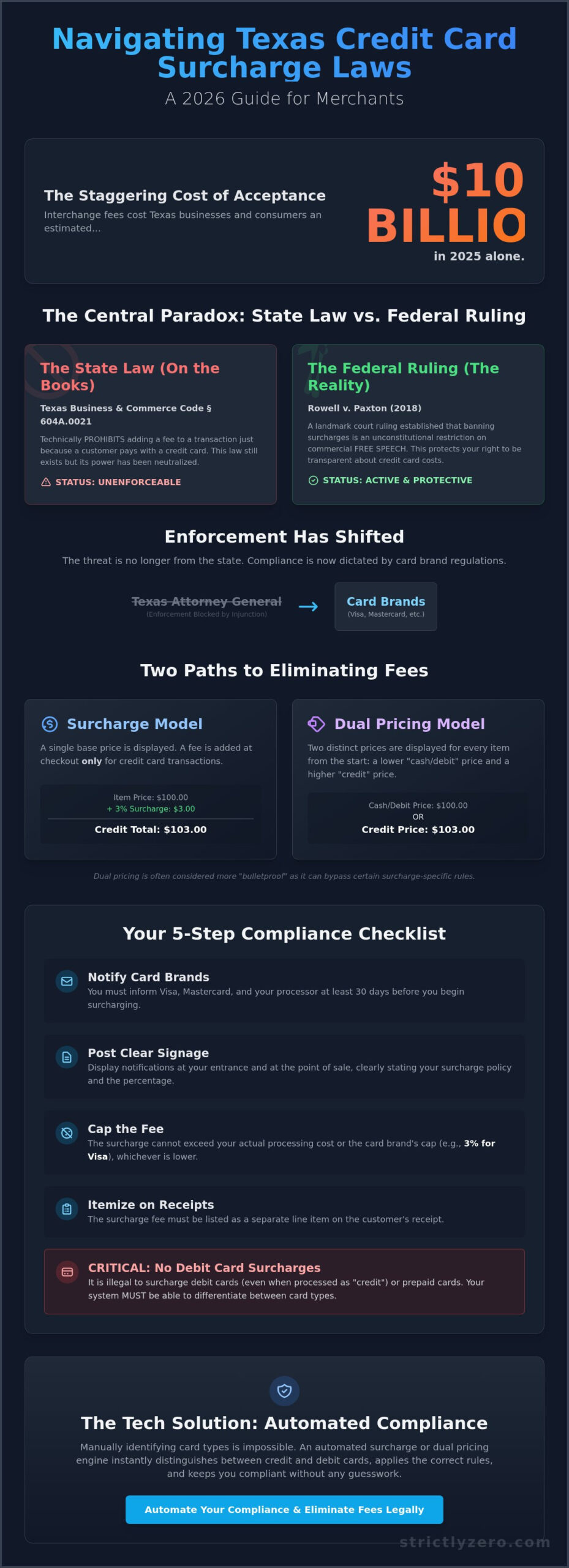
Did you know that a law still sitting on the books in Austin technically bans the very thing that could save your business thousands of dollars this month? This paradox defines the current state of credit card surcharge laws in Texas 2026, where statutory language and federal court rulings often seem at odds. You’re likely tired of watching interchange fees, which cost Texas businesses over $10 billion in 2025 according to a Senate committee report, eat away at your hard-earned margins while fearing a potential enforcement action.
It’s frustrating to feel caught between state statutes and card brand rules, but you don’t have to guess about your compliance. We’ll show you exactly how to manage these rules to legally eliminate your processing fees while staying on the right side of the law. This guide provides a clear framework for the 3% Visa cap, the mandatory 30-day notification rule, and how an automated surcharge and dual pricing engine can handle the heavy lifting for you.
Key Takeaways
- Understand how the landmark Rowell v. Paxton ruling protects your right to surcharge by framing it as a First Amendment issue of free speech.
- Navigate the nuances of credit card surcharge laws in Texas 2026 to ensure your business remains compliant with the latest card network regulations and state-specific disclosure rules.
- Compare the traditional surcharge model against dual pricing to determine which strategy offers the most “bulletproof” protection for your specific business type.
- Identify the mandatory signage and registration requirements you must fulfill to avoid being targeted by card brand audits or state enforcement.
- Learn how an automated pricing engine handles the complex task of distinguishing between credit and debit cards to prevent illegal surcharges on non-credit transactions.
Understanding the Legal Landscape of Texas Surcharge Laws in 2026
If you look at the Texas Business and Commerce Code today, you’ll see Section 604A.0021 staring back with a clear message: surcharges are prohibited. However, the reality for a business owner in 2026 is much different than what the statute suggests. This specific section of the code defines a payment surcharge as an additional fee added to a transaction solely because the buyer chooses to use a credit card. While the text remains part of state law, the credit card surcharge laws in Texas 2026 are primarily governed by a federal court injunction that effectively stripped the state of its power to punish merchants for this practice.
This creates a unique situation where a law is technically “on the books” but largely unenforceable. For a merchant, this distinction is vital. You aren’t breaking a law that can be used against you; instead, you’re operating under a constitutional protection of commercial speech. While the State of Texas cannot fine you for surcharging, you aren’t in the clear to do whatever you want. The real “enforcement” has shifted from the Attorney General to the card brands themselves. Visa and Mastercard have their own strict sets of rules that, if ignored, can lead to heavy fines or the loss of your processing privileges.
The Texas Business & Commerce Code vs. Reality
Texas Business & Commerce Code § 604A.0021 was originally designed to shield consumers from unexpected costs at the register. Even in 2026, the Attorney General’s office occasionally issues opinions that reference these statutes, which can create a sense of hesitation for new business owners. The market has shifted rapidly because the math no longer works for small businesses. A 2025 Texas Senate committee report revealed that processing fees cost state businesses and consumers over $10 billion annually. This massive financial burden is forcing a re-evaluation of fee-passing models across every industry from retail to professional services.
Why ‘Gray Area’ Doesn’t Mean ‘Illegal’
The term “gray area” often scares people away, but in this context, it simply describes a law that exists without teeth. A statutory ban is just words on a page if it isn’t enforceable. Because of the 2018 Rowell v. Paxton ruling, the state is legally blocked from enforcing the surcharge ban. Merchants across the Lone Star State are currently utilizing surcharges to protect their margins without fear of state-level prosecution. The legality rests on the intent of the communication. As long as you are transparent about the cost of credit, your right to speak about your pricing is protected. You don’t need to fear the statute; you just need to respect the card brand caps and disclosure requirements.
Federal Rulings vs. State Statutes: Rowell v. Paxton Explained
The core of the legal conflict in the Lone Star State stems from the 2018 federal district court case, Rowell v. Paxton. Before this ruling, Texas merchants faced potential prosecution if they added a specific line item for credit card fees. The court fundamentally changed that reality by deciding the state’s ban was an unconstitutional restriction on commercial speech. This wasn’t just a debate about money. It was a debate about how a business communicates its costs to the customer. The ruling established that as long as the price difference is communicated clearly, the state cannot dictate the terminology you use. This is why credit card surcharge laws in Texas 2026 are such a critical topic for local business owners seeking to reclaim their margins.
As of June 2026, the permanent injunction from this case remains the primary reason why credit card surcharge laws in Texas 2026 favor the merchant. There have been no successful attempts by the State of Texas to overturn this injunction in the years since. This legal stability allows you to manage your overhead without the constant threat of a state-level lawsuit, provided you don’t cross into the territory of deceptive pricing.
The First Amendment Victory for Merchants
The court’s logic in Rowell was refreshingly simple. If a merchant is allowed to offer a “cash discount,” they must also be allowed to describe the same price difference as a “credit surcharge.” By banning the word “surcharge,” the state was effectively censoring how businesses talk to their clients. This victory brought Texas into alignment with other major markets like New York and Florida. It reinforced the idea that price transparency is a right. You have the legal standing to show your customers exactly where their money is going, including the cost of processing their credit cards.
Ken Paxton’s Stance and Potential Risks
While the federal injunction protects your right to surcharge, Attorney General Ken Paxton’s office hasn’t completely stepped aside. In Opinion KP-0257, the AG’s office acknowledged the court’s decision but emphasized that the state still enforces the Deceptive Trade Practices Act. This means your disclosures must be prominent and honest. If a customer feels misled about the final price, you could still face an investigation.
The biggest risk for Texas merchants in 2026 involves debit cards. Even with the Rowell ruling, surcharging a debit card is strictly prohibited by federal law and card network rules. If your point-of-sale system doesn’t automatically detect the difference between a credit and debit card, you’re at risk of making an illegal charge every time a customer swipes a check card. To avoid these compliance traps, many savvy owners implement a surcharge and dual pricing engine that handles the technical verification for them. This ensures you only pass on fees when it is legally permissible to do so.
Surcharging vs. Dual Pricing: Which is Best for Texas Businesses?
Choosing between a surcharge model and dual pricing is one of the most important operational decisions you’ll make this year. While both strategies aim to protect your bottom line from high interchange fees, they approach the problem from different angles. Surcharging adds a fee on top of a listed price, which some customers perceive as a penalty. Dual pricing, however, presents two distinct prices for every item: one for cash and one for credit. This psychological shift often makes dual pricing more palatable for the average Texan, as it frames the lower price as a reward for using cash rather than a punishment for using a card.
From a regulatory standpoint, understanding credit card surcharge laws in Texas 2026 requires a look at how these models interact with state transparency rules. Surcharging is heavily regulated by both the state and the card brands. Dual pricing is generally considered a more “bulletproof” strategy because it bypasses many of the specific legal hurdles associated with adding fees. When you display both prices clearly, you are providing full transparency, which aligns perfectly with the consumer protection standards enforced by the Texas Attorney General.
The Mechanics of Surcharging
If you choose to implement a surcharge, you must follow a strict set of technical and disclosure rules. The maximum allowable surcharge rate for Visa transactions in 2026 is capped at 3%. While Mastercard technically allows up to 4%, merchants who accept both brands are effectively limited to the lower 3% cap. You also need to meet specific signage requirements:
- Post a notice at the entrance of your business.
- Provide a clear disclosure at the point of sale before the transaction is finalized.
- Ensure the surcharge appears as a separate line item on every receipt.
Remember that surcharges apply only to credit cards. Applying these fees to debit or prepaid cards is a violation of federal law and can result in significant fines from the card networks.
The Advantages of Dual Pricing in 2026
Many merchants are moving toward dual pricing because it simplifies the compliance process. One of the biggest benefits is that you don’t have to provide a 30-day written notice to card brands like you do with surcharging. This model is a core component of zero fee credit card processing, allowing you to offset your costs without the administrative burden of traditional surcharge programs. Because credit card surcharge laws in Texas 2026 primarily target the act of adding a fee to a single listed price, dual pricing avoids that “gray area” entirely by offering two transparent, pre-determined price points for the customer to choose from.
Compliance Checklist: How to Legally Pass on Fees in Texas
Moving from legal theory to daily operations requires a disciplined approach. While the federal injunction protects your right to choose your pricing model, staying compliant with credit card surcharge laws in Texas 2026 means satisfying the private contracts you hold with payment networks. This isn’t just about avoiding state lawsuits; it’s about preventing the loss of your processing account. To stay safe, you should follow this five-step compliance framework:
- Notify your processor: You must provide written notice to your acquirer at least 30 days before you start charging. This gives the network time to update your merchant status.
- Display clear signage: You need signs at your entrance and at the point of sale. If you sell online, the disclosure must appear before the customer enters their payment details.
- Format your receipts: The surcharge must be a separate line item. You cannot simply roll it into the total price without identifying it clearly for the consumer.
- Detect debit cards automatically: Federal law prohibits surcharging debit cards, even when they are run as credit. Your system must be smart enough to tell the difference instantly.
- Train your team: Your staff needs to know how to explain the fee clearly. This prevents “deceptive trade practice” complaints that could trigger an investigation from the Attorney General.
Card Brand Rules You Cannot Ignore
Visa and Mastercard have a low tolerance for hidden fees. If a network “secret shopper” visits your store and finds you aren’t disclosing the surcharge at the point of entry, they can levy fines that quickly erase any savings you’ve gained. Beyond transparency, you must maintain standard PCI DSS compliance to ensure that your surcharge engine handles sensitive data securely. A security breach during a surcharge transaction could lead to triple the normal penalties. Keep your rate at or below the 3% Visa cap to ensure you stay within the “cost of acceptance” boundaries defined by the networks.
The Danger of Manual Surcharging
Calculations done by hand are a recipe for disaster. The #1 source of card brand fines in Texas is the accidental surcharging of a debit card. Because debit and credit cards often look identical, your system must identify the Bank Identification Number (BIN) in real-time. If you guess wrong, you’ve violated the Durbin Amendment. Using an automated surcharge and dual pricing engine removes this human error by verifying the card type the moment it’s dipped or tapped. This technology ensures you only apply fees when credit card surcharge laws in Texas 2026 and federal regulations allow it, protecting you from both legal and financial backlash.
Automate Your Texas Surcharge Compliance with Strictly
Managing the shifting requirements of credit card surcharge laws in Texas 2026 doesn’t have to be a source of constant stress for your team. While the legal landscape provides the right to protect your margins, the technical execution of that right is where most businesses stumble. Strictly provides a Smart Pricing Engine specifically engineered to handle the legal paradoxes of the Lone Star State. Our platform takes the guesswork out of compliance by automatically identifying card types at the moment of interaction, ensuring you never inadvertently surcharge a debit card. This precision is why we’re the preferred choice for credit card processing for small business in Texas.
The “surcharge stress” often comes from the fear of an unexpected audit or a customer dispute. Because our system receives automated updates on state-by-state rule changes, you don’t have to spend your weekends reading legislative bulletins. We manage the 3% Visa caps and the specific disclosure requirements for you. If a rule changes in Austin or at the card network headquarters, your system updates in real-time. This proactive approach turns a complex legal hurdle into a silent, background process that simply works.
Zero Fees, Zero Compliance Headaches
Our “Smart Surcharge” program is designed to offset 100% of your processing costs by applying the correct fee only when it’s legally allowed. This isn’t just for in-person retail. We provide a unified solution for both ecommerce payment processing and physical storefronts. Texas merchants using our engine frequently report saving thousands of dollars every month, money that previously vanished into interchange fees. By automating the distinction between credit and debit, you maintain perfect compliance while maximizing your revenue recovery without the risk of manual errors.
Getting Started with Strictly in 2026
Onboarding with Strictly is a streamlined process designed for busy Texas-based merchants. We don’t just provide a platform; we offer a partnership built on trust and expertise. You’ll have access to local support and compliance guidance to ensure your signage and disclosures meet the highest standards. We’ve helped businesses across Texas transition from fee-heavy processing to a zero-cost model without losing customer loyalty. You’ve worked hard to build your business; don’t let processing fees take a bite out of your success. Start eliminating your fees today with Strictly and take control of your bottom line.
Protect Your Business Margins Today
Success in the Lone Star State requires more than just hard work. It requires the right financial tools to protect your bottom line. While the Texas Business and Commerce Code still contains old prohibitions, the federal court’s stance on commercial speech has opened the door for you to reclaim your revenue. Understanding the credit card surcharge laws in Texas 2026 is the first step toward building a more sustainable pricing model that values transparency over hidden costs.
You’ve seen how the right signage and automated debit detection can shield your business from unnecessary fines. Now, it’s time to put that knowledge into action. Eliminate your processing fees today with Strictly’s compliant surcharge program. Our automated state-by-state compliance engine and real-time debit card detection provide the omni-channel support Texas merchants need to thrive. You have the legal right to grow your business without the burden of high interchange fees. We’re here to help you do it safely and effectively. Your more profitable future starts now.
Frequently Asked Questions
Is it legal to surcharge credit cards in Texas in 2026?
Yes, it’s legal to apply a surcharge to credit card transactions in Texas as of 2026. While state statutes technically prohibit the practice, a landmark 2018 federal court ruling found the ban unconstitutional. As long as you follow specific card brand rules from Visa and Mastercard, you can legally implement a surcharge program to offset your processing costs. This ruling protects your right to communicate pricing clearly to your customers.
What is the maximum surcharge fee I can charge in Texas?
The maximum surcharge rate is currently capped at 3% for Visa transactions. Although Mastercard technically allows up to 4%, merchants who accept both major brands must adhere to the lower 3% threshold to remain compliant. It’s also required that the surcharge amount doesn’t exceed your actual cost of card acceptance. Most Texas businesses today find their actual costs range between 1.5% and 3.5% per transaction.
Can I add a surcharge to debit card transactions in Texas?
No, you cannot add a surcharge to any debit card or prepaid card transaction under any circumstances. This rule remains strict even if the customer chooses to process the debit card as “credit” at your terminal. Surcharging debit cards is a direct violation of federal law and card network agreements. Doing so can lead to immediate financial penalties or the permanent termination of your merchant processing account.
What signage is required for credit card surcharging in Texas?
You must display clear disclosure signage at both the entrance of your store and at the point of sale. These notices must inform customers that a surcharge applies to credit transactions before they reach the register. For online sales, the disclosure needs to appear before the customer enters their card information. This transparency is a key part of staying compliant with credit card surcharge laws in Texas 2026.
What is the difference between a surcharge and a cash discount in Texas law?
A surcharge is an additional fee added to a listed price when a customer pays by credit card. In contrast, a cash discount involves offering a lower price than the standard card price for those paying with cash. While both models help manage processing costs, cash discounts are generally viewed more favorably by consumers. They also avoid some of the stricter card brand notification requirements that apply to traditional surcharging.
Do I need to notify my customers before implementing a surcharge?
Yes, you must notify your customers through the required signage at the point of entry and point of sale. Additionally, you are required to notify your payment processor in writing at least 30 days before you begin your surcharge program. This advance notice ensures that your business is properly registered with the card networks and that your receipt formatting meets all the necessary transparency standards for modern merchants.
What happens if a business violates Texas surcharge laws?
Violations can lead to investigations by the Texas Attorney General under the Deceptive Trade Practices Act if your pricing is considered misleading. However, the most immediate threat comes from the card networks themselves. Visa and Mastercard can impose significant fines or revoke your ability to accept cards if they discover you are surcharging debit cards or failing to provide proper disclosures to your customers at the checkout.
How does Strictly ensure my business stays compliant with Texas regulations?
Strictly uses a Surcharge and Dual Pricing Engine that automatically detects the card type during every transaction. This ensures that fees are only applied to credit cards and never to debit cards. Our platform stays updated with the latest credit card surcharge laws in Texas 2026, providing real-time compliance checks and automated receipt formatting. This allows you to focus on running your business without the stress of manual compliance errors.