

In 2026, the best payment partner is a pricing strategist, not just a transaction pipe. You’ve likely felt the sting of opaque fee structures eating into your margins or the frustration of managing fragmented systems for online and in-person sales. It’s exhausting to keep up with shifting state-by-state surcharge laws while trying to grow your brand. Learning how to choose a payment processing partner is no longer just about finding the lowest advertised rate; it’s about finding a strategic ally that protects your bottom line.
We understand that you want to stop overpaying and start scaling. This guide will show you how to select a partner that eliminates hidden costs, automates compliance with mandatory standards like PCI DSS v4.0.1, and provides the infrastructure to grow through 2026 and beyond. You’ll learn how to navigate the latest Nacha fraud monitoring rules, the impact of the recent Visa and Mastercard interchange settlement, and the specific criteria that separate modern, AI-driven processors from outdated legacy systems.
Key Takeaways
- Learn to decode complex fee structures and identify why traditional flat-rate models might be costing your business more than transparent interchange-plus options.
- Discover exactly how to choose a payment processing partner that offers a robust API-first approach to future-proof your technical infrastructure and developer workflow.
- Master the use of smart pricing engines to automate state-by-state surcharge compliance and protect your margins from evolving legal regulations.
- Explore how AI-driven fraud prevention and continuous compliance monitoring move your security from annual checks to real-time, 2026-ready protection.
- Identify the specific partner management tools and omni-channel capabilities needed to unify your online and in-person sales systems for seamless growth.
Understanding the Role of a Modern Payment Processing Partner
The payment landscape has shifted. A decade ago, a processor was just a utility. You’d sign a contract, plug in a terminal, and forget about it until a statement arrived. In 2026, that passive approach is a liability. Understanding how to choose a payment processing partner requires looking past the basic ability to swipe a card. You need a partner that acts as a revenue architect, helping you optimize every cent that moves through your business.
The ecosystem consists of three main pillars: the gateway, the merchant account, and the Payment processor. While some vendors offer these as disconnected pieces, a modern partner unifies them. This evolution means moving away from simple transaction handling toward strategic revenue optimization. You aren’t just looking for someone to move money from A to B. You’re looking for a system that uses data to lower your costs, increase your approval rates, and protect your margins from hidden fees.
To better understand the pitfalls of choosing the wrong provider, watch this helpful video:
The Difference Between a Vendor and a Partner
Vendors provide a service, but partners provide a scalable infrastructure. When deciding how to choose a payment processing partner, look for those who prioritize transparency in reporting and offer dedicated support rather than automated ticket systems. For many merchants, working with a specialist like Advanced Payments ensures that POS and credit-card processing solutions are tailored to their specific operational needs. The hidden cost of “cheap” processors often shows up in integration friction and support lag. When your tech stack doesn’t talk to your processor, your team spends hours on manual reconciliation. That’s time and money lost that no “low rate” can justify.
Why Omni-Channel Support is Non-Negotiable
By 2026, the line between physical stores and digital storefronts has blurred completely. If your systems are fragmented, you’re flying blind. Linking your ecommerce payment processing with your physical POS systems is vital for a clear view of your business health. Unified reporting allows you to see all sales data in one centralized dashboard. This streamlining ensures that as you scale, your payment infrastructure remains a catalyst for growth rather than a technical bottleneck.
Evaluating Pricing Models: Beyond Interchange-Plus
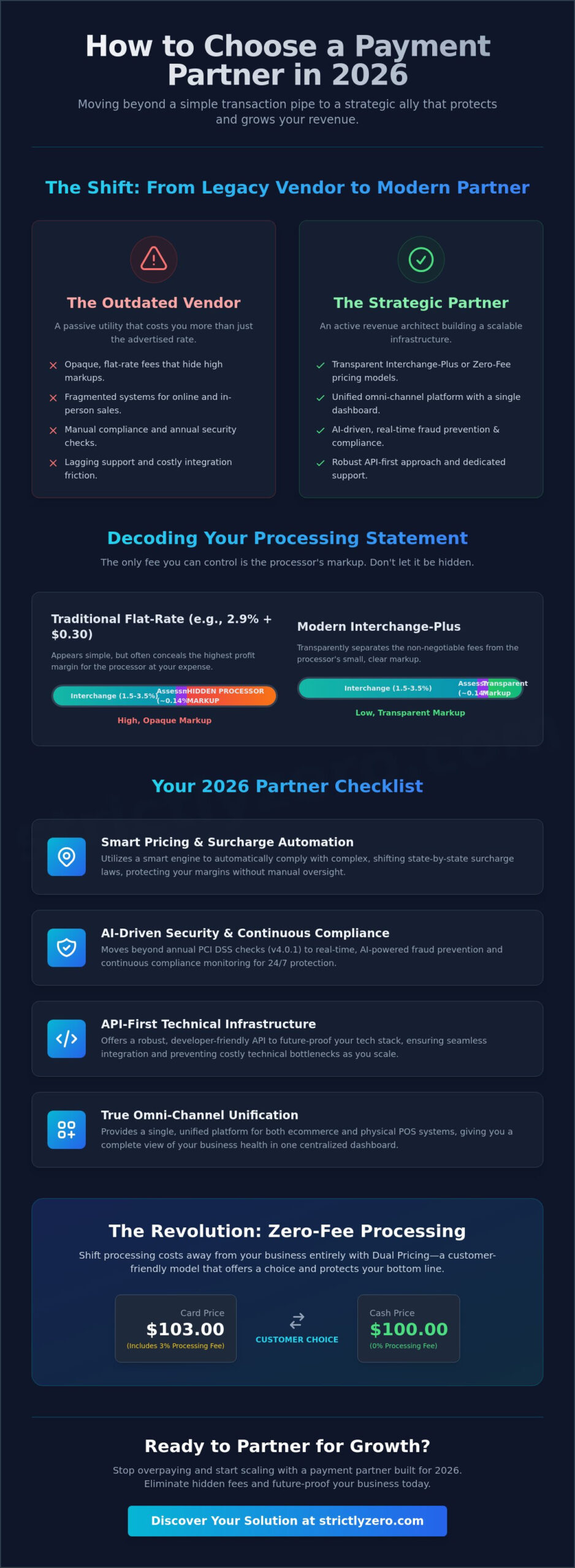
Pricing is where most merchants lose the battle before it even starts. When you’re figuring out how to choose a payment processing partner, you’ll encounter a maze of interchange fees, assessment fees, and processor markups. Interchange fees, set by card networks, averaged between 1.5% and 3.5% in 2026. Assessment fees are non-negotiable, like Visa’s 0.14% charge for credit transactions. The only part you can actually influence is the processor markup. Many providers push flat-rate pricing because it seems simple, but it often masks a significant profit margin that could be staying in your pocket. For e-commerce businesses paying 2.9% plus $0.30, that markup adds up fast.
High-volume merchants are moving away from traditional models. If your business processes millions annually, even a 0.1% markup difference represents thousands of dollars. The real ROI in 2026 comes from models that shift the cost of processing away from the business owner entirely. This is why understanding the mechanics of your contract is just as important as the technology you use to run it. A strategic partner won’t just give you a rate; they’ll provide a framework to minimize what you pay per swipe.
The Surcharge and Dual Pricing Revolution
Modern businesses are increasingly adopting zero fee credit card processing to offset rising costs. This model uses a surcharge or dual pricing engine to pass the processing cost to the consumer. Dual pricing is particularly effective because it uses simple psychology: customers see a “cash price” and a “card price.” It gives them the choice to save money by using an alternative payment method, which feels like a reward rather than a penalty. Compared to traditional merchant accounts, the long-term savings of a well-implemented surcharge program can effectively eliminate your processing bill.
Spotting Hidden Fees in Merchant Contracts
Even with a great rate, hidden fees can destroy your margins. The “PCI Non-Compliance” fee is a classic trap; processors charge this monthly if you haven’t validated your security status. Following guidance from the PCI Security Standards Council is the best way to stay secure and avoid these unnecessary penalties. Watch out for statement fees, batch fees, and annual “membership” costs that provide zero actual value. Liquidation damages are a major red flag in 2026 contracts, acting as a massive financial penalty for trying to switch processors before your term ends. If you want a partner that avoids these traps, you might want to explore a more transparent processing model that prioritizes your bottom line.
Technical Integration and API Capability
Your technical infrastructure determines your speed to market. When researching how to choose a payment processing partner, evaluate their API documentation before signing any contracts. An API-first approach ensures that your payment system grows with your business rather than becoming a legacy anchor. If a processor only offers pre-built plugins for a few platforms, they’re likely lacking the depth needed for custom enterprise workflows. Modern commerce requires flexibility that standard templates can’t provide.
A true tech partner provides a robust sandbox environment. Your developers should be able to simulate every transaction type, from successful authorizations to specific error codes, without touching live data. This transparency reduces the risk of downtime during a launch. Beyond the code, look for responsive developer support. If your team hits a roadblock with a complex integration, waiting three days for a ticket response can stall your entire project. Speed and clarity are the benchmarks of a 2026-ready partner.
The Power of a Unified Virtual Terminal
Many modern businesses don’t need a storefront to thrive. A unified virtual terminal allows you to process phone and mail orders securely without any physical hardware. This is a game-changer for service-based companies or wholesalers who manage back-office sales. By leveraging a virtual terminal, you can access the same powerful features as a retail setup, including recurring billing and subscription management. This fits perfectly into a strategy for credit card processing for small business, where hardware-free setups reduce upfront costs and simplify operations. You get the power of a full POS without the clutter of a physical machine.
Developer-Centric Features to Look For
To build a truly automated workflow, your processor must support real-time webhooks. These notifications trigger immediate actions in your CRM or ERP system the moment a payment is successful. This eliminates manual data entry and reduces the chance of human error. Security is another technical pillar. Tokenization is essential because it replaces sensitive card data with a unique identifier. This keeps the data off your servers, significantly reducing your PCI scope and protecting your business from the fallout of a potential data breach. Finally, look for the ability to generate custom payment links. These links allow for frictionless invoicing, letting you send a secure checkout page directly to a customer’s inbox for rapid collections. When you understand how to choose a payment processing partner that prioritizes these technical capabilities, you’re investing in a system that won’t need to be replaced in two years.
Compliance, Security, and Fraud Prevention
Security is no longer a checkbox; it’s a moving target. As you evaluate how to choose a payment processing partner, you must look for a provider that treats compliance as a continuous process. With PCI DSS v4.0.1 now mandatory, the industry has shifted from annual audits to year-round evidence of security controls. A partner that leaves the heavy lifting of compliance to you is a liability. You need a system that manages these complexities natively, allowing you to focus on growth rather than regulatory paperwork.
The 2026 landscape is particularly tricky regarding state-by-state surcharge regulations. Legal requirements vary wildly across the country, and what’s compliant in one state could lead to heavy fines in another. This is where a Smart Pricing Engine becomes essential. These engines automatically detect whether a card is credit or debit in real-time. Since surcharging debit cards remains illegal under federal law, this automated detection is the only way to protect your business from accidental non-compliance and potential litigation.
Automated Compliance Management
Manual surcharge programs are a ticking time bomb. Relying on staff to identify card types or manually adjusting rates based on customer location is prone to error. A modern partner provides automated tools that update in real-time as local laws change. This automation ensures you stay within the legal limits of the Visa and Mastercard settlement terms, which received preliminary approval in June 2026. By offloading these updates to your processor, you eliminate the risk of class-action lawsuits that often target merchants for improper fee disclosures.
Advanced Security Protocols
Protecting data requires more than just a firewall. Point-to-Point Encryption (P2PE) ensures that sensitive cardholder data is unreadable from the moment it’s swiped until it reaches the secure decryption environment. This significantly reduces the scope of your PCI audits. Beyond encryption, AI-driven fraud prevention is now the industry standard for risk management. By analyzing billions of data points, AI-driven fraud detection saves merchants thousands in chargebacks annually by identifying suspicious patterns before the transaction is even approved. This level of oversight is vital as Nacha’s 2026 rule changes now mandate fraud-monitoring processes for ACH originators. If you’re ready to secure your business with these advanced tools, see how our AI-driven fraud prevention works to safeguard your margins.
The Partner Perspective: Scaling with Strictly
Scaling a business in 2026 requires more than a gateway; it demands a foundation built on reliability and technical excellence. When you’re deciding how to choose a payment processing partner, the evaluation usually comes down to who provides the best tools for long-term growth. Strictly operates on a “Trust as a Processor” philosophy. This means we don’t just move money. We provide the partner management tools necessary to oversee complex portfolios with absolute precision. Our ClearSplit™ system automates compensation, ensuring that partners and stakeholders receive accurate payouts without manual intervention.
Retention is the other side of the growth coin. Market shifts happen fast, and losing a merchant to a competitor because of a missed trend is a preventable mistake. We use ChurnIQ™ to provide merchant retention intelligence, allowing you to stay ahead of market shifts and address potential issues before they lead to a cancellation. This data-driven approach transforms your processing from a back-office function into a proactive growth engine.
Infrastructure for ISOs and Developers
For those building their own payments business, the right infrastructure is a force multiplier. Strictly serves as a high-performance payment processing platform for ISOs, offering the stability and compliance needed to scale quickly. We provide white-labeling opportunities and co-branded merchant experiences that let you keep your brand front and center. You can manage a diverse portfolio of merchants through a single, unified interface, using our partner tools to monitor health, performance, and compliance across every account you manage.
Next Steps: Transitioning to a Better Partner
Switching processors often feels daunting, but it doesn’t have to be. The “Strictly Zero” onboarding process is designed to make the transition painless. We start with a comprehensive statement analysis to uncover the hidden costs buried in your current contract. This transparency ensures you know exactly where your money is going before you ever sign a new agreement. If you’re currently researching how to choose a payment processing partner, use this final checklist to vet your prospective providers today:
- Does the platform automatically update based on state-by-state surcharge laws?
- Can I access a developer sandbox and full API documentation immediately?
- Is there a unified dashboard that links my online and physical POS sales?
- Do you offer AI-driven fraud prevention natively within the platform?
- Are there any “liquidation damages” or hidden exit fees in the contract?
By asking these questions, you protect your business from the traps of legacy processors. A true partner will have clear, immediate answers for every one of them. When you’re ready to stop overpaying and start scaling, a strategic switch is the most impactful move you can make for your bottom line.
Secure Your Business Future in 2026
The landscape of digital payments moves fast. You’ve seen how a modern partner does more than just authorize transactions; they protect your margins through transparent pricing and automated compliance. By prioritizing an API-first approach and a Smart Pricing Engine, you ensure your business remains compliant with shifting state laws while providing a seamless experience for your customers. Mastering how to choose a payment processing partner is the definitive step toward reclaiming your profit from opaque fee structures and legacy systems.
It’s time to move beyond the limitations of traditional merchant accounts. With AI-driven fraud prevention included and ClearSplit™ for automated partner residuals, you can focus on expansion without the administrative headache. You don’t have to settle for “good enough” when a strategic ally can help you scale with confidence. Eliminate your processing fees today with Strictly and take control of your revenue. Your growth deserves a platform that works as hard as you do.
Frequently Asked Questions
How do I switch payment processors without disrupting my business?
Run parallel systems to ensure a seamless transition. Keep your current account active while you set up the new platform, then switch your gateway or terminal over during a low-traffic window. This strategy prevents missed sales during the migration. A quality partner will help migrate your stored customer data securely so recurring billing continues without requiring customers to re-enter their card information.
Is it legal to pass credit card processing fees to customers in 2026?
Yes, it’s legal in most states provided you follow specific card network rules and disclosure requirements. You must notify card brands 30 days before starting and provide clear signage at your point of sale or digital checkout. However, you cannot surcharge debit cards. Doing so violates federal law and card network agreements, which is why an automated detection system is vital for compliance.
What is the difference between a payment gateway and a payment processor?
A gateway is the digital bridge that sends transaction data to the network, while the processor is the entity that moves the money. Think of the gateway as the virtual terminal or online checkout page and the processor as the back-end engine. When researching how to choose a payment processing partner, look for one that provides both to simplify your technical support and reporting.
How long does it typically take to get approved for a merchant account?
Approval times usually range from 24 to 48 hours for standard businesses. High-risk industries or complex corporate structures might take 5 to 7 business days for a full underwriting review. You can speed up this process by providing all financial documentation, such as bank statements and tax IDs, at the time of your initial application.
Can I use a surcharge program if I sell products both online and in-store?
Yes, you can use surcharge programs across all sales channels simultaneously. An omni-channel system will automatically apply the correct fee at your digital checkout and your physical terminal. This ensures your margins stay protected regardless of where the customer shops, provided your system can instantly distinguish between credit and debit cards to maintain legal compliance.
What security certifications should a payment processing partner have?
Your partner must be PCI DSS v4.0.1 compliant at a minimum. This is the mandatory standard as of 2026. You should also look for partners that offer Point-to-Point Encryption (P2PE) and SOC 2 Type II reports. These certifications prove that the processor follows rigorous, year-round security protocols to protect your sensitive transaction data from evolving cyber threats.
How does dual pricing differ from a standard credit card surcharge?
Dual pricing displays two separate prices for every item, a cash price and a card price, while a surcharge adds a percentage fee at the end of the transaction. Dual pricing is often viewed more favorably by customers because it offers a clear choice to save money. Understanding these nuances is a key part of how to choose a payment processing partner that fits your specific brand identity.
What are the most common hidden fees in payment processing contracts?
The most frequent hidden costs include PCI non-compliance fees, monthly minimum penalties, and liquidation damages. Some processors also bury annual membership fees or data reporting fees in the fine print of their merchant agreements. Always request a full fee schedule and a transparent statement analysis before signing to ensure every line item is accounted for and provides actual value.